They Were Paid in the Drug They Came to Quit | The U.S. Narcotic Farm
The film of this episode premieres August 30, 2026 on YouTube. The documents, the transcript and the sources are below now.
Outside Lexington, Kentucky stands a building you cannot identify from the front. Limestone, arches, a squat clock tower. It could be a courthouse or a university. Congress called it a farm. The Act Establishing Narcotic Farms and a Narcotics Division in the Public Health Service was approved January 19, 1929.
Transcript
You cannot tell what it is
P01
U.S. Public Health Service · National Library of Medicine · U.S. Public Health Service Hospital, Lexington, Ky.. View the original.
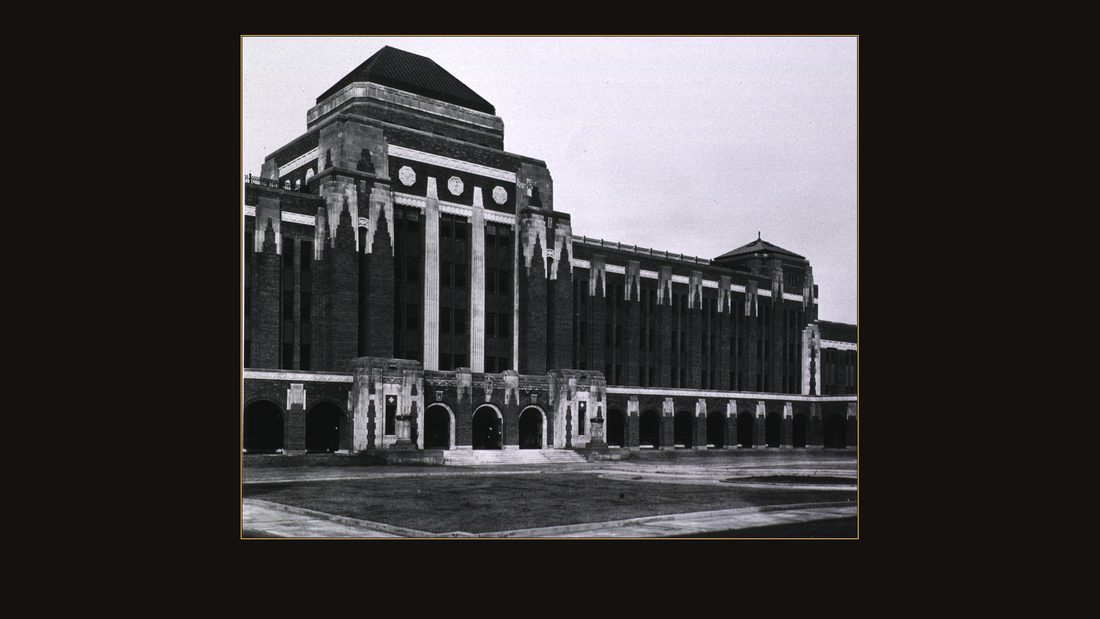
Outside Lexington, Kentucky, there is a building you cannot identify from the front.
P06
U.S. Public Health Service · National Library of Medicine · U.S. Public Health Service Hospital, Lexington, Ky.. View the original.
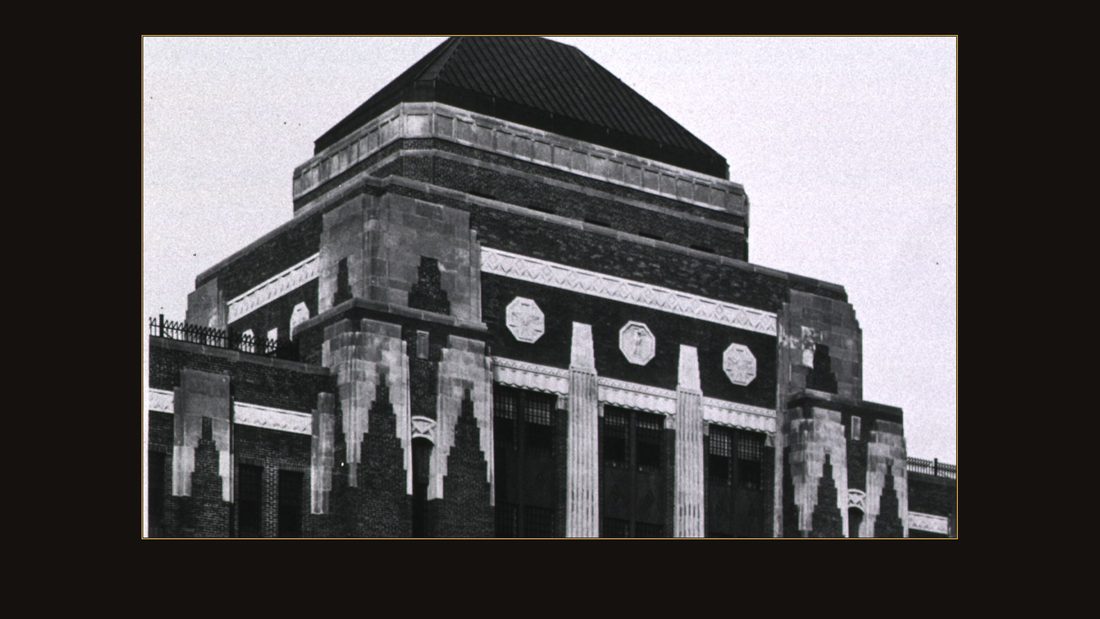
Limestone. Arches. Carved stone medallions over the door. It could be a courthouse. It could be a university. It could be a prison.
P03
U.S. Public Health Service · National Library of Medicine · aerial view, Lexington, Ky., 1950s. View the original.
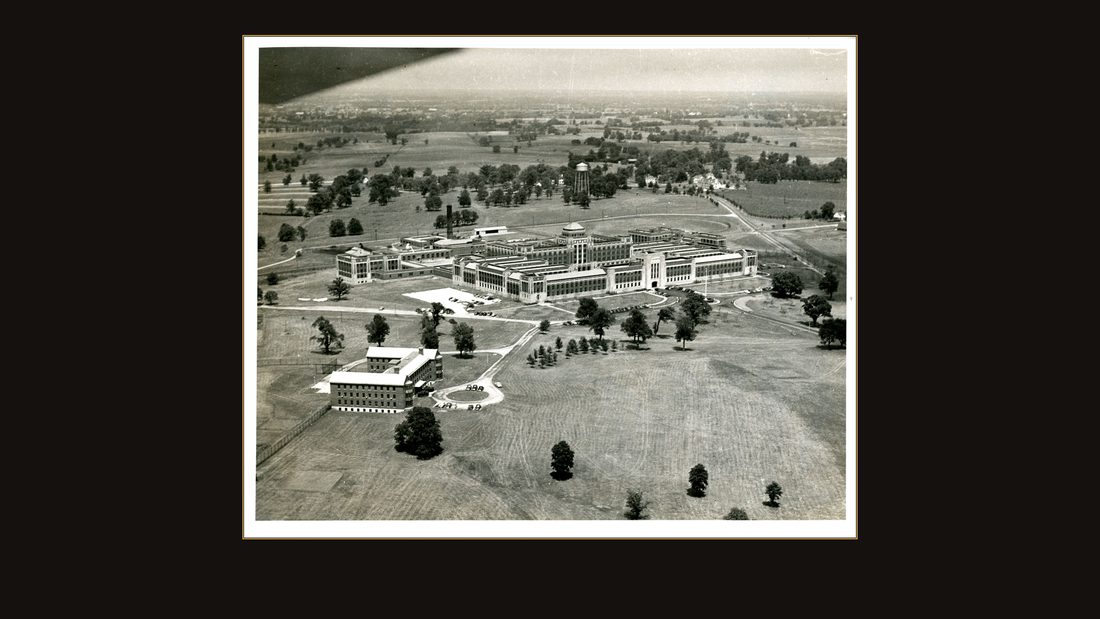
From the air it is a very long federal building standing in a Kentucky hayfield, with nothing around it but pasture, a water tower and a road.
P02
U.S. Public Health Service · National Library of Medicine · U.S. Public Health Service Hospital, Lexington, Ky.. View the original.
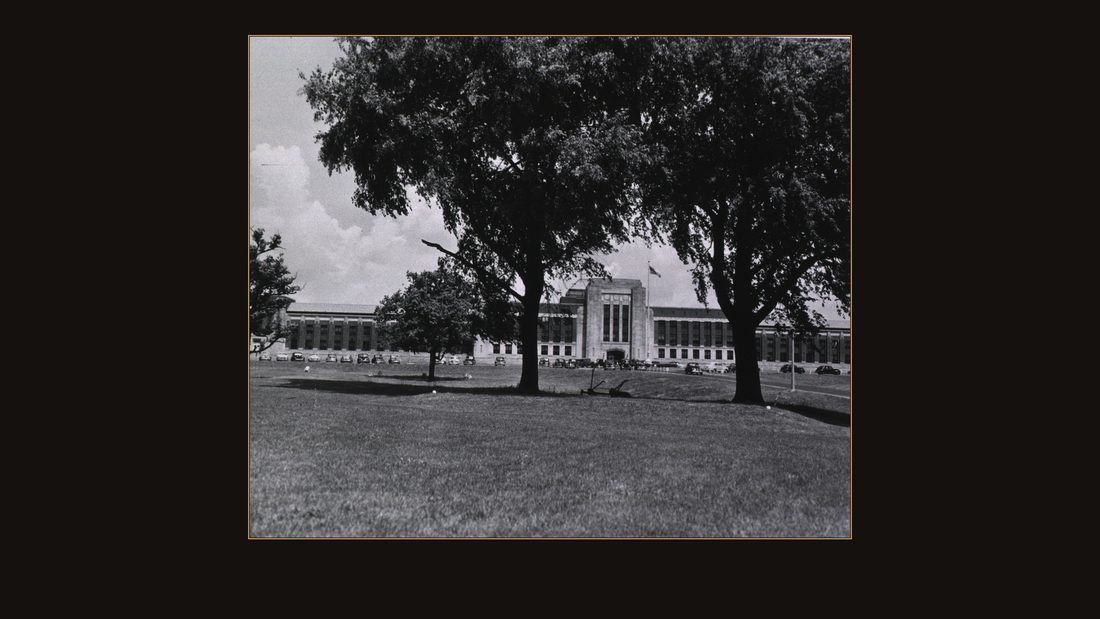
From the lawn, through the oaks, with the staff cars parked along the front, it looks like the calmest place in the state.
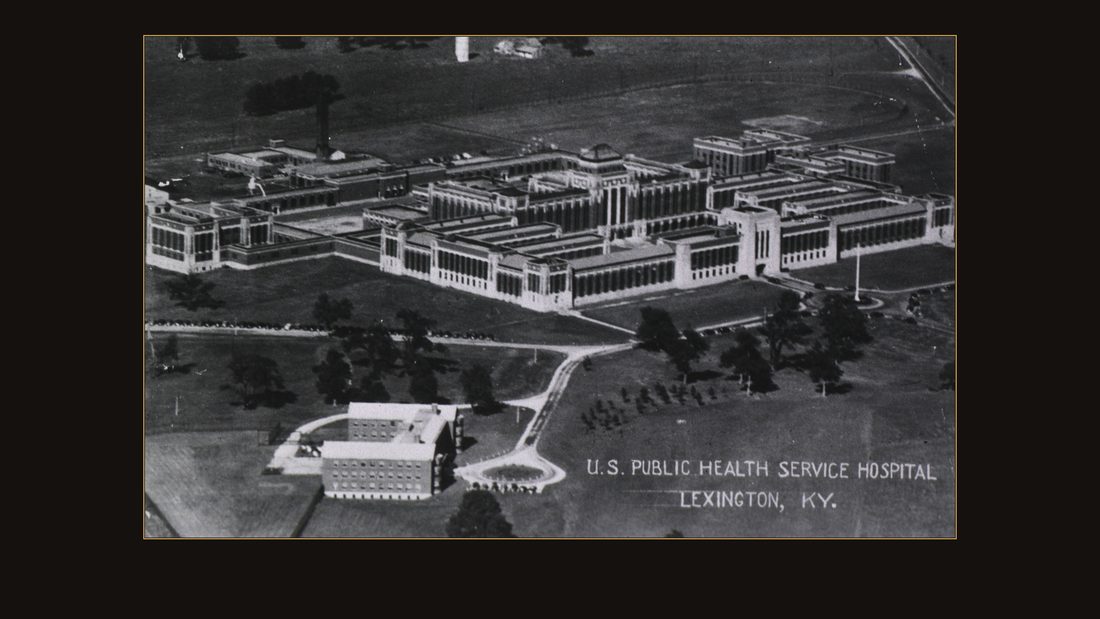
P04
U.S. Public Health Service · National Library of Medicine · aerial view, Lexington, Ky.. View the original.
United States Public Health Service Hospital. Lexington, Kentucky.
Congress called it a farm
On the nineteenth of January, nineteen twenty-nine, the Seventieth Congress passed an act, and the Public Health Service reprinted it for five cents.
An act to establish two United States narcotic farms.
Read what the farms were for. Two institutions, for the confinement and treatment of persons addicted to habit-forming narcotic drugs who have committed offenses against the United States.
Confinement and treatment. In that order.
And of addicts who voluntarily submit themselves for treatment.
So the same building would hold two populations. People sent there by a federal court. And people who drove there themselves and knocked on the door.
In the statute's own words: habit-forming narcotic drug means opium and coca leaves and their derivatives, and also Indian hemp, and peyote.
And it defined the person. An addict is anyone who habitually uses such a drug so as to endanger the public morals, health, safety, or welfare.
Or who has been so far addicted as to have lost the power of self-control with reference to his addiction.
Section two names the three officials who would choose the site. The Attorney General. The Secretary of the Treasury. And the Secretary of War.
The Secretary of War helped pick the site of a hospital.
Section five gives the Surgeon General power to hire superintendents, physicians, pharmacists, psychologists and nurses. For the safe-keeping, care, protection, treatment, and discipline of the inmates.
Inmates. That is the statute's own word, sitting in the same clause as nurses.
Section six is the promise. The care, discipline, and treatment of the persons admitted to or confined in a United States narcotic farm shall be designed to rehabilitate them.
Section seven emptied the prisons into it. Transfer to the narcotic farms all addicts now or hereafter sentenced to any penal, correctional, disciplinary, or reformatory institution of the United States.
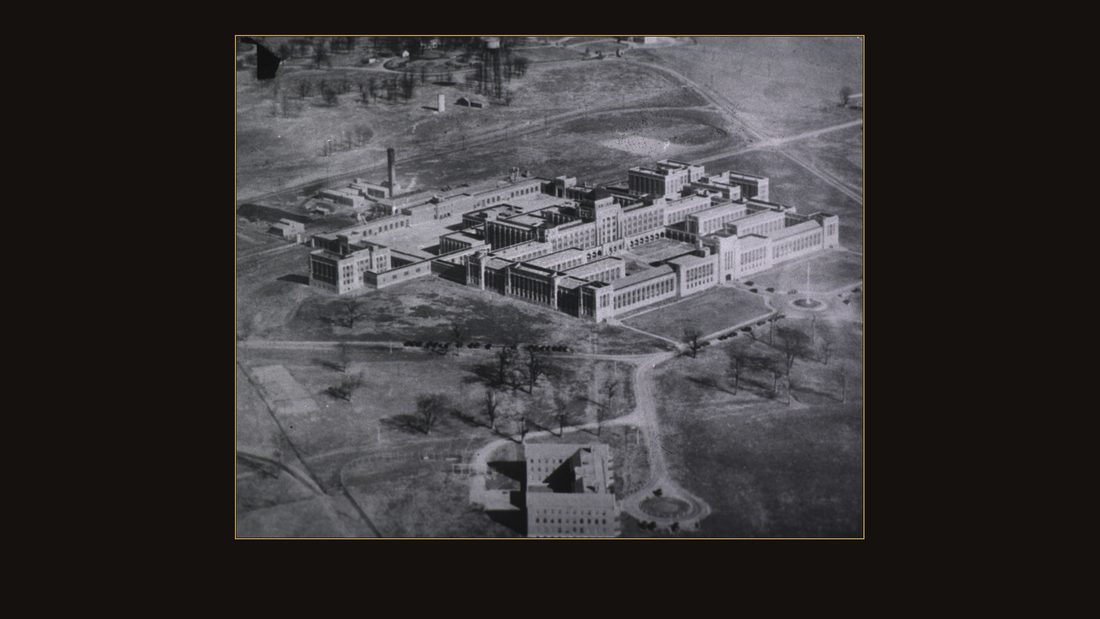
P05
U.S. Public Health Service · National Library of Medicine · aerial view, Lexington, Ky.. View the original.
Six years later the building existed. It took its first patients in nineteen thirty-five.
The punch list
And that year somebody walked the finished building with a clipboard and wrote a punch list.
Memorandum regarding projects for United States Narcotic Farm, Lexington, Kentucky. Class A. Emergency and urgently needed.
Item one. Provide one surgeons' scrub-up sink with instrument trays. Through an oversight this surgical scrub-up sink was not provided for in the original specifications.
So: a hospital. Somebody forgot the sink the surgeons wash their hands in, and it is item one.
Item two. Install hand-operated chain hoist and steam exhaust box, complete, for the cannery.
So: a farm. The crop was coming in and there was nothing to can it with.
Item three. Install partition in Guards' Assembly Room, to provide office space for the chief custodial officer.
Guards' Assembly Room. In a hospital.
Item five. Minor changes are required in the Dairy Unit. New pen panels and gates should be installed in the calf barn for dividing stall space for calves.
Allowing calves freer activity, the memo says. Two pages later, the same list, still under Class A. Emergency.
Item nine. The installation of additional grilles at certain strategic points is urgently required for the custody and safe-keeping of prisoners.
One page. One clipboard. One morning's walk. A surgical scrub sink, a cannery, a guards' room, a calf barn, and a steel grille with a tertiary lock.
P01
U.S. Public Health Service · National Library of Medicine · U.S. Public Health Service Hospital, Lexington, Ky.. View the original.
The hospital, the farm and the prison were never three phases of this place. They were three items on the same list, in the same week, before a single patient arrived.
The research department
Inside it, in a wing of its own, was a research department.
It became the Addiction Research Center, and for forty years it was the center of American research on addiction.
In nineteen sixty-four the government published its own catalogue of that work: nearly five hundred pages of abstracts. Here is one, from March nineteen forty-seven.
Treatment of the morphine abstinence syndrome with compound one oh eight two oh. Harris Isbell. Anna Eisenman. Abraham Wikler. Mary Daingerfield. Karl Frank.
Research Department, United States Public Health Service Hospital, Lexington, Kentucky.
Seven former addicts, who volunteered for experiments.
Received four subcutaneous injections of morphine sulfate daily, for twenty-eight to fifty-six days.
Seven men who had gotten off morphine were put back on it, four times a day, for up to two months, in the hospital that existed to get them off it.
Then it was taken away. By the thirty-sixth hour all of them showed severe abstinence, and the drug being tested was given to see whether it stopped the withdrawal.
It did. Compound one oh eight two oh is methadone. That experiment is one of the reasons methadone treatment exists.
The letters
In nineteen fifty-three the research director at Lexington began writing letters to a correspondent whose name is blacked out on every page.
The letterhead is the Federal Security Agency, Public Health Service, Lexington, Kentucky. The file they were kept in belongs to the Central Intelligence Agency.
They were released decades later under the Freedom of Information Act, out of the agency's program of research in behavioral modification.
The twenty-fourth of June, nineteen fifty-three. I am sure you will be pleased to learn that I have had a letter from the Office of Naval Research indicating their intention to support my research program.
The contract, of course, still remains to be negotiated. Since this may require some time, the National Institute of Mental Health intends to handle the matter by increasing my regular allotment until the funds do become available.
The money would arrive looking like ordinary public health money, and then the books would be squared afterwards.
I am feeling rather isolated here, and am wondering if clearances have been obtained on Doctors Wikler and Fraser. I would like to begin discussion of plans with them.
Clearances. Two physicians at a Kentucky hospital, waiting to be cleared before their own colleague could tell them what the work was.
Forty-two days
The fourteenth of July, nineteen fifty-four.
Our experiments on tolerance to L S D twenty-five have been proceeding well, although I continue to be somewhat surprised by the results.
Which to me are the most amazing demonstration of drug tolerance I have ever seen.
I have had seven patients who have now been taking the drug for more than forty-two days.
Patients. That is his word. Seven patients, six weeks, in a hospital.
We have attempted to break through this tolerance by administering double, triple and quadruple doses.
We have not yet observed full restoration of the L S D effect with any of these doses.
Which, in the case of one of the patients, amounted to five hundred and thirty-two micrograms, total dose.
The men had stopped responding, so the doses went up until they did.
On the way to the Senate
The twenty-ninth of August, nineteen fifty-five. Addiction Research Center, Box two thousand.
It seems possible that I will have to go to New York on September eighteenth, to appear before the Senate Subcommittee concerning narcotic addiction.
This means that I could be in Washington on September twentieth or twenty-first. If you or someone else will be available, I should like to stop in Washington for a brief conference concerning our work here.
He is going to testify to the United States Senate about narcotic addiction, and he is offering his covert funder a private meeting on the way home.
Experiments with the mixture of hyoscine and L S D are fairly well along. As soon as the data are analyzed I will send them along.
Nothing in the record says the Senate was told any of that.
What the Senate was told
Twenty years passed. Then, in the autumn of nineteen seventy-five, a Senate subcommittee under Edward Kennedy took sworn testimony about what the agency had paid for.
Drug addicts undergoing rehabilitation were given doses of narcotics as a reward for participating in a C I A funded drug experiment.
The addicts were rewarded with drugs, the story says, because there was no authority to pay them money. That was the research director's explanation.
A man who had been confined there from nineteen fifty-three to nineteen fifty-five told the subcommittee that inmates were offered a choice between drugs and a reduced sentence, and that since they were all addicts, the majority chose narcotics.
A senator on the panel said one sentence that is still the shortest summary of this story. I understand now why the percentage cure at Lexington may not have been too high.
In its own words
Two years later, the Senate published it in a joint hearing, in its own words, on the record.
The annual grants of funds to these specialists were made under ostensible research foundation auspices, thereby concealing the agency's interest from the specialist's institution.
One of the first studies was conducted by the National Institute of Mental Health, to test various drugs, including hallucinogenics, at the Addiction Research Center in Lexington, Kentucky.
The Lexington Rehabilitation Center, as it was then called, was a prison for drug addicts serving sentences for drug violations.
A prison. Not a farm, not a hospital. That is the United States Senate describing it, forty-eight years after the act that built it.
The test subjects were volunteer prisoners who, after taking a brief physical examination and signing a general consent form, were administered hallucinogenic drugs.
As a reward for participation in the program, the addicts were provided with the drug of their addiction.
Read that against the definition Congress wrote in nineteen twenty-nine. A person who has lost the power of self-control with reference to his addiction.
The statute said these were men who could not say no to the drug. The consent form was for the drug.
The agency's own witness put the funding at Lexington from nineteen fifty-three to nineteen sixty-two, and said nobody halted it until its inspector general found it in sixty-three.
February 1974
In nineteen sixty-three, Isbell, Wikler and Fraser retired.
In February nineteen seventy-four, the Lexington Clinical Research Center was closed, and the facility turned over to the Bureau of Prisons.
P03
U.S. Public Health Service · National Library of Medicine · aerial view, Lexington, Ky., 1950s. View the original.
Forty-five years after Congress voted to build a farm, the government stopped pretending and handed the building to the people who run prisons. It is a Bureau of Prisons medical center today.
What it left behind
The last thing to say is the uncomfortable one.
Much of what American medicine knows about opioid withdrawal was learned in that building. The measurement scale for withdrawal was invented there. Methadone treatment came out of that ward.
People are alive because of work done at Lexington on men who were told a brief physical and a general consent form were enough.
But the building was honest from the first week, and nobody read it. It is all on the punch list.
A scrub sink for the surgeons. A hoist for the cannery. Pens for the calves. And a steel grille, with a tertiary control lock, for the custody and safe-keeping of prisoners.
P01
U.S. Public Health Service · National Library of Medicine · U.S. Public Health Service Hospital, Lexington, Ky.. View the original.
They built all three at once and called the whole thing a farm.
P04
U.S. Public Health Service · National Library of Medicine · aerial view, Lexington, Ky.. View the original.
Every document in this episode is federal and free. The letters are in the agency's own reading room. The act cost five cents.
Sources
- Act Establishing Narcotic Farms and a Narcotics Division in the Public Health Service, Public No. 672, 70th Congress (H.R. 13645), approved January 19, 1929. Read from the Public Health Service's own five-cent reprint, Reprint No. 1286 from *Public Health Reports*, Vol. 44, No. 21, May 24, 1929, pp. 1256-1260. National Library of Medicine, Lawrence Kolb Papers, item nlm:nlmuid-9918351284206676X308-doc. Public domain (federal work; NLM states public domain on the item record). - the purpose clause — "confinement and treatment," and "addicts who voluntarily submit themselves for treatment" - the definitions — "Indian hemp" and "peyote," and the PHS's note that this is the first federal law to include them; "lost the power of self-control with reference to his addiction" - Sec. 2 — sites chosen by the Attorney General, the Secretary of the Treasury and the Secretary of War - Sec. 5 — "safe-keeping, care, protection, treatment, and discipline of the inmates" - Sec. 6 — "shall be designed to rehabilitate them, restore them to health, and where necessary train them to be self-supporting and self-reliant" - Sec. 7 — transfer of addicts from "any penal, correctional, disciplinary, or reformatory institution of the United States"
- Memorandum Re Projects for United States Narcotic Farm, Lexington, Kentucky, U.S. Public Health Service, 1935. NLM, Lawrence Kolb Papers, item nlm:nlmuid-9918351284206676X208-doc. Public domain per the item record. - Class A, item 1 — the surgeons' scrub-up sink omitted from the original specifications - item 2 — the chain hoist and steam exhaust box for the cannery - item 3 — the partition in the Guards' Assembly Room - item 5(a) — pen panels and gates in the calf barn, "allowing calves freer activity" - item 9 — "additional grilles at certain strategic points is urgently required for the custody and safe-keeping of prisoners," and the steel grille with tertiary control lock in the Service Tunnel
- Collected Abstracts, NIMH Addiction Research Center, Lexington, Kentucky, 1945-1963 (Public Health Service). archive.org `collectedabstrac00addi`. - "Treatment of the morphine abstinence syndrome with 10820," Isbell, Eisenman, Wikler, Daingerfield and Frank, reprinted from *Federation Proceedings* Vol. 6, No. 1, March 1947: seven former addicts who volunteered, four subcutaneous injections of morphine sulfate daily for 28 to 56 days, the dose raised from 20 to 80 mg, severe abstinence by the 36th hour. 10820 is methadone.
- 24 June 1953 (CIA 00153385) — Federal Security Agency / Public Health Service / Lexington, Kentucky letterhead. The Office of Naval Research letter; NIMH to "handle the matter by increasing my regular allotment," then decrease it "in order to bring things into balance"; "I am feeling rather isolated here and am wondering if clearances have been obtained on Drs. Wikler and Fraser." Signed Harris Isbell, M.D., Director of Research. Stamped declassified 4 Feb 1977.
- 14 July 1954 (CIA 00151524) — "the most amazing demonstration of drug tolerance I have ever seen. I have had 7 patients who have now been taking the drug for more than 42 days"; and "We have attempted to break through this tolerance by administering double, triple and quadruple doses… amounted to 532 mcgm. total dose."
- 29 August 1955 (CIA 00151537) — Addiction Research Center, Box 2000 letterhead. The Senate subcommittee appearance, the offer to "stop in Washington for a brief conference concerning our work here," and "Experiments with the mixture of Hyoscine and LSD are fairly well along."
- 30 April 1953 (CIA 00153379) — the earliest letter in the run.
- Project MKULTRA, the CIA's Program of Research in Behavioral Modification, joint hearing before the Select Committee on Intelligence and the Subcommittee on Health and Scientific Research, U.S. Senate, August 3, 1977, at printed p. 71 (reprinting the Select Committee's earlier report at p. 391): - grants "made under ostensible research foundation auspices, thereby concealing the CIA's interest from the specialist's institution" - "The 'Lexington Rehabilitation Center,' as it was then called, was a prison for drug addicts serving sentences for drug violations." - "The test subjects were volunteer prisoners who, after taking a brief physical examination and signing a general consent form, were administered hallucinogenic drugs. As a reward for participation in the program, the addicts were provided with the drug of their addiction."
- The Washington Star, November 8, 1975 (Associated Press), "Addicts Paid Off With Narcotics in CIA-Funded Tests," preserved in CIA file CIA-RDP88-01315R000400070026-6 and released under FOIA. The Kennedy subcommittee testimony; "no authority to pay them money"; the choice between drugs and a reduced sentence; Carl Duckett putting the CIA funding at 1953-1962 and the halt at 1963; Sen. Schweiker's "I understand now why the percentage cure at Lexington may not have been too high." This one is not public domain. It is a 1975 AP story surviving inside a released federal file, used here as a cropped fair-use excerpt and credited to both. Nothing in the narration rests on it alone that the 1977 hearing does not also carry.
- Drug Addiction and the U.S. Public Health Service: proceedings of symposium commemorating the 40th anniversary of the Addiction Research Center at Lexington, Ky., NIDA, 1978. archive.org `drugaddictionusp00mart`, p. 103: "In February 1974, the Lexington Clinical Research Center was closed and the facility turned over to the Bureau of Prisons." Same page: Isbell, Wikler and Fraser retired in 1963.
- The statute admitted volunteers as well as prisoners, and the episode says so before the Senate's 1977 description of the place as "a prison for drug addicts serving sentences" is quoted. Both are true of different people in the same building.
- The 1947 morphine experiment was not CIA-funded. It predates that money by six years, and the episode keeps the two threads apart: the addiction research generally, and the hallucinogen work the agency paid for from 1953.
- The research produced real medicine. Methadone treatment and the standard withdrawal-severity scale came out of that ward, and the episode says so in the closing chapter rather than leaving it out.
- The reward-in-drugs finding is the Senate's, quoted from the 1977 hearing, not an inference from the letters.
- No subproject number is claimed. Secondary accounts number this work within MKULTRA; no document in this set carries a number, so none is stated and none is burned onto a plate.
- No patient is named. The man who testified in 1975 about the choice between drugs and a reduced sentence is described, not named.