126 Saloons, 43 Night Clubs, 41 Gambling Convictions
The film of this episode premieres August 20, 2026 on YouTube. The documents, the transcript and the sources are below now.
Newport, Kentucky sits on the south bank of the Ohio, four minutes over the bridge from Cincinnati. In 1950 it had 32,000 people, 126 saloons and 43 night clubs, and its casinos advertised in the Cincinnati papers.
Transcript
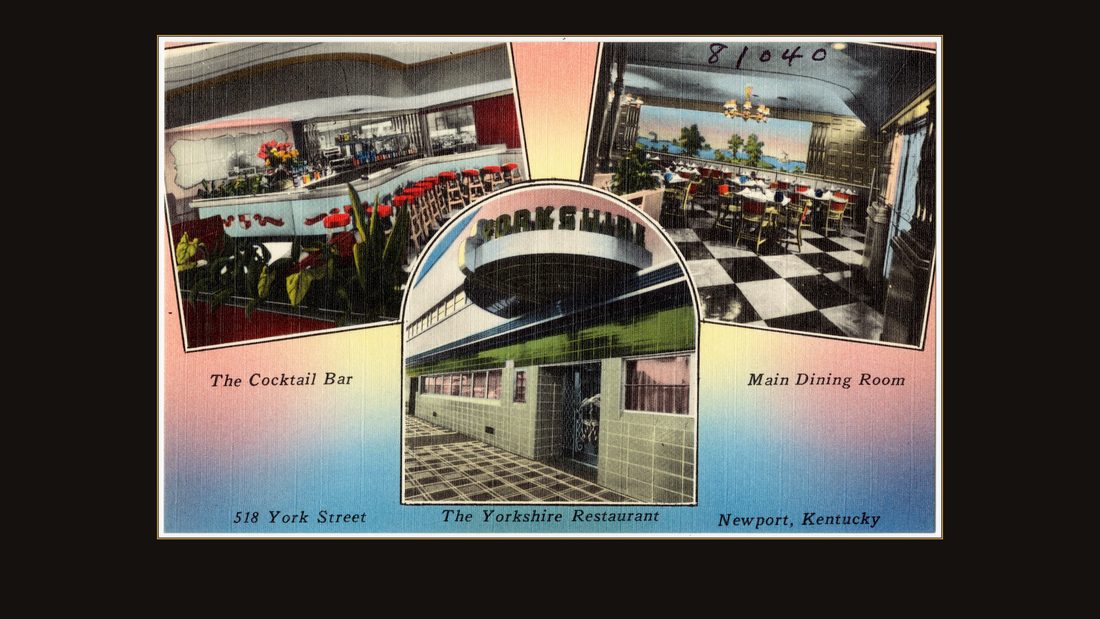
Five eighteen York Street
P02
Tichnor Bros. linen postcard · Boston Public Library · The Yorkshire, 518 York St., Newport. View the original.
Five eighteen York Street, Newport, Kentucky. The card the owners printed shows you two rooms. The cocktail bar. The main dining room.

P01
Tichnor Bros. linen postcard · Boston Public Library · The Yorkshire, 518 York St., Newport. View the original.
There is no picture of the room at the back.
In January of nineteen fifty-one a Senate committee put this town's city manager and its chief of police under oath, one after the other.
By the end of the afternoon they had sworn to versions of the same meeting that cannot both be true.
A liberal community
P11
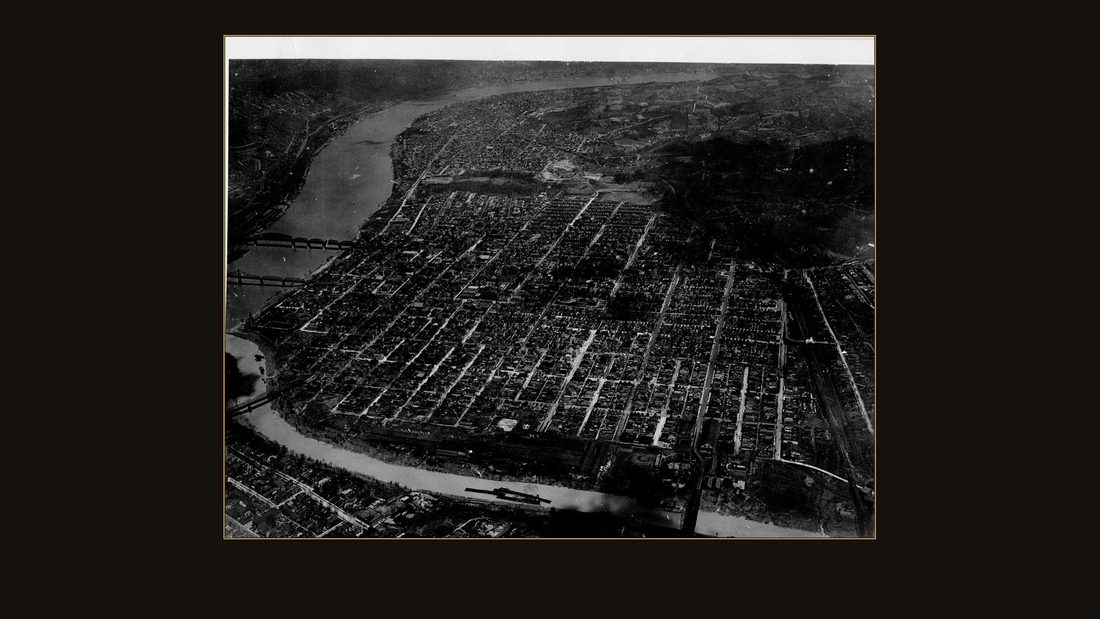
Tichnor Bros. linen postcard · Boston Public Library · Newport, Ky., Dec. 1923 · 7th Photo Section · U.S. Army Air Service. View the original.
Newport sits on the Kentucky bank, where the Licking runs into the Ohio. Cincinnati is four minutes over the bridge.
P12
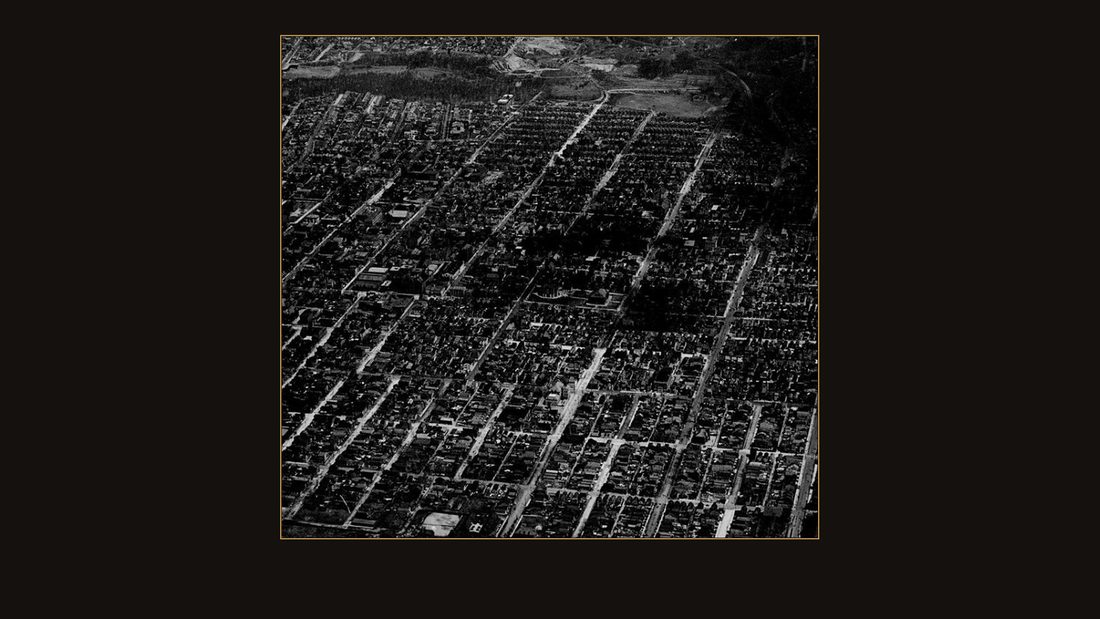
Tichnor Bros. linen postcard · Boston Public Library · Newport, Ky., Dec. 1923 · 7th Photo Section · U.S. Army Air Service. View the original.
Thirty-two thousand people. The chief of police gave that figure under oath.
The city manager was asked to name the clubs. He said there were too many to list.
"There are one hundred and twenty-six saloons, forty-three night clubs, and a good many groceries possibly that have licenses."
P07
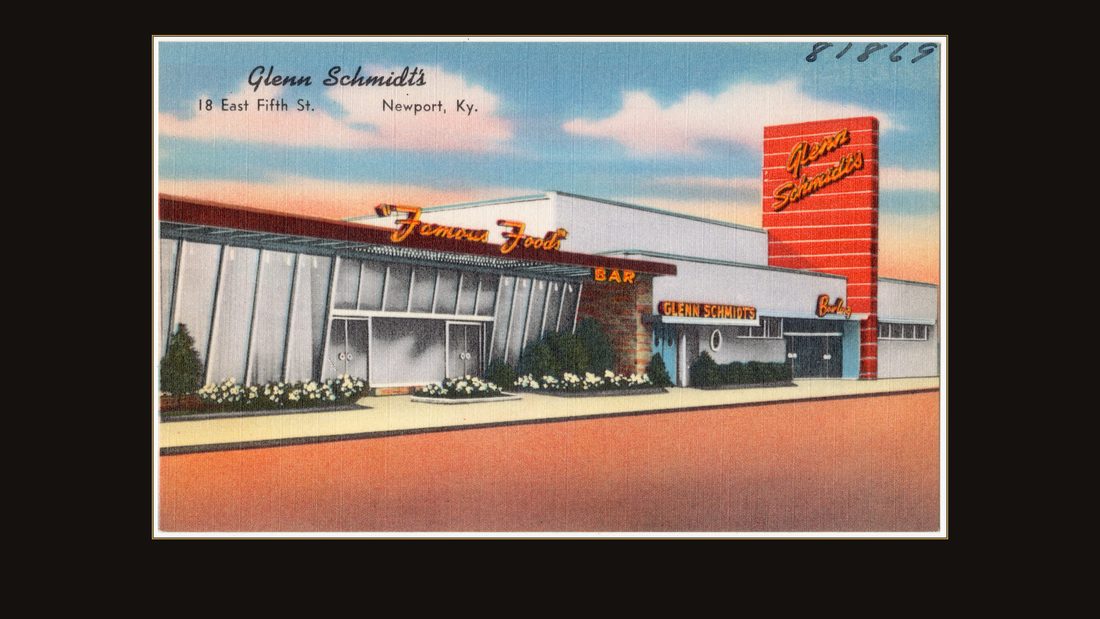
Tichnor Bros. linen postcard · Boston Public Library · Glenn Schmidt’s, 18 East Fifth St., Newport. View the original.
They advertised. Glenn Schmidt's, at eighteen East Fifth Street, sold famous foods under thirty feet of neon.
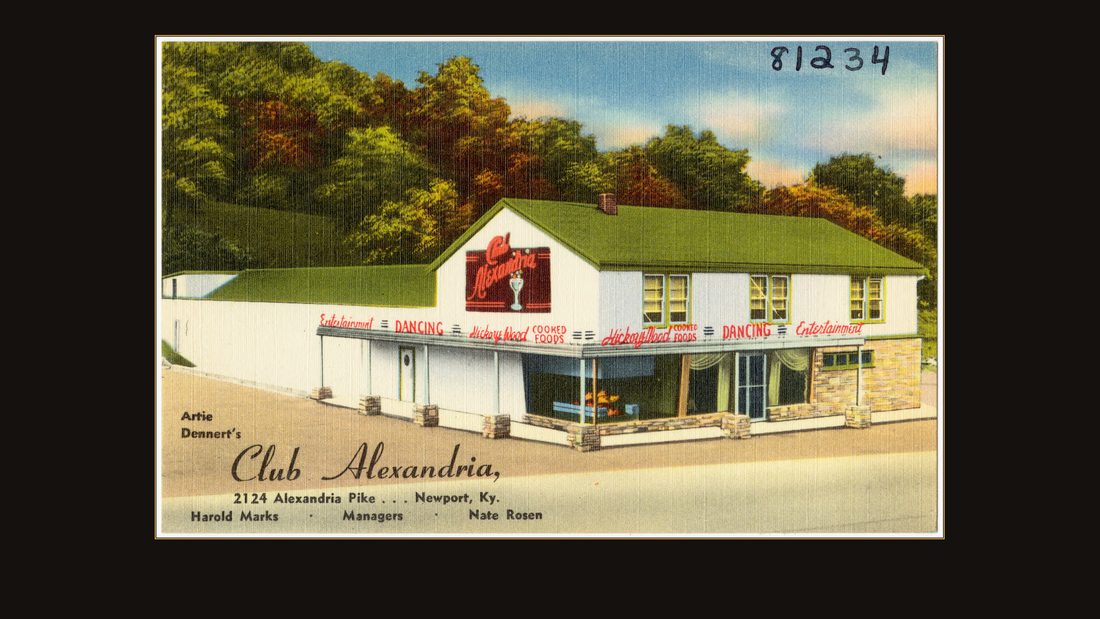
P05
Tichnor Bros. linen postcard · Boston Public Library · Artie Dennert’s Club Alexandria, Newport. View the original.
Artie Dennert's Club Alexandria offered dancing and air-conditioned rooms. Remember Dennert. His name decides the ending.
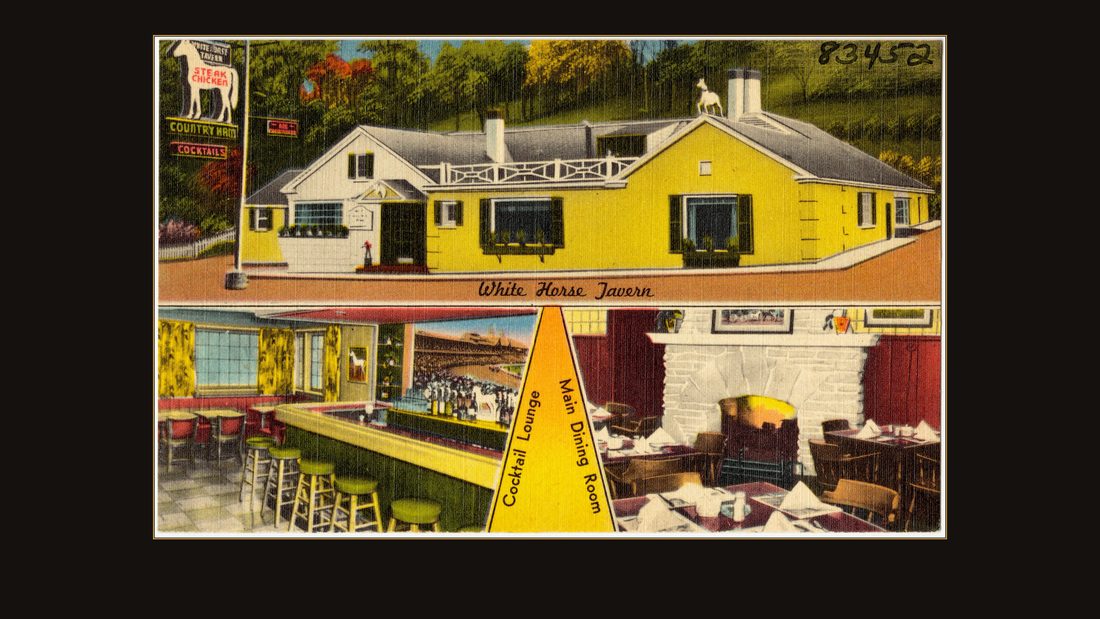
P08
Tichnor Bros. linen postcard · Boston Public Library · White Horse Tavern, Route 25, near Covington. View the original.
Out on Route Twenty-five, the roadhouses. Everything on these cards is legal.
The city manager said Newport was known as a liberal community. Then he explained the word.
"In Newport, to some people, liberal means license to operate illegal activities."
The Cleveland boys
The day before, the committee had been on a different question. Not who ran the clubs. Who owned them.
It called an accountant whose firm filed the returns for a casino in Southgate, Kentucky, and read him the list of partners.
He was asked to confirm each one.
Samuel Tucker. Moe Dalitz. Louis Rothkopf. Morris Kleinman. Al Polizzi. Thomas McGinty. John Croft.
Every one of them from Cleveland, three hundred miles north.
Five hundred and twenty-eight thousand
Then counsel read him a figure off those returns. Gross receipts, nineteen forty-nine.
Five hundred and twenty-eight thousand, six hundred and fifty-four dollars.
The accountant would not stand behind it. "Don't tie me down to any specific figure."
So the number comes from the committee, not from the witness. Half a million dollars in one year, from one club, in a town of two thousand people.
The city manager
Malcolm Reet Rhoads had taught country school for fifteen years and practiced law for four. He had never been a city manager and had never wanted to be.
A slate of businessmen won the city commission on a platform of eliminating commercialized gambling, and asked him to take the job in January of nineteen fifty.
The decree went out against all of the clubs that May.
Counsel asked whether he had confidence in his police department. The answer went further than the question.
"Gambling had gone on there for some fifty years, I suppose, or longer, and I can't conceive of big-time commercialized gambling going on without the knowledge and possibly the cooperation of the police department."
That is the city manager of Newport, under oath, about his own force.
In December he began ouster proceedings against his chief of police. The grounds were insubordination, and failure to carry out the orders on gambling.
The commissioners heard it and did not remove him. The chief got a twenty-eight-day suspension, and it had already expired.
He was still the chief. He was sitting in the room. The committee brought him up next.
The chief
He had served seventeen years on the Newport force before he was made chief. He had been chief for five.
Three thousand six hundred dollars a year. A nineteen thirty-nine Dodge. Two houses, one bought in nineteen forty-two, one inherited.
No other source of income. Nobody ever showed otherwise, and that should be read as it stands.
Counsel asked whether the Yorkshire was open. Not to his knowledge. His men checked three or four times a day and wrote it up.
"Visited five eighteen York Street, known as the Yorkshire, and found nothing. Visited the Merchants, and the same."
Then the committee's chief counsel took over. He asked the chief to name the gambling houses in his own jurisdiction.
The chief named them by street number, without hesitating. The Merchants Club. The Yorkshire, which is five eighteen York. The Flamingo, six thirty-three York. And at one time the Glenn Rendezvous.
He could list them. And he said he had never been inside one of them.
The taxicab
Counsel asked how a man in his position could not know.
"Did you ever ride in a taxicab in Cincinnati?" No, sir. "Did you ever ride in a taxi in Newport?" No, sir. "Or in Covington?" No, sir.
"You have never ridden in a taxicab?" No, sir.
"As chief of police, have you ever had occasion to talk to a taxi driver?" No, sir.
"Are you the only man in that entire vicinity who didn't know that any taxi driver could take you to a selection of five or six gambling joints?"
The chief's lawyer objected. Counsel answered plainly. I inquired there, and I was taken to them.
He was asked to stand on it under oath. "For me to say it, I have to say: No, I don't."
Forty-one
Five months earlier the committee had written to him. The letter is printed in the appendix.
A wire service on York Street was supplying racing results to subscribers all over his city. The letter printed the list.
Names, with street corners beside them, two columns running onto a second page. Sixty-six of them.
"It would appear that the above persons are undoubtedly engaged in the operation of making book on horse races."
The chief never answered the letter. He said he turned it over to his chief of detectives.
Forty-six men on the whole department. Twenty-seven in uniform. Six detectives.
And the table of everyone charged in Newport in nineteen fifty. One thousand seven hundred and thirty-three found guilty.
Five hundred and eighteen of those were for violating road and driving laws.
Forty-one were for gambling.
The chairman asked him whether his men were being paid off. He said he could not answer that. He did not know.
The memorandum
At that point the chief's own lawyer asked to put a question, and what he produced turned the hearing around.
The chief's own lawyer produced a memorandum his client wrote in February of nineteen fifty, signed by him and three of his detectives. The chief swore it was true.
It records that the detectives went to the Merchants Club, then to the Yorkshire, found the back rooms locked, and were told they would need a search warrant.
And it records what the city manager said when they reported that to him.
That he was not interested in the Merchants Club or the Yorkshire. That the only places he wanted were the ones owned by Arthur Dennert.
Because Dennert, the memorandum says, was the only operator who had sued the city over his property assessment.
A detective asked twice, three times. "You mean to tell me you do not want these other places stopped?" And the manager said no.
Absolutely untrue
Then the lawyer asked one more question, and it is the reason he produced the memorandum at all.
"State whether or not by reputation the Yorkshire and the Merchants Clubs are operated by the Cleveland mob." Yes, I had heard that.
"And Arthur Dennert's places are not, are they, so far as you know?" No.
P05
Tichnor Bros. linen postcard · Boston Public Library · Artie Dennert’s Club Alexandria, Newport. View the original.
The accusation was that a reform administration had steered its police away from the syndicate's clubs and onto the local man who annoyed it over a tax bill.
The chairman kept the city manager in the room and asked him to answer. He said he had ordered raids on both places, that his men got in, and that they found gambling equipment in both.
And of the memorandum: "The statement made in the memorandum is absolutely untrue."
He said the police had gone there to inventory property, because the chief's lawyer had filed forty tax suits against the city for club owners.
Two sworn accounts of one meeting. The committee never called the three detectives who signed, and never resolved it.
The chairman said only this. "A very, very poor showing of law enforcement, from all the evidence that we have had."
No response
Two months later, in Washington, the committee went after the owners directly.
Morris Kleinman of Cleveland was asked whether he had an interest in an establishment at Covington called the Lookout Club.
The transcript prints his answer in brackets. No response.
Asked about a partnership in the Beverly Hills. No response. The chairman directed him to answer. No response.
Louis Rothkopf was asked whether he was a partner in the Beverly Hills, which counsel noted was scheduled to reopen on the first of April.
Hold on to that date.
Sufferance
One witness did talk. James Brink of Covington bought the Lookout House in nineteen thirty-three, the year after repeal.
Counsel put it to him that the place had been a notorious gambling establishment for years. He hesitated, then agreed in his own words.
"We have had gambling for many years."
Asked how the Cleveland men became his partners, he said they came to Kentucky and bought the Beverly Hills. Counsel stopped him. You say "they."
And Brink said: "The Cleveland boys."
He set his own price. About one hundred and twenty-five thousand dollars for eighty percent of the Lookout House, a tenth of the Beverly Hills, and a capital gain he put near sixty-five thousand.
He felt he was doing anything any businessman would do.
He also held five percent of the Yorkshire, at five eighteen York Street. He had been inside once, after it was remodeled.
"What kind of deal have you made with the local authorities to prevent them raiding your place night after night?" No deal.
How do you stay open, year after year, running an establishment recognized to be illegal, without connivance between yourself and the police?
And Brink gave the honest answer, which is not a denial and is not a confession.
"I think it is sufferance on the part of the officials."
Sufferance. Nobody paid, nobody was bought, nobody stopped it. Everyone simply put up with it.
He was not there voluntarily. The Senate had voted a warrant, and he was picked up at his home in Covington on a Saturday night.
Opens April 1
There was one more exhibit that week. A small printed card, mailed to the customers of a Kentucky country club.
"Opens April first. Beverly Hills Country Club. This card is for admittance to the gaming room. If you don't intend to use it, destroy it. Don't pass it on."
The committee was scheduled to go out of existence on the thirty-first of March. The club was announcing that it would open the following day.
Brink said he did not believe any such card was printed by the people at Beverly Hills. It stayed in the record.
Ten years
P02
Tichnor Bros. linen postcard · Boston Public Library · The Yorkshire, 518 York St., Newport. View the original.
The committee expired on schedule. Ten years later the clubs on York Street were still running.
P01
Tichnor Bros. linen postcard · Boston Public Library · The Yorkshire, 518 York St., Newport. View the original.
Gambling was a state offense, Kentucky would not prosecute it, and a man who crossed a bridge had broken no federal law.
On the thirteenth of September, nineteen sixty-one, Congress passed a law titled travel or transportation in aid of racketeering enterprises.
Crossing a state line, or using the mail, to run a gambling business that broke the law of the state it stood in became a federal crime.
Ten years and six months after that word sufferance, the sufferance of local officials stopped being the only thing that mattered.
What is still buried
What is still buried is the meeting in the city manager's office in February of nineteen fifty.
Either the police were told to leave the syndicate's clubs alone and go after a local man over a tax suit, or a chief facing ouster wrote a memorandum that was absolutely untrue and swore to it in front of the Senate.
Three detectives signed it. Donley, Hawthorne and Fredericks. They were in the room. None of them was ever asked.
If your family was in Newport or Covington then, they knew which it was. The comment below asks. Every document here is sourced in the description.
Sources
- Investigation of Organized Crime in Interstate Commerce, Hearings before the Special Committee to Investigate Organized Crime in Interstate Commerce, U.S. Senate, Part 6 (Cleveland, Jan. 17–19 and Feb. 19, 1951). archive.org/details/investigationofo06unit - Malcolm Reet Rhoads, city manager, Newport, Ky. — pp. 367–373, 385 - George Gugel, chief of police, Newport, Ky. — pp. 373–385 - Alvin E. Giesey, accountant, Cleveland — pp. 19–28, 118–175 - Exhibit 74 (letter of Aug. 18, 1950 to Chief Gugel) — appendix, pp. 468–469 - Exhibit 75 (Newport Police Department consolidated reports, 1950) — appendix, pp. 470–473
- Part 12 (Washington, closing sessions, Mar. 1951). archive.org/details/investigationofo12unit - Morris Kleinman — pp. 628–636 - Louis Rothkopf — pp. 636–642 - James H. Brink, Covington, Ky. — pp. 723–742 - Exhibit 47, the Beverly Hills reopening card, read into the record at p. 734
- Index to the hearings. archive.org/details/investigationofo0112unit — this is what found Part 6. The episode was scoped from Part 12 and the index showed that the Newport officials testified in Part 6, which nothing in Part 12 says.
- Public Law 87-228, approved September 13, 1961; 75 Stat. 498, adding 18 U.S.C. § 1952, "Interstate and foreign travel or transportation in aid of racketeering enterprises." United States Statutes at Large, vol. 75. archive.org/details/sim_united-states-united-states-statutes-at-large_1961_75
- Seven linen postcards from the Tichnor Brothers collection, Boston Public Library, via Wikimedia Commons. Public domain (published without copyright notice), c. 1930–45. The Yorkshire Restaurant at 518 York Street; Artie Dennert's Club Alexandria; Glenn Schmidt's at 18 East Fifth Street; two roadhouses on Route 25 near Covington; the American National Bank. These are advertisements the operators paid to print. They are shown as such — the credit on every plate says "linen postcard."
- Newport, Ky. from the air, December 1923, 7th Photo Section, Wilbur Wright Field, Fairfield, Ohio — U.S. Army Air Service, a federal work. Via Wikimedia Commons, credited to the National Archives.
- The item PDFs are the worst derivative on all three archive.org items. The per-page jp2 (`/download/<id>/page/n<N>_w4000.jpg`) returns 2064×3364 for Part 6, 2017×3455 for Part 12 and 2576×3960 for the Statutes volume.
- The leaf-to-printed-page offset is a property of each scan: Part 6 is n = printed + 11, Part 12 is n = printed + 13, and the Statutes volume was one off from what its own `page_numbers.json` implied. Every page used was confirmed by scoring its OCR against the transcript of its own printed page and its neighbours, since a misplaced crop is always an off-by-N.