"I Love My Mountains." Then He Went to Work on the Dam.
The film of this episode premieres August 16, 2026 on YouTube. The documents, the transcript and the sources are below now.
In October 1933 the Tennessee Valley Authority sent Lewis Hine - the photographer whose pictures of children in the mills had helped write the child labor laws - into East Tennessee. He worked for six weeks, from the twentieth of October to the twenty-fifth of November, and numbered his negatives 1 through 197.
Transcript
Negative thirty-six
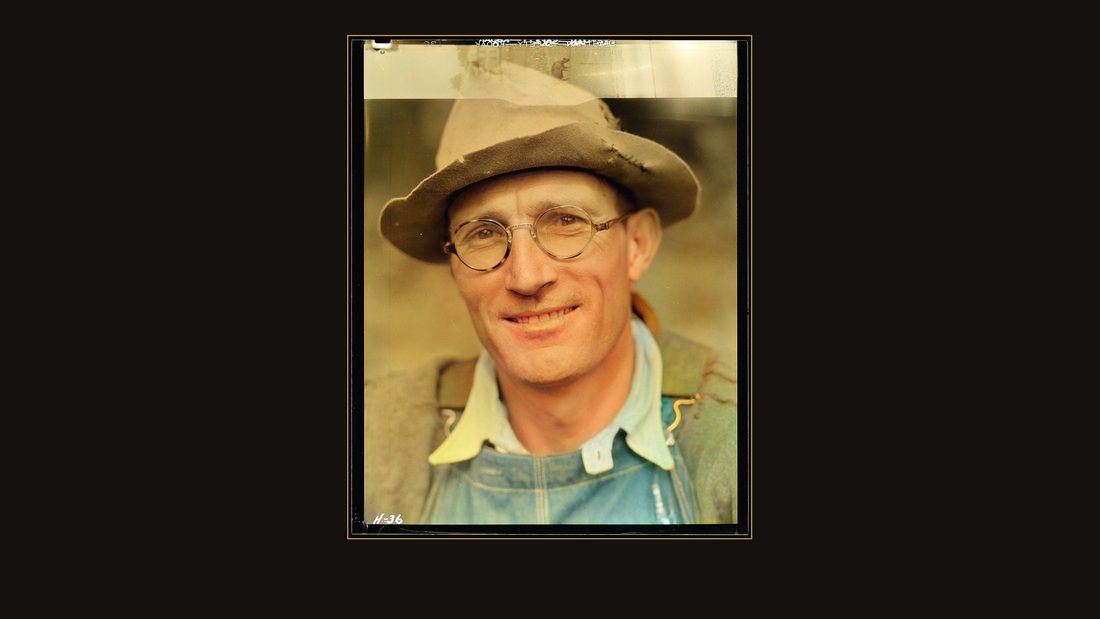
H001 "Curtis Stiner, an example of the mountain farmer of East Tennessee. `I love my mountains, and I want to stay right here the rest of my life if I can.' The flooding of the reservoir area will take his home."
Lewis W. Hine · Tennessee Valley Authority, Oct.-Nov. 1933 · National Archives, RG 142 · AI-colorized. View the original.
This is Curtis Stiner. He farmed in East Tennessee, and in the autumn of nineteen thirty-three a photographer working for the government wrote down what he said.
"I love my mountains, and I want to stay right here the rest of my life if I can." Then one more line on the card. The reservoir will take his home.
Remember him. We are coming back to where this camera found him next.
Nineteen days
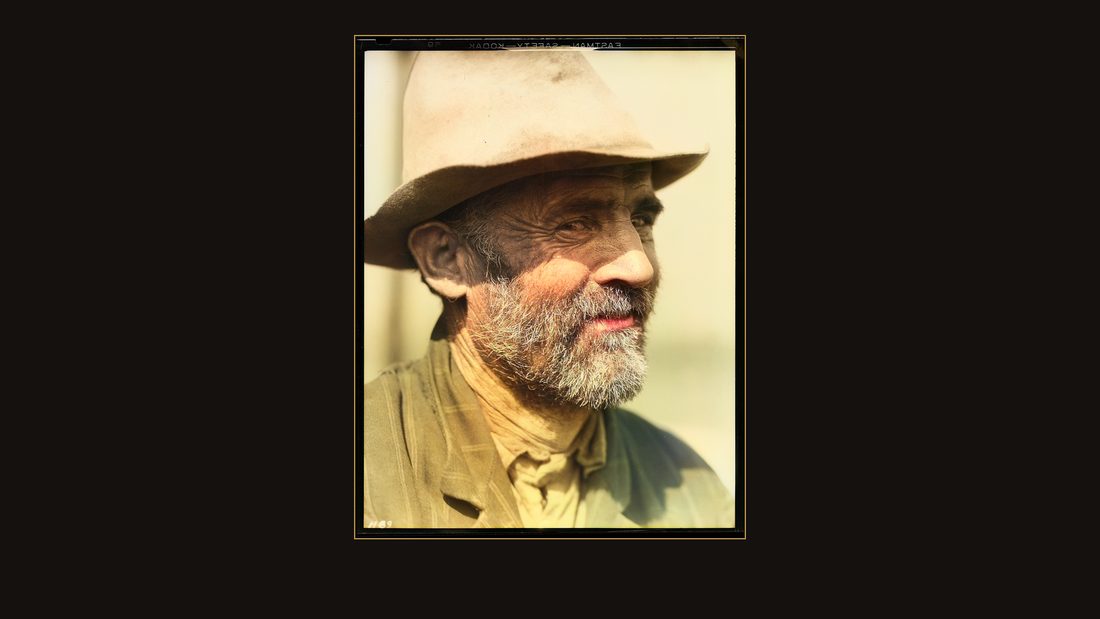
H002 "Edgar Coffman, a renter farmer in Anderson County, Tennessee, near Clinton. He is also a preacher for the Holiness sect."
Lewis W. Hine · Tennessee Valley Authority, Oct.-Nov. 1933 · National Archives, RG 142 · AI-colorized. View the original.
The photographer was Lewis Hine. Twenty-five years earlier, his pictures of children in the mills had helped write the child labor laws.

H003 "Edgar Coffman, a renter farmer in Anderson County, Tennessee, near Clinton. He is also a preacher for the Holiness sect."
Lewis W. Hine · Tennessee Valley Authority, Oct.-Nov. 1933 · National Archives, RG 142 · AI-colorized. View the original.
In nineteen thirty-three he worked for the Tennessee Valley Authority. He went into the field on the twentieth of October and came out on the twenty-fifth of November.
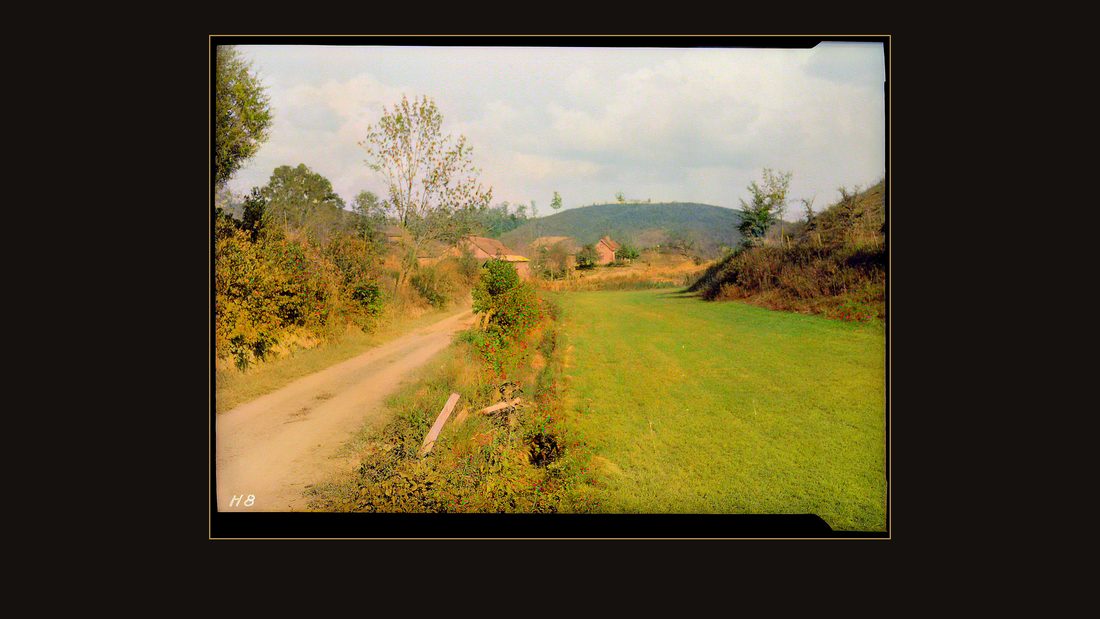
H004 "Sevier County, Tennessee. This view reveals the rolling landscape. Many farms have a little level land and much of hills and steep grades."
Lewis W. Hine · Tennessee Valley Authority, Oct.-Nov. 1933 · National Archives, RG 142 · AI-colorized. View the original.
Six weeks. He numbered the negatives one through one hundred ninety-seven. One hundred ninety of them survive.
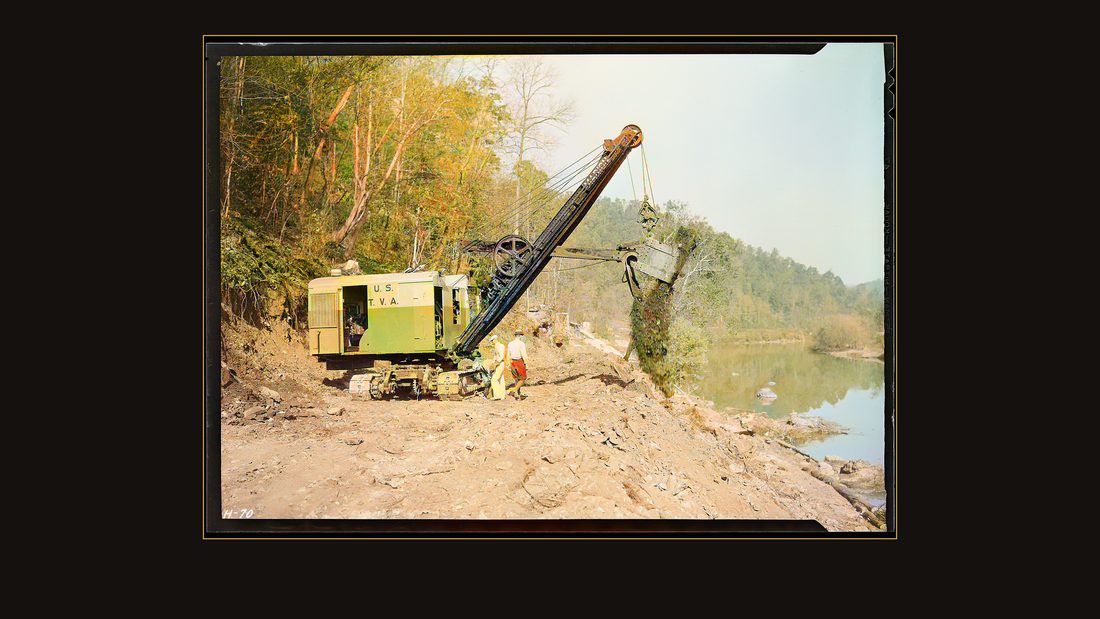
H006 "Making the dirt fly at Norris Dam site. A power shovel working on the roadway at the Dam."
Lewis W. Hine · Tennessee Valley Authority, Oct.-Nov. 1933 · National Archives, RG 142 · AI-colorized. View the original.
Construction on Norris Dam began on the first of October. Hine's first exposure is dated the twentieth. He arrived nineteen days behind the shovels.
Seven years later the Authority published a technical report on the project. Page fifty-nine explains what had not been done first.
No studies had been made about moving the families off the land. There was no time, it says, because of the urgent need to relieve unemployment.
What the camera was for
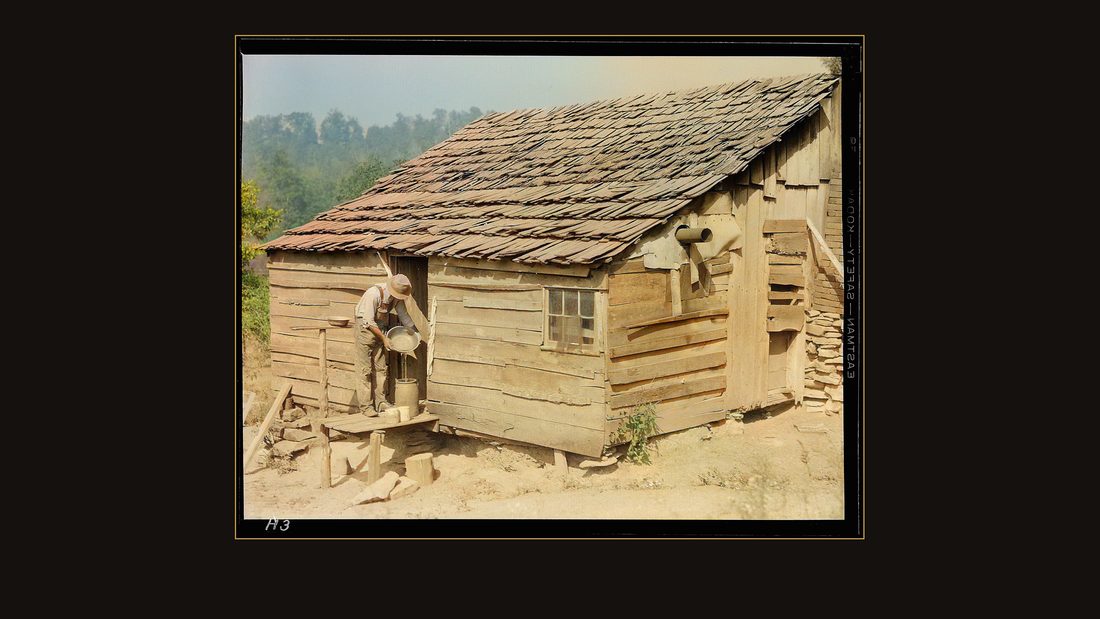
H007 "Rear view of the McHaffie homestead at Powell Station, Route #1, Knox County, Tennessee."
Lewis W. Hine · Tennessee Valley Authority, Oct.-Nov. 1933 · National Archives, RG 142 · AI-colorized. View the original.
So what Hine brought back is the closest thing to a survey of that valley before the water. He made it with a camera and a pencil.
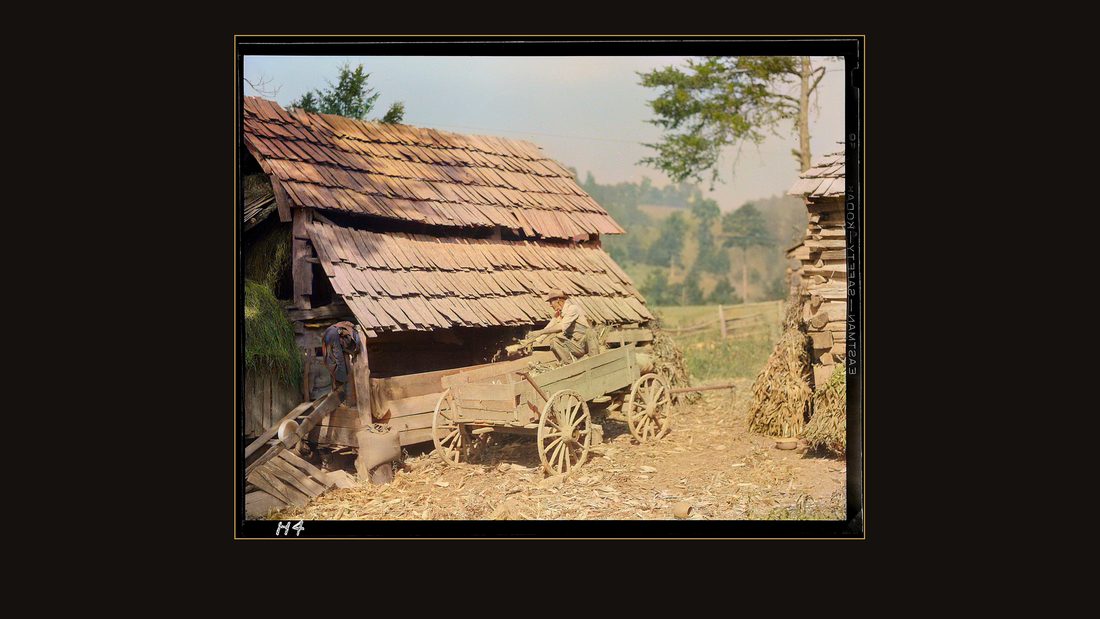
H008 "View of the barnyard of the McHaffie homestead at Powell Station, Route #1, Knox County, Tennessee. Note the handhewn clapboard shingling."
Lewis W. Hine · Tennessee Valley Authority, Oct.-Nov. 1933 · National Archives, RG 142 · AI-colorized. View the original.
He wrote the captions himself. They carry names, road numbers, ages, acreage, and now and then a sentence somebody said to him.
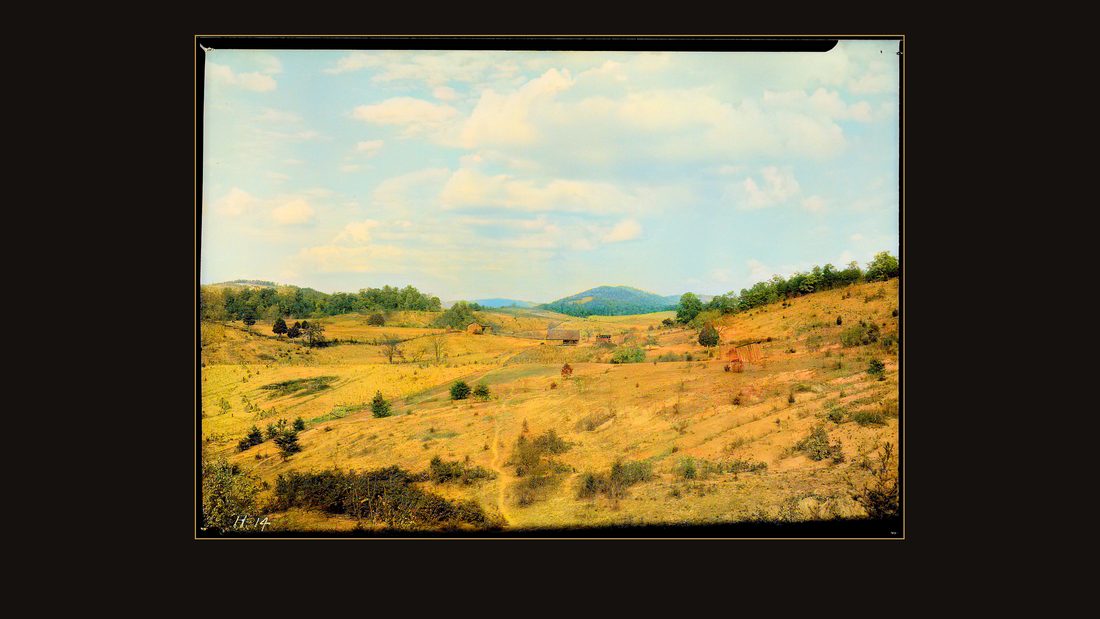
H009 "Farm land in Jefferson County, Tennessee. Note the cleared patch on the wooded hill. Areas of hillside land so situated are usually arable for a few years only. The top soil soon washes away."
Lewis W. Hine · Tennessee Valley Authority, Oct.-Nov. 1933 · National Archives, RG 142 · AI-colorized. View the original.
He started with the ground. Of the cleared patch on the hill, his caption says land like that is arable a few years only. The top soil washes away.
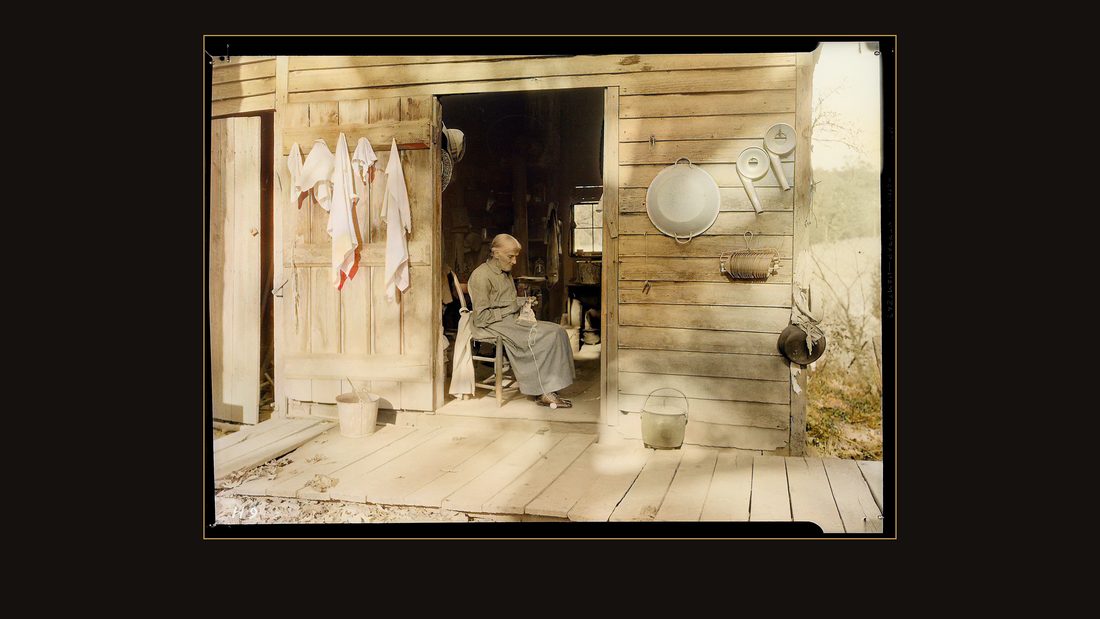
H012 "Mrs. Sarah J. Wilson has lived ninety-one years on a farm near Bulls Gap, Tennessee. She is still very active and resourceful. She is a fine example of the vitality and industry found in this old Tennessee stock."
Lewis W. Hine · Tennessee Valley Authority, Oct.-Nov. 1933 · National Archives, RG 142 · AI-colorized. View the original.
Missus Sarah J. Wilson had lived ninety-one years on a farm near Bulls Gap.
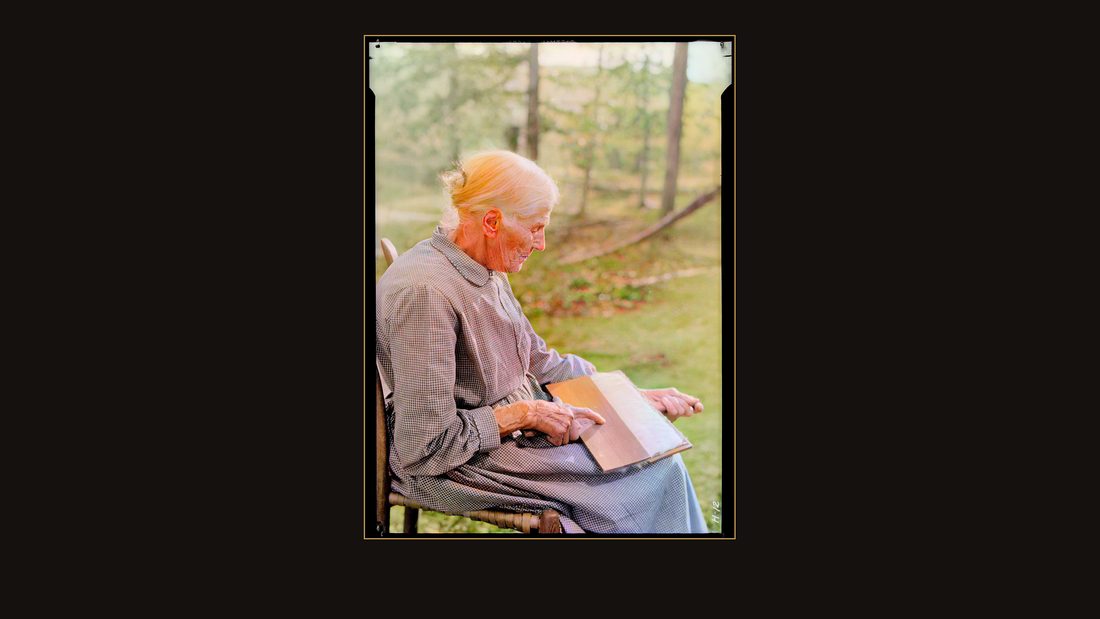
H013 "Mrs. Sarah J. Wilson, Bulls Gap, Tennessee. In addition to daily work around the home, she finds time to raise some cotton, carding and spinning it herself. She also does some hand-weaving."
Lewis W. Hine · Tennessee Valley Authority, Oct.-Nov. 1933 · National Archives, RG 142 · AI-colorized. View the original.
She still raised her own cotton. She did the carding, the spinning and the weaving herself. At ninety-one.
Sorghum
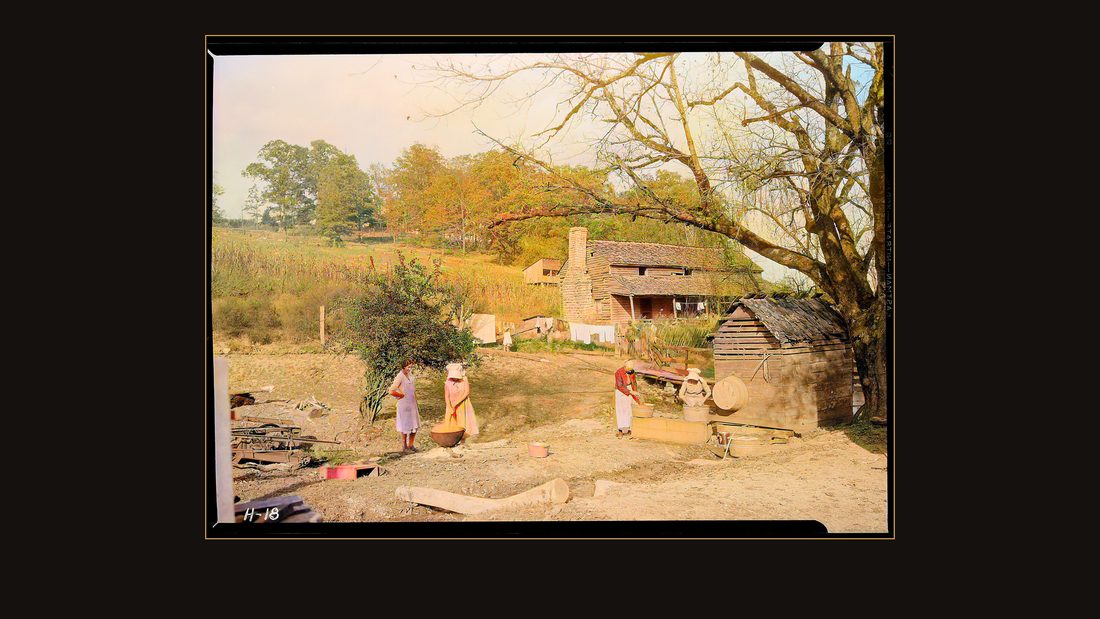
H014 "Washday at the Stooksberry homestead near Andersonville, Tennessee. This old estate of 350 acres dates back to the Civil War. It will be submerged when the Norris Dam reservoir fills. This family is very versatile and carries on all kinds of activities and construction."
Lewis W. Hine · Tennessee Valley Authority, Oct.-Nov. 1933 · National Archives, RG 142 · AI-colorized. View the original.
Then he moved into the valley the water was going to fill. Washday at the Stooksberry homestead. Three hundred and fifty acres, dating back to the Civil War.
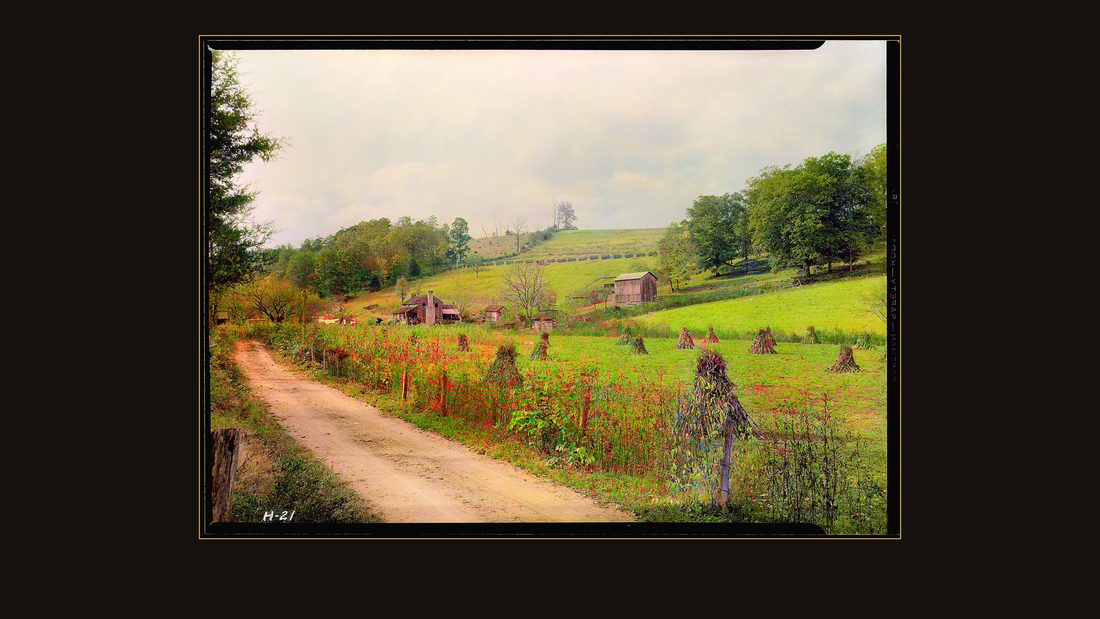
H015 "The Stooksberry homestead near Andersonville, Tennessee. This land will be submerged by the Norris Dam Reservoir."
Lewis W. Hine · Tennessee Valley Authority, Oct.-Nov. 1933 · National Archives, RG 142 · AI-colorized. View the original.
"This land will be submerged by the Norris Dam Reservoir." That sentence, or one like it, is on more than twenty of these cards.
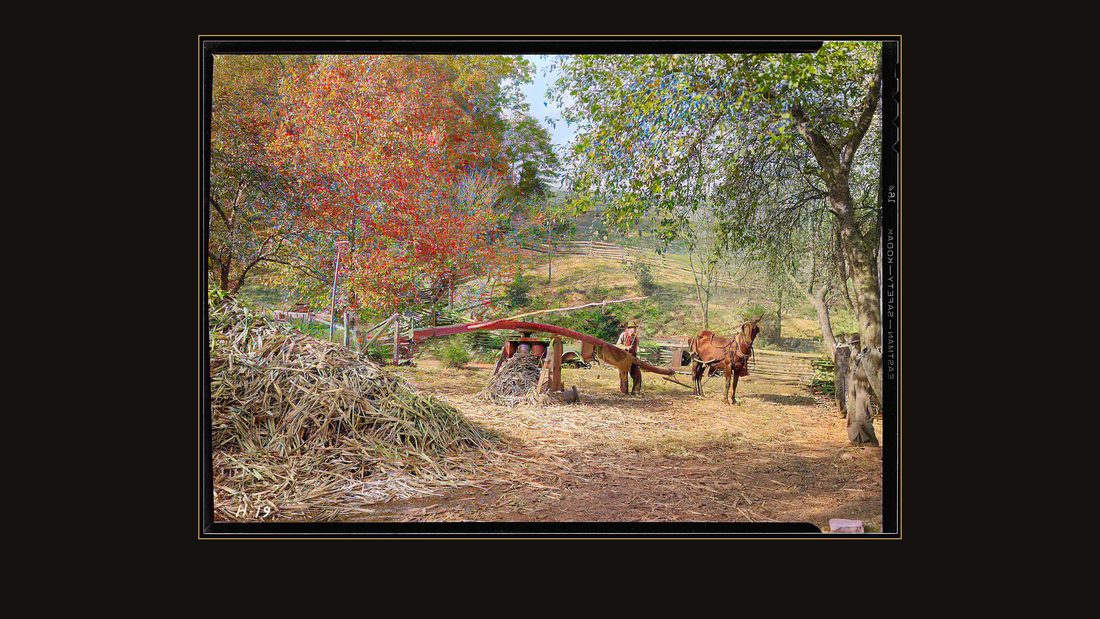
H016 "Grinding cane for sorghum at the Stooksberry homestead near Andersonville, Tennessee. Sorghum cane could be raised in large crops in this district."
Lewis W. Hine · Tennessee Valley Authority, Oct.-Nov. 1933 · National Archives, RG 142 · AI-colorized. View the original.
It was October, so they were making molasses. Grinding the cane.
The school and the church
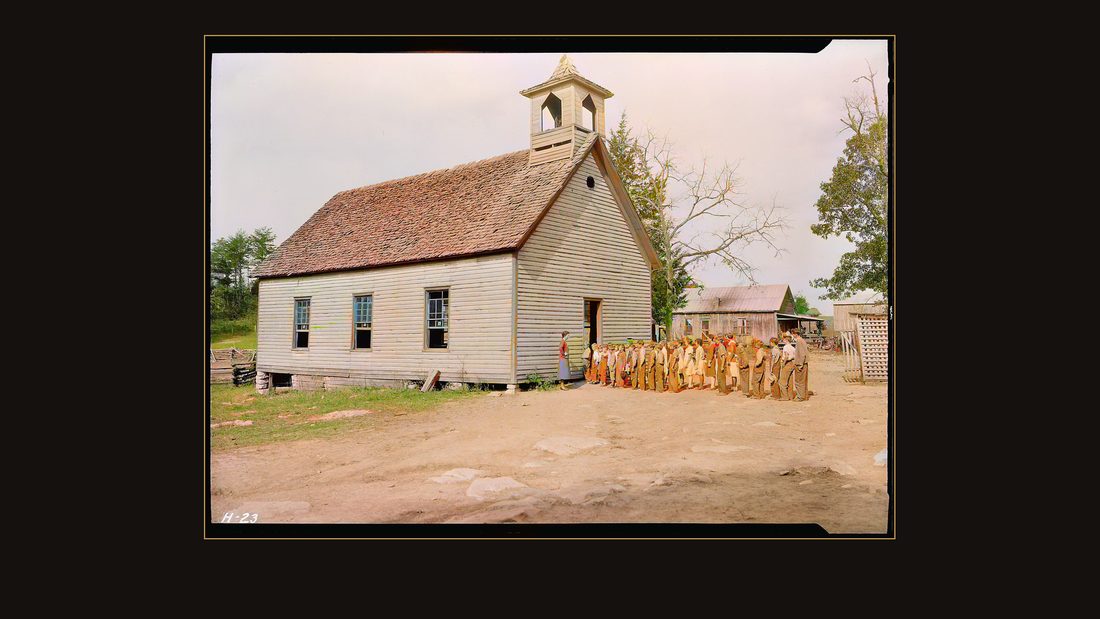
H019 "Exterior view of Oakdale School near Loyston, Tennessee. This immediate region will be flooded when the Norris Dam Reservoir fills."
Lewis W. Hine · Tennessee Valley Authority, Oct.-Nov. 1933 · National Archives, RG 142 · AI-colorized. View the original.
Oakdale School, near Loyston. The whole school came outside to be photographed.
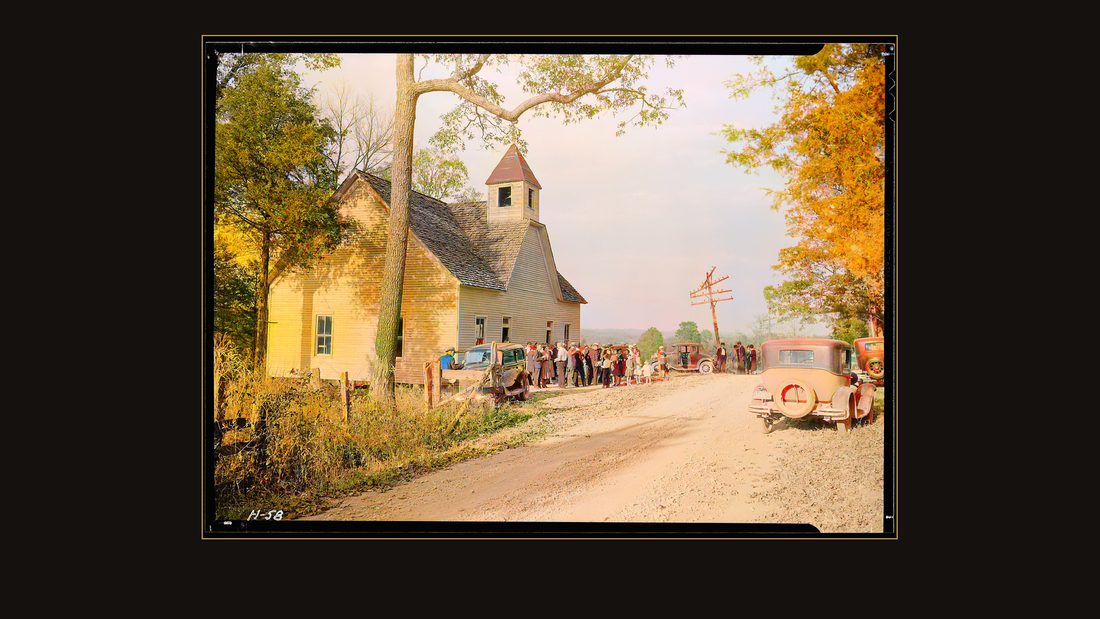
H021 "A little country church, Sharps Station M.E. Church, near Loyston, Tennessee. Congregation leaving at close of the service. This church will be submerged by the waters of the Norris Dam reservoir."
Lewis W. Hine · Tennessee Valley Authority, Oct.-Nov. 1933 · National Archives, RG 142 · AI-colorized. View the original.
Sharps Station Methodist Church, also near Loyston. The congregation is coming out at the close of the service.
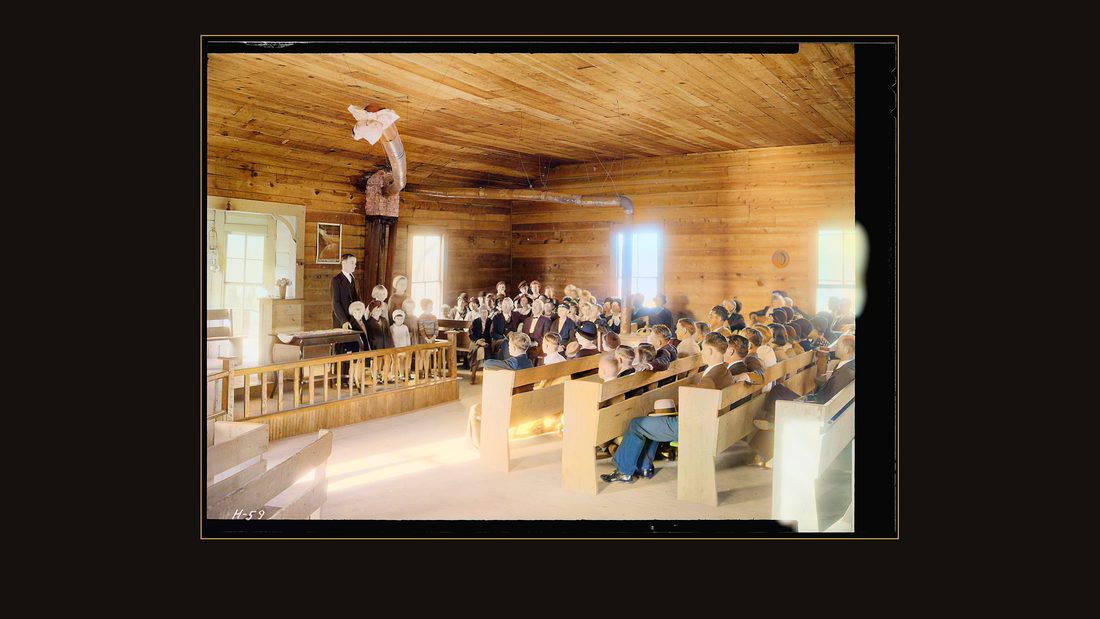
H022 "Interior view of Sharps Station M.E. Church near Loyston, Tennessee. Reverend Lovelace and some children from an orphanage conduct the Sunday afternoon service."
Lewis W. Hine · Tennessee Valley Authority, Oct.-Nov. 1933 · National Archives, RG 142 · AI-colorized. View the original.
Inside, on a Sunday afternoon. The caption names the preacher, Reverend Lovelace. Both buildings stood inside the taking line.
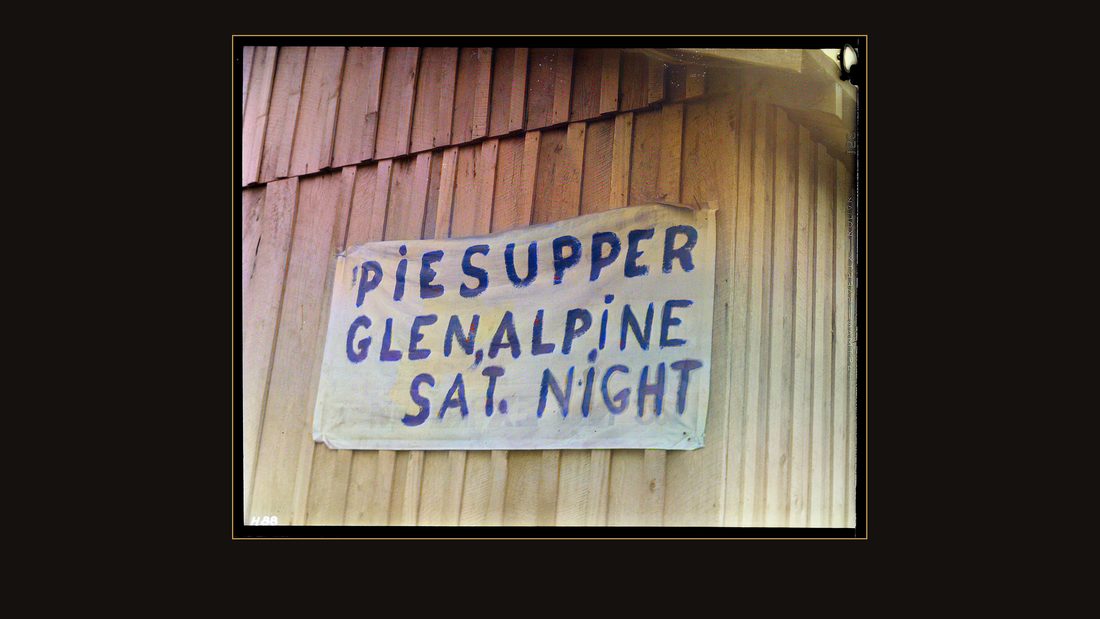
H023 "The `Pie Supper' is a popular source of entertainment and recreation for the young people in the mountain region."
Lewis W. Hine · Tennessee Valley Authority, Oct.-Nov. 1933 · National Archives, RG 142 · AI-colorized. View the original.
He also photographed a sign on the side of a barn. Pie supper. Glen Alpine. Saturday night.
Names and addresses
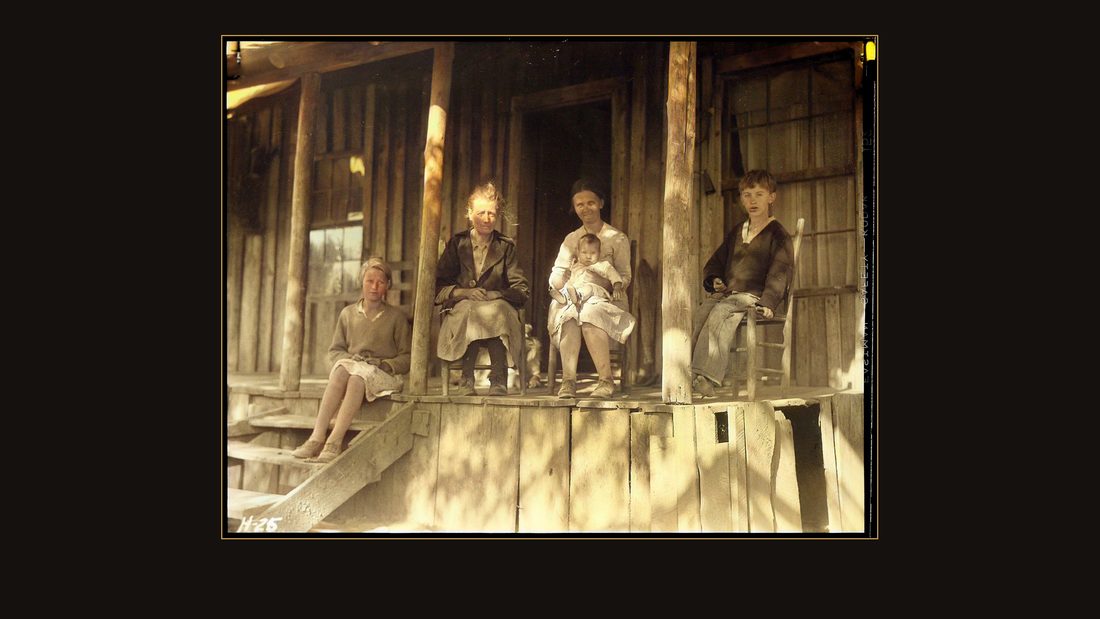
H024 "Family group on farm near Andersonville, Tennessee. This family owns two acres and has always lived in the vicinity."
Lewis W. Hine · Tennessee Valley Authority, Oct.-Nov. 1933 · National Archives, RG 142 · AI-colorized. View the original.
Then he went house to house, and the captions turn into an address book. This family owns two acres and has always lived in the vicinity.
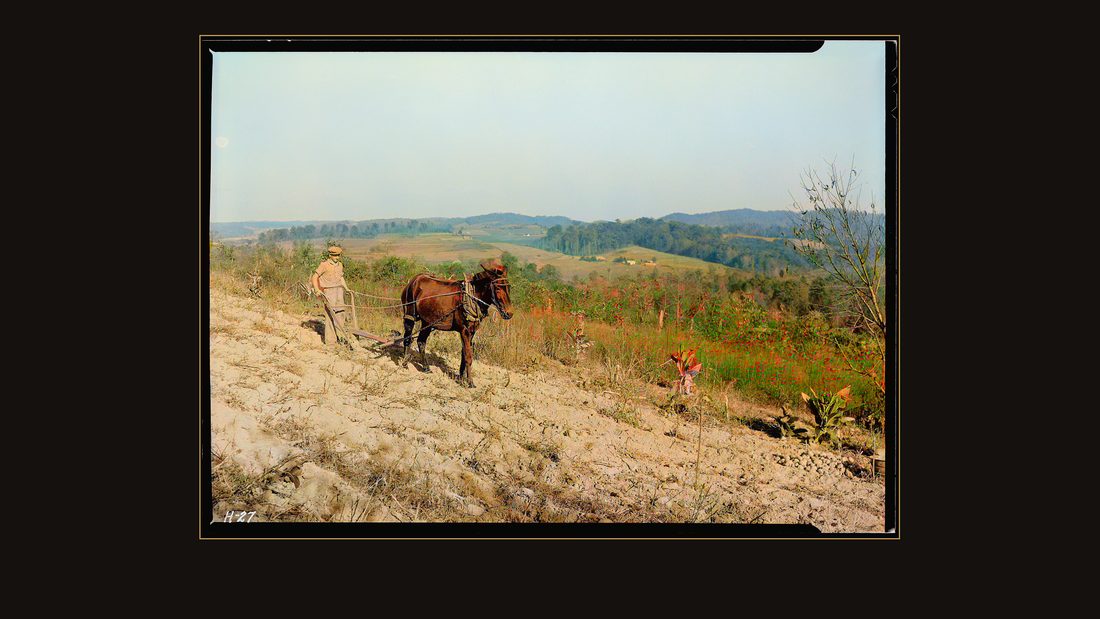
H026 "Boy plowing potato field with a mule and bull-tongue plow on steep slope on J. W. Melton farm on Andersonville, Tennessee, road. This farm is on the edge of the area to be flooded by the Norris Dam reservoir."
Lewis W. Hine · Tennessee Valley Authority, Oct.-Nov. 1933 · National Archives, RG 142 · AI-colorized. View the original.
A boy plowing a potato field with a mule and a bull-tongue plow. This farm, the caption says, is on the edge of the area to be flooded.
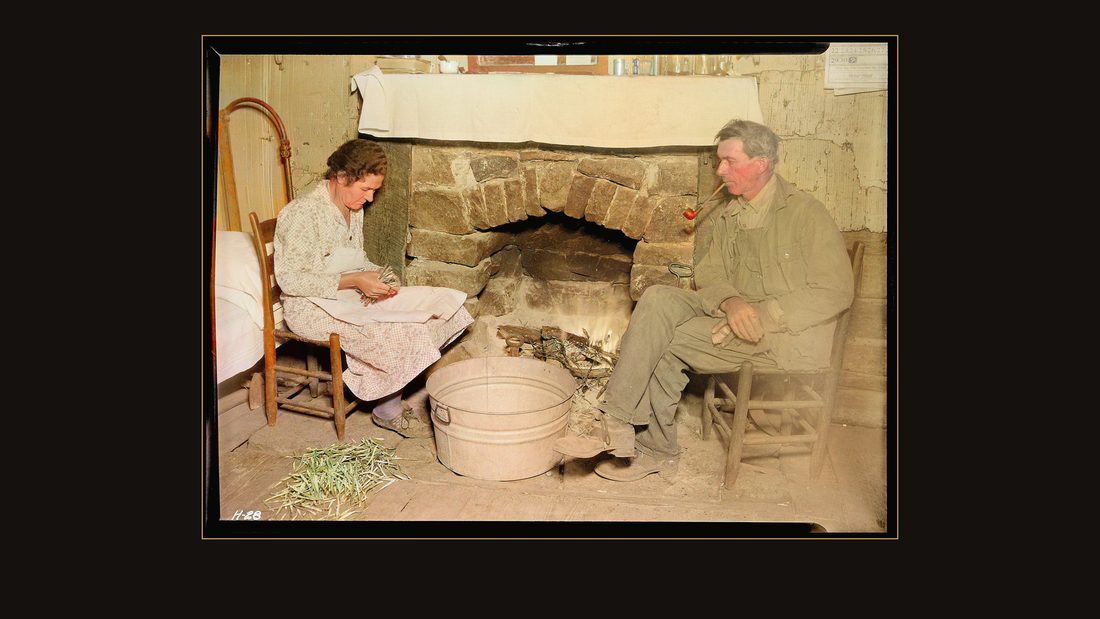
H027 "Mr. J. W. Melton and his wife by the fireplace getting ready for supper. Melton has used up the better part of his life in the mines. His boys run the farm. The Melton homestead is on the Andersonville, Tennessee, road."
Lewis W. Hine · Tennessee Valley Authority, Oct.-Nov. 1933 · National Archives, RG 142 · AI-colorized. View the original.
Mister Melton and his wife, getting ready for supper. Melton has used up the better part of his life in the mines. His boys run the farm.
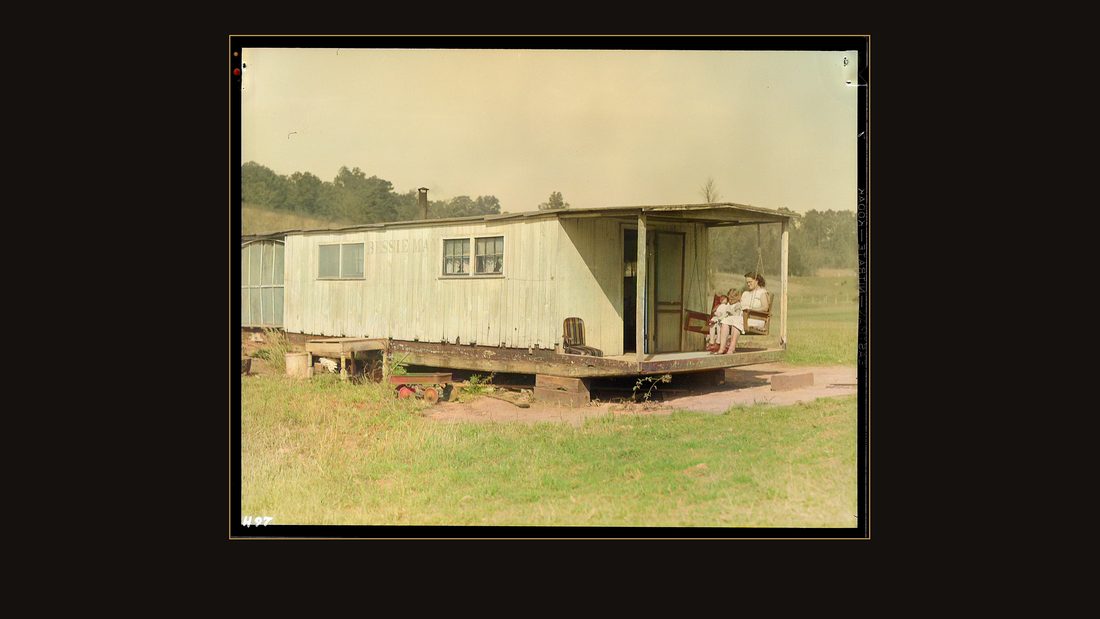
H029 "`Squatter's' home on Andersonville Road, Tennessee. The house is a made-over houseboat."
Lewis W. Hine · Tennessee Valley Authority, Oct.-Nov. 1933 · National Archives, RG 142 · AI-colorized. View the original.
A house on the Andersonville road that Hine labelled a squatter's home. It is a made-over houseboat.
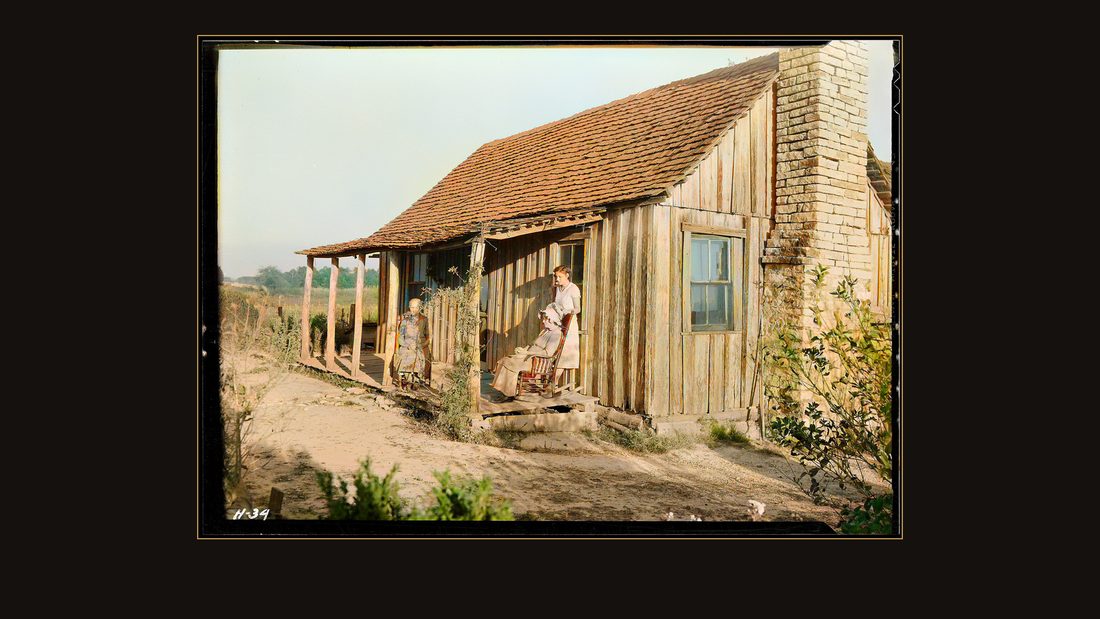
H030 "The home of Harriet Hankins in the area of the proposed town at Norris Dam."
Lewis W. Hine · Tennessee Valley Authority, Oct.-Nov. 1933 · National Archives, RG 142 · AI-colorized. View the original.
Harriet Hankins lived exactly where the new town was going to be built.
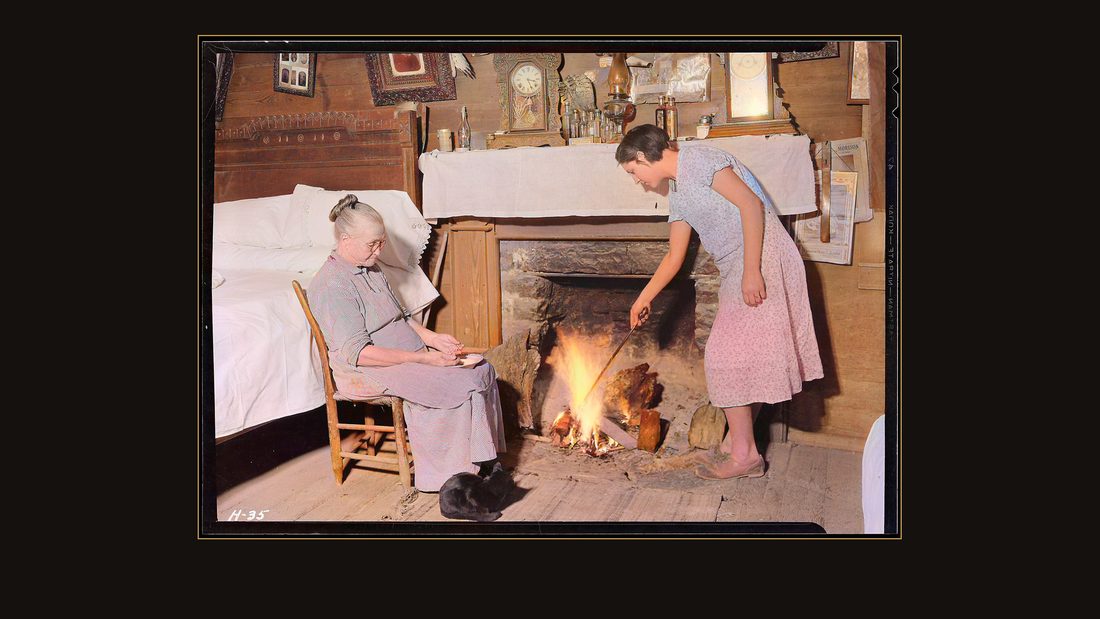
H031 "Interior of the home of Harriet Hankins at the site of the planned community near Norris Dam. Harriet Hankins is 73 years old."
Lewis W. Hine · Tennessee Valley Authority, Oct.-Nov. 1933 · National Archives, RG 142 · AI-colorized. View the original.
He went inside. Harriet Hankins is seventy-three years old.
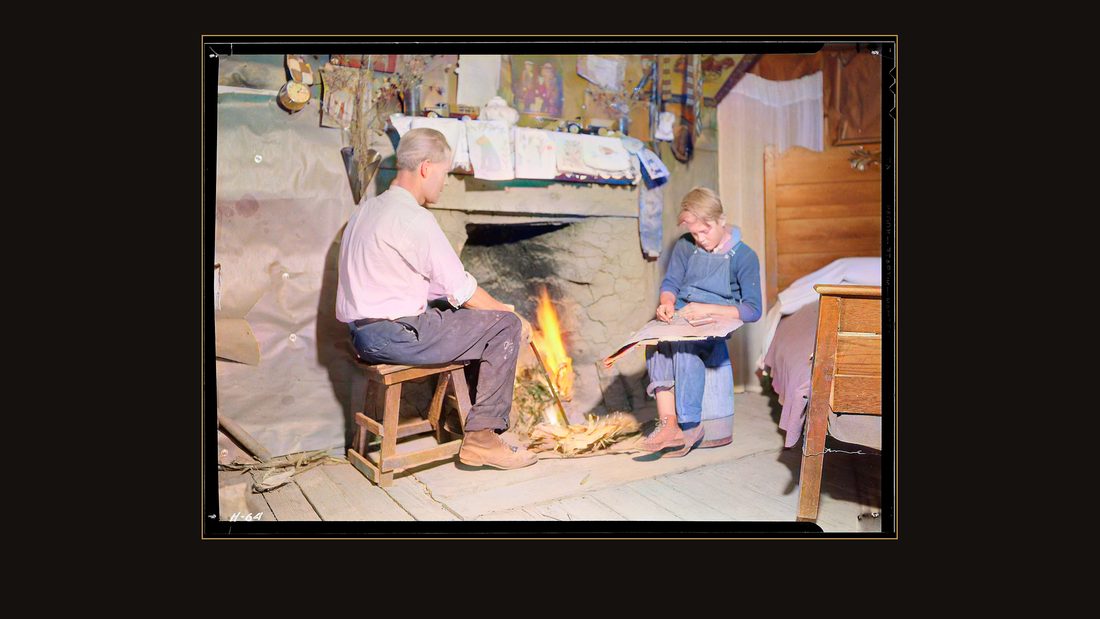
H032 "Esco Glandon, a renter, lives at Bridges Chapel on land that will be islanded by the Norris Dam reservoir. His son has developed some talent in drawing. Note the drawings along the mantel of the fireplace."
Lewis W. Hine · Tennessee Valley Authority, Oct.-Nov. 1933 · National Archives, RG 142 · AI-colorized. View the original.
At Bridges Chapel he found Esco Glandon, a renter on land the reservoir would turn into an island. Note the drawings along the mantel, says the caption. They are his son's.
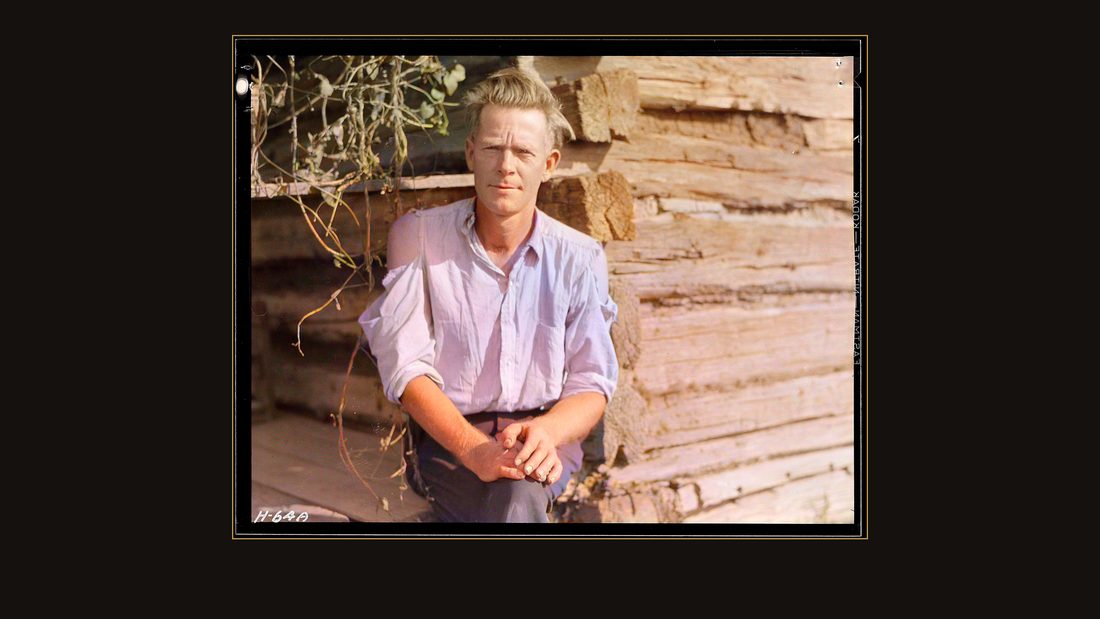
H033 "Esco Glandon, a renter at Bridges Chapel near Loyston, Tennessee. He rebuilt the cabin in which his family lives. Glandon has lived all his life in this region except for 3 years in a glass works in Kokomo, Indiana."
Lewis W. Hine · Tennessee Valley Authority, Oct.-Nov. 1933 · National Archives, RG 142 · AI-colorized. View the original.
Glandon rebuilt this cabin himself. He had lived here all his life, except for three years in a glass works in Kokomo, Indiana.
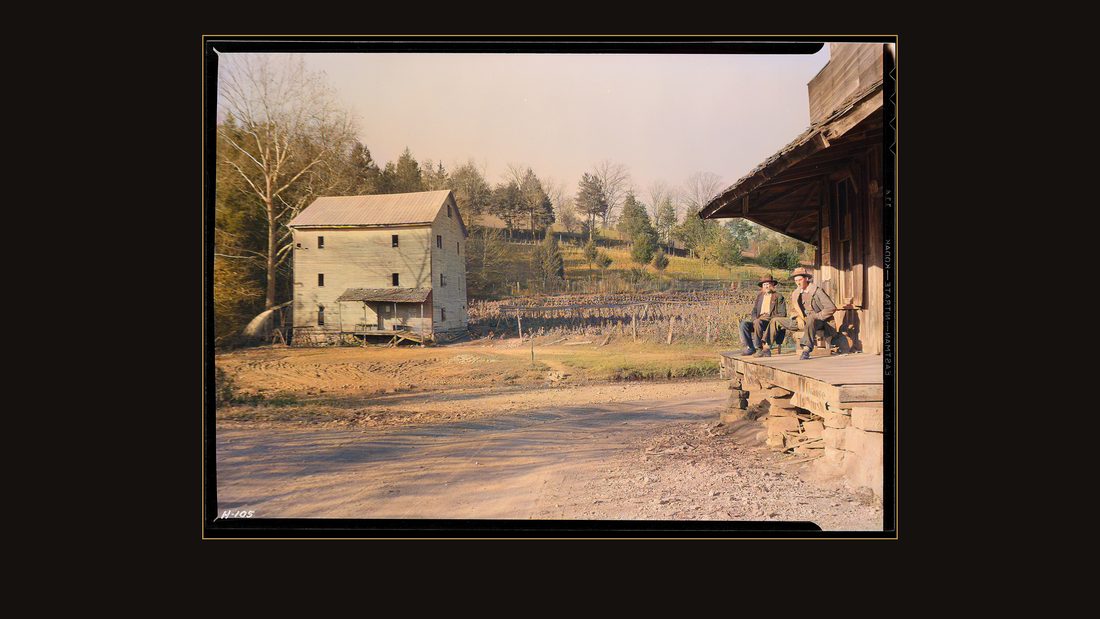
H037 "Store and postoffice at Goin, Tennessee. Mr. J. C. Nicely has been a storekeeper here for 30 years."
Lewis W. Hine · Tennessee Valley Authority, Oct.-Nov. 1933 · National Archives, RG 142 · AI-colorized. View the original.
At Goin, the store and post office. Mister J. C. Nicely had kept it for thirty years.

H038 "J. C. Nicely, P. O. at Goin, Tennessee. He is 70 years old, was born and reared in Union County, Tennessee. He is of English ancestry, via Virgina to Tennessee.
Lewis W. Hine · Tennessee Valley Authority, Oct.-Nov. 1933 · National Archives, RG 142 · AI-colorized. View the original.
Here he is. Seventy years old, born and reared in Union County.
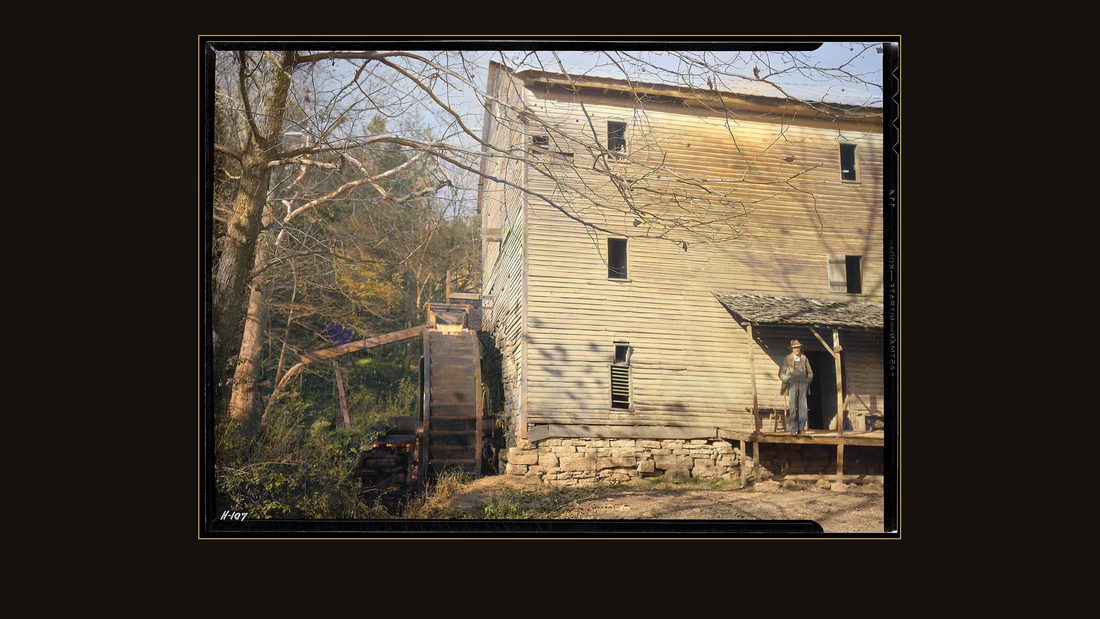
H039 "Watermill grinding meal, run by H. L. Nicely, son of J. C. Nicely, at Goin, Tennessee. This old mill was built 100 years ago. All of this region will be deep under water when the Norris Dam reservoir fills."
Lewis W. Hine · Tennessee Valley Authority, Oct.-Nov. 1933 · National Archives, RG 142 · AI-colorized. View the original.
His son ran the mill that ground their cornmeal. Built a hundred years ago. All of this region, the caption ends, will be deep under water.
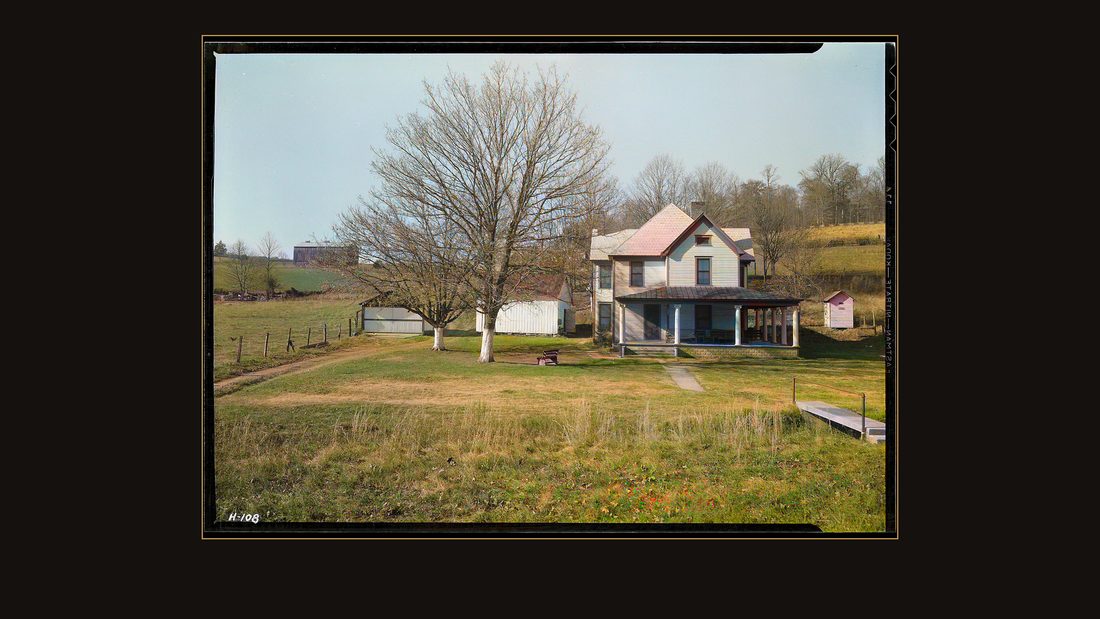
H040 "The homestead of Sherman Stiner, Lead Mine Bend, Union County, Tennessee. Mr. Stiner is a prosperous and progressive farmer. Much of his 1500 acres will be flooded by the Norris Dam reservoir, Stiner raises fine Hereford cattle."
Lewis W. Hine · Tennessee Valley Authority, Oct.-Nov. 1933 · National Archives, RG 142 · AI-colorized. View the original.
On Ledd Mine Bend, the homestead of Sherman Stiner. A prosperous and progressive farmer, Hine wrote. Fifteen hundred acres, much of it going under.
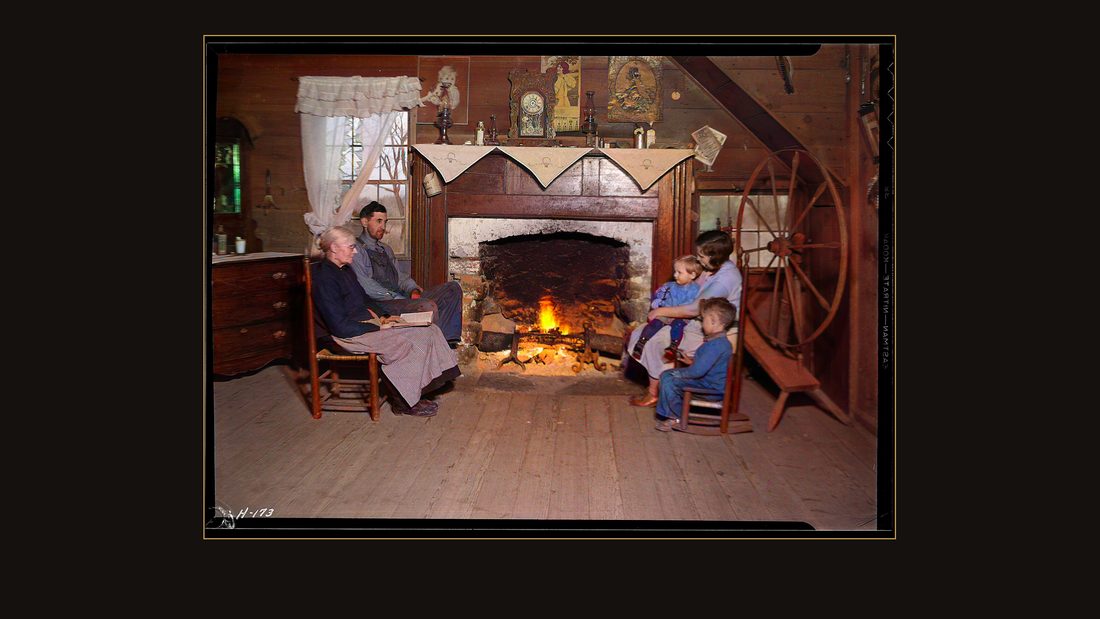
H042 "Interior of the home of Mrs. Jacob Stooksbury, Loyston, Tennessee. This homestead is in the region which will be inundated by the waters of the Norris Dam reservoir."
Lewis W. Hine · Tennessee Valley Authority, Oct.-Nov. 1933 · National Archives, RG 142 · AI-colorized. View the original.
In the last week of the assignment he spent an afternoon in one room at Loyston. The home of Missus Jacob Stooksbury.
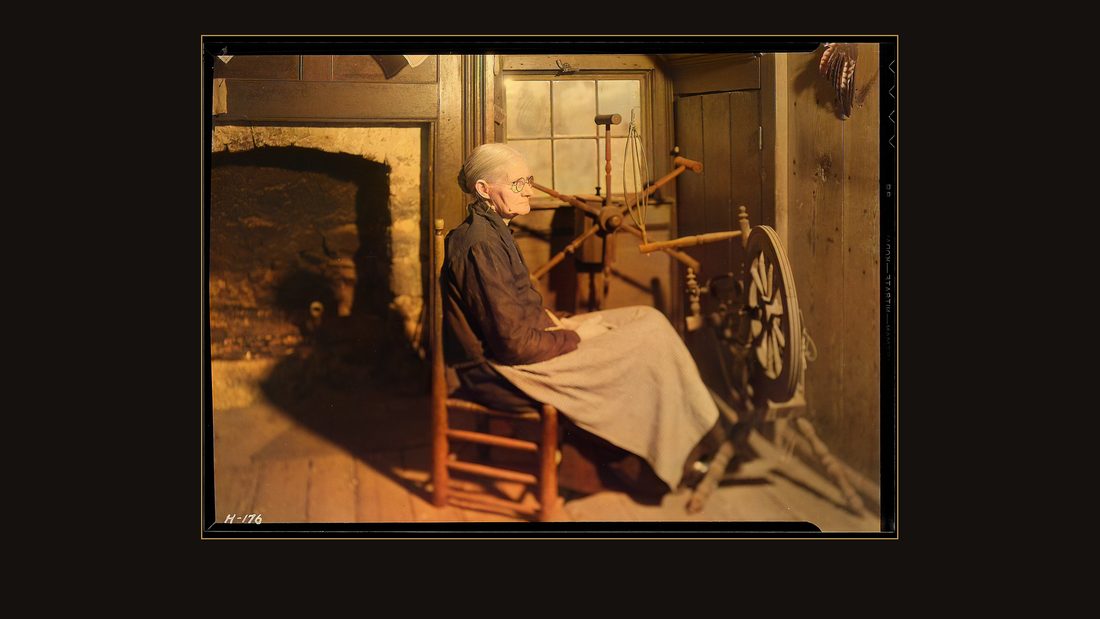
H044 "Another view of Mrs. Jacob Stooksbury, Loyston, Tennessee, seated before a spinning wheel in her home. The creel in the background is used for measuring yarn by the hank."
Lewis W. Hine · Tennessee Valley Authority, Oct.-Nov. 1933 · National Archives, RG 142 · AI-colorized. View the original.
She sat at the wheel for him. The creel behind her is used for measuring yarn by the hank.
The same men
H001 "Curtis Stiner, an example of the mountain farmer of East Tennessee. `I love my mountains, and I want to stay right here the rest of my life if I can.' The flooding of the reservoir area will take his home."
Lewis W. Hine · Tennessee Valley Authority, Oct.-Nov. 1933 · National Archives, RG 142 · AI-colorized. View the original.
Now go back to negative thirty-six. The man who said he wanted to stay in his mountains.
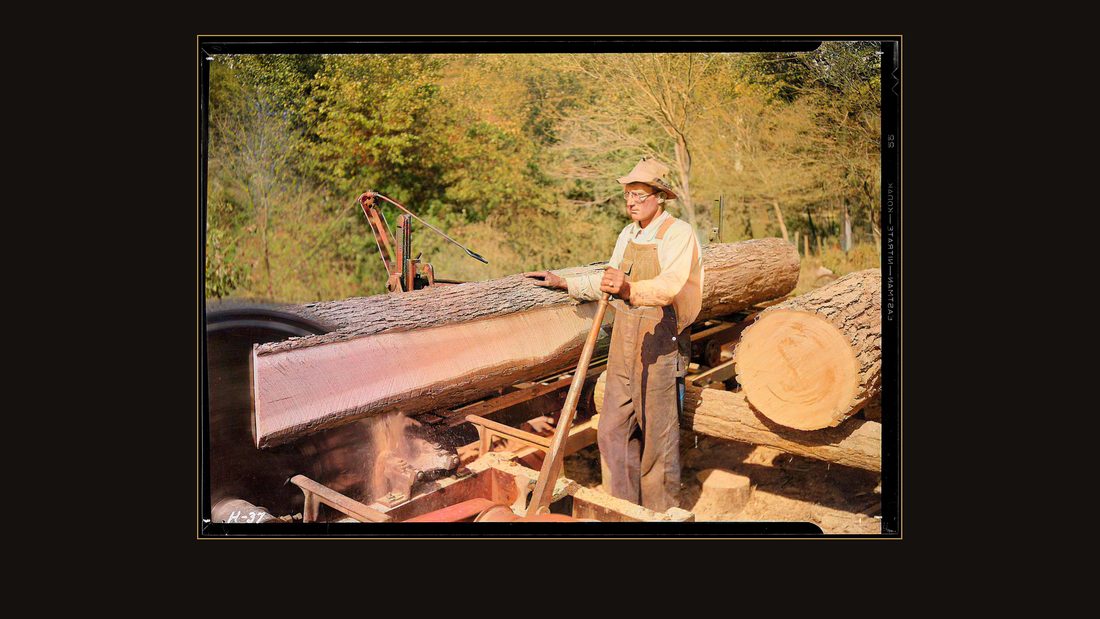
H046 "Curtis Stiner operating circular saw at the Norris Dam site."
Lewis W. Hine · Tennessee Valley Authority, Oct.-Nov. 1933 · National Archives, RG 142 · AI-colorized. View the original.
Negative thirty-seven. Curtis Stiner, operating a circular saw at the Norris Dam site. Same hat. Same wire glasses. Same man.
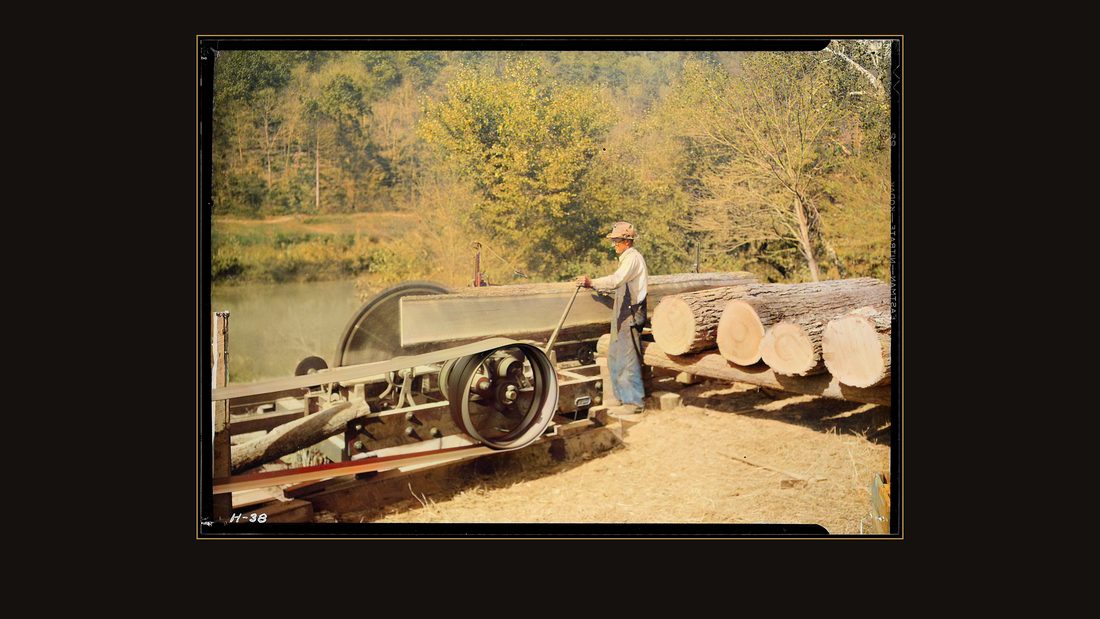
H047 "Another view of Curtis Stiner operating a circular saw at the Norris Dam site."
Lewis W. Hine · Tennessee Valley Authority, Oct.-Nov. 1933 · National Archives, RG 142 · AI-colorized. View the original.
Negative thirty-eight, the whole rig, on the bank of the Clinch. The dam that was going to take his home was also the only work in the county. He took it.
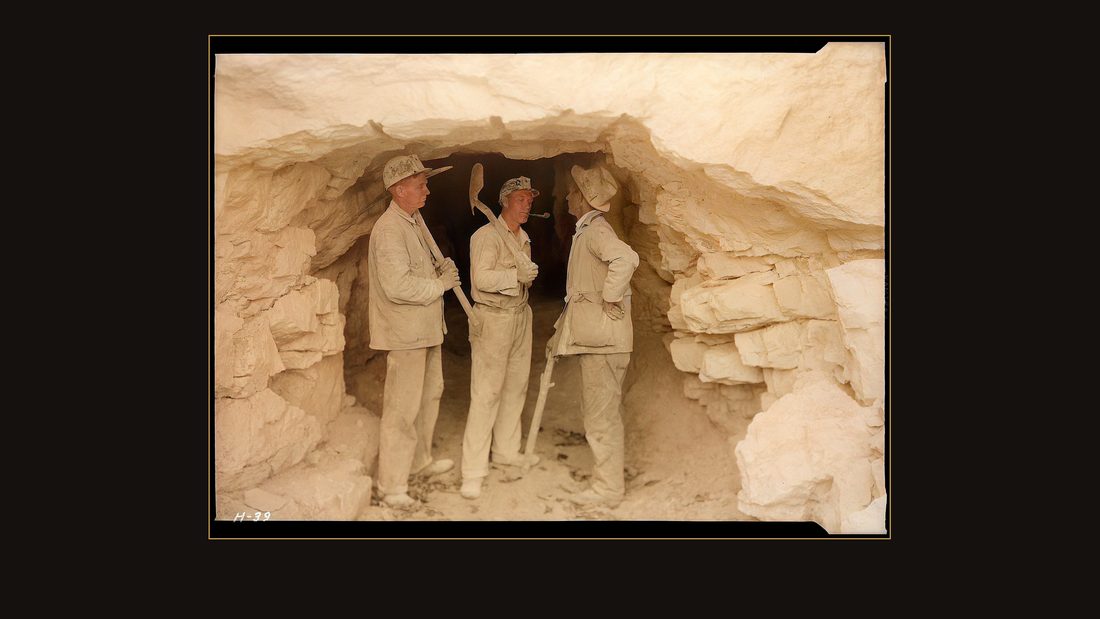
H050 "Foreman Clark and two of the shaftmen, Arthur Roberts and Sam Mynatt, at the mouth of the test tunnel at Norris Dam site."
Lewis W. Hine · Tennessee Valley Authority, Oct.-Nov. 1933 · National Archives, RG 142 · AI-colorized. View the original.
Most of the second half of this file is the same story. Foreman Clark and two shaftmen, at the mouth of the test tunnel.

H052 "Rock-driller and helper drilling in rock under water at Norris Dam site."
Lewis W. Hine · Tennessee Valley Authority, Oct.-Nov. 1933 · National Archives, RG 142 · AI-colorized. View the original.
A rock driller, working in the river itself. Drilling in rock under water.
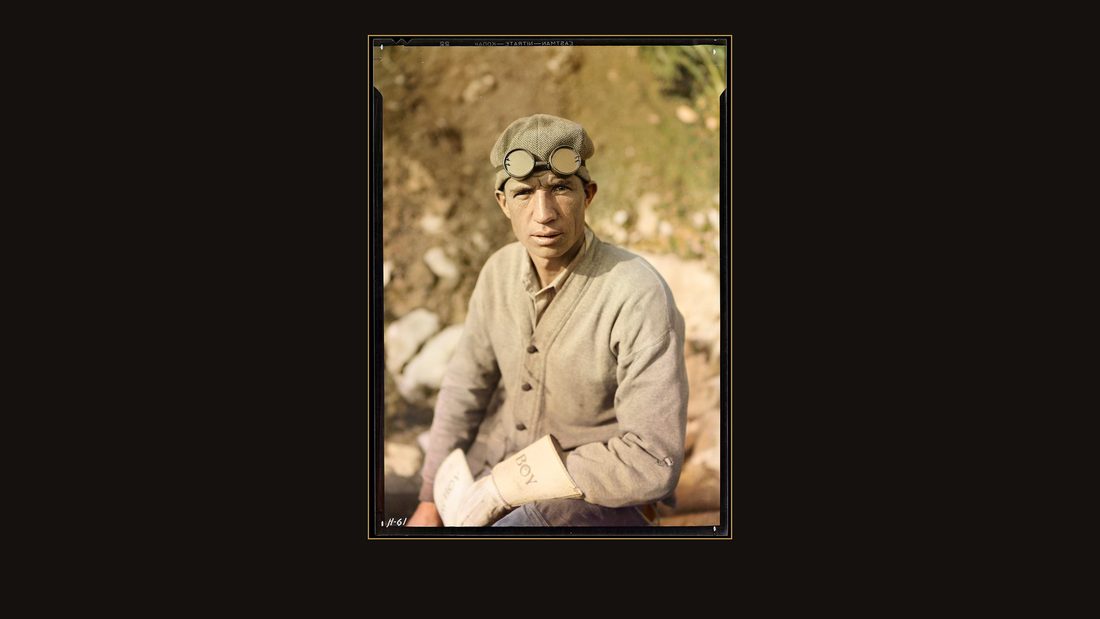
H053 "William L. Carden, of Anderson County, Tennessee, acetylene burner at Norris Dam site."
Lewis W. Hine · Tennessee Valley Authority, Oct.-Nov. 1933 · National Archives, RG 142 · AI-colorized. View the original.
William L. Carden, of Anderson County, acetylene burner. His helper that day was C. L. Hatmaker, of Campbell County.
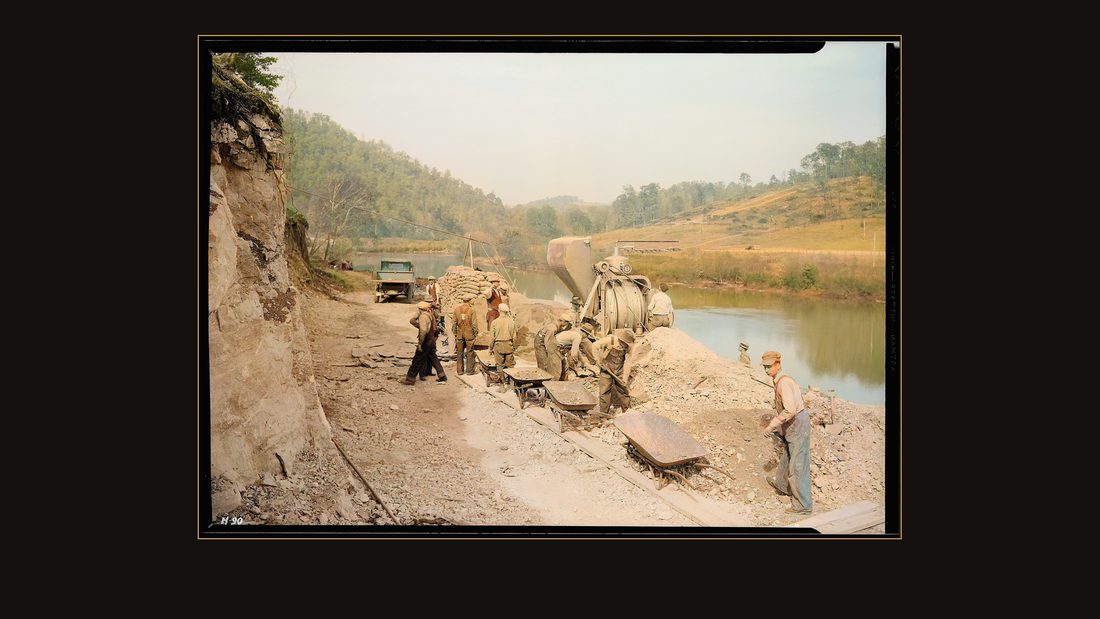
H056 "Pouring the first batch of concrete for Crib #1 on the heavy duty construction bridge at Norris Dam site, just below the Dam itself. R. S. Carter, foreman, Hershel Womack, assistant foreman, Eugene Greenwood, water boy, Ernest Rutledge, mix operator, Swan Sharp, Alvin Settles, Mynard Sharp, Blaine Oakes, Eschar Baird, Bryan Chadwell, Edward Hill, Hobart Truce, Claude Schaffner, John H. Glandon, Henry B. Comer, and Esco Rogers."
Lewis W. Hine · Tennessee Valley Authority, Oct.-Nov. 1933 · National Archives, RG 142 · AI-colorized. View the original.
On the first of November they poured the first concrete. Hine's caption for that frame lists seventeen men by name, down to the water boy.
I've just got to have a job
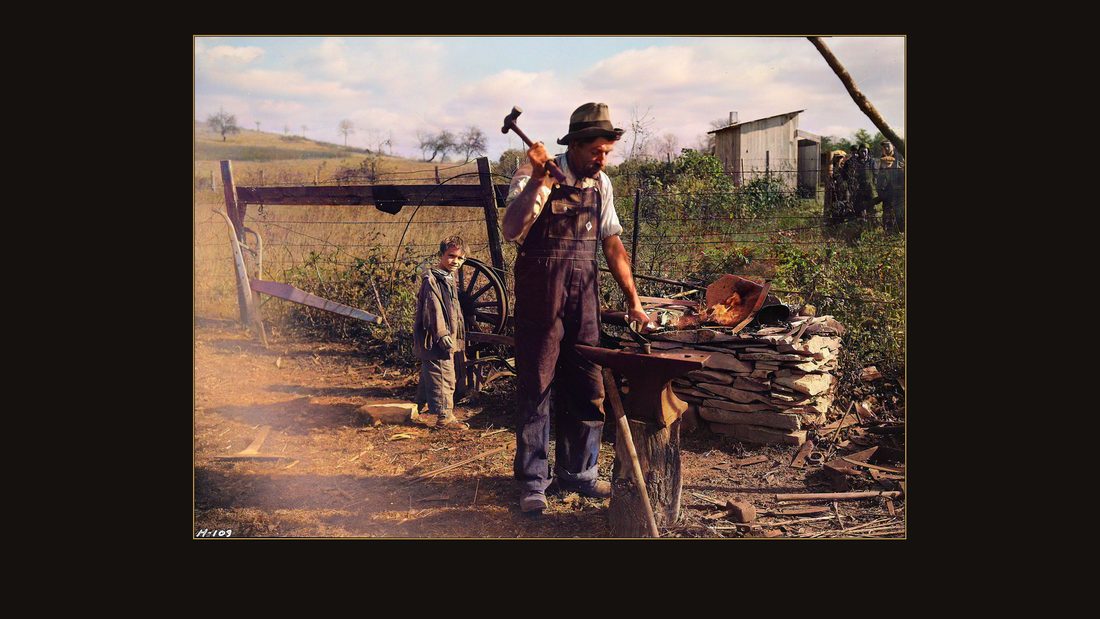
H059 "S. J. Barley, Rural Route #2, La Follette, Tennessee"
Lewis W. Hine · Tennessee Valley Authority, Oct.-Nov. 1933 · National Archives, RG 142 · AI-colorized. View the original.
S. J. Barley, Rural Route two, La Follette, at his outdoor forge.
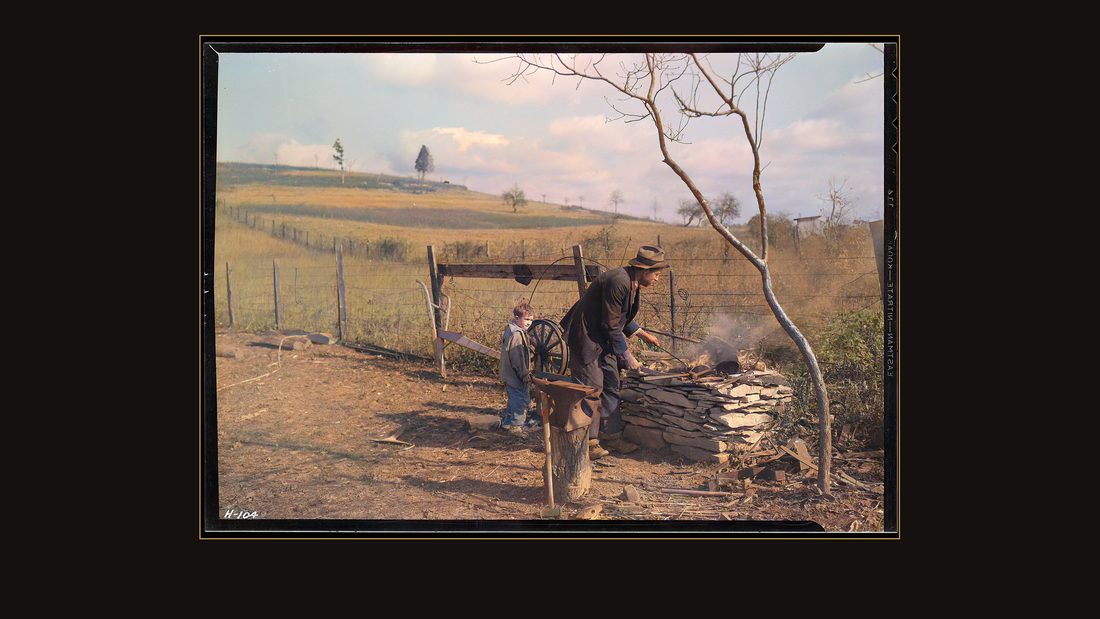
H060 "Another view of S. J. Barley, Rural Route #2, LaFollette, Tennessee, at his outdoor forge. Barley says: `I've just got to have a job. First I'm a blacksmith, next I'm a carpenter, or I'll do anything.'"
Lewis W. Hine · Tennessee Valley Authority, Oct.-Nov. 1933 · National Archives, RG 142 · AI-colorized. View the original.
Hine wrote down what Barley told him. "I've just got to have a job. First I'm a blacksmith, next I'm a carpenter, or I'll do anything."
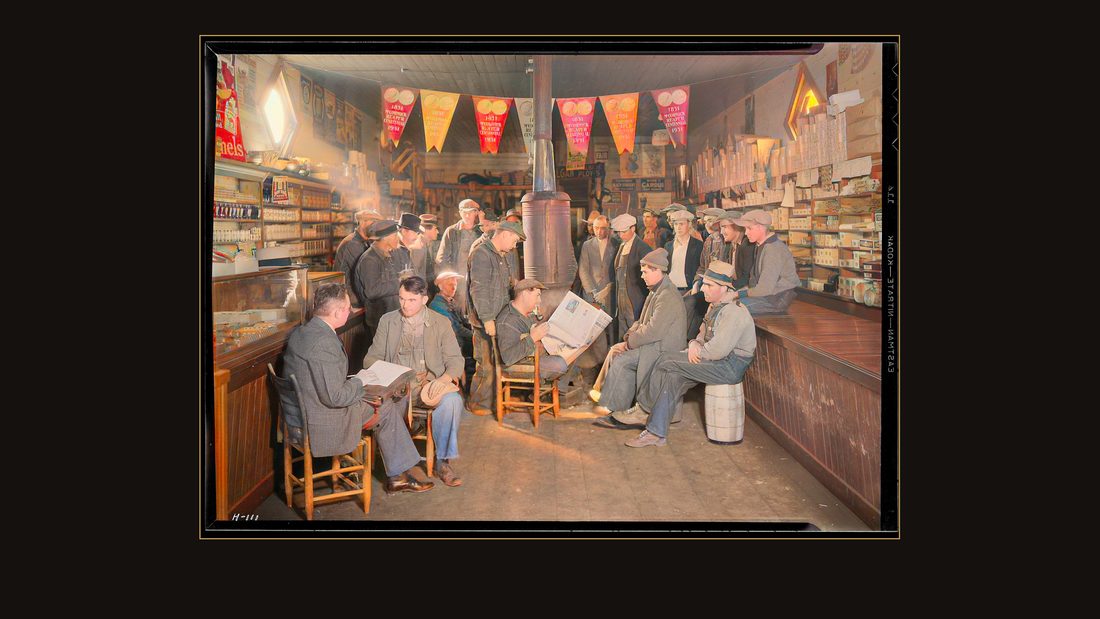
H062 "E. H. Elam, interviewer, making personal interviews at Stiner's Store, Lead Mine Bend, Tennessee. This shows how selections for employment with the TVA are made on the basis of ability and efficiency." Interviewee Manna "Mannie" Dyke.
Lewis W. Hine · Tennessee Valley Authority, Oct.-Nov. 1933 · National Archives, RG 142 · AI-colorized. View the original.
The Authority came to them. This is the store at Lead Mine Bend, kept by the same family whose fifteen hundred acres were going under.
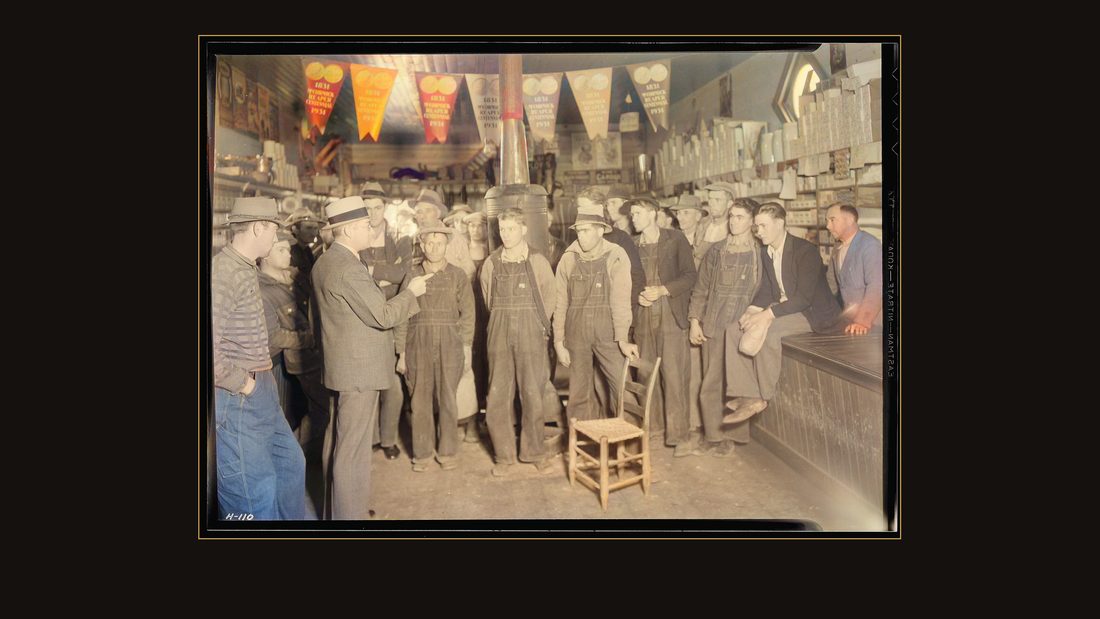
H061 "E. H. Elam, interviewer from the Personnel Division, TVA, conferring with residents of the neighborhood at Stiner's store, Lead Mine Bend, Union County, Tennessee, and explaining the methods of employment used by the TVA."
Lewis W. Hine · Tennessee Valley Authority, Oct.-Nov. 1933 · National Archives, RG 142 · AI-colorized. View the original.
The man in the hat is E. H. Elam, an interviewer from the TVA Personnel Division, explaining the methods of employment used by the Authority.
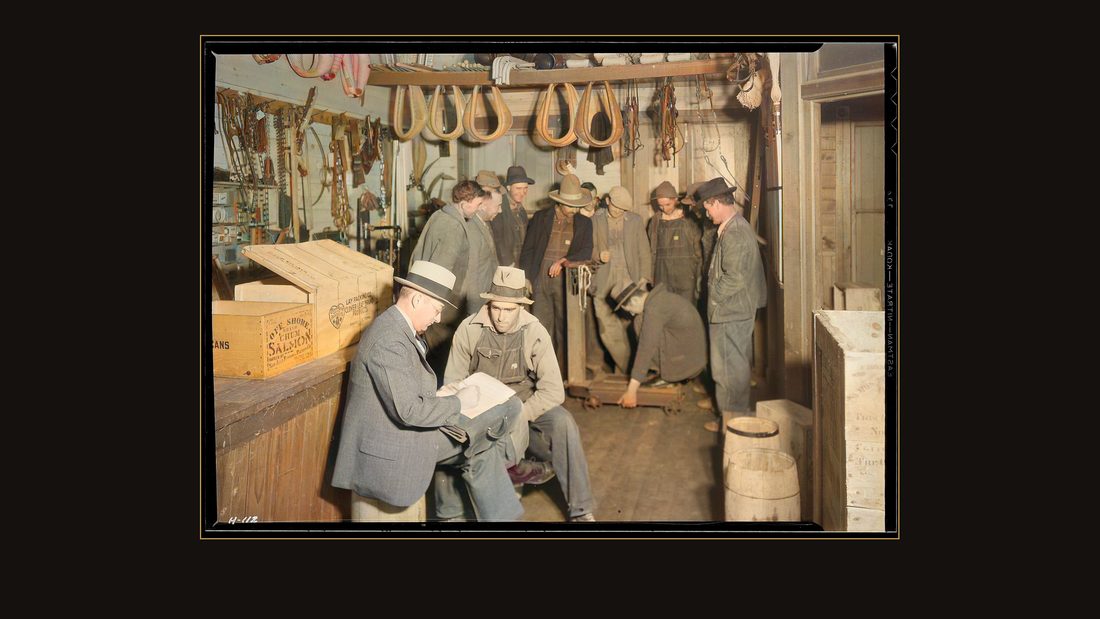
H063 "E. H. Elam, interviewer for the TVA, making personal interviews at Stiner's Store, Lead Mine Bend, Tennessee, with applicants for work on Norris Dam. The group in the background are seeing who can pull up the most weight on the scales."
Lewis W. Hine · Tennessee Valley Authority, Oct.-Nov. 1933 · National Archives, RG 142 · AI-colorized. View the original.
Another frame from the same afternoon. Look at the group in the background. Hine explains them. They are seeing who can pull up the most weight on the scales.
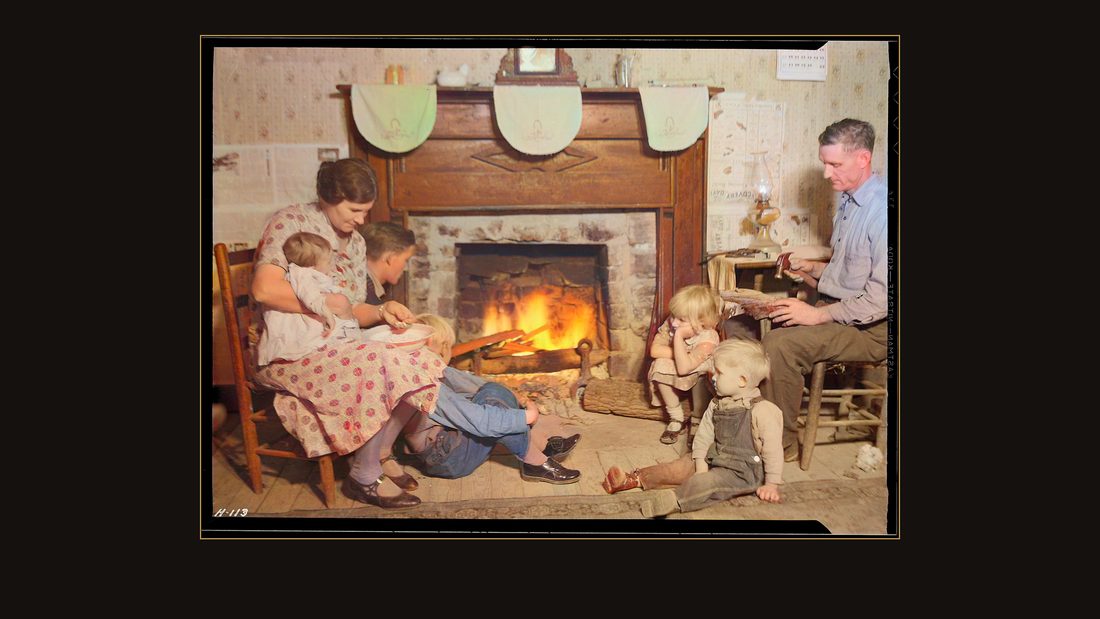
H064 "Family group of Fletcher Carden, Route #1, Andersonville, Tennessee, a night-watchman at the bunkhouses at Norris Dam. His home is on the townsite of Norris and will be moved. Carden has 12 children. He is shown here repairing shoes at the fireside."
Lewis W. Hine · Tennessee Valley Authority, Oct.-Nov. 1933 · National Archives, RG 142 · AI-colorized. View the original.
Fletcher Carden, night watchman at the bunkhouses. His home stands on the site of the new town at Norris, and will be moved. He has twelve children.

H066 "Applicants for skilled and unskilled laboring positions with the TVA being examined at High School building, Clinton, Tennessee. Mr. McDade, of TVA Division of Personnel, in charge."
Lewis W. Hine · Tennessee Valley Authority, Oct.-Nov. 1933 · National Archives, RG 142 · AI-colorized. View the original.
On the twenty-fifth of November, at the high school in Clinton, they sat the examination for skilled and unskilled labor.

H067 "A view of a group of applicants at the High School building, Clinton, Tennessee, ready to take the examination for skilled and unskilled laborers on TVA projects."
Lewis W. Hine · Tennessee Valley Authority, Oct.-Nov. 1933 · National Archives, RG 142 · AI-colorized. View the original.
Grown men in overcoats, at school desks, waiting to be tested.

H068 "Close-up of an applicant for employment with the TVA taking the examination for skilled and unskilled labor at the high school building, Clinton, Tennessee."
Lewis W. Hine · Tennessee Valley Authority, Oct.-Nov. 1933 · National Archives, RG 142 · AI-colorized. View the original.
This is the last negative Hine exposed on the assignment. One applicant, writing.
What a farmer was turning into

H069 "Gaines McGlothin, R. F. D. #2, Kingsport, Tennessee. McGlothin is here shown cutting index tabs in the process of indexing a book. This is a medium-skilled operation, requiring accuracy and care. Too deep or too shallow a cut would spoil a book. Due to small overrun normally with any order, excessive spoilage means increased costs. This man has been with the Kingsport Press two years, and on this particular operation for the past month."
Lewis W. Hine · Tennessee Valley Authority, Oct.-Nov. 1933 · National Archives, RG 142 · AI-colorized. View the original.
In the middle of all this he spent four days on something that looks unrelated. A hand at a book bindery up the valley, cutting index tabs. Hine writes down his name, his rural route, and his acreage.
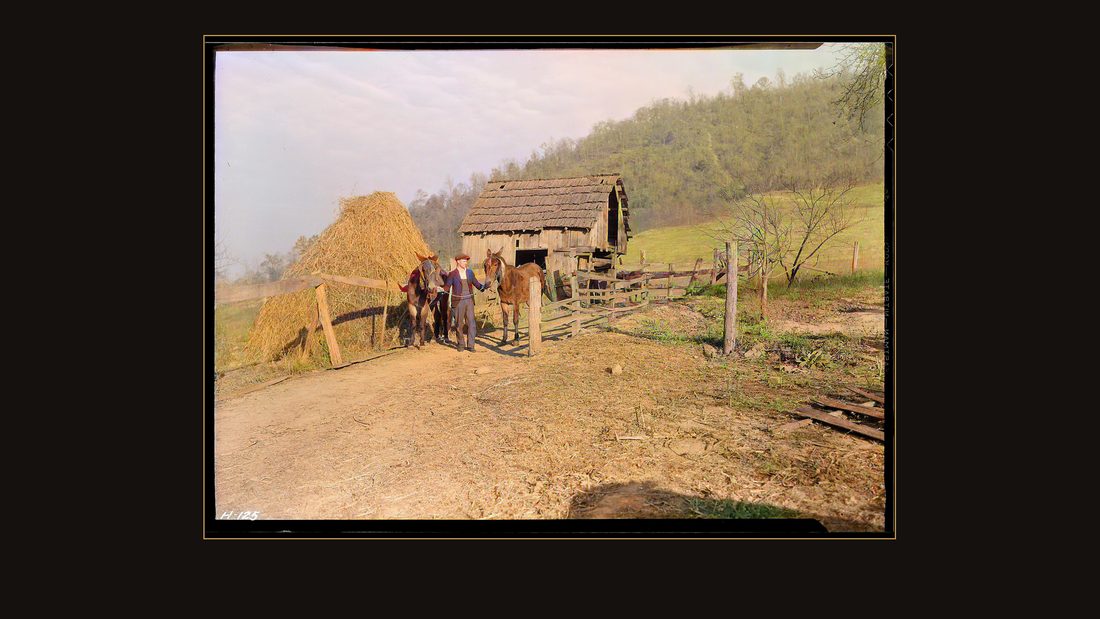
H070 "Gaines McGlothin on his farm, R. F. D. #2, Kingsport, Tenn. Like many of the Kingsport Press workers, McGlothin is a farmer as well as an industrial worker. Originally from Honaker, Virginia, he now lives with his mother and two brothers on a farm three miles from the plant."
Lewis W. Hine · Tennessee Valley Authority, Oct.-Nov. 1933 · National Archives, RG 142 · AI-colorized. View the original.
Then Hine drove three miles out of town and photographed him again, on his own farm.

H076 "Walter Hensley, head kiln fireman at Southern Potteries, Elroy, Tennessee. Hensley came to the Potteries from a mountain farm."
Lewis W. Hine · Tennessee Valley Authority, Oct.-Nov. 1933 · National Archives, RG 142 · AI-colorized. View the original.
Walter Hensley, head kiln fireman at the potteries at Elroy. He came to the potteries from a mountain farm.
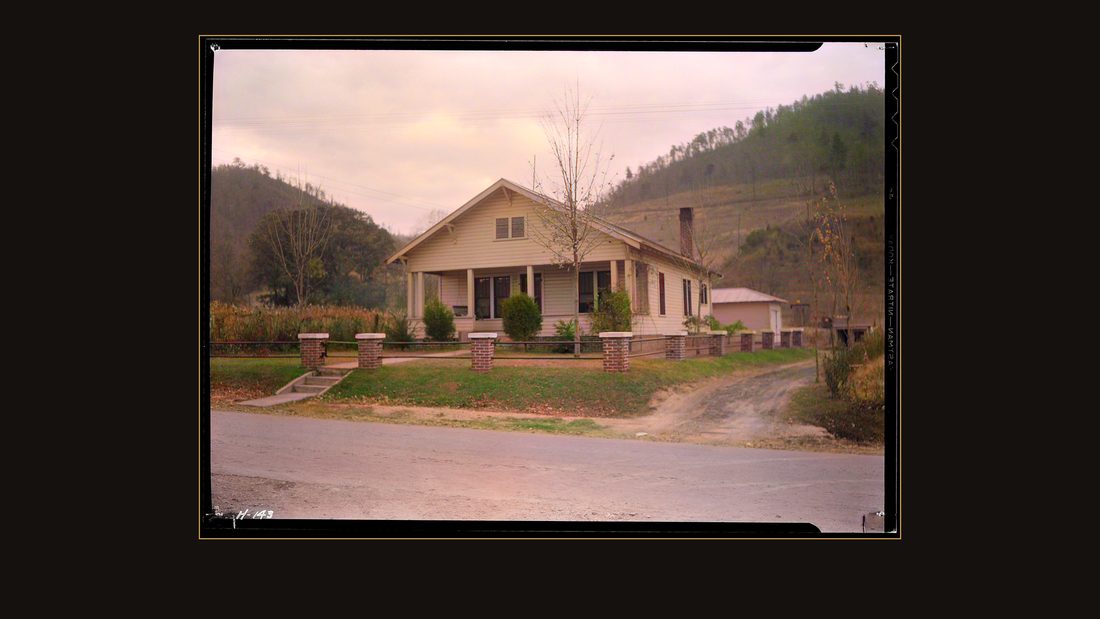
H077 "The home of one of the workmen employed by the Southern Potteries, Elroy, Tennessee."
Lewis W. Hine · Tennessee Valley Authority, Oct.-Nov. 1933 · National Archives, RG 142 · AI-colorized. View the original.
And this is where a pottery hand lived. Compare it to the cabins.
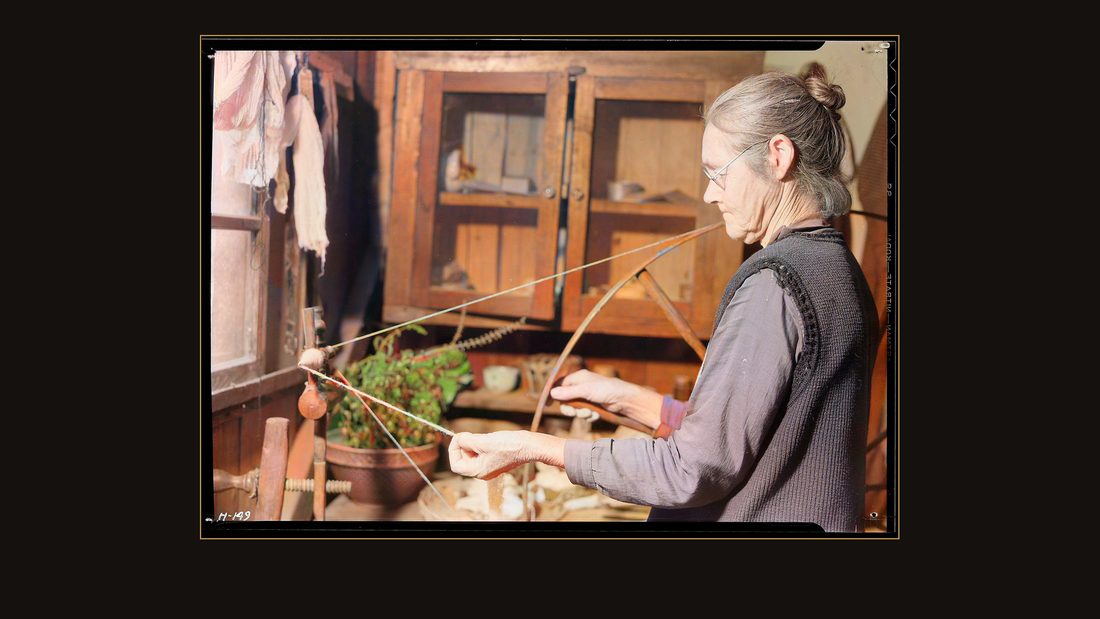
H079 "Mrs. James Watson in her mountain cabin near Gatlinburg, Tennessee. (P.O. Sevierville-Star Route). Mrs. Watson is 65 years old and spins wool yarn for the weavers at the Pi Beta Phi School in Gatlinburg. She is shown here operating the old-style spinning wheel."
Lewis W. Hine · Tennessee Valley Authority, Oct.-Nov. 1933 · National Archives, RG 142 · AI-colorized. View the original.
Missus James Watson, sixty-five, in her cabin near Gatlinburg. She spins wool yarn for the weavers at the settlement school, and is paid for it.
Boys off the train
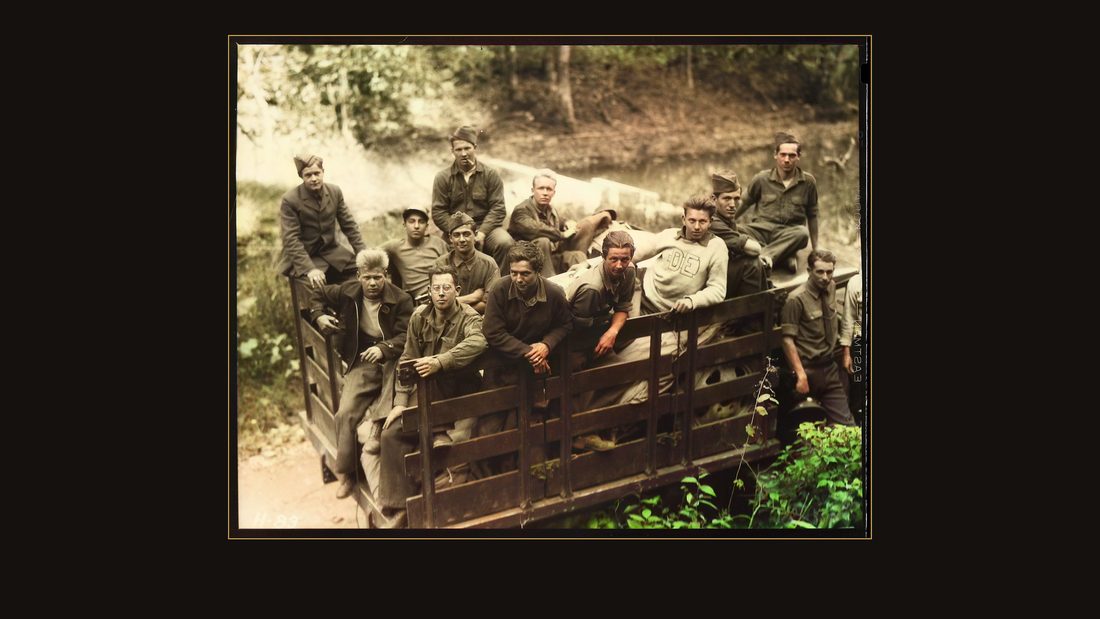
H080 "Group of CCC boys from Idaho just arrived in camp near Andersonville, Tennessee. The CCC units are to assist in the reforestation work on the Clinch River watershed above the Dam."
Lewis W. Hine · Tennessee Valley Authority, Oct.-Nov. 1933 · National Archives, RG 142 · AI-colorized. View the original.
Something else was arriving that autumn. Civilian Conservation Corps boys, sent to replant the watershed above the dam.
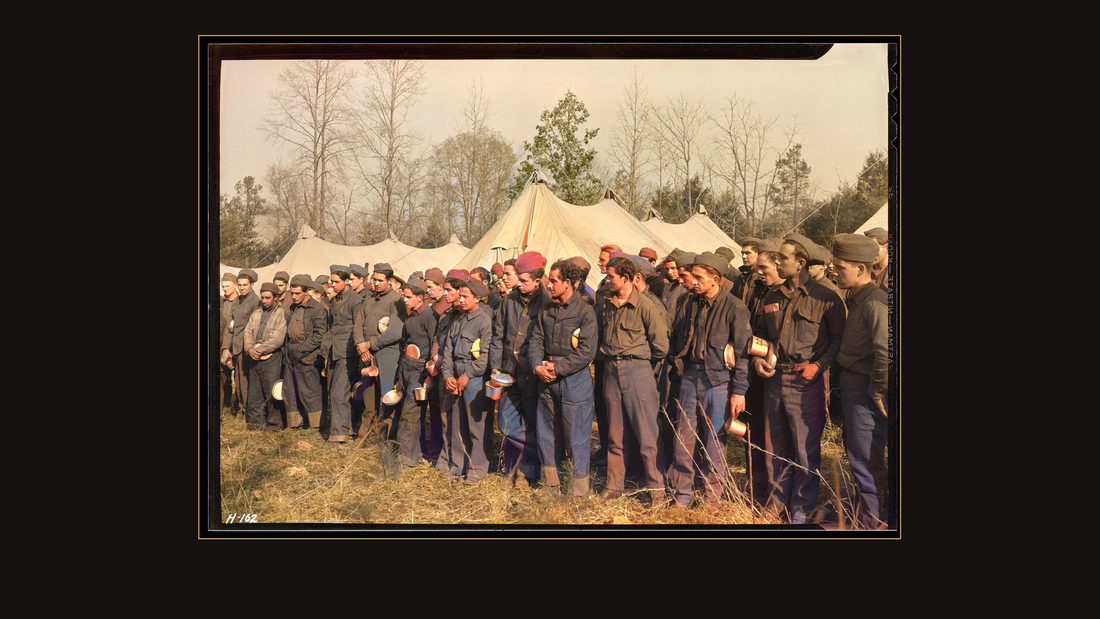
H082 "Newly-arrived replacements at CCC Camp, TVA #22, near Esco, Tennessee, lined up before their first meal in camp. The boys arrived at New Tazewell on November 17, 1933, in day coaches form New York, tired and hungry, but eager for their new life. For many of these boys, this was their first time away from home."
Lewis W. Hine · Tennessee Valley Authority, Oct.-Nov. 1933 · National Archives, RG 142 · AI-colorized. View the original.
These reached New Tazewell on the seventeenth of November, in day coaches from New York. Tired and hungry, Hine wrote, but eager for their new life.
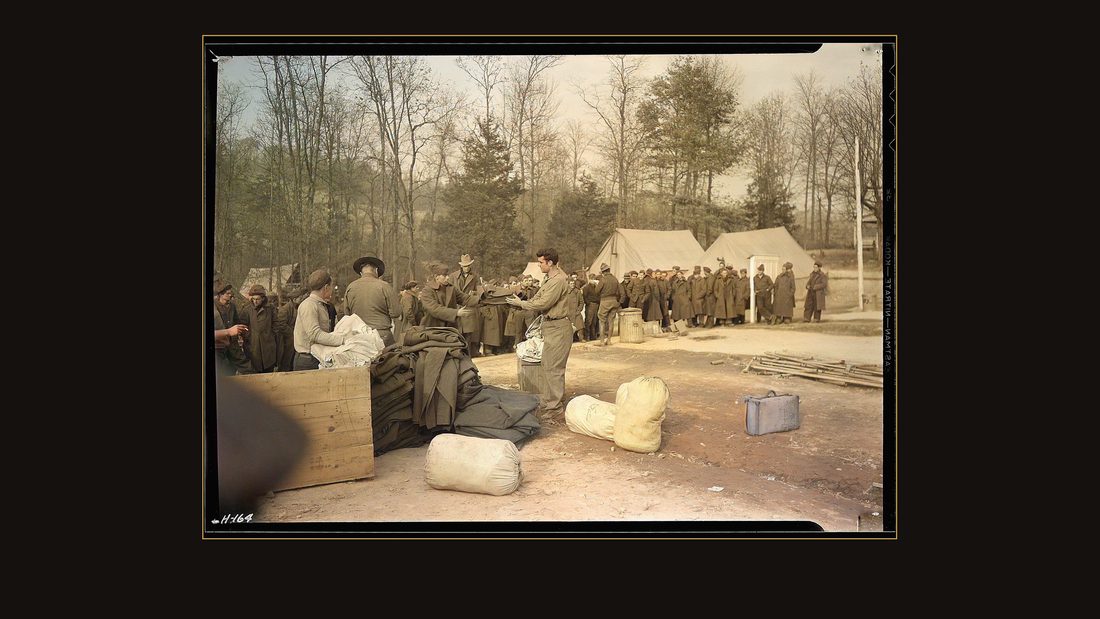
H083 "Issuing cots and blankets to new replacements just arrived from New York at CCC Camp, TVA #23, located just north of the Clinch River between Walker's Ford and Lone Mountain, Tennessee. These boys will be part of the force working on reforestation and erosion retardation in the Clinch River watershed above Norris Dam."
Lewis W. Hine · Tennessee Valley Authority, Oct.-Nov. 1933 · National Archives, RG 142 · AI-colorized. View the original.
For many of these boys, the caption adds, this was their first time away from home.
The town they built instead
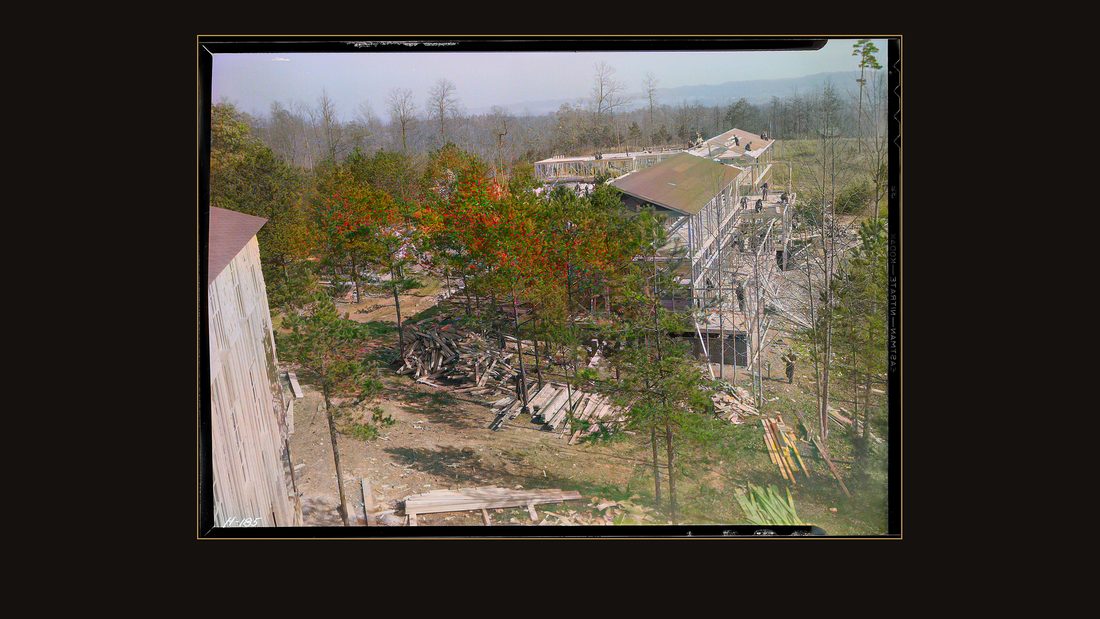
H085 "View of engineers' building and girls' dormitory at Norris townsite. This picture was taken from the roof of one of the men's dormitories."
Lewis W. Hine · Tennessee Valley Authority, Oct.-Nov. 1933 · National Archives, RG 142 · AI-colorized. View the original.
Downstream from Loyston, the government was building a town.
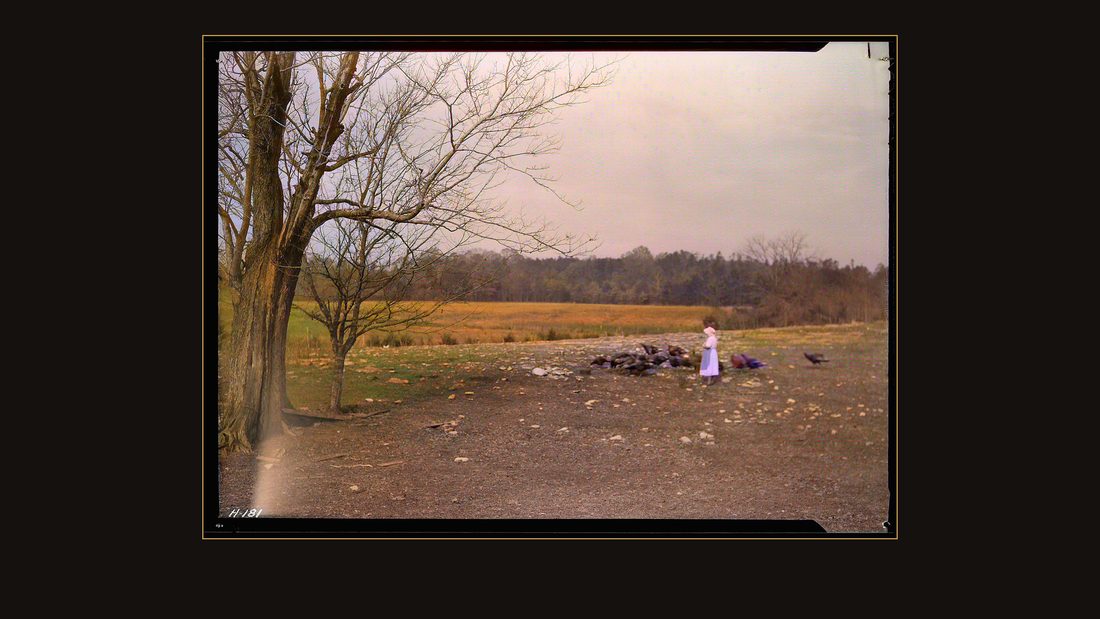
H089 "Mrs. Wallace feeding turkeys on one of the small farms purchased by the TVA for experimental purposes."
Lewis W. Hine · Tennessee Valley Authority, Oct.-Nov. 1933 · National Archives, RG 142 · AI-colorized. View the original.
On farmland it had just bought, the Authority was starting a poultry demonstration center. The woman feeding its turkeys is named only as Missus Wallace.
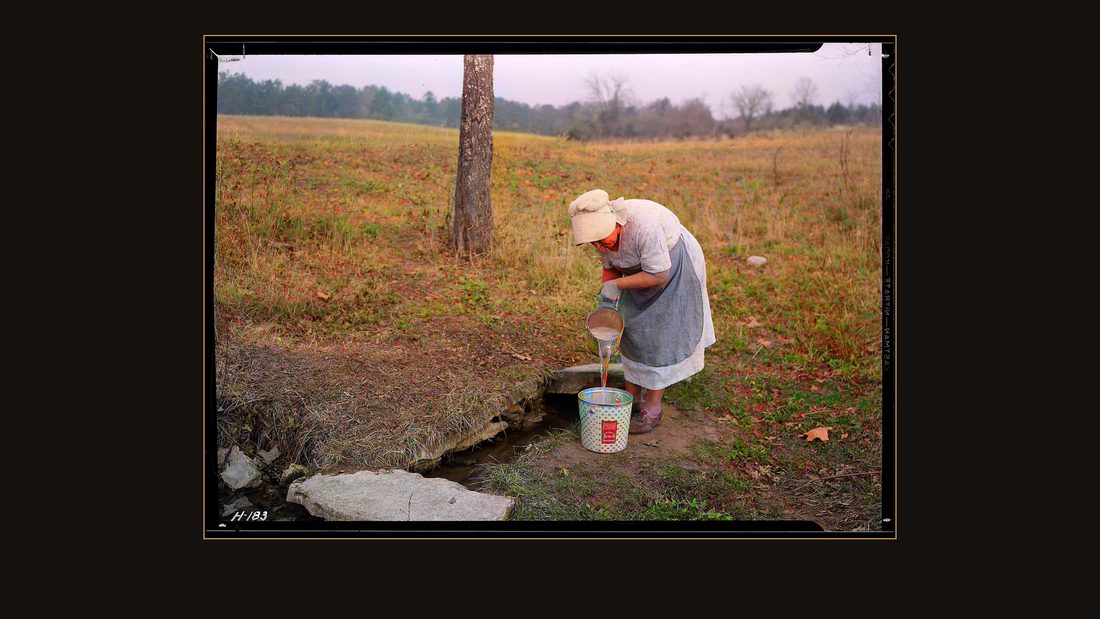
H090 "Mrs. Wallace dipping water from spring on farm near Norris townsite recently purchased by the TVA for experimental purposes. This spring has been in use for 30 years."
Lewis W. Hine · Tennessee Valley Authority, Oct.-Nov. 1933 · National Archives, RG 142 · AI-colorized. View the original.
Hine photographed her once more, at the spring. The caption ends: this spring has been in use for thirty years.
The accounting
Then he went home, and the counting started. In the summer of nineteen thirty-four the Authority interviewed nearly three thousand families who had to move.
The final number, in the report. Two thousand eight hundred and ninety-nine families on the land it bought. Most of them, it says, had lived in the same place for generations.
Some of the difficulties were unusual. One owner asked the Authority to agree that his pet frog could stay in a spring, where it had lived since its tadpole days.
Some of the largest landowners felt they were being forced out for a new civilization in which they had little interest. A few considered starting a colony in Brazil.
Forty-one percent were tenants, who got no payment for land, because they owned none. A hundred and forty thousand acres went out of cultivation.
Here is the number that carries the whole thing. Moving a household cost the median family about fifty dollars.
The report notes, in the same sentence, that the reputed per capita annual spendable income for this area in nineteen thirty-five was but ninety dollars.
Almost nobody had to be forced. Five families out of the whole two thousand eight hundred and ninety-nine were put out by court order. By nineteen thirty-eight they had all gone.
The report prints a chart of who was meant to help them, sorted into five boxes. Farmers with resources. Farmers without. Industrial families with resources, and without. And sub-marginal families.
It illustrates the houses it was buying with two photographs. Figure two thirty-nine: representative of the better houses. Figure two forty: the poorer houses.
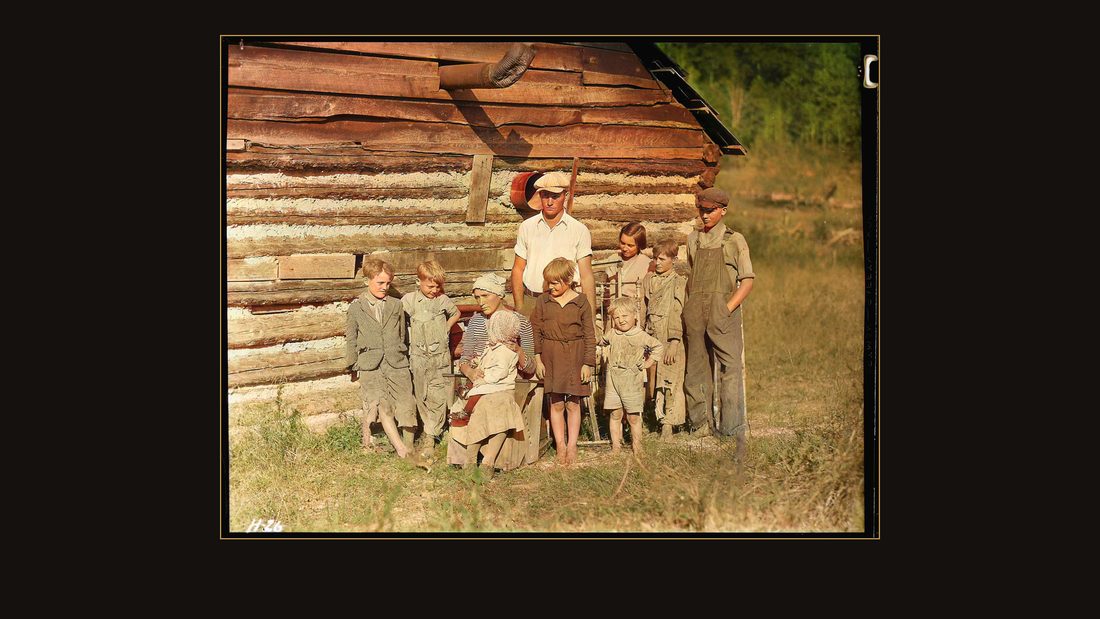
H025 "Part of the family of Hugh Noe, a renter on a farm near Andersonville, Tennessee."
Lewis W. Hine · Tennessee Valley Authority, Oct.-Nov. 1933 · National Archives, RG 142 · AI-colorized. View the original.
Hine had photographed houses like those with the people standing in front of them, and written down their names.
Twenty dollars a grave
There was one more thing in that valley that had to be moved.
The survey crews mapped three hundred and twenty-six cemeteries holding twelve thousand and five graves.
Most were unmarked. Many dated from before eighteen hundred. The people of the valley, the report says, maintained an unusual reverence for these graves, even the unmarked ones.
The nearest of kin were offered three choices, in writing. One. An undertaker of their own choosing would move the grave, and the Authority would pay him twenty dollars.
Two. The Authority would move the remains itself. Three. The grave would be allowed to remain as it was, and be inundated.
Of the contracts signed, three hundred and forty-one chose a private undertaker. Four thousand eight hundred and eighty-five let the Authority do it.
Twenty-two families chose the third one, and left their dead where they were.
Five new memorial cemeteries took four thousand three hundred and eighty-nine of the reinterments. The work, the report records, was conducted to the general satisfaction of all concerned, and entirely free from litigation.
The one he didn't name
H021 "A little country church, Sharps Station M.E. Church, near Loyston, Tennessee. Congregation leaving at close of the service. This church will be submerged by the waters of the Norris Dam reservoir."
Lewis W. Hine · Tennessee Valley Authority, Oct.-Nov. 1933 · National Archives, RG 142 · AI-colorized. View the original.
Norris Lake began filling on the fourth of March, nineteen thirty-six, when they closed the gates.
H015 "The Stooksberry homestead near Andersonville, Tennessee. This land will be submerged by the Norris Dam Reservoir."
Lewis W. Hine · Tennessee Valley Authority, Oct.-Nov. 1933 · National Archives, RG 142 · AI-colorized. View the original.
Loyston is under it. Sharps Station is under it. So is Oakdale School. So is the Nicely water mill. So is the Stooksberry place, with its sorghum kettles.
H001 "Curtis Stiner, an example of the mountain farmer of East Tennessee. `I love my mountains, and I want to stay right here the rest of my life if I can.' The flooding of the reservoir area will take his home."
Lewis W. Hine · Tennessee Valley Authority, Oct.-Nov. 1933 · National Archives, RG 142 · AI-colorized. View the original.
What is not under it is the file. One hundred and ninety negatives, in the National Archives, free to anyone who wants them.
H033 "Esco Glandon, a renter at Bridges Chapel near Loyston, Tennessee. He rebuilt the cabin in which his family lives. Glandon has lived all his life in this region except for 3 years in a glass works in Kokomo, Indiana."
Lewis W. Hine · Tennessee Valley Authority, Oct.-Nov. 1933 · National Archives, RG 142 · AI-colorized. View the original.
Because Lewis Hine wrote the captions himself, almost nobody in it is anonymous. Curtis Stiner. Esco Glandon. Harriet Hankins. Fletcher Carden and his twelve children.
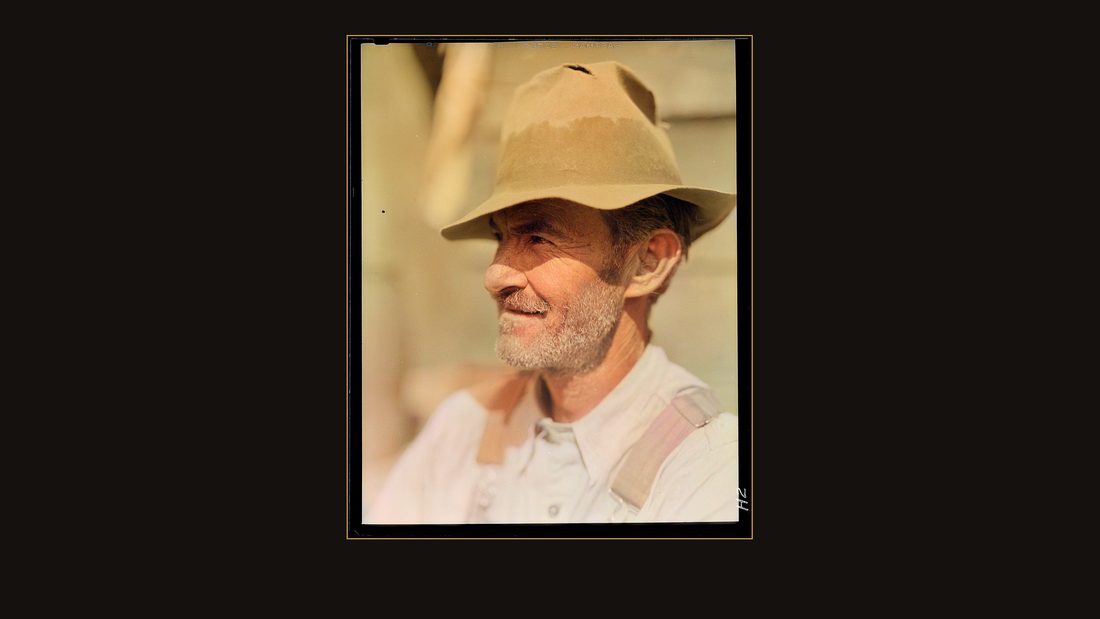
H091 No Caption. Portrait of a man.
Lewis W. Hine · Tennessee Valley Authority, Oct.-Nov. 1933 · National Archives, RG 142 · AI-colorized. View the original.
There is one exception. Negative number two. The whole caption reads: "No Caption. Portrait of a man."
He is the only person in this file the government photographed and did not write down. If you know who he is, the comments are open.
Sources
- Lewis W. Hine, photographs for the Tennessee Valley Authority, 1933. National Archives, Record Group 142 (Records of the Tennessee Valley Authority), series "Lewis Hine Photographs for the Tennessee Valley Authority (TVA), compiled 1933–1933." Local identifiers 142-H-1 through 142-H-197; 190 frames survive in the digitized series. Federal works, public domain. Digitized copies via Wikimedia Commons: https://commons.wikimedia.org/wiki/Category:US_National_Archives_series:_Lewis_Hine_Photographs_for_the_Tennessee_Valley_Authority_(TVA),_compiled_1933_-_1933
- Every caption quoted on screen is Hine's own, taken from the untruncated NARA title on each item's Commons file page (the Commons *filename* truncates long captions with an ellipsis; the wikitext does not). Individual records: catalog.archives.gov/id/532625 through 532814.
- Dates run 20 October to 25 November 1933. Frames used here, in episode order, are listed in `research/hine-norris/picks.py`.
- The Norris Project. Tennessee Valley Authority, Technical Report No. 1. Washington: Government Printing Office, 1940. A federal document, public domain. Scan: archive.org item `in.ernet.dli.2015.206087`. https://archive.org/details/in.ernet.dli.2015.206087
- HathiTrust holds the TVA annual reports but `babel.hathitrust.org` is behind a Cloudflare challenge that 403s every command-line client; the Norris report on archive.org covers the same ground with a downloadable scan.
- The other archive.org copy of this report (`norrisproject0000unit`) is a lending-only item and its files are not retrievable.