Why Every Bridge in America Is Inspected Every Two Years
The film of this episode premieres August 13, 2026 on YouTube. The documents, the transcript and the sources are below now.
At about five in the evening on December 15, 1967 — two weeks before Christmas — the U.S. 35 highway bridge between Point Pleasant, West Virginia and Kanauga, Ohio went into the river. Forty-six people died. Thirty-one of the thirty-seven vehicles on the bridge went down with it. The whole structure was gone in about a minute.
Transcript
Five o'clock
M01
NBS Report 9981 - fig. 1, eyebar 330. View the original.
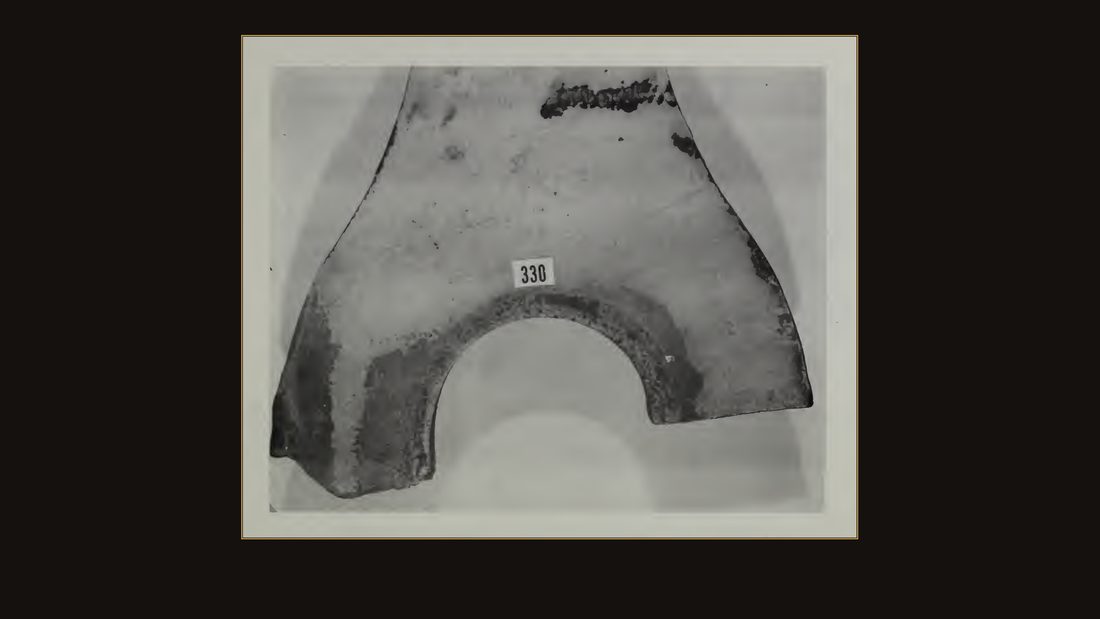
This is a broken piece of steel, photographed on a laboratory bench at the National Bureau of Standards.
Three-thirty was this bar's number on the bridge. The curve at the bottom is a hole, and a pin went through it.
M02
NBS Report 9981 - fig. 2, eyebar 330. View the original.
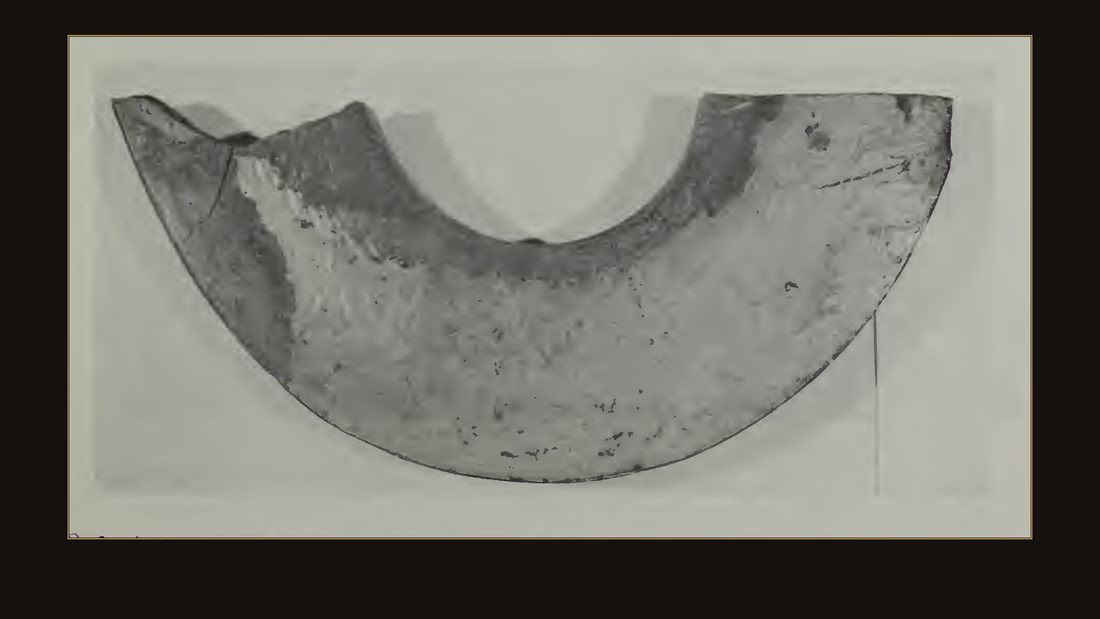
This is the other half of the same hole.
M01
NBS Report 9981 - fig. 1, eyebar 330. View the original.
Forty-six people died when it came apart.
This is the cover of the report that says so. It carries two dates.
December fifteenth, nineteen sixty-seven. And the day the government finished explaining it.
Three years and one day apart.
The bridge carried U.S. 35 across the Ohio River, from Point Pleasant, West Virginia, to Kanauga, Ohio. It had stood since nineteen twenty-eight.
At about five in the evening, two weeks before Christmas, it went into the river.
Forty-six people died. Nine were hurt.
Thirty-one of the thirty-seven vehicles on the bridge went down with it. Twenty-four into the water. Seven onto the Ohio bank.
The whole structure — a seven-hundred-foot center span, two three-hundred-and-eighty-foot side spans, and both towers — was gone in about a minute.
This is the story of what the government did next, and it is almost entirely a paper story.
Possible causes of failure
An interim report in October nineteen sixty-eight. A public hearing in Charleston that May. And then two more years of laboratory work.
They pulled the bridge out of the river and put it back together on the bank, member by member, and drew every piece of it.
Early on, the investigators drew a chart.
They titled it "Possible Causes of Failure." Every branch is a thing the bridge might have died of.
Read the top row. Substructure. Overstress. Wind excitation. External event.
And under external event, in a government flow chart, printed for the record: sabotage, vehicle collision, sonic boom.
Point Pleasant had heard a noise. People said it sounded like a sonic boom.
So the Safety Board checked with nearby military installations. No aircraft likely to produce such effects were operating in the vicinity.
Then they did the arithmetic. The bridge chains were built to carry fourteen hundred pounds per foot at deck level — a heavier loading than most roofs are designed for.
A pressure wave big enough to drop that bridge would have taken the windows out of the town. Nobody in Point Pleasant reported so much as minor damage.
The report says the search for evidence of that cause was, therefore, abandoned.
That is what the boxes on the chart are for. One by one, they get crossed off.
The towers went first. Then pier movement. Then wind. Then the trusses, the hangers, the gusset plates.
The last row is a list of mechanisms, and every one of them works out of sight: hydrogen embrittlement, stress corrosion, corrosion fatigue, fretting.
Eyebar 330
What is left at the bottom of the page is a single chain of boxes, and it narrows.
Eyebar chain. Ohio side span. Joint C-thirteen north.
A suspension bridge usually hangs from spun wire cable. This one didn't.
It hung from a chain of flat steel bars, each with a hole punched at either end, pinned together like a bicycle chain scaled up to carry a highway.
The report's own caption for this drawing ends: "This plate shows makeup of joint C-thirteen north."
They drew the joint that failed before they knew it had.
And there is one more design detail, which the Board lists among the contributing causes.
There were only two eyebars per link. Two. Which made the total failure of the chain inevitable once one of them broke.
Had there been three or more, the report says, there would have been the possibility that the failure of one bar would not have led to disaster.
An eighth of an inch
The bar that broke was numbered three-thirty. You saw it at the start.
M02
NBS Report 9981 - fig. 2, eyebar 330. View the original.
Forty years in the weather over the Ohio River, holding up a highway.
The work was done for the Bureau of Public Roads by a metallurgist at the Bureau of Standards named John Bennett.
M03
NBS Report 9981 - fig. 3. View the original.
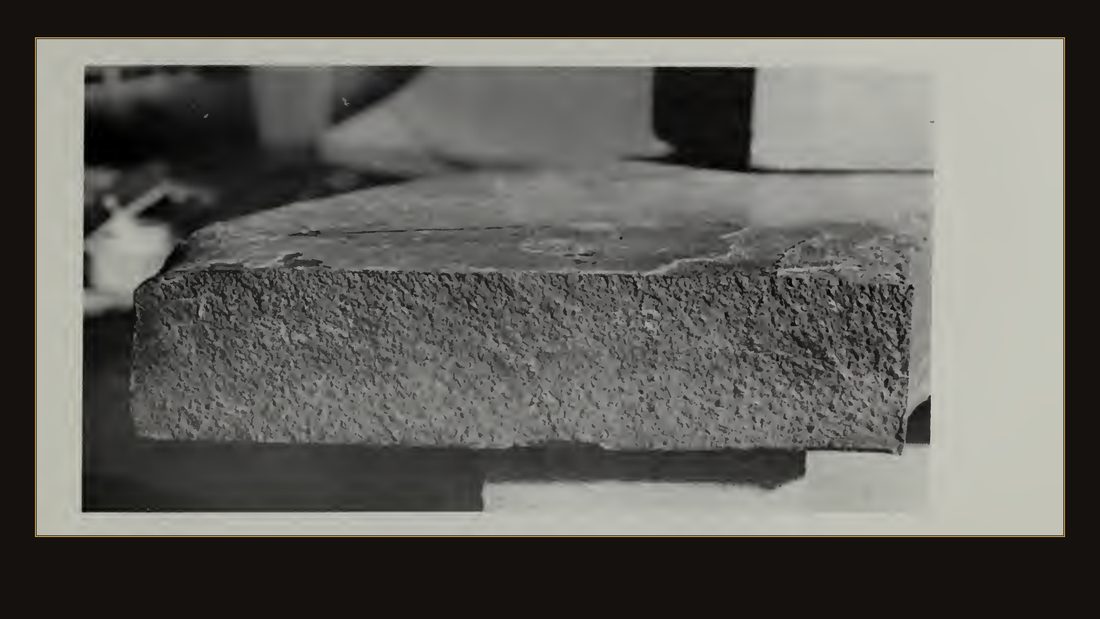
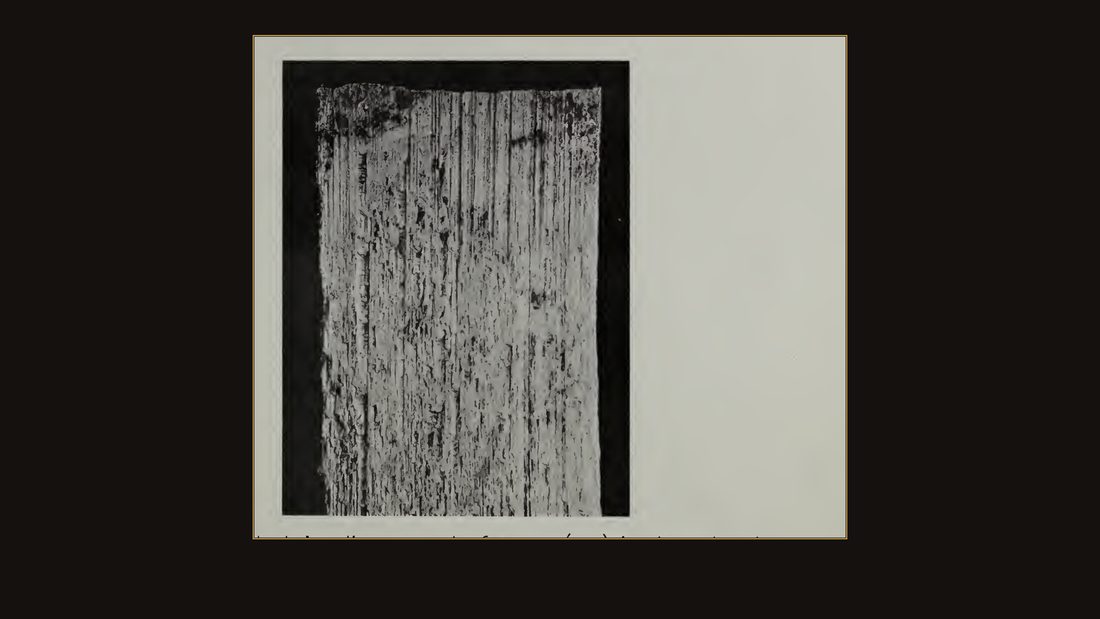
He photographed the fracture before he cleaned it.
M05
NBS Report 9981 - fig. 5. View the original.
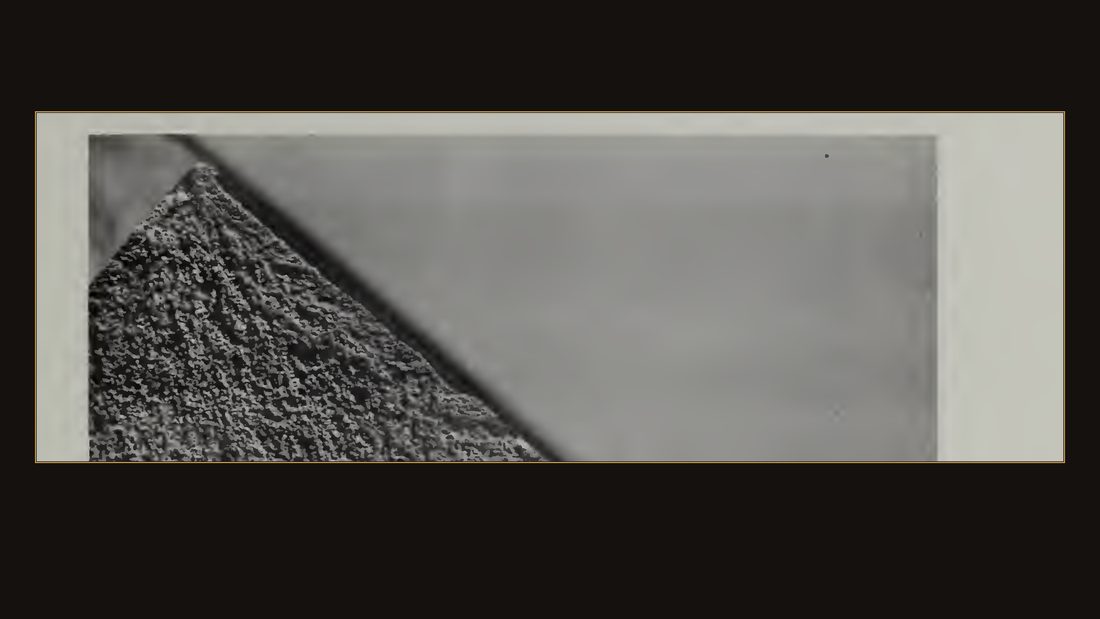
Then after.
M06
NBS Report 9981 - fig. 7. View the original.
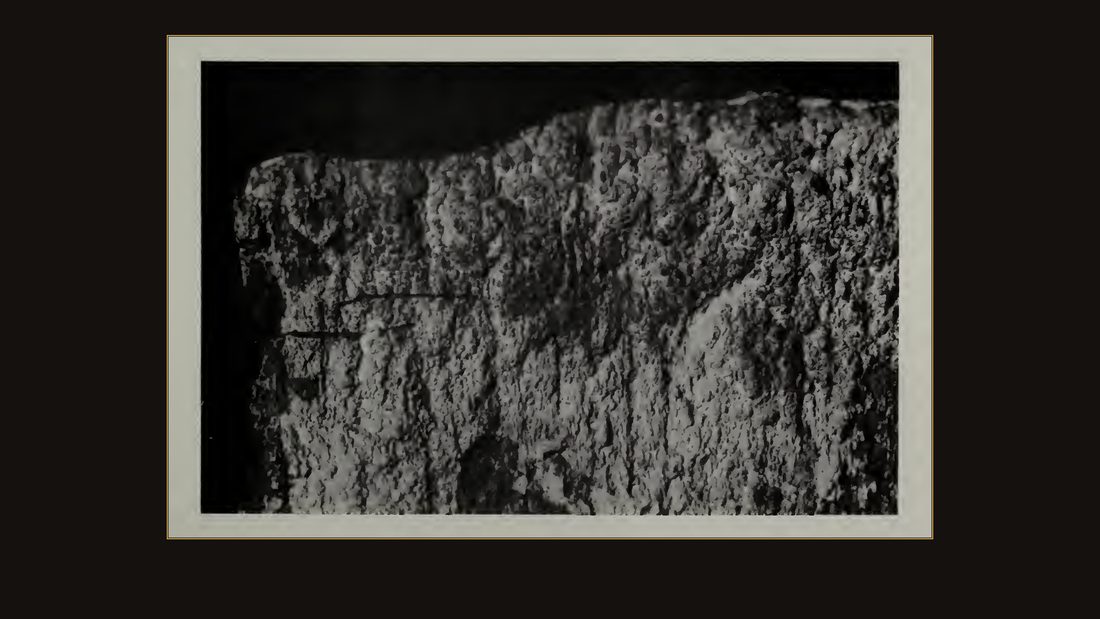
Then the surface of the hole itself, where the steel had been in contact with the pin for forty years.
M07
NBS Report 9981 - fig. 8. View the original.
And then he went inside the metal.
M08
NBS Report 9981 - fig. 20, 200x. View the original.
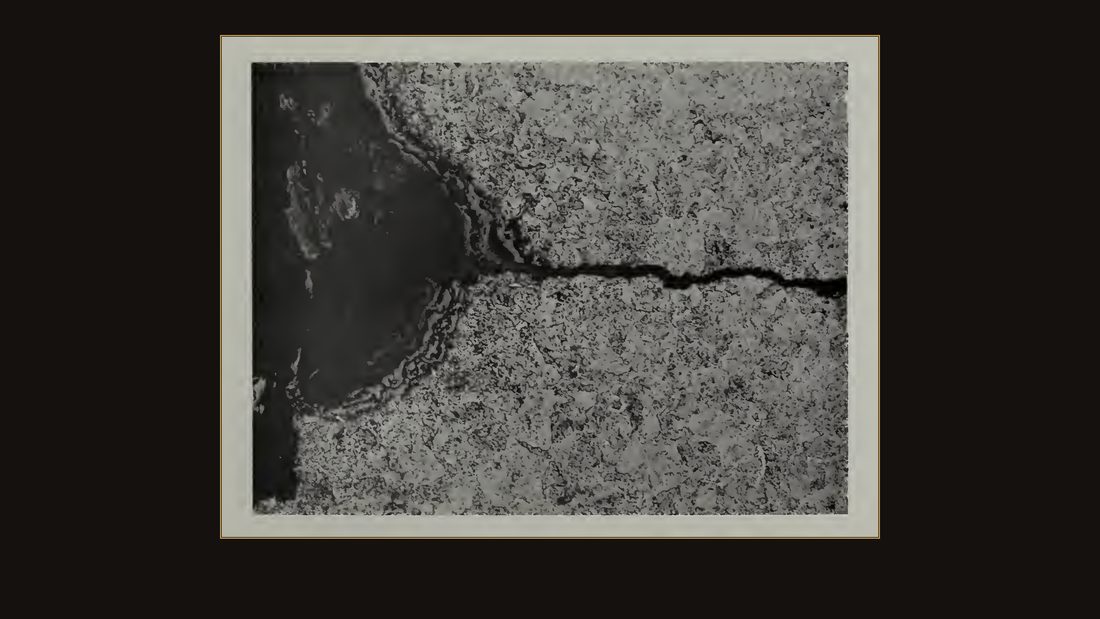
This is a corrosion pit, magnified two hundred times, with a crack running out of it.
The caption calls it the crack origin.
M09
NBS Report 9981 - fig. 21, 200x. View the original.
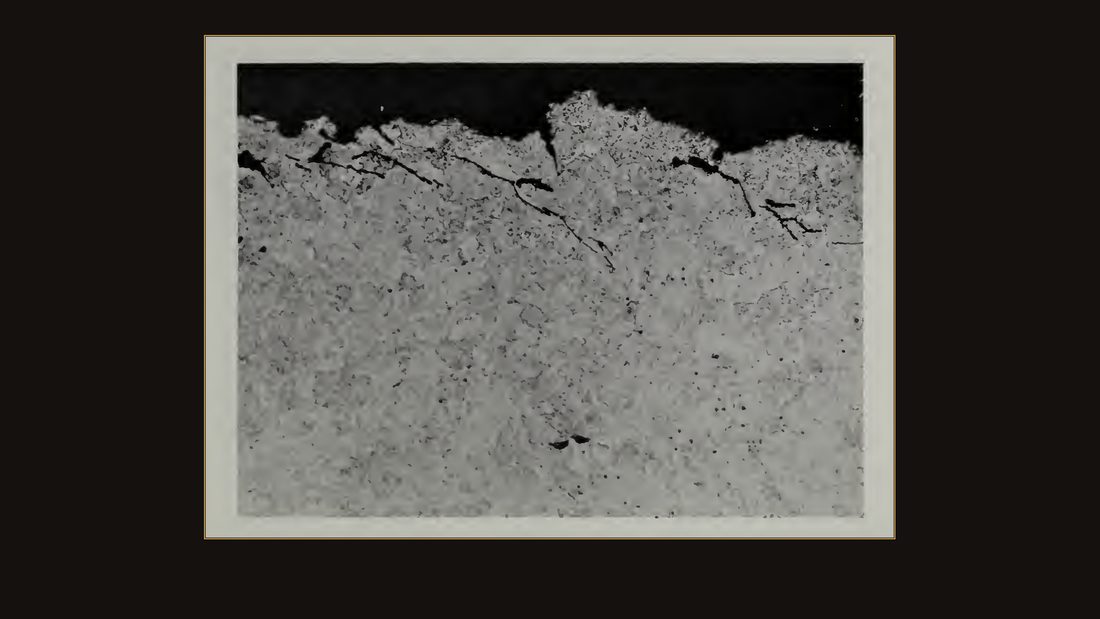
These are secondary cracks beside the fracture.
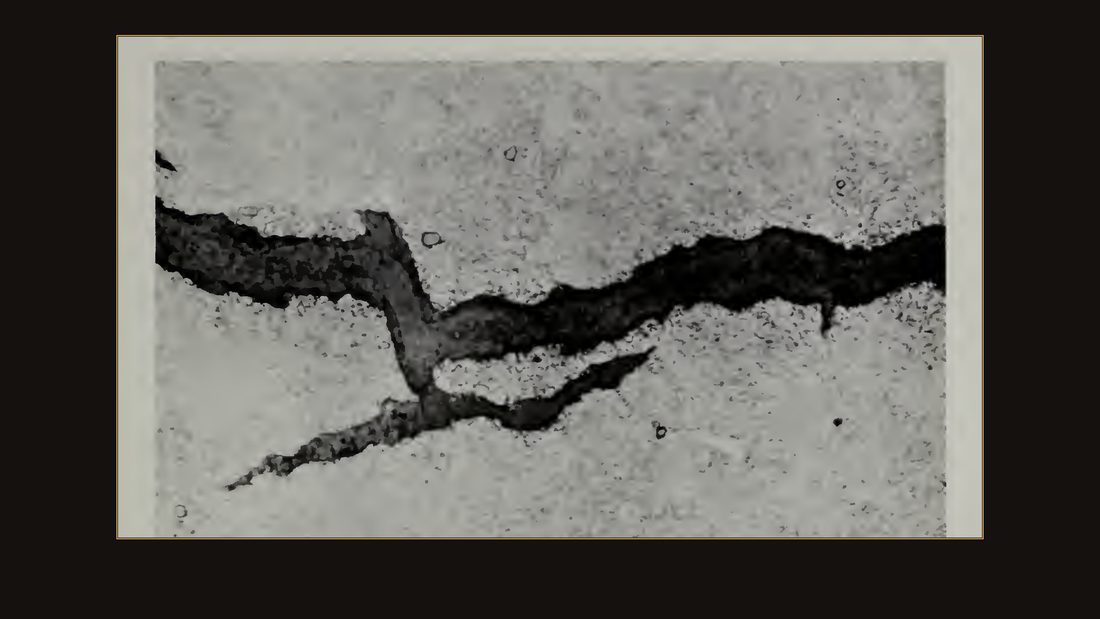
M10
NBS Report 9981 - fig. 23, 1000x. View the original.
At a thousand times, the black is not empty. It is oxide, laid down in layers.
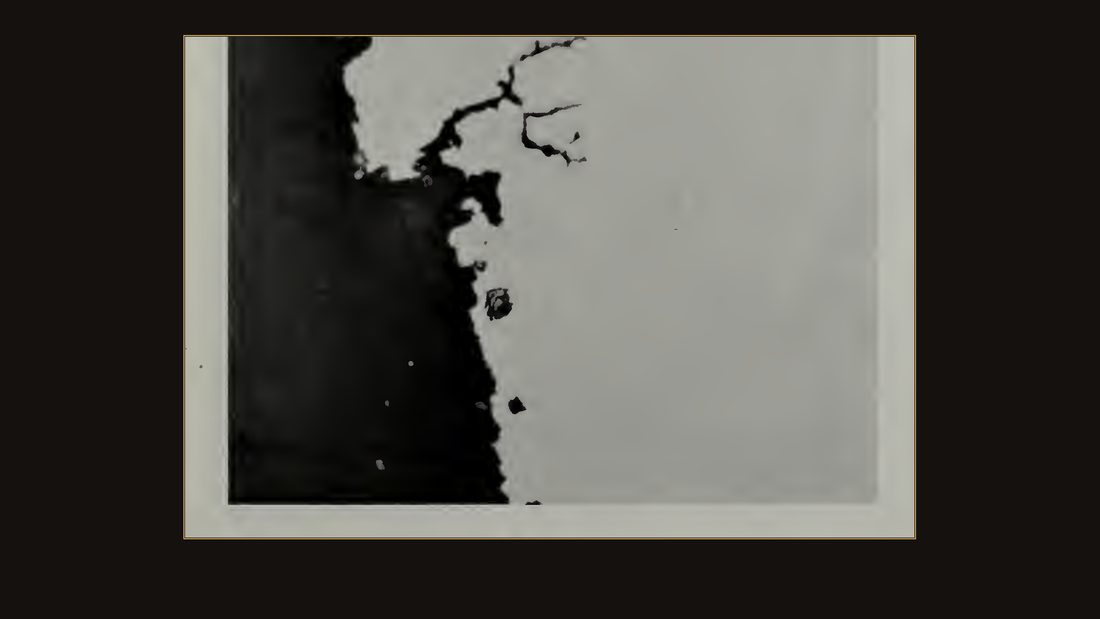
M11
NBS Report 9981 - fig. 24, 1000x. View the original.
More cracks, just starting, four tenths of an inch under the face of the bar.
Bennett's first conclusion states the size of the thing that killed forty-six people.
The fracture propagated from pre-existing cracks having a depth of less than one eighth of an inch.
An eighth of an inch. Less than the thickness of a pencil.
And his third conclusion says how long they had been there. Almost all the cracks were filled with oxide — meaning they had been held open by tension for a long time.
Forty years
Not an accident that happened in December. A condition that had been developing since the Coolidge administration.
Here is the Safety Board's finding, on page one hundred and twenty-six.
The cause was the fracture in eyebar three-thirty, from a critical size flaw developed over the forty-year life of the structure, by the joint action of stress corrosion and corrosion fatigue.
Then three contributing causes. The first is a kind of absolution. In nineteen twenty-seven, when the bridge was designed, nobody knew these mechanisms happened to this class of steel in ordinary rural weather.
The second: the location of the flaw was inaccessible to visual inspection.
And the third is the sentence this whole episode turns on.
"The flaw could not have been detected by any inspection method known in the state of the art today without disassembly of the eyebar joint."
Read that again. Not "nobody looked." Not "the inspectors missed it."
In nineteen seventy, three years after the collapse, with the pieces on a laboratory bench, the government's finding was that there was no way to have found it while the bridge was standing.
Which raises an obvious question about the rule this disaster produced.
Section 26
Because the law had already moved, and it had moved fast.
August twenty-third, nineteen sixty-eight. Eight months after the bridge went down, and more than two years before the Safety Board said why.
Buried in the Federal-Aid Highway Act of nineteen sixty-eight, between a section on apportionment and a section on emergency relief, is a heading.
Bridge inspection. Section twenty-six.
The Secretary shall, as soon as possible, establish national bridge inspection standards. Specifying the method. The maximum time lapse between inspections. And the qualifications of the people doing them.
Before this, there was no federal answer to the question of how often an American bridge should be looked at. After it, there had to be one.
A hundred and forty-five comments
It took the Federal Highway Administration a little over two years to write it.
September twenty-fourth, nineteen seventy. A proposal, published for comment.
A hundred and forty-five comments came back. More than half the state highway departments wrote in.
Some of them objected to the inventory — to being made to count their own bridges.
It would require collecting data that were not readily available, they argued, and an expenditure of time and effort out of proportion to their value.
Others asked that the qualifications for inspectors be lowered.
The Administrator declined to do so — and instead made two changes raising them.
The final rule ran on April twenty-seventh, nineteen seventy-one.
Every two years
Part twenty-five. National Bridge Inspection Standards.
A bridge, for this purpose, is anything carrying traffic over an opening of more than twenty feet.
The person running the program has to be a registered professional engineer, or qualify as one, or have ten years in bridge inspection plus a formal course.
Every state has to keep an inventory. Every structure has to be rated for the load it can actually carry, and posted if it can't carry the legal one.
And then the line that outlived everything else on the page.
Each bridge is to be inspected at regular intervals not to exceed two years.
M01
NBS Report 9981 - fig. 1, eyebar 330. View the original.
That is where the two-year cycle comes from. Every bridge you have ever driven over in this country has a file, because of a piece of steel photographed on a bench at the Bureau of Standards.
What the Board said last
The rule was signed a little over four months after the Safety Board adopted its report. Which brings us back to what that report actually said.
The Board called the new standards a positive step. Then it did some counting.
There were about five hundred and sixty-three thousand five hundred highway bridges in the United States. Over seventy percent of them were not in the federal-aid system at all.
Of the three hundred and seventy-three thousand on county roads, rural roads and city streets, ninety-four percent had been built before nineteen thirty-five.
The oldest bridges. Owned by the governments with the least money to fix them. Covered by nothing.
The standards would become known to those authorities, the Board wrote. But there is no requirement that such authorities implement the intent of these documents.
And then, plainly: the 1968 Act had created a situation where federal-aid bridges must meet rigorous standards while the majority of the bridges in the country are not subject to those standards, except as voluntarily adopted.
So the Board recommended that the Secretary explore how to make it apply to all of them. And that he consider federal money to repair the ones left out.
There is one more thing in the conclusions, and it is the coldest sentence in the file.
There was a second bridge in the country combining every one of these factors. It was at St. Marys, West Virginia. It had been closed since early in the investigation.
Bennett had seen it coming from the metal. There is another structure virtually identical to the Point Pleasant bridge, he wrote, so it is of great importance to determine whether anything about this eyebar was unique.
If not, one must assume that cracks may be present in other bars with a similar history.
He found nothing unique. Nothing defective about the eye when it was installed, nothing to suggest it had been damaged.
M02
NBS Report 9981 - fig. 2, eyebar 330. View the original.
It was an ordinary bar that had done an ordinary job for forty years.
And the Board would not say it was over. Many other structures possess one or more of these factors, it wrote, and it is not precisely known what the critical combinations may be.
Which is the honest shape of it. The disaster that gave America bridge inspection was caused by something inspection could not have found.
The rule that followed is not a promise that it won't happen again. It is a decision to keep looking anyway, on a schedule, and to write down what is seen.
Five signatures. Adopted, December sixteenth, nineteen seventy.
Three years and one day after five o'clock at Point Pleasant.
M01
NBS Report 9981 - fig. 1, eyebar 330. View the original.
Sources
- Collapse of U.S. 35 Highway Bridge, Point Pleasant, West Virginia, December 15, 1967. National Transportation Safety Board, Highway Accident Report NTSB-HAR-71-1, File SS-H-2, adopted December 16, 1970. 202 pp. <https://www.ntsb.gov/investigations/AccidentReports/Reports/HAR7101.pdf>; - Synopsis, p. 9 — 46 dead, 9 injured; 31 of 37 vehicles fell, 24 into the river and 7 on the Ohio shore; 700-foot center span and two 380-foot side spans down in about one minute. - Foreword, p. 1 — supplements the interim report of October 4, 1968; public hearing at Charleston, West Virginia, May 10–13, 1968; bridge completed 1928. - Figure 3, p. 14, "Logic Framework for Conduct of Investigation" — the tree of possible causes, including the External Event branch: sabotage, vehicle collision, sonic boom. - p. 18 — the sonic-boom rumor checked and dismissed; chains designed for a live load of 1,400 pounds per foot at deck level, about 50 pounds per square foot. - p. 11 — the National Bureau of Standards found "a small radial crack about 1/8-inch deep extending from the eyebar hole surface." - Cause, p. 126 — cleavage fracture in the lower limb of the eye of eyebar 330 at joint C13N, from a critical size flaw developed over the 40-year life of the structure by the joint action of stress corrosion and corrosion fatigue; and contributing cause 3, "The flaw could not have been detected by any inspection method known in the state of the art today without disassembly of the eyebar joint." - Conclusions, p. 123 — only two eyebars per link; the only other bridge in the country combining all these factors is at St. Marys, West Virginia, closed since early in the investigation. - Conclusions, pp. 124–125 — about 563,500 highway bridges in the United States, over 70 percent of them outside the federal-aid system; of the 373,000 on county, rural and city roads, 94 percent built before 1935; and no requirement that non-federal-aid authorities implement any of it. - Recommendations, pp. 127–128, and the signature page. - Appendix A — the reassembly-site drawings.
- Metallurgical Examination and Mechanical Tests of Material from the Point Pleasant, W. Va. Bridge, Part I. John A. Bennett, Engineering Metallurgy Section, National Bureau of Standards. NBS Report 9981, NBS Project 3120646, for the Bureau of Public Roads, Federal Highway Administration. <https://archive.org/details/metallurgicalex9981benn_0>; - Figures 1–2 — the inboard and outboard pieces of the broken eye of eyebar 330, as received. - Figures 3–8 — the fracture before and after cleaning, and the hole surface. - Figures 20–24 — the crack origin at a corrosion pit; secondary cracks; the lamellar oxide in the cracks at 1000x; incipient cracks at the hole surface 0.394 inch below the south face. - Conclusions 1 and 3 — the fracture propagated from pre-existing cracks less than 1/8 inch deep, and almost all the cracks not involved in the fracture were filled with oxide, "indicating that they had been held open by tensile stress for a long time." - Discussion — "As there is another structure virtually identical to the Point Pleasant bridge, it is of great importance to determine if there was any unique condition in the fractured eyebar that caused the cracking."
- Federal-Aid Highway Act of 1968, Pub. L. 90-495, August 23, 1968, sec. 26, "Bridge Inspection," 82 Stat. 829 — adding 23 U.S.C. 116(d) and (e). <https://archive.org/details/sim_united-states-united-states-statutes-at-large_1968_82>;
- Proposed National Bridge Inspection Standards, Federal Highway Administration, notice issued September 14, 1970, published 35 F.R. 14864, September 24, 1970. <https://archive.org/details/federal-register-1970-09-24>;
- National Bridge Inspection Standards, final rule, 23 C.F.R. Part 25, published 36 F.R. 7851, April 27, 1971 (later recodified as 23 C.F.R. Part 650, Subpart C). <https://archive.org/details/federal-register-1971-04-27>; - The preamble — 145 comments filed, from over half the state highway departments; the objection that the inventory would require "an expenditure of time and effort out of proportion to their value"; the Administrator declining to lower the qualifications for inspectors and raising them instead. - § 25.1 — a bridge is a structure carrying traffic over an opening of more than 20 feet. - § 25.5 — "Each bridge is to be inspected at regular intervals not to exceed 2 years." - § 25.7 — qualifications: registered professional engineer, or qualified for registration, or ten years' experience plus a course based on the Bridge Inspector's Training Manual. - § 25.11 — the state inventory, due July 1, 1972 and July 1, 1973.