The Government Photographed Cincinnati for Eight Years. It Started in the Slums.
Between 1935 and 1943, photographers for the Resettlement Administration, the Farm Security Administration, and the Office of War Information kept returning to Cincinnati and the Kentucky towns across the Ohio — Covington, and the watch-case factory town of Dayton, Kentucky.
Transcript
3:33 p.m.
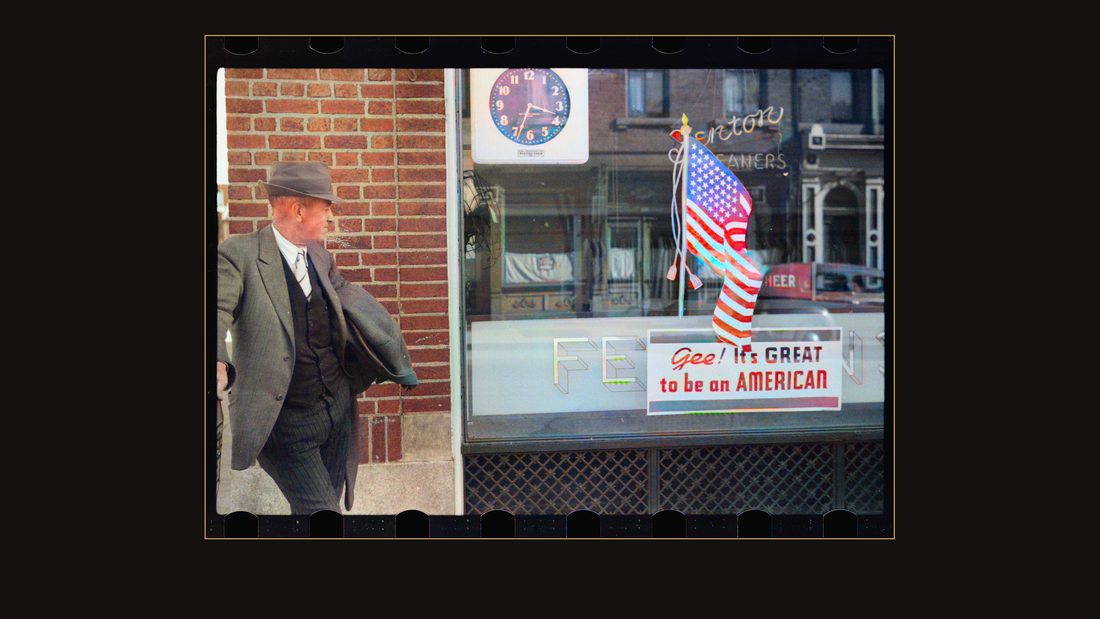
R35 Covington, Kentucky, street corner, 3:33 p.m.
John Vachon · September 1939 · Library of Congress · FSA/OWI · AI-colorized. View the original.
A street corner in Covington, Kentucky, at exactly three thirty-three in the afternoon — the photographer put the time in his caption. In the window behind the man, a printed card: Gee! It's great to be an American. September, nineteen thirty-nine.
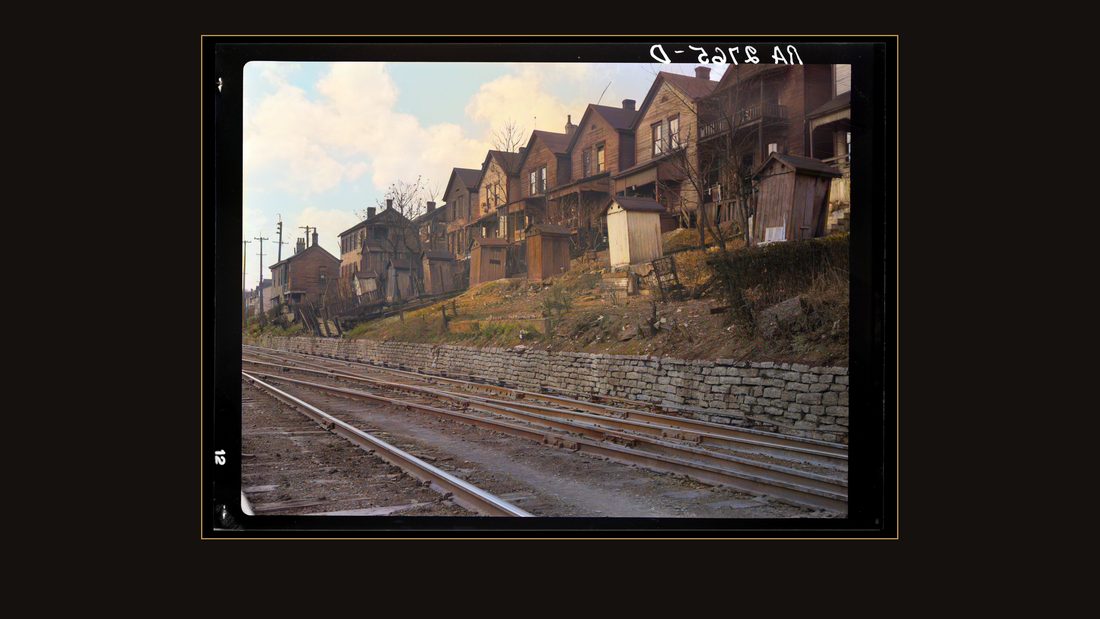
R11 Cincinnati, Ohio
Carl Mydans · December 1935 · Library of Congress · FSA/OWI · AI-colorized. View the original.
For eight years — nineteen thirty-five to nineteen forty-three — photographers on the federal payroll kept a camera on Cincinnati and the Kentucky towns across the river. Their negatives have sat in Washington ever since, in black and white.
The colors are guesses
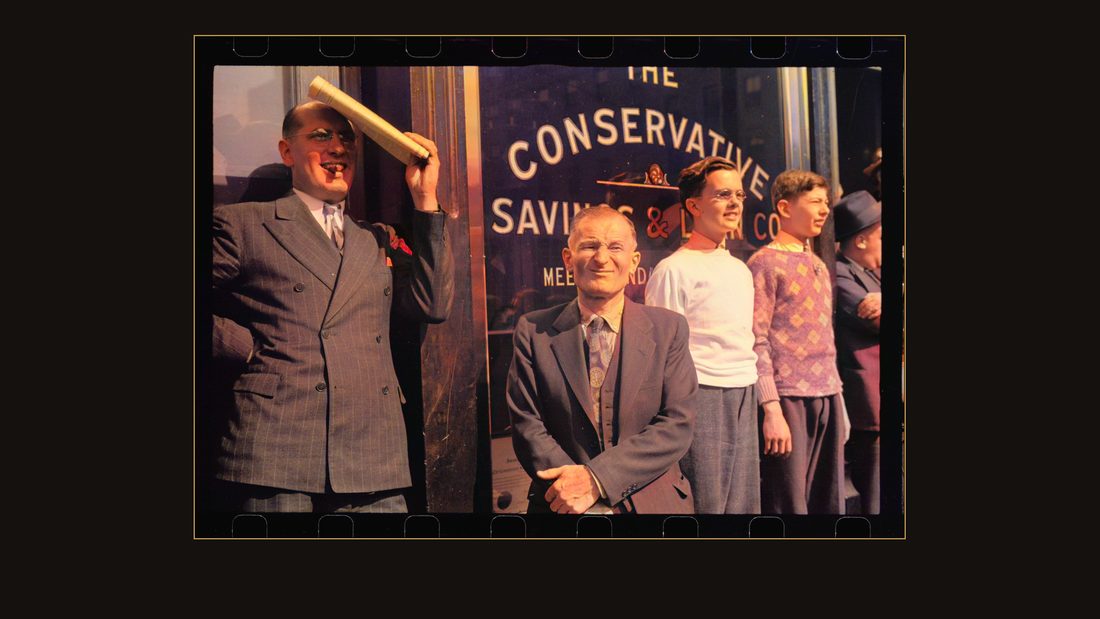
R26 The flag is going by, sesquicentennial parade, Cincinnati, Ohio
John Vachon · October 1938 · Library of Congress · FSA/OWI · AI-colorized. View the original.
So let's be straight about what you're watching. Every color in this film is a guess — made this year, by a machine, from the gray values on those negatives.
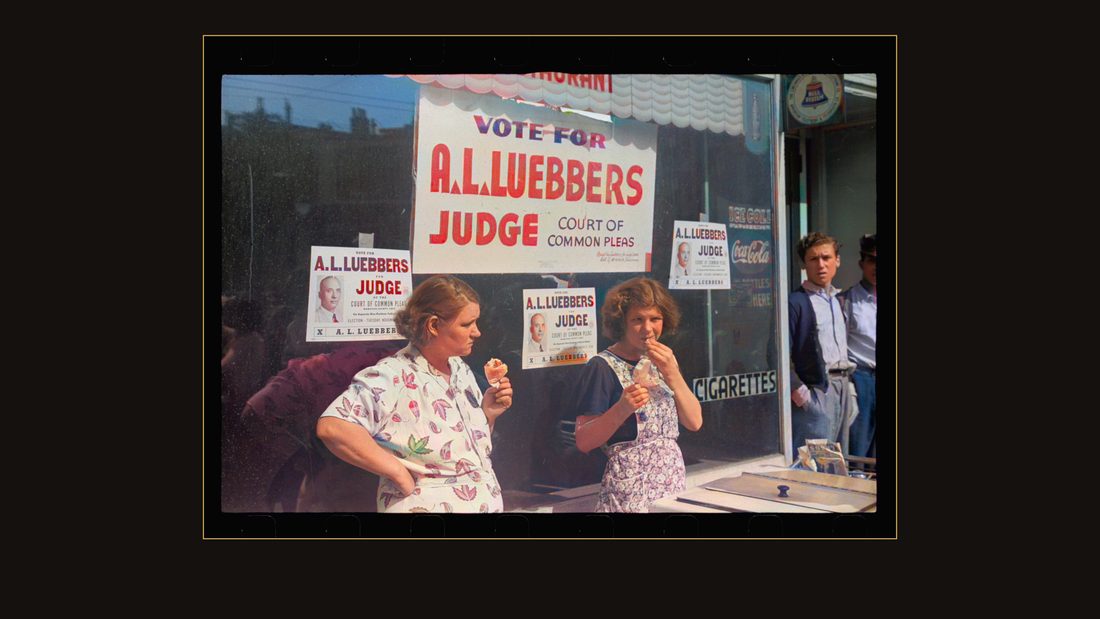
R29 Women selling ice cream to parade watchers, Cincinnati, Ohio
John Vachon · October 1938 · Library of Congress · FSA/OWI · AI-colorized. View the original.
The faces, the light, the framing — those belong to the photographers, untouched. The colors are estimates. Every original is free at the Library of Congress, linked below. And one frame near the end of this film is real color, made in the camera. We'll tell you when.
The survey, 1935
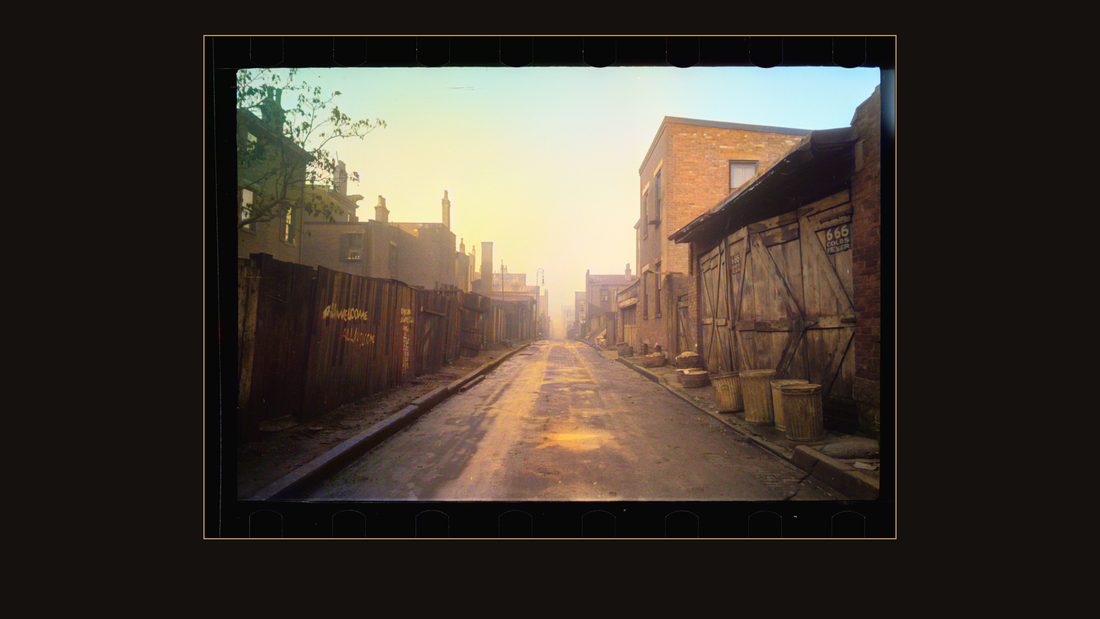
R01 Van Horn Street, Hamilton County, Ohio
Carl Mydans · December 1935 · Library of Congress · FSA/OWI · AI-colorized. View the original.
December, nineteen thirty-five. Carl Mydans carried a government camera through the tenement districts of Cincinnati. Van Horn Street, in the haze.
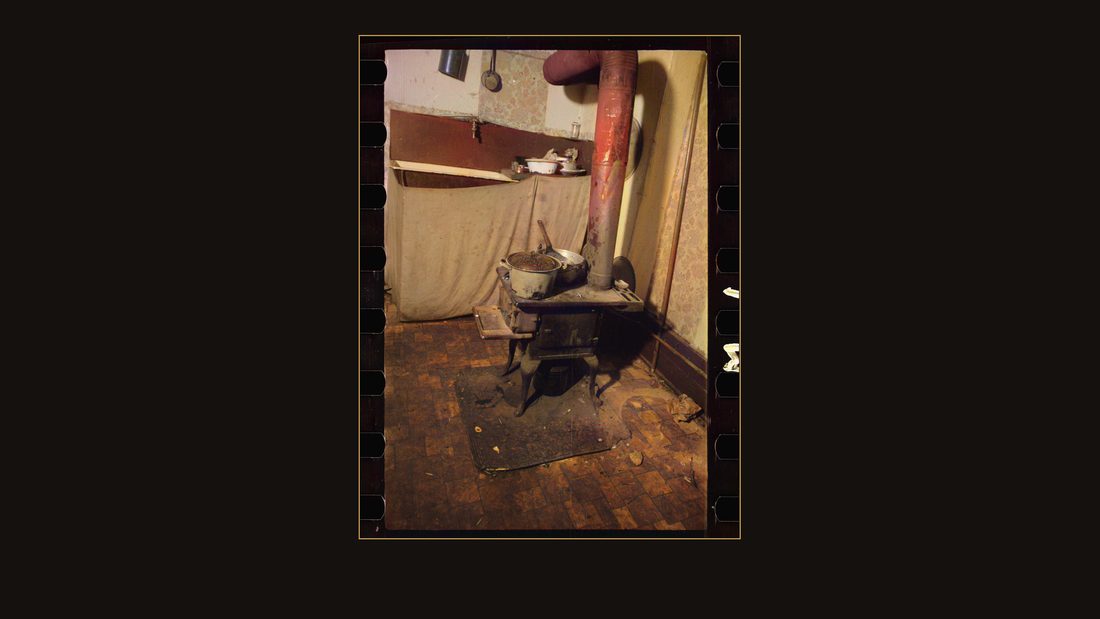
R02 Tenement kitchen shambles, Hamilton County, Ohio
Carl Mydans · December 1935 · Library of Congress · FSA/OWI · AI-colorized. View the original.
His captions do not editorialize much. This one says: tenement kitchen shambles.
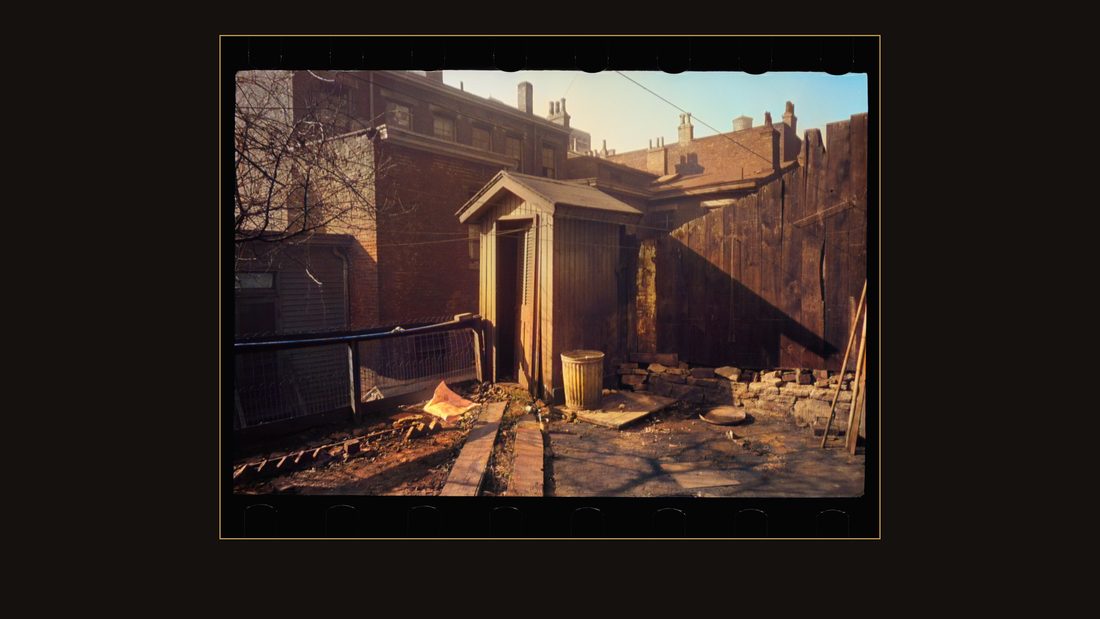
R03 Tenement backyard and privy, Hamilton County, Ohio
Carl Mydans · December 1935 · Library of Congress · FSA/OWI · AI-colorized. View the original.
Tenement backyard and privy.
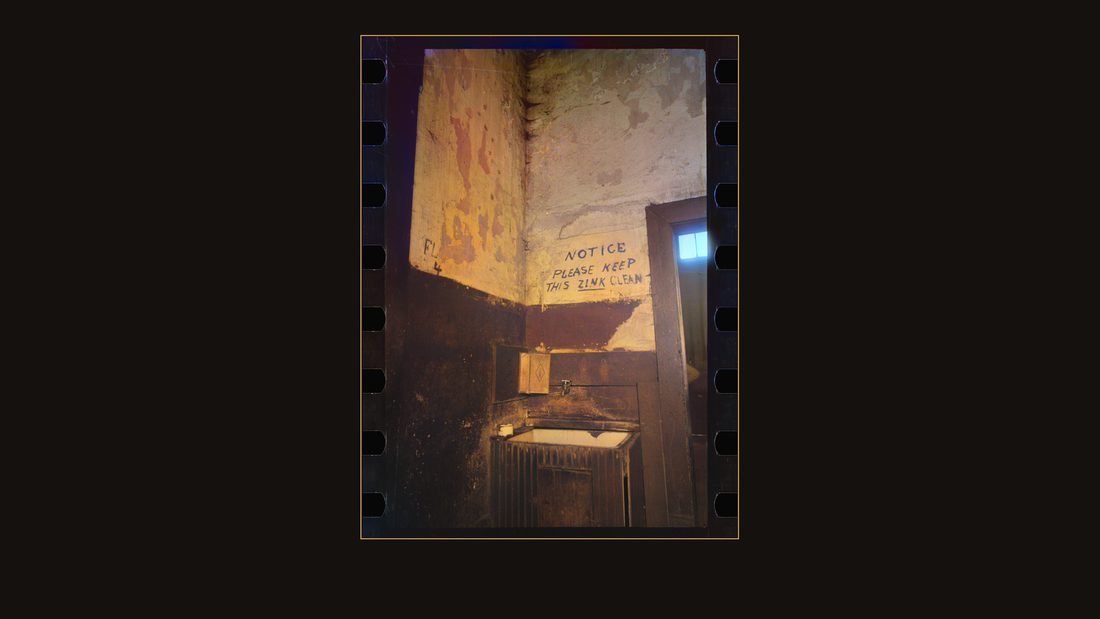
R04 Common hallway sink in old schoolhouse, Hamilton, Ohio
Carl Mydans · December 1935 · Library of Congress · FSA/OWI · AI-colorized. View the original.
In an old schoolhouse cut up into dwellings, the common hallway sink. On the wall, somebody's hand-lettered notice: please keep this zink clean.
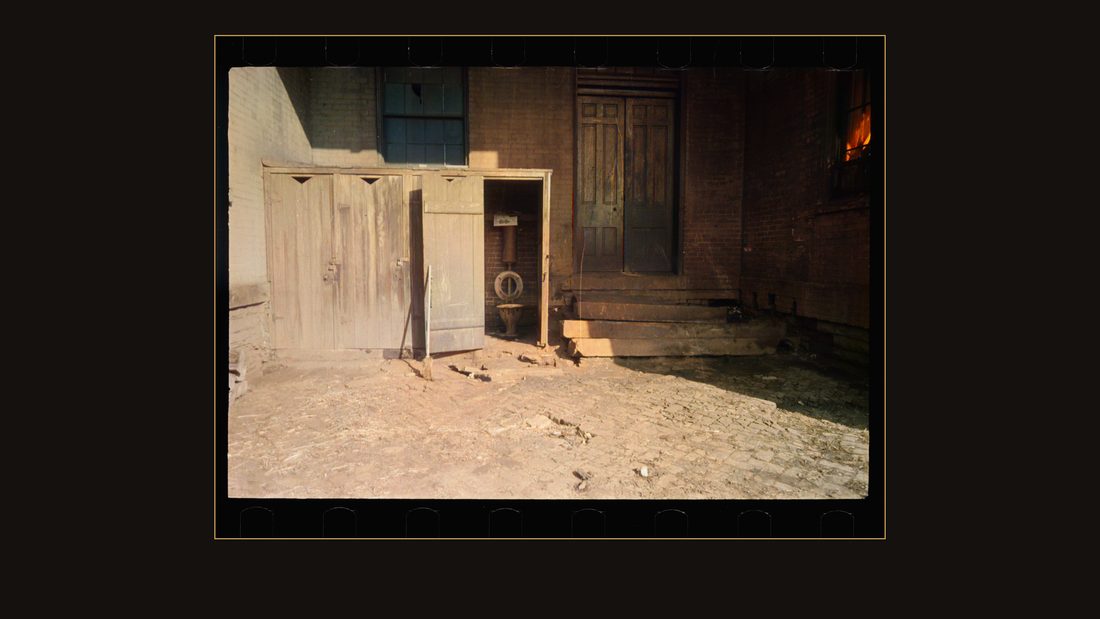
R05 Tier of outhouses by the old schoolhouse, Hamilton County, Ohio
Carl Mydans · December 1935 · Library of Congress · FSA/OWI · AI-colorized. View the original.
Out back of the same schoolhouse, the toilets stood in a tier.
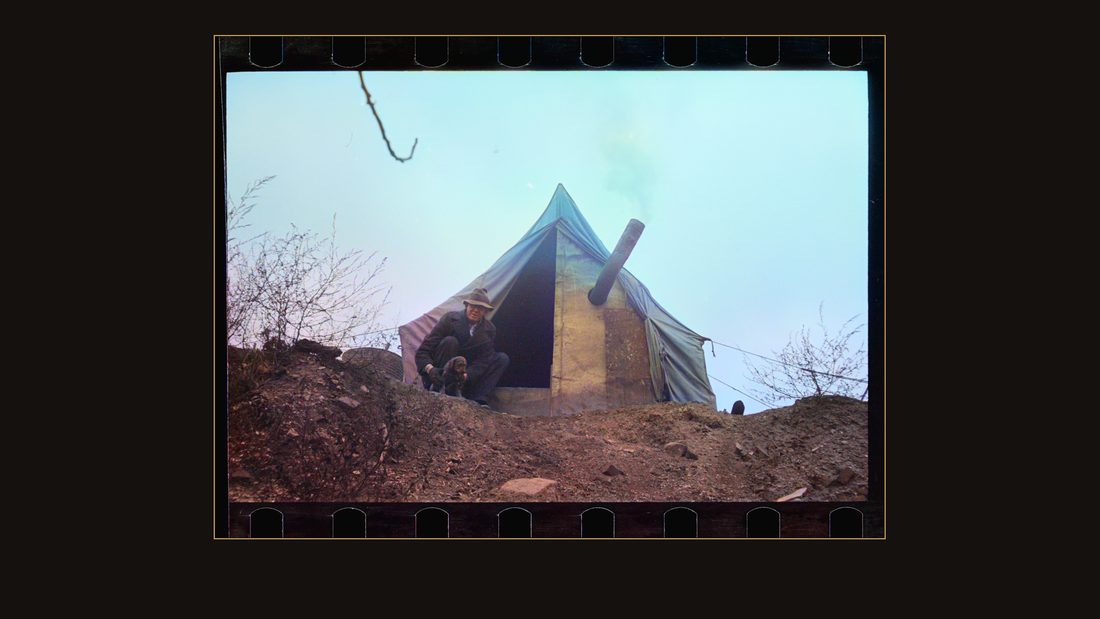
R06 Tent squatter, common scenes along the Ohio River, Hamilton County, Ohio
Carl Mydans · December 1935 · Library of Congress · FSA/OWI · AI-colorized. View the original.
Along the Ohio, a man lived in a tent under a stovepipe. The caption calls it a common scene along the river.
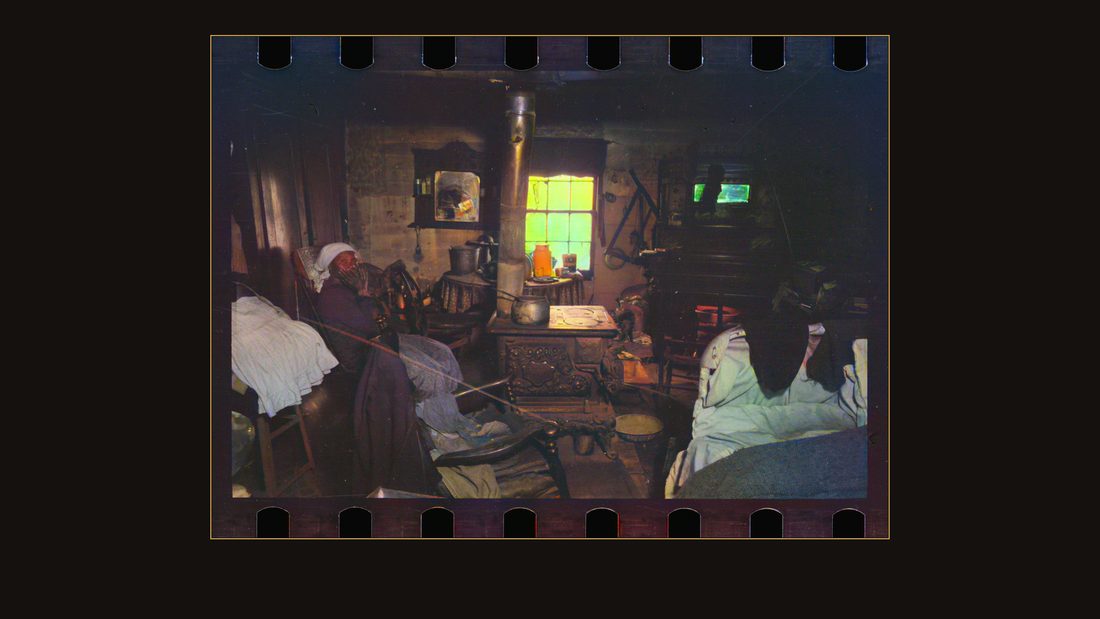
R07 Negro dwelling interior, Hamilton Co., Ohio
Carl Mydans · December 1935 · Library of Congress · FSA/OWI · AI-colorized. View the original.
The file sorts the poor of nineteen thirty-five by race, in the language of nineteen thirty-five. This frame is captioned: Negro dwelling, interior.
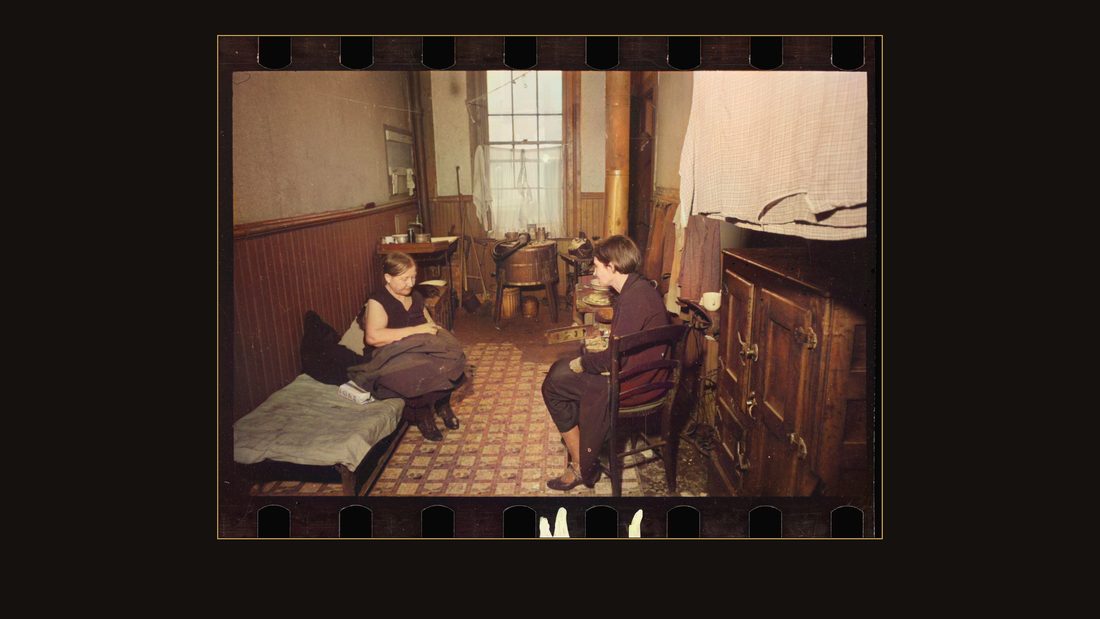
R08 Tenement bedroom and kitchen, Hamilton Co., Ohio
Carl Mydans · December 1935 · Library of Congress · FSA/OWI · AI-colorized. View the original.
A bedroom that is also the kitchen.
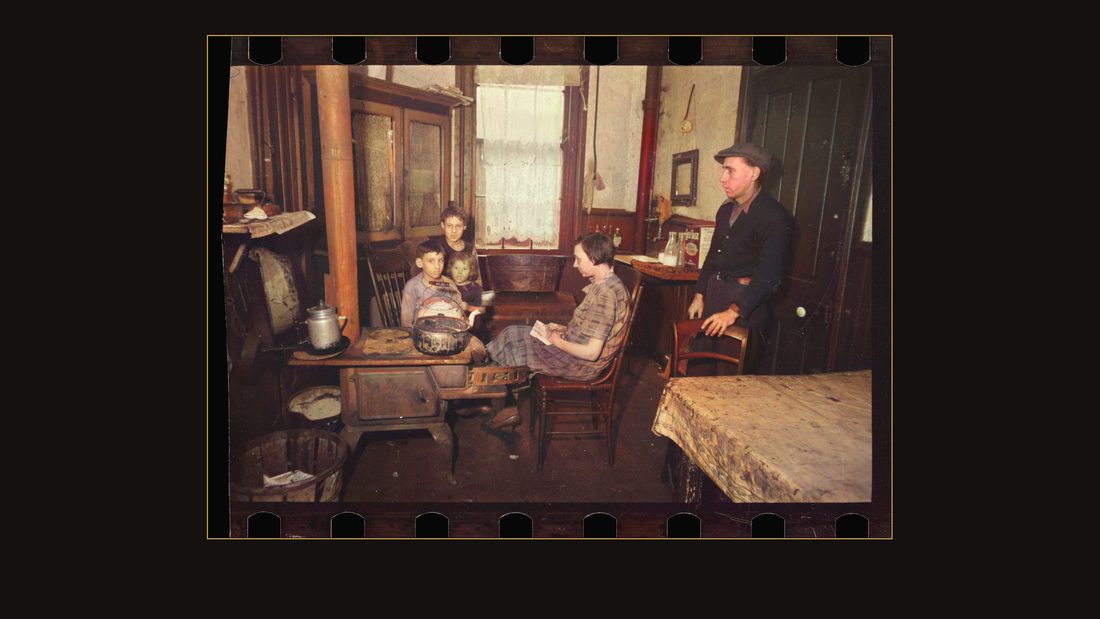
R09 Tenement kitchen, Hamilton Co., Ohio
Carl Mydans · December 1935 · Library of Congress · FSA/OWI · AI-colorized. View the original.
A family at their kitchen table.
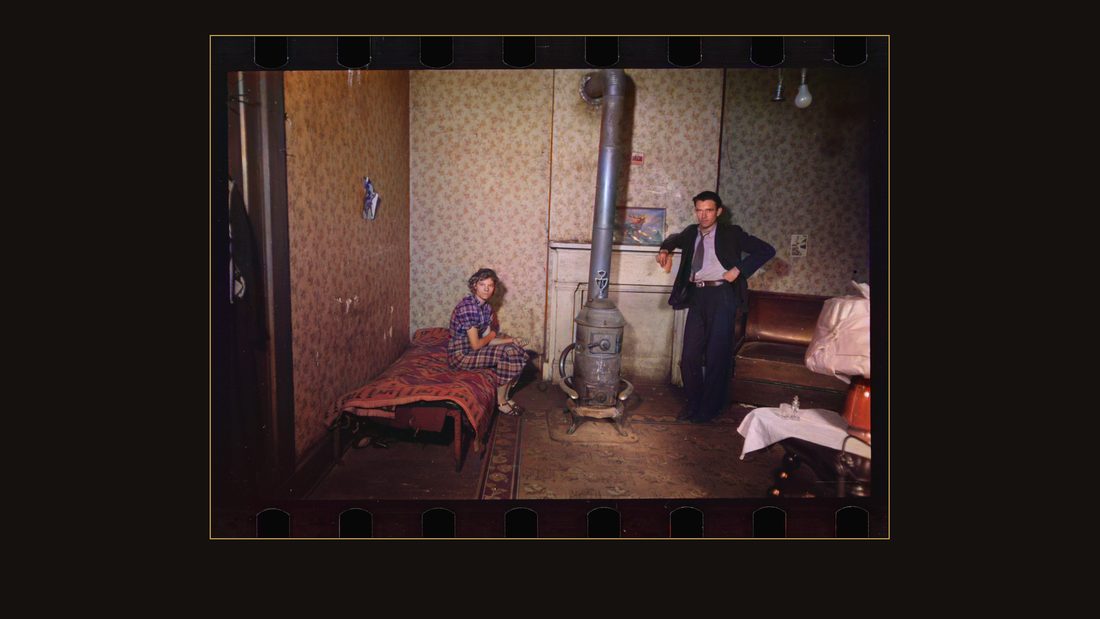
R10 Bed and sitting room, Hamilton County, Ohio
Carl Mydans · December 1935 · Library of Congress · FSA/OWI · AI-colorized. View the original.
A bed and sitting room, one stove for both.
R11 Cincinnati, Ohio
Carl Mydans · December 1935 · Library of Congress · FSA/OWI · AI-colorized. View the original.
Houses stacked on the hillside over the railroad cut. None of this was photographed by accident. The pictures were evidence, being gathered for a purpose.
The plan
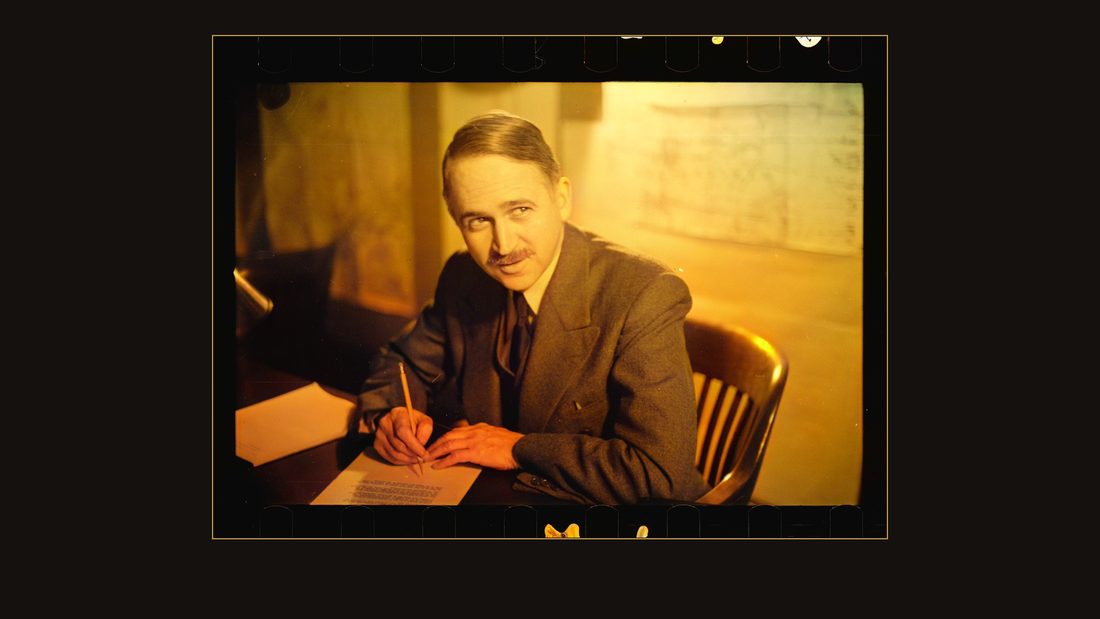
R12 Justen Hertzog, Washington, D.C., Chief Town Planner, Cincinnati project, Division of Suburban Resettlement
Carl Mydans · February 1936 · Library of Congress · FSA/OWI · AI-colorized. View the original.
February, nineteen thirty-six. Mydans turned the same camera on four men at drafting tables in Washington. This is Justin Hartzog, chief town planner of what the government called the Cincinnati project.
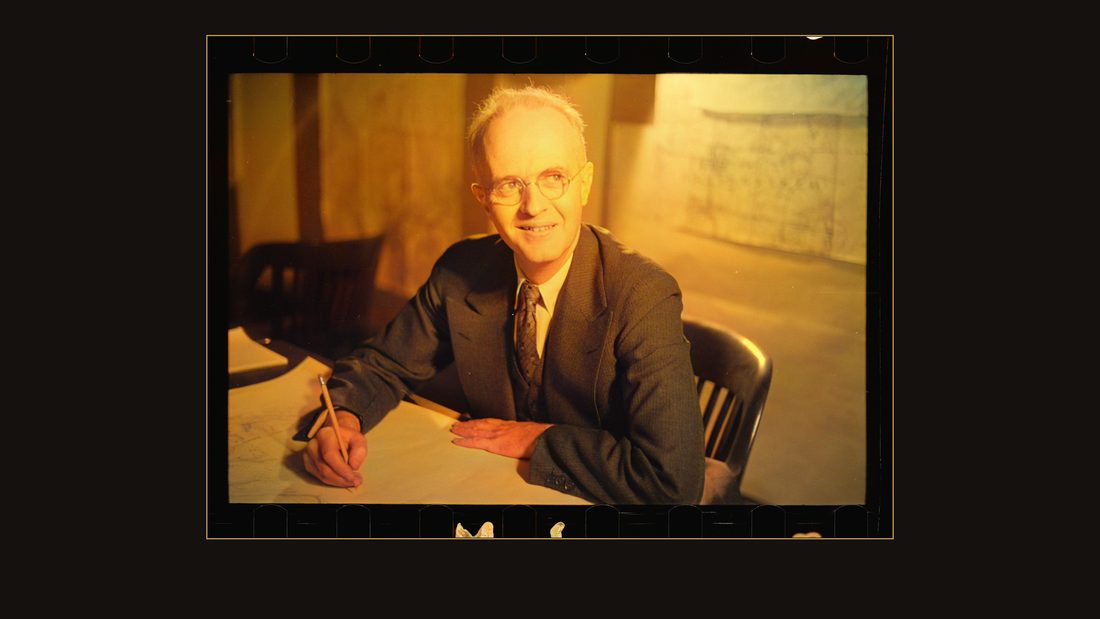
R13 William A. Strong, Washington, D.C., Assistant Chief Town Planner, Cincinnati project
Carl Mydans · February 1936 · Library of Congress · FSA/OWI · AI-colorized. View the original.
William A. Strong, assistant chief town planner.
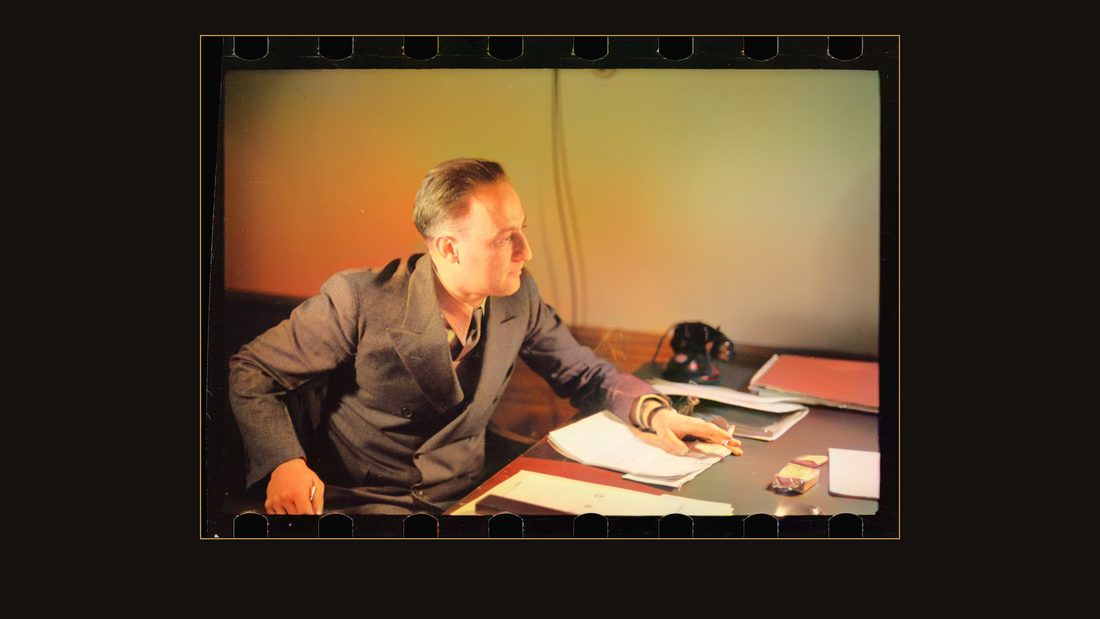
R14 Roland A. Wank, Washington, D.C., Chief of Architectural Staff of Cincinnati project, Suburban Resettlement Division
Carl Mydans · February 1936 · Library of Congress · FSA/OWI · AI-colorized. View the original.
Roland A. Wank, chief of the architectural staff.
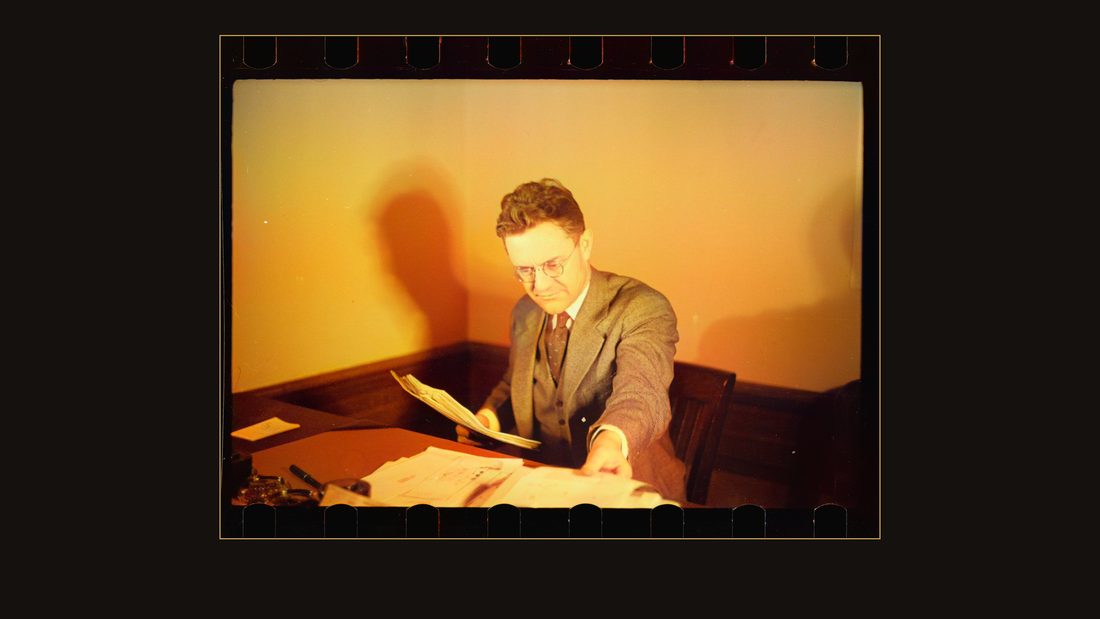
R15 Frank A. Cordner, Washington, D.C., Assistant Chief of architectural staff of Cincinnati project
Carl Mydans · February 1936 · Library of Congress · FSA/OWI · AI-colorized. View the original.
And Frank Cordner, his assistant. The slum survey was their justification file. The answer to it was to be a whole new town, built from nothing, owned by the government.
Greenhills
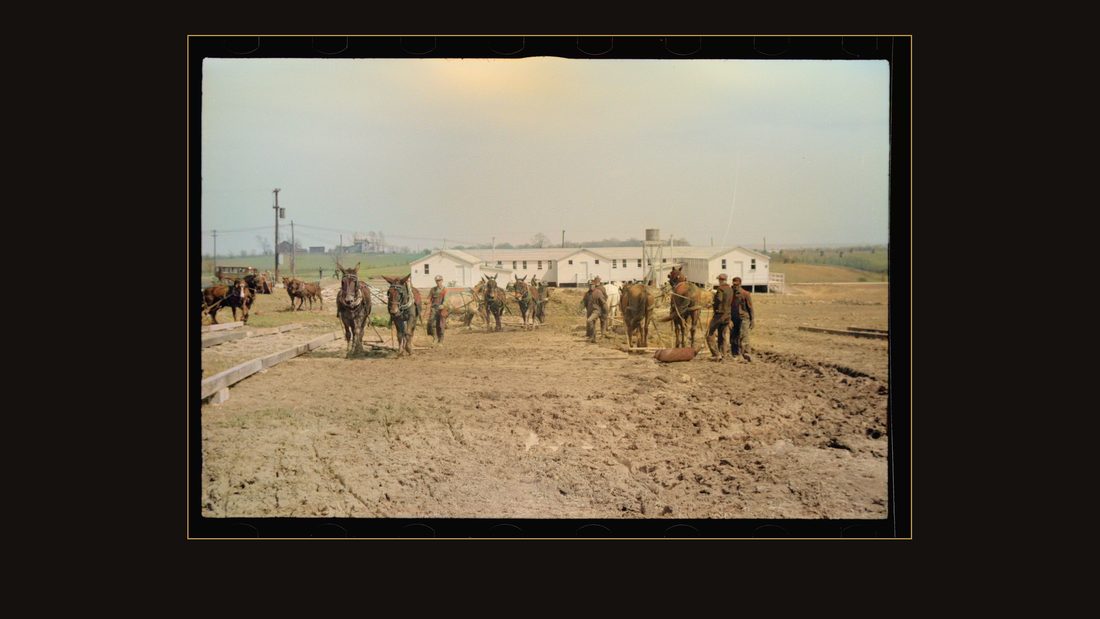
R16 Construction work at the Greenhills Project, Cincinnati, Ohio
Theodor Jung · April 1936 · Library of Congress · FSA/OWI · AI-colorized. View the original.
April, nineteen thirty-six. On farmland north of the city, teams and machines began grading a town that did not exist yet. They called it Greenhills.
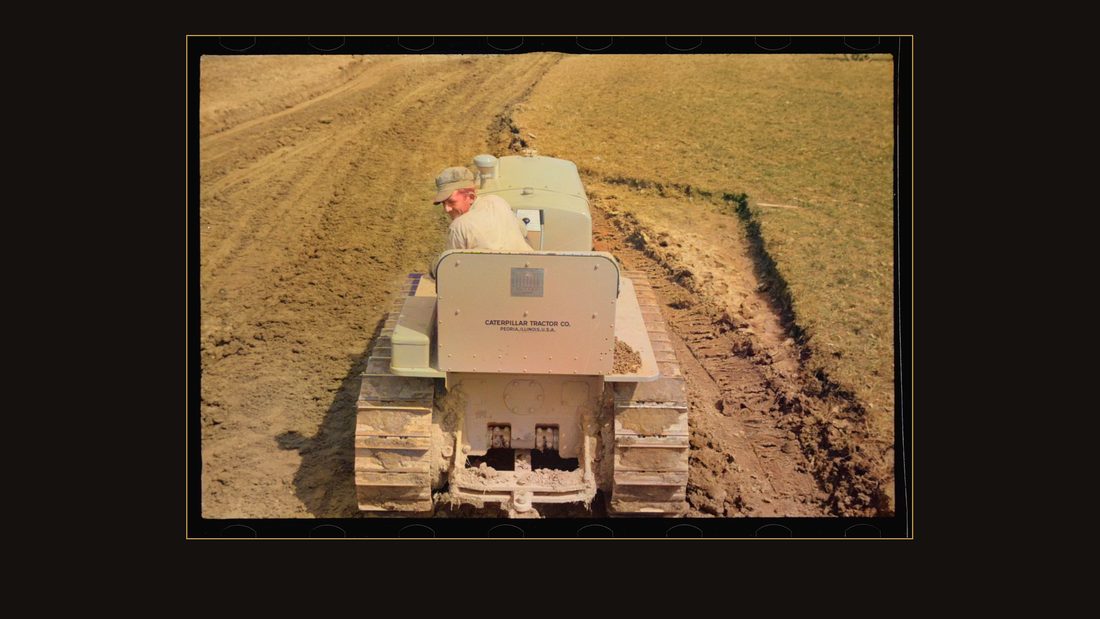
R17 Grading at the Greenhills Project, Cincinnati, Ohio
Theodor Jung · April 1936 · Library of Congress · FSA/OWI · AI-colorized. View the original.
The program's own booklet said each greenbelt town would eventually house three to five thousand families — though only seven hundred fifty to thirteen hundred dwellings would be built at first.
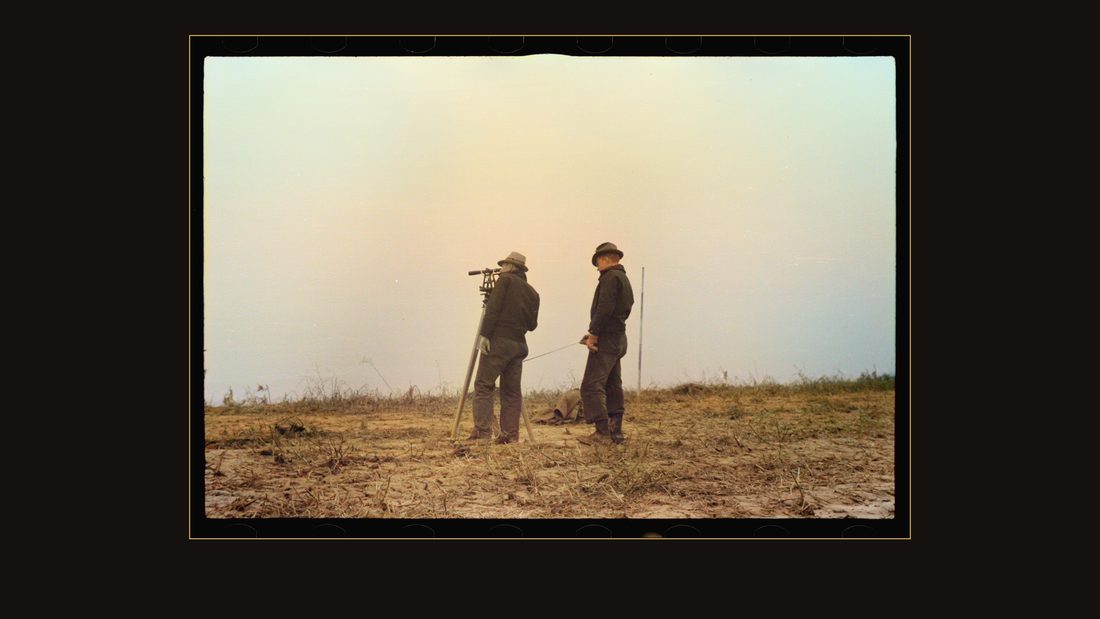
R18 Surveying at the Greenhills Project, Cincinnati, Ohio
Theodor Jung · April 1936 · Library of Congress · FSA/OWI · AI-colorized. View the original.
Surveyors on the bare ground.
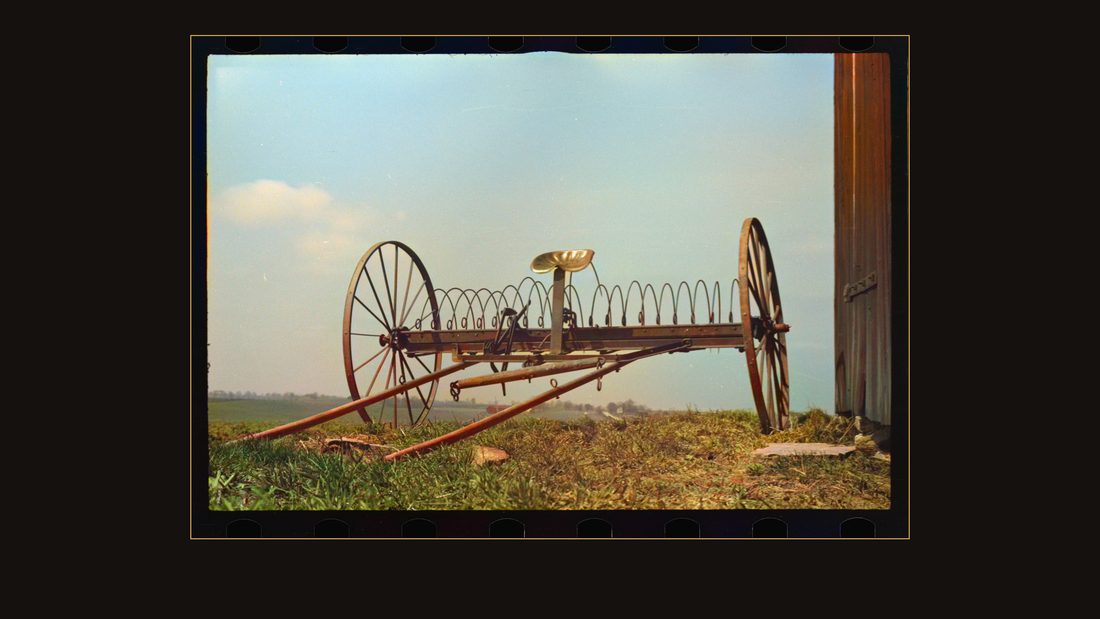
R19 Hayrake on farm near the Greenhills Project, Cincinnati, Ohio
Theodor Jung · April 1936 · Library of Congress · FSA/OWI · AI-colorized. View the original.
A hayrake at a barn near the project — the farm country the new town was replacing.
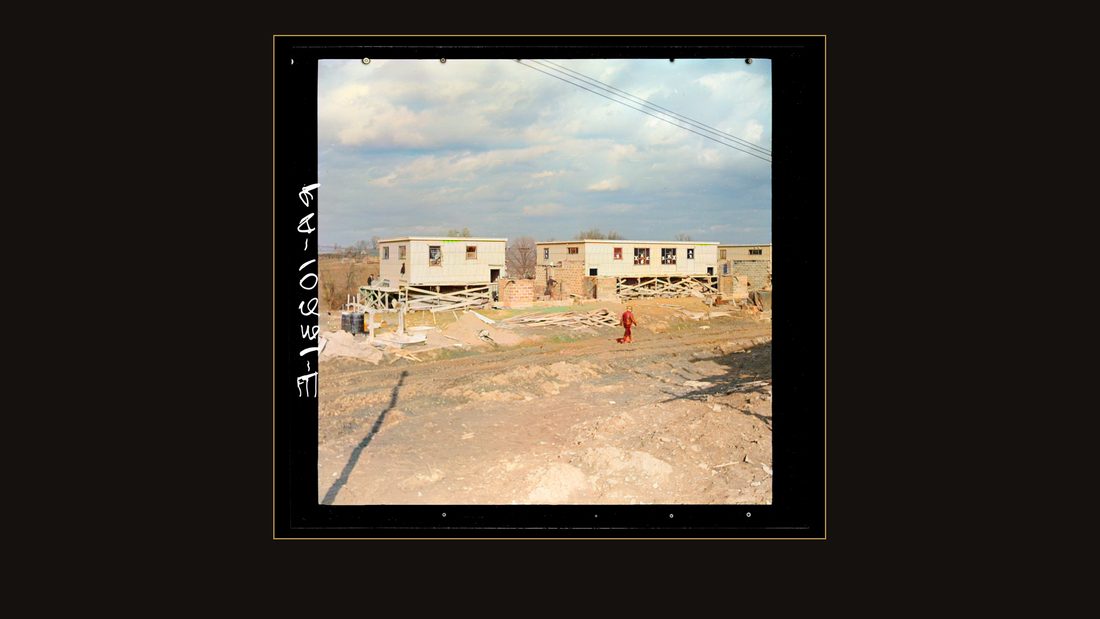
R20 Houses under construction at Greenhills project near Cincinnati, Ohio
Russell Lee · February 1937 · Library of Congress · FSA/OWI · AI-colorized. View the original.
By February, nineteen thirty-seven, houses.
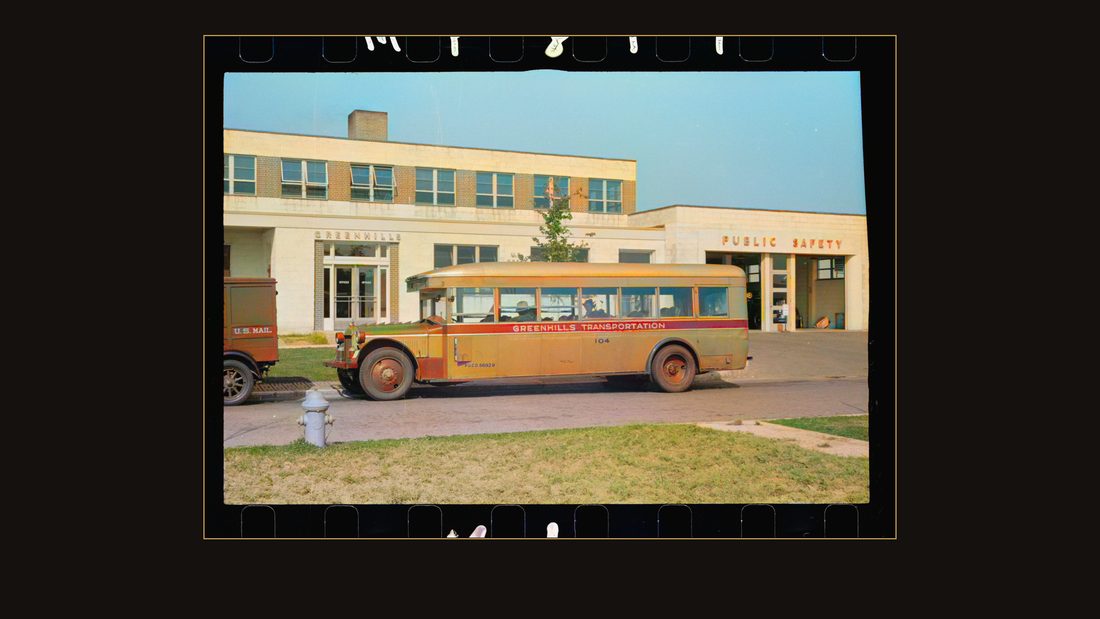
R21 Bus which runs between Greenhills and Cincinnati
John Vachon · October 1938 · Library of Congress · FSA/OWI · AI-colorized. View the original.
The first families moved in on April first, nineteen thirty-eight. Six hundred seventy-six homes — the plan had said a thousand; the money said less. Rent ran eighteen dollars a month for one bedroom, forty-two for a house.
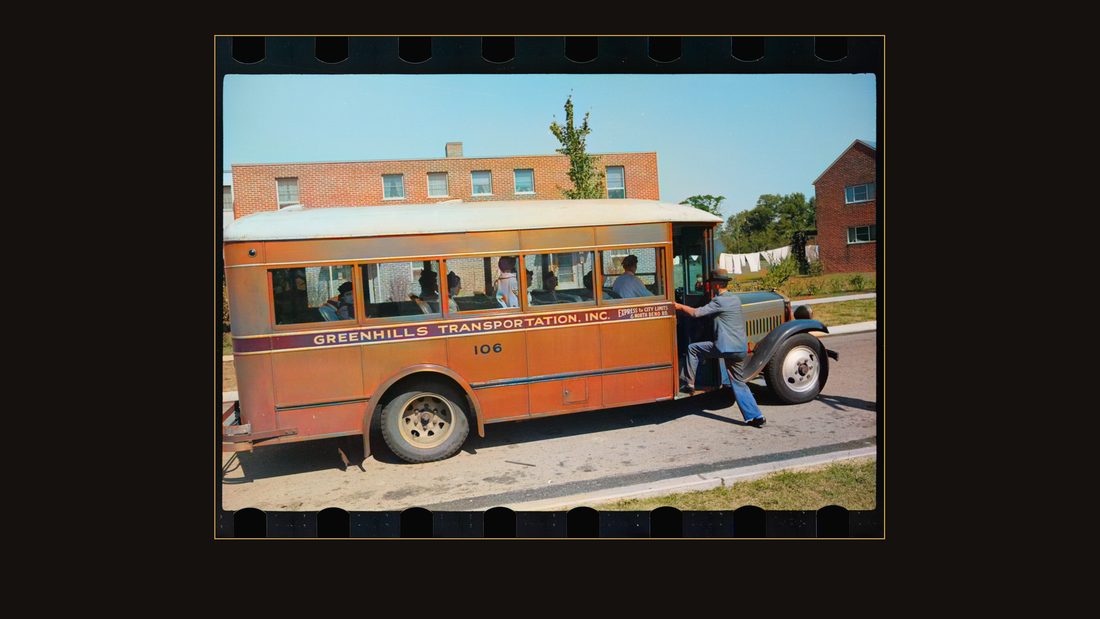
R22 Bus which travels between Greenhills and Cincinnati, Ohio
John Vachon · October 1939 · Library of Congress · FSA/OWI · AI-colorized. View the original.
Getting in took as many as fourteen forms, a credit check, and a visit from a social worker. Families where both parents worked were excluded. This is the bus that ran between Greenhills and Cincinnati.
The city's birthday
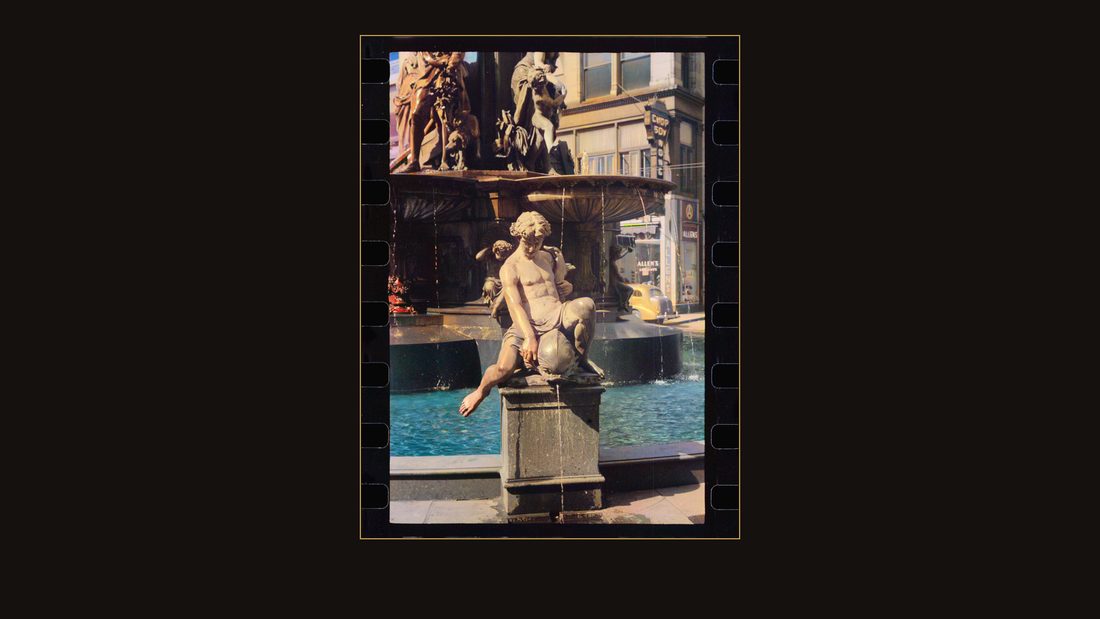
R23 Fountain Square, Cincinnati, Ohio
John Vachon · October 1938 · Library of Congress · FSA/OWI · AI-colorized. View the original.
October, nineteen thirty-eight. A new photographer, John Vachon, twenty-four years old, reached Fountain Square as the city turned one hundred fifty.
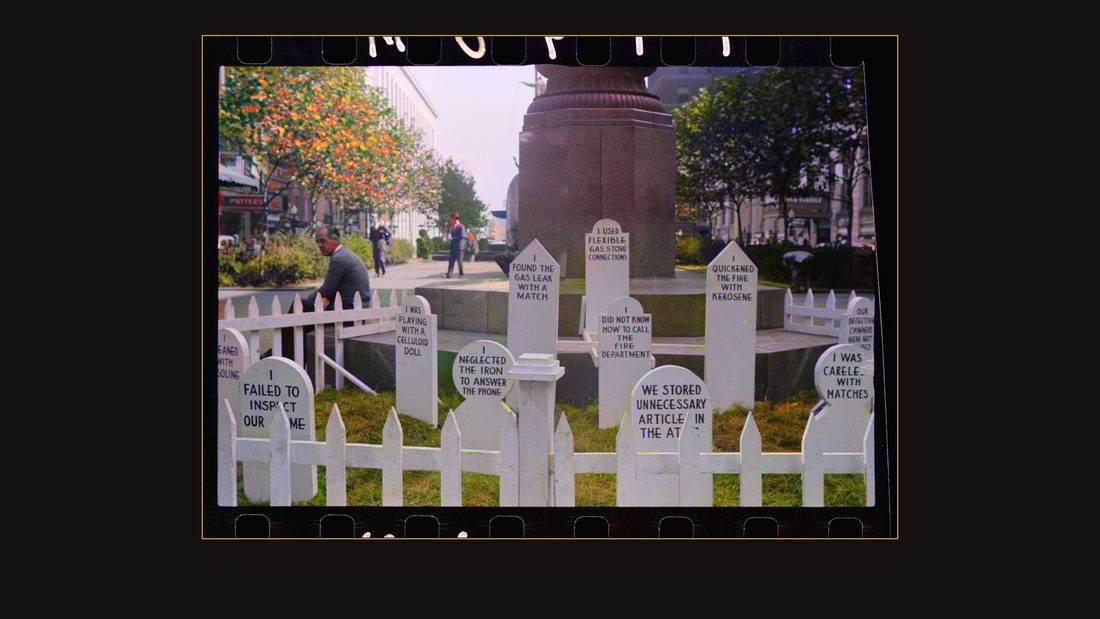
R24 Fire prevention week in Cincinnati, Ohio
John Vachon · October 1938 · Library of Congress · FSA/OWI · AI-colorized. View the original.
He found fire prevention week first — a mock cemetery downtown, a headstone for every way a house burns down.
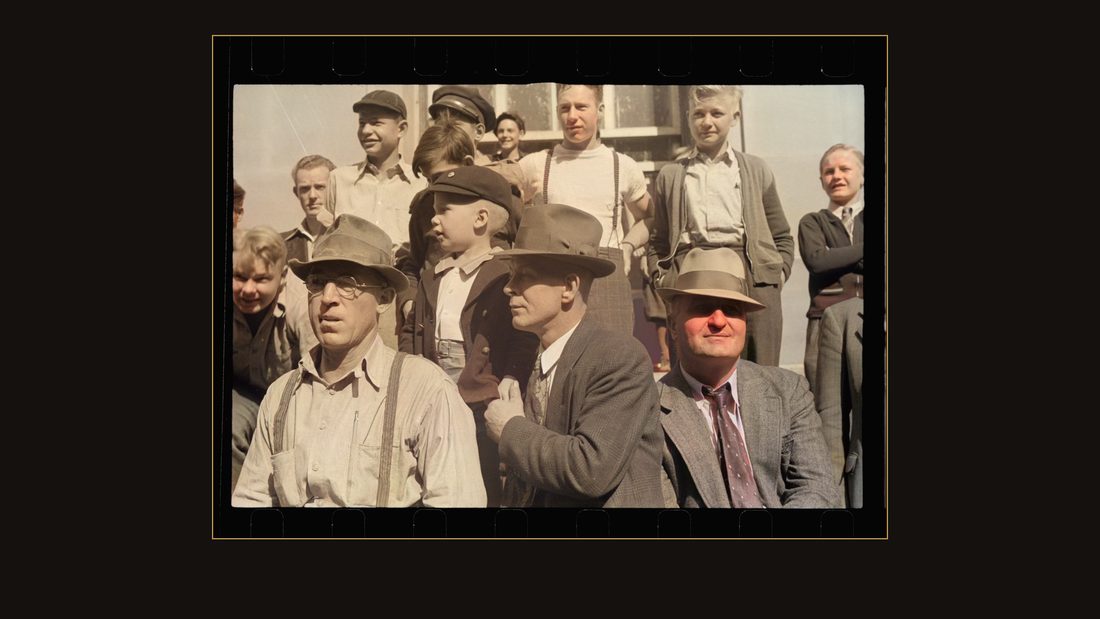
R25 Spectators at Cincinnati sesquicentennial parade, Cincinnati, Ohio
John Vachon · October 1938 · Library of Congress · FSA/OWI · AI-colorized. View the original.
Then the sesquicentennial parade. He mostly photographed the crowd, not the floats.
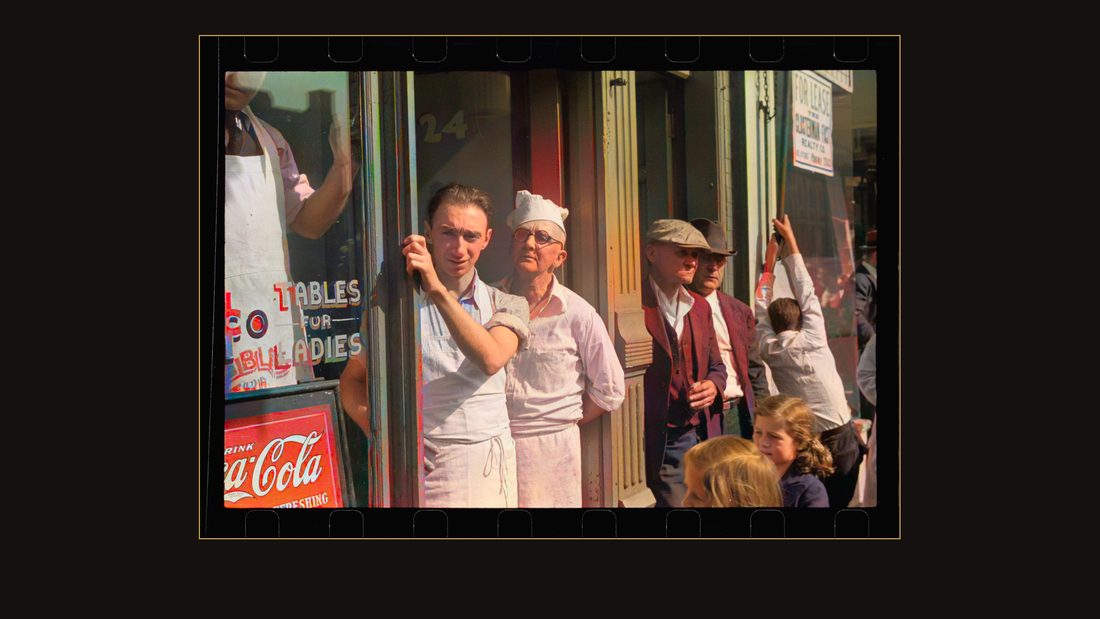
R27 Waiter and chef watching Cincinnati's sesquicentennial parade, Cincinnati, Ohio
John Vachon · October 1938 · Library of Congress · FSA/OWI · AI-colorized. View the original.
A waiter and a chef, out on the sidewalk in their whites. His caption: watching Cincinnati's sesquicentennial parade.
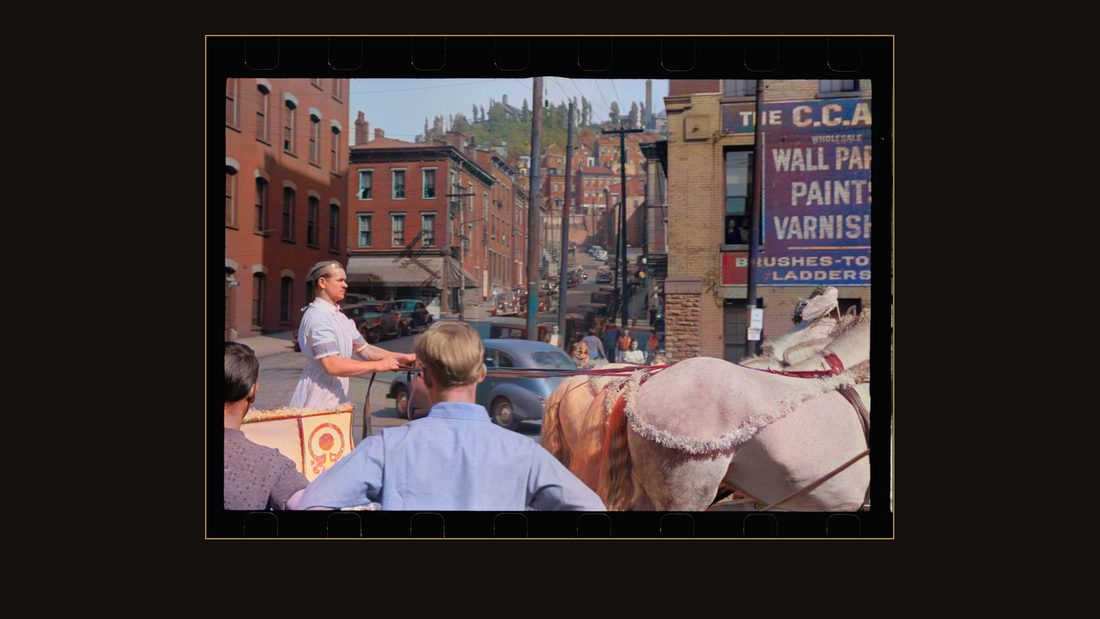
R28 Roman chariot at the tail end of the sesquicentennial, Cincinnati, Ohio
John Vachon · October 1938 · Library of Congress · FSA/OWI · AI-colorized. View the original.
A Roman chariot at the tail end of the parade, waiting on a bus.
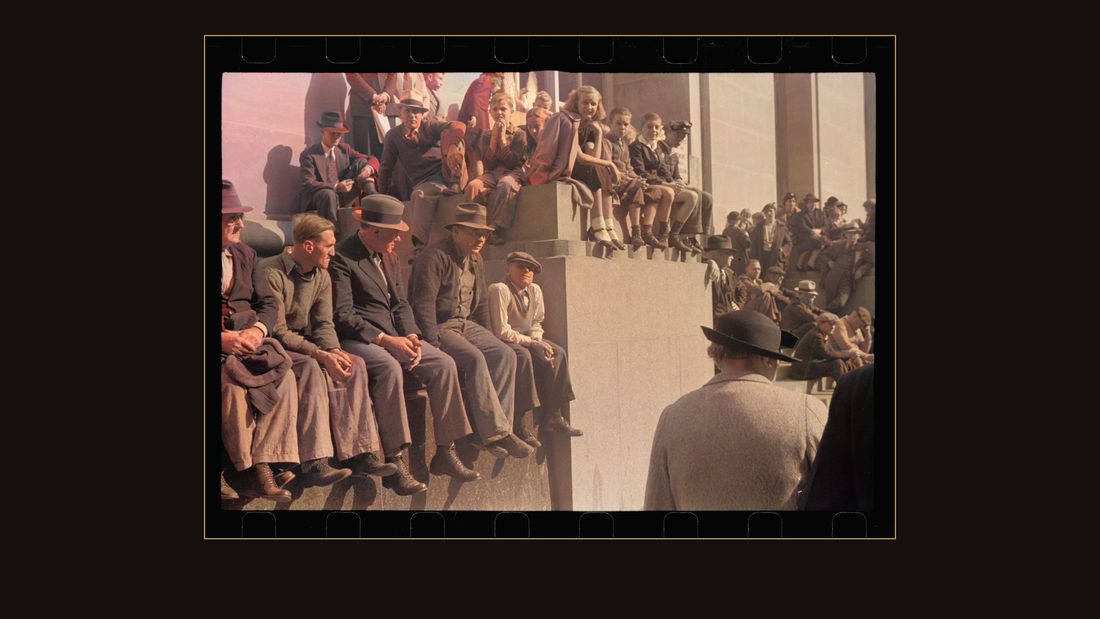
R30 Piled up on the post office to watch the parade go by. Cincinnati, Ohio
John Vachon · October 1938 · Library of Congress · FSA/OWI · AI-colorized. View the original.
Boys piled up on the post office to watch it all go by.
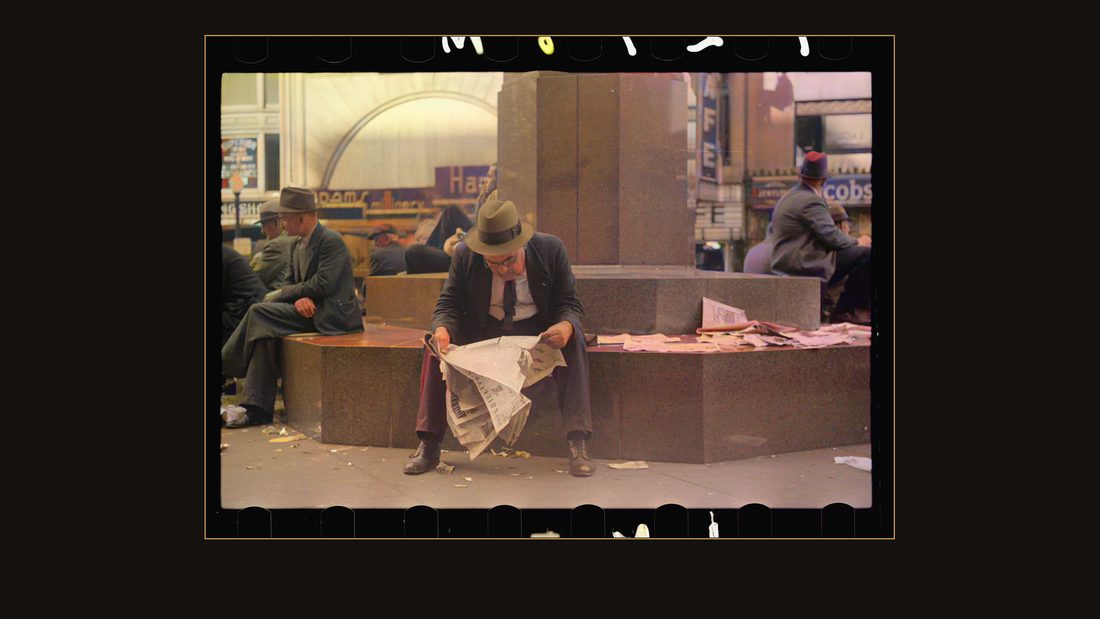
R31 Man reading newspaper in Fountain Square, Cincinnati, Ohio
John Vachon · October 1938 · Library of Congress · FSA/OWI · AI-colorized. View the original.
And when it was over — a man alone with his newspaper on Fountain Square, among the pigeons.
Across the river, 1939
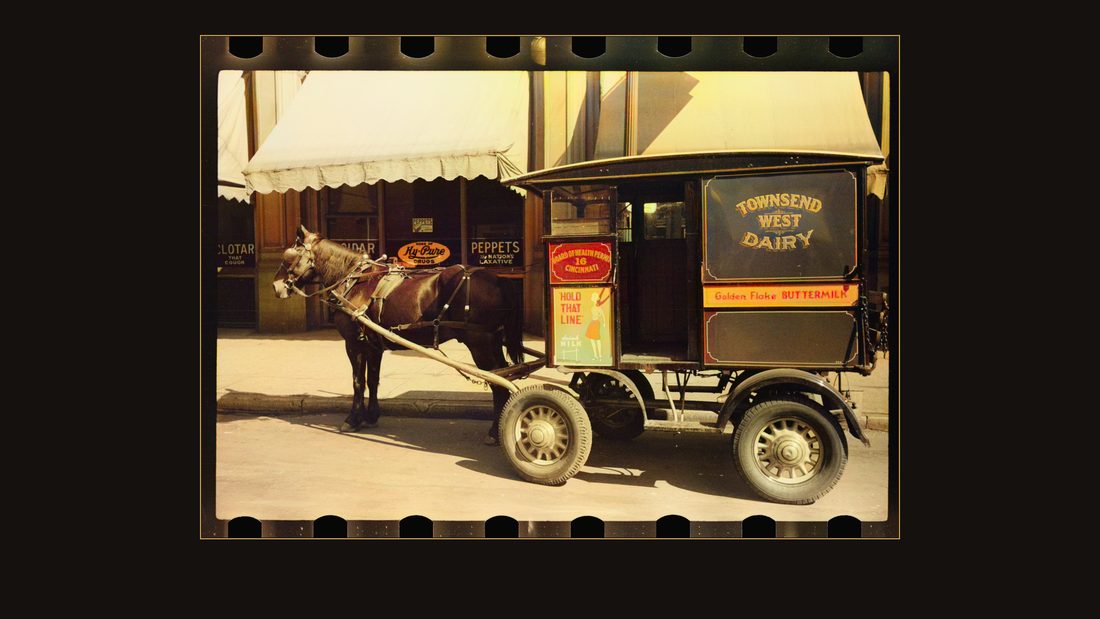
R32 Cincinnati, Ohio. Milk wagon.
John Vachon · September 1939 · Library of Congress · FSA/OWI · AI-colorized. View the original.
September, nineteen thirty-nine. Milk in downtown Cincinnati still came behind a horse.
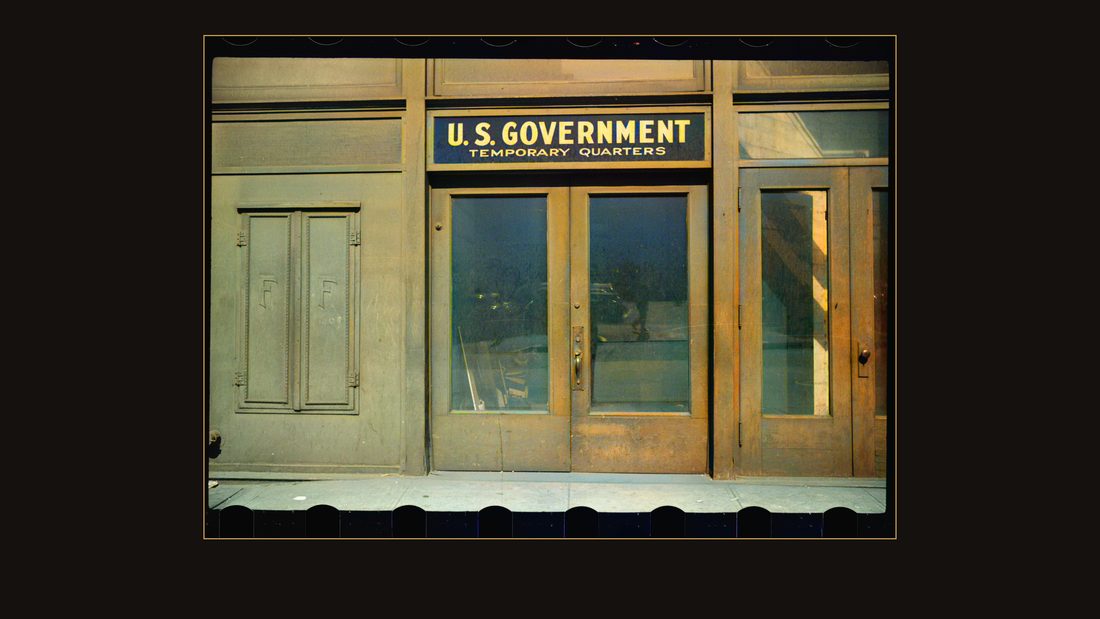
R33 Doorway, Cincinnati, Ohio
John Vachon · September 1939 · Library of Congress · FSA/OWI · AI-colorized. View the original.
A doorway downtown, lettered: U.S. Government, temporary quarters.
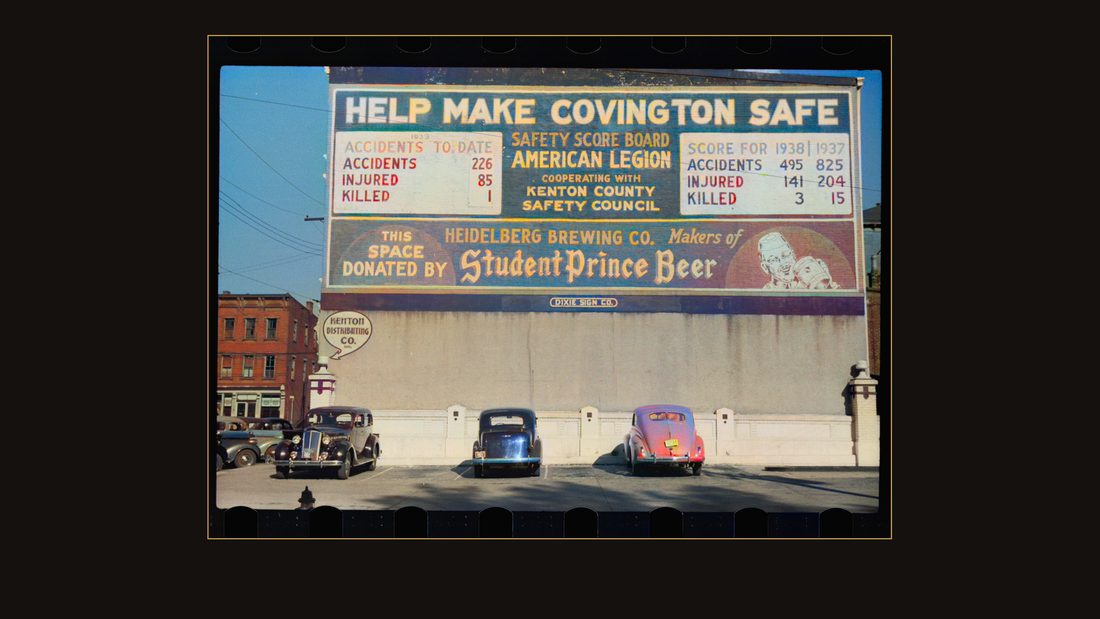
R34 Parking lot, Covington, Kentucky. Sign on building: Help make Covington safe
John Vachon · September 1939 · Library of Congress · FSA/OWI · AI-colorized. View the original.
Across the river in Covington, a billboard kept score of the county's traffic dead — accidents, injured, killed, this year against last — space donated, the sign says, by a brewing company. Help make Covington safe.
R35 Covington, Kentucky, street corner, 3:33 p.m.
John Vachon · September 1939 · Library of Congress · FSA/OWI · AI-colorized. View the original.
The street corner from the start of this film. Three thirty-three in the afternoon, and the war in Europe three weeks old.
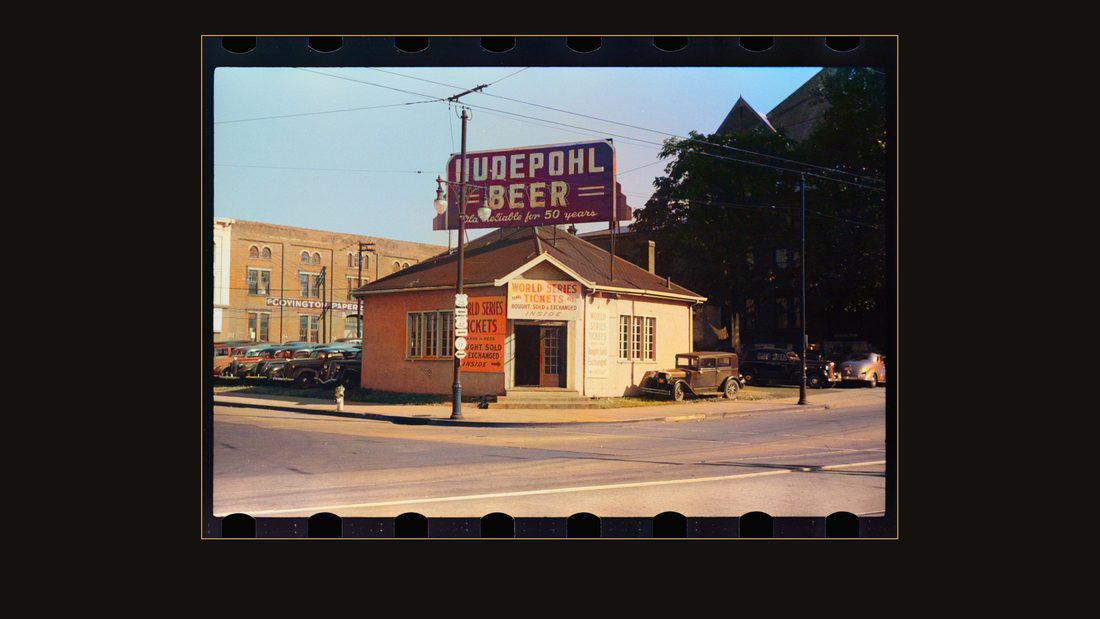
R36 World Series ticket dealer, Covington, Kentucky
John Vachon · September 1939 · Library of Congress · FSA/OWI · AI-colorized. View the original.
That same month the Reds clinched the pennant — Cincinnati's first World Series since nineteen nineteen. In Covington, Vachon photographed this man and captioned him in three words: World Series ticket dealer.
![[Untitled photo, possibly related to: Milk wagon, Cincinnati, Ohio]](img/R37.jpg)
R37 [Untitled photo, possibly related to: Milk wagon, Cincinnati, Ohio]
John Vachon · September 1939 · Library of Congress · FSA/OWI · AI-colorized. View the original.
The suspension bridge over to Cincinnati. The file goes quiet here for two years. When it picks up again, everything in it has been drafted.
Conversion
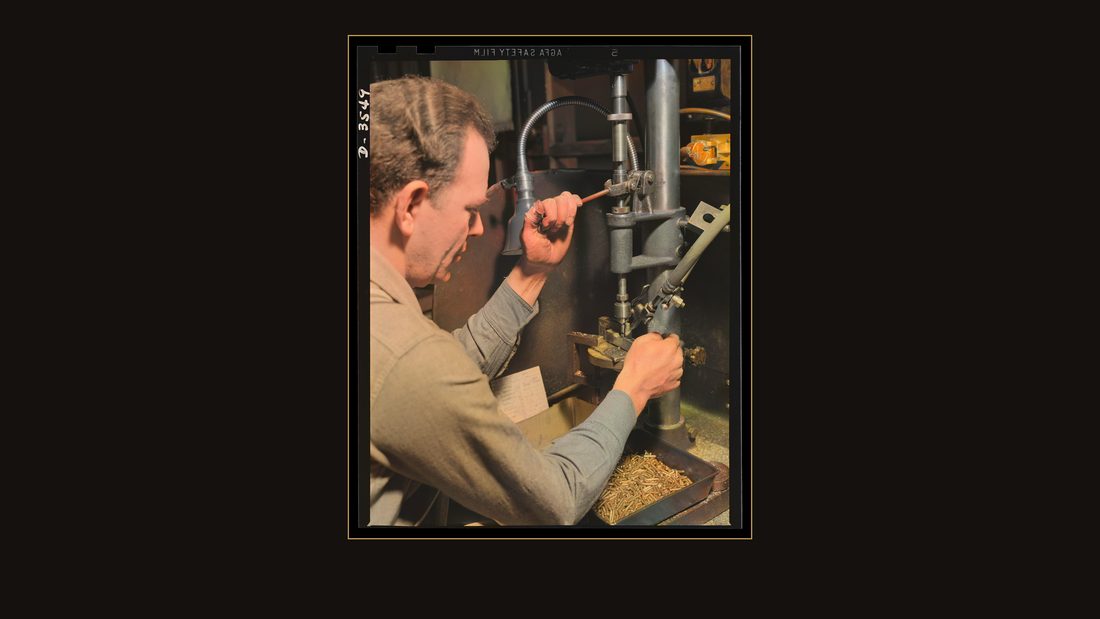
R38 Conversion. Watch cases to war production. Volunteers for Victory. The fine machinery and skilled operators of a commercial watch case factory are now producing precision radio parts for the armed forces. Wadsworth Watch Company, Louisville [i.e. Dayton] , Kentucky
Alfred T. Palmer · February 1942 · Library of Congress · FSA/OWI · AI-colorized. View the original.
February, nineteen forty-two. Dayton, Kentucky, on the riverbank east of Covington. The Wadsworth watch case factory — cases, compacts, luxury goods in brass — photographed for a government series titled: Conversion. Watch cases to war production.
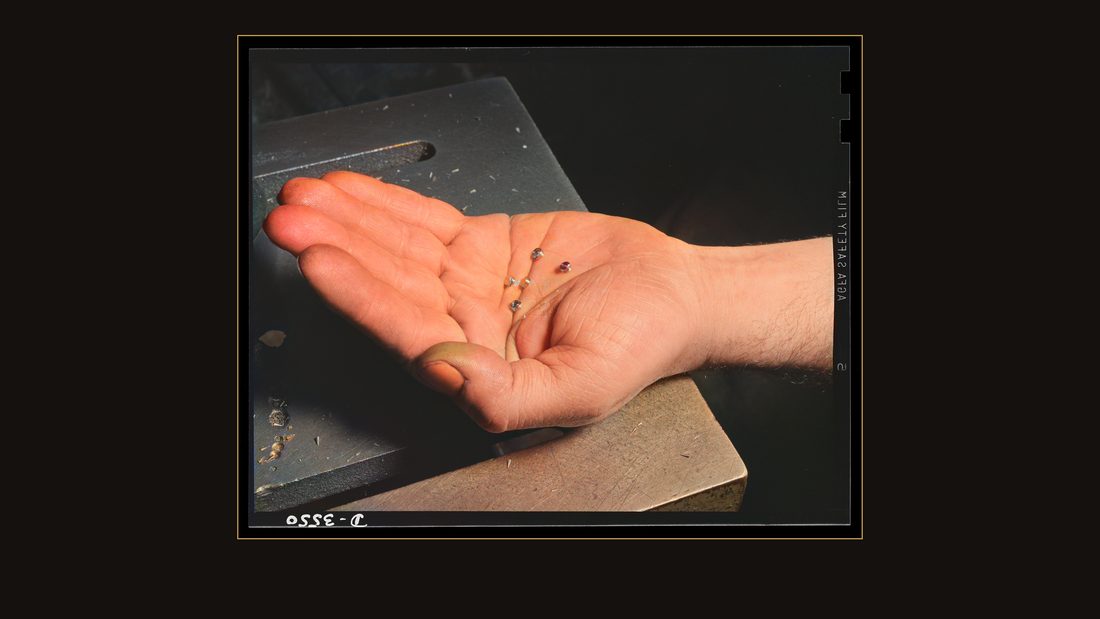
R39 Conversion. Watch cases to war production. Little giants. Tiny fuse baffles, vital to victory, are produced for the Picatinny Arsenal in a Kentucky plant that formerly made watch cases. Wadsworth Watch Company, Louisville [i.e. Dayton], Kentucky
Alfred T. Palmer · February 1942 · Library of Congress · FSA/OWI · AI-colorized. View the original.
In a workman's palm, the new product. The caption calls them little giants — tiny fuse baffles, vital to victory, made for the Picatinny Arsenal.
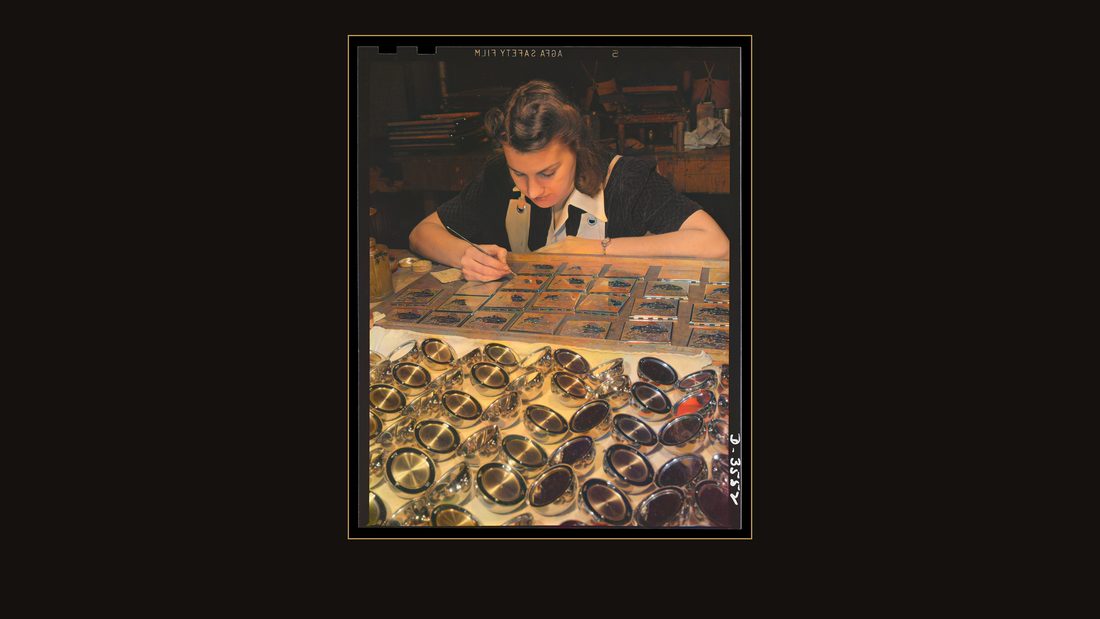
R40 Conversion. Watch cases to war production. The last of the compacts. When the operator has finished decorating the last batch of novelty compacts going through a converted watch case factory, she'll help the plant turn out war essentials. Wadsworth Watch Company, Louisville [i.e. Dayton], Kentucky
Alfred T. Palmer · February 1942 · Library of Congress · FSA/OWI · AI-colorized. View the original.
The last of the compacts. When the operator finishes decorating this batch, the caption says, she'll head for the war production end of the plant.
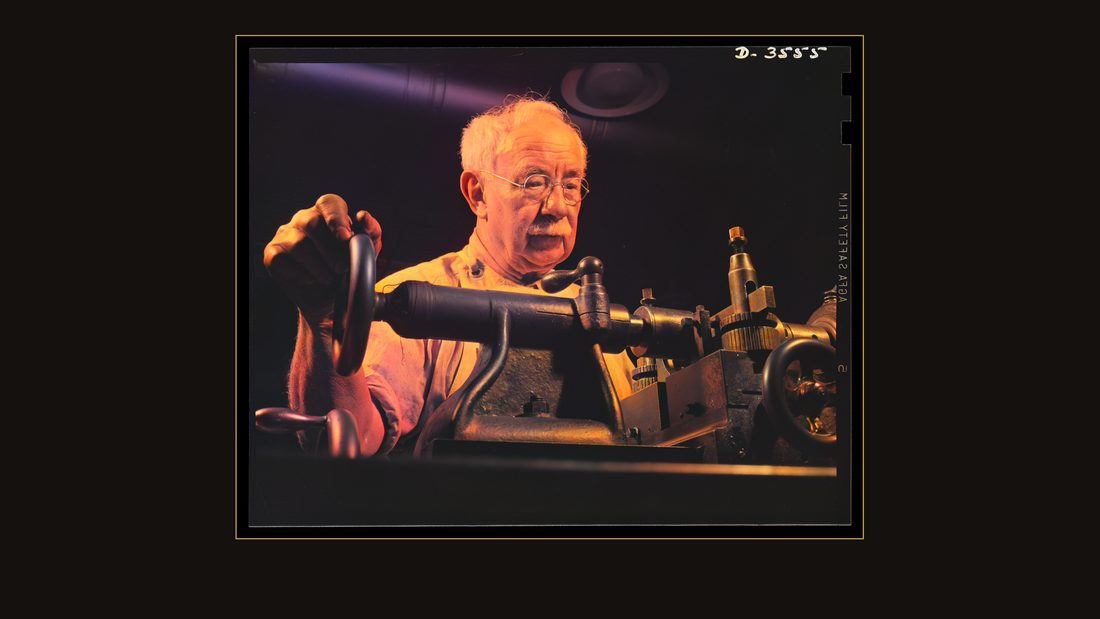
R41 Conversion. Watch cases to war production. His hair is white, but his eye is keen. Fifty years of precision work for a Kentucky watch-case manufacturer, now converted to war production, gave this artisan rare skill in developing fine dies for the arsenal of democracy. Wadsworth Watch Company, Louisville [i.e. Dayton], Kentucky
Alfred T. Palmer · February 1942 · Library of Congress · FSA/OWI · AI-colorized. View the original.
Of this machinist, the government's caption writer says: his hair is white, but his eye is keen. Fifty years of precision work.
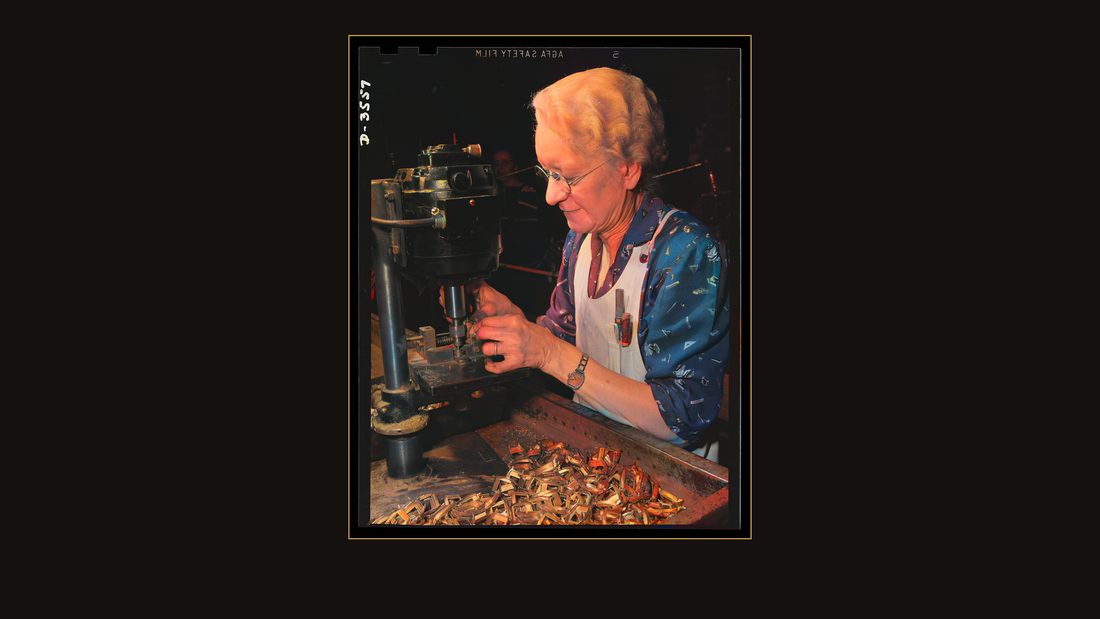
R42 Conversion. Watch cases to war production. Another skilled worker "enlists" for the duration. When the Kentucky watch case factory for whom she has worked twenty years converted to war production, this lady was ready to join the procession of war workers. Wadsworth Watch Company, Louisville [i.e. Dayton], Kentucky
Alfred T. Palmer · February 1942 · Library of Congress · FSA/OWI · AI-colorized. View the original.
Of this operator, twenty years at the plant: another skilled worker enlists for the duration.
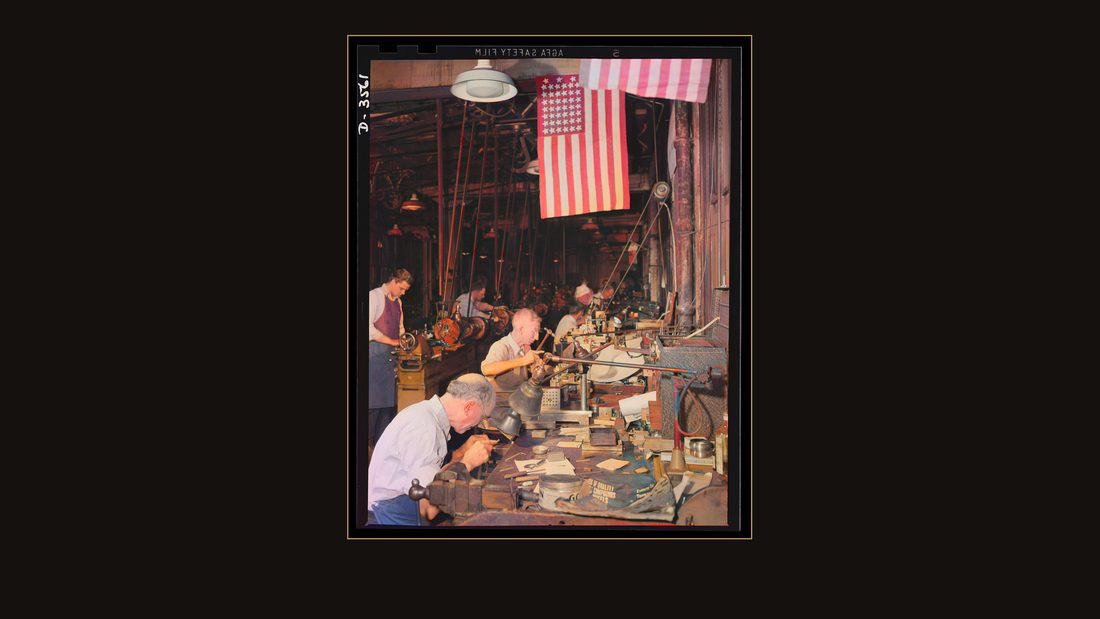
R43 Conversion. Watch cases to war production. Conversion, all the day. The fourty-five star flag above a worker in a converted watch case factory marks a soldier of the firing line of '98, now a soldier of the production line of '42. The plant makes small carbine and machine gun parts, compass cases and radio parts for our armed forces. Wadsworth Watch Company, Louisville [i.e. Dayton], Kentucky
Alfred T. Palmer · February 1942 · Library of Congress · FSA/OWI · AI-colorized. View the original.
Above one bench hangs a forty-five star flag. Its owner, the caption says, was a soldier of the firing line of ninety-eight — now a soldier of the production line of forty-two.
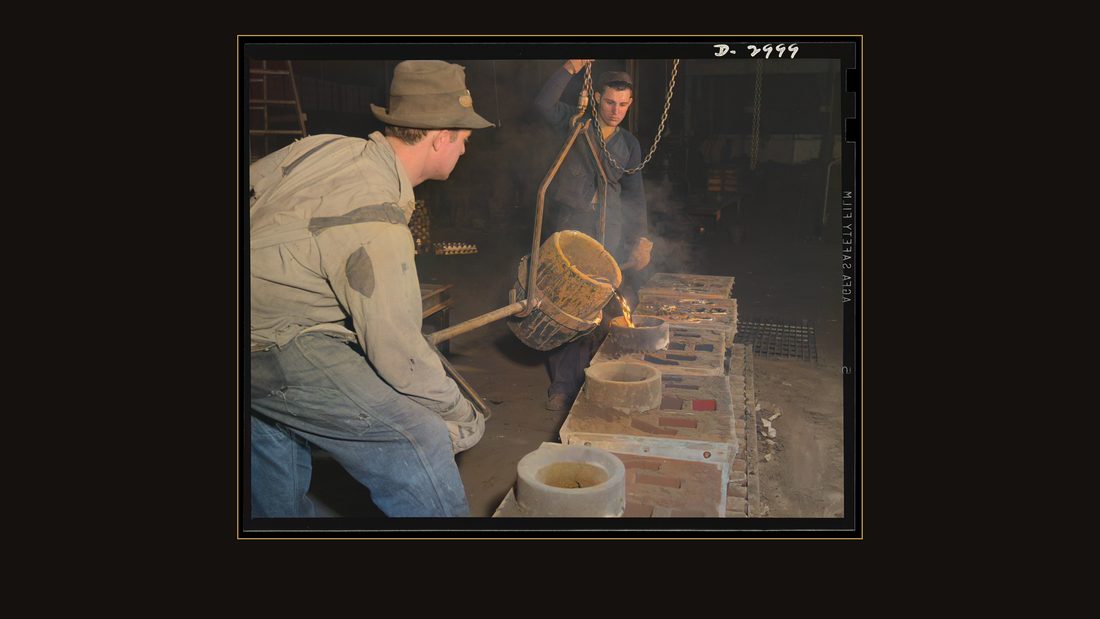
R44 Aluminum casting. Experienced workers in an aluminum plant, converted to production of essential articles for America's armed forces, pictured pouring the molten aluminum alloy into molds. Aluminum Industries Inc., Cincinnati, Ohio
Alfred T. Palmer · February 1942 · Library of Congress · FSA/OWI · AI-colorized. View the original.
Across the river at Aluminum Industries Incorporated of Cincinnati, the same month. Molten aluminum going into sand molds.
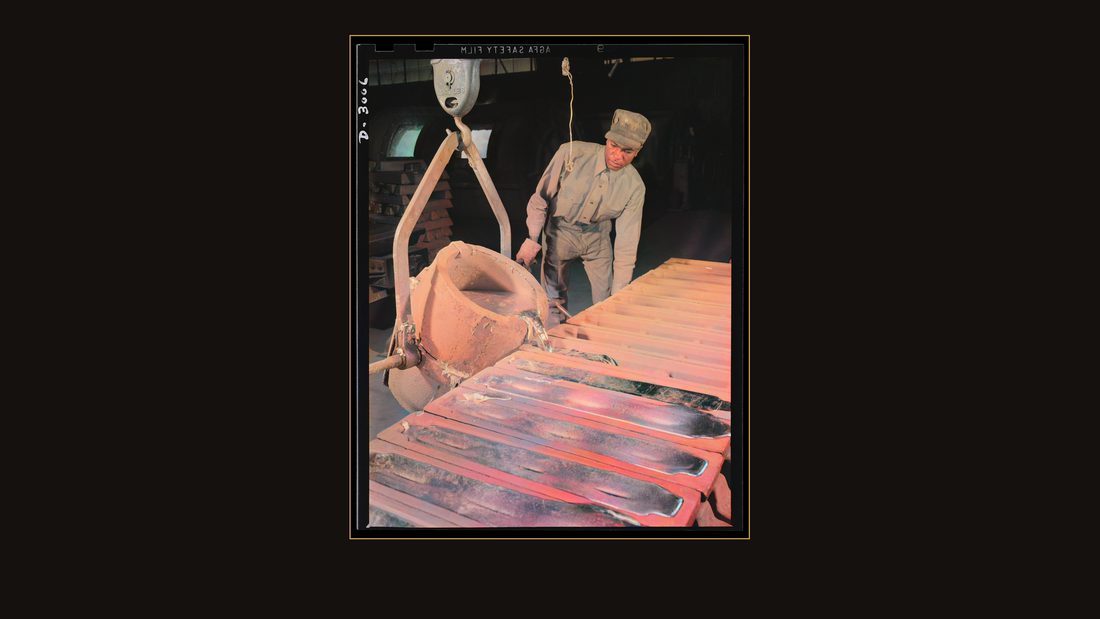
R45 Aluminum casting. Bright white hot aluminum, vital to Uncle Sam's war effort, discharged from carrying pot into ingot molds. Aluminum Industries Inc., Cincinnati, Ohio
Alfred T. Palmer · February 1942 · Library of Congress · FSA/OWI · AI-colorized. View the original.
The caption: bright white hot aluminum, vital to Uncle Sam's war effort.
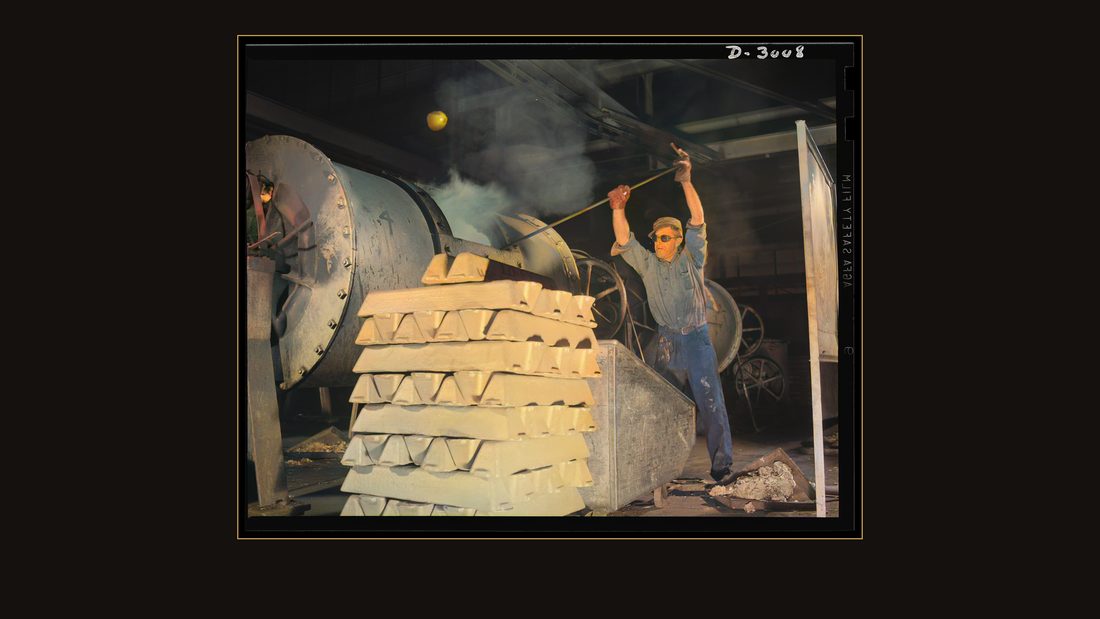
R46 Aluminum casting. Ingots of aluminum, rejected for slight imperfection are shoveled back into a furnace to be recast. Here a worker is puddling the 2,000-pound rotary furnace. Aluminum Industries Inc., Cincinnati, Ohio
Alfred T. Palmer · February 1942 · Library of Congress · FSA/OWI · AI-colorized. View the original.
Ingots rejected for slight imperfection, shoveled back into the furnace to try again.
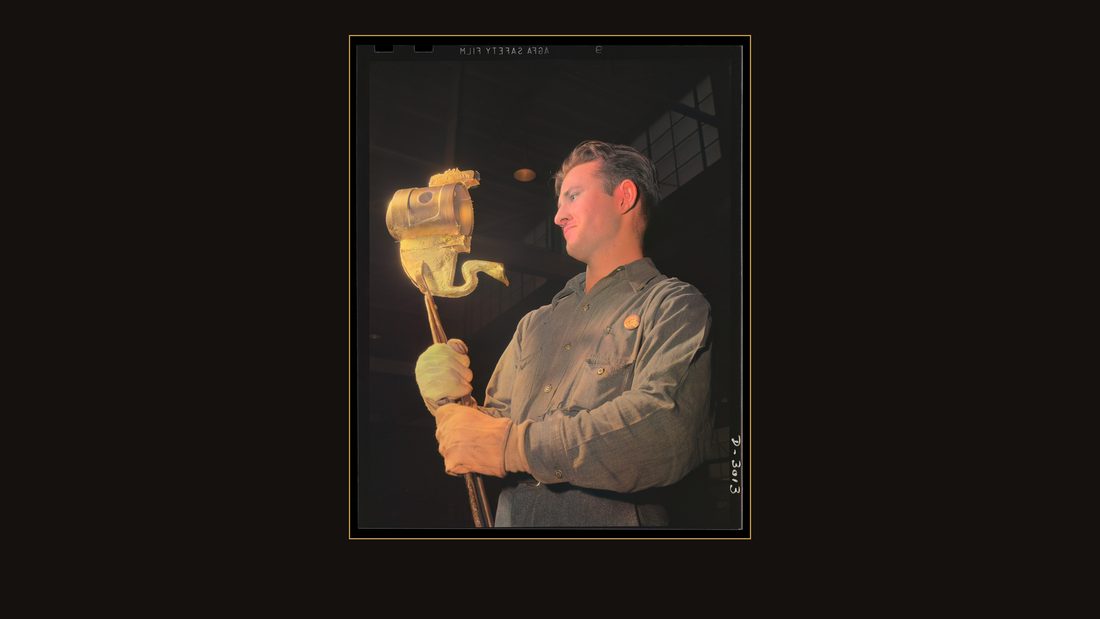
R47 Aluminum casting. These castings are being loaded onto a sandblast table prior to the actual sandblasting operation. Conversion of this large Midwest aluminum foundry to production of war essentials has already taken place. This factory is producing aluminum equipment for Uncle Sam's war effort, under subcontract to other factories producing war items. Destination of the finished aluminum products is kept secret, but they'll probably end up as jeeps and airplane engines. Aluminum Industries Inc., Cincinnati, Ohio
Alfred T. Palmer · February 1942 · Library of Congress · FSA/OWI · AI-colorized. View the original.
Castings headed for the sandblast table.
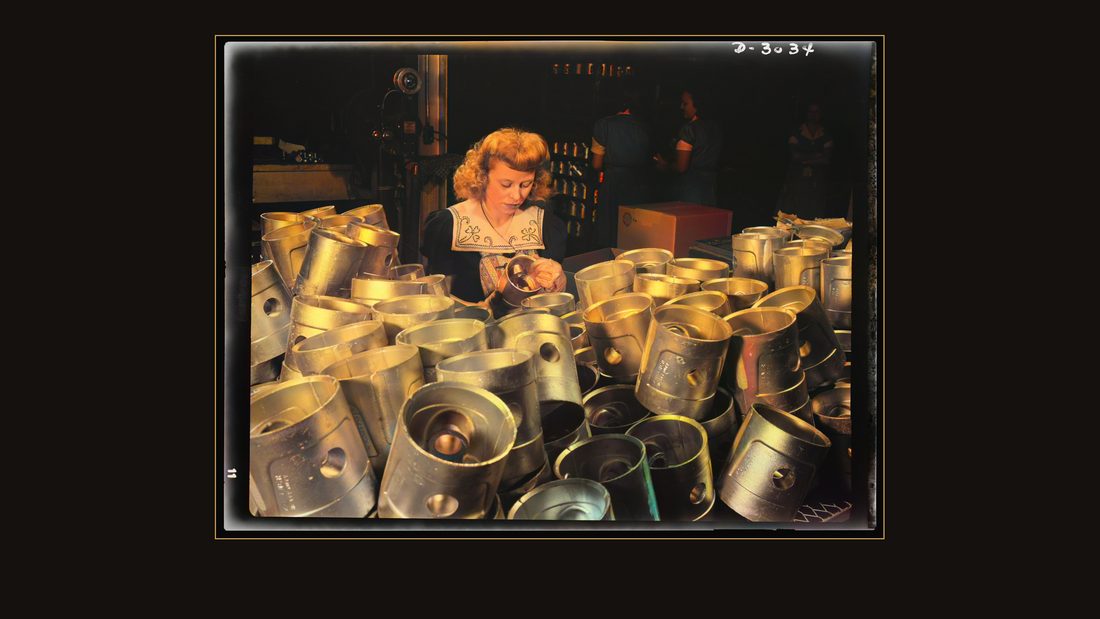
R48 Aluminum casting. Womens' place in this large Midwest aluminum factory is on the inspection line. She's giving a final checkup on these aluminum pistons which are destined for use by America's armed forces. Destination of the finished aluminum products is kept secret. They'll probably end up as jeep or airplane engine parts. Aluminum Industries Inc., Cincinnati, Ohio
Alfred T. Palmer · February 1942 · Library of Congress · FSA/OWI · AI-colorized. View the original.
And a frame the file titles: women's place in this large Midwest aluminum factory.
The river at war
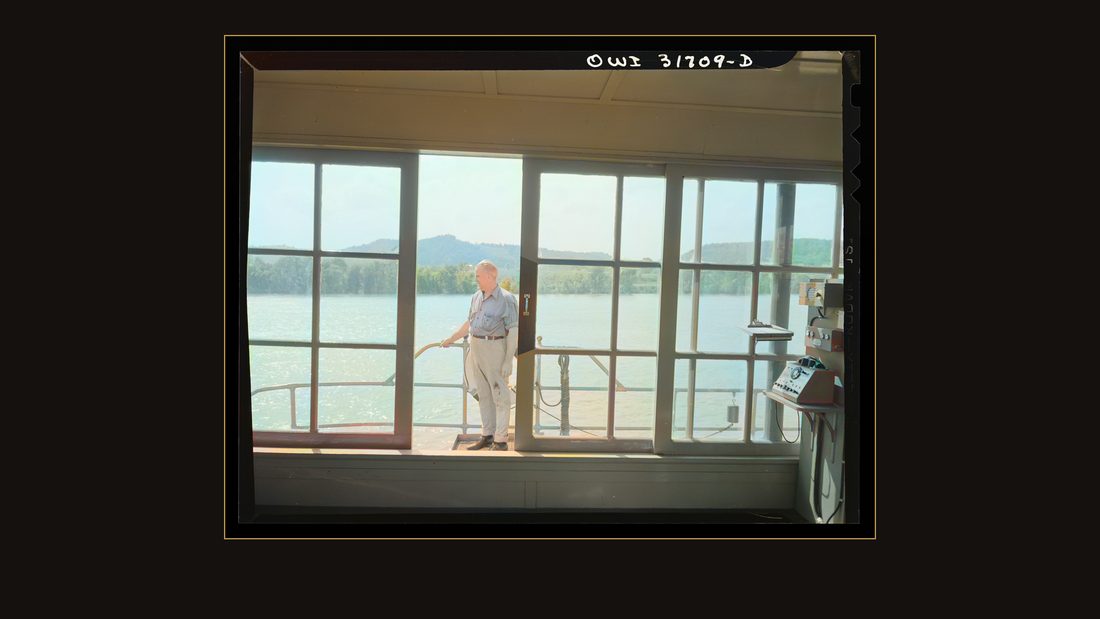
R49 The side of the pilot house of the towboat Ernest T. Weir going down the Ohio River to Cincinnati
Arthur S. Siegel · June 1943 · Library of Congress · FSA/OWI · AI-colorized. View the original.
June, nineteen forty-three. Arthur Siegel rode a towboat called the Ernest T. Weir down the Ohio to Cincinnati, and photographed the whole run.
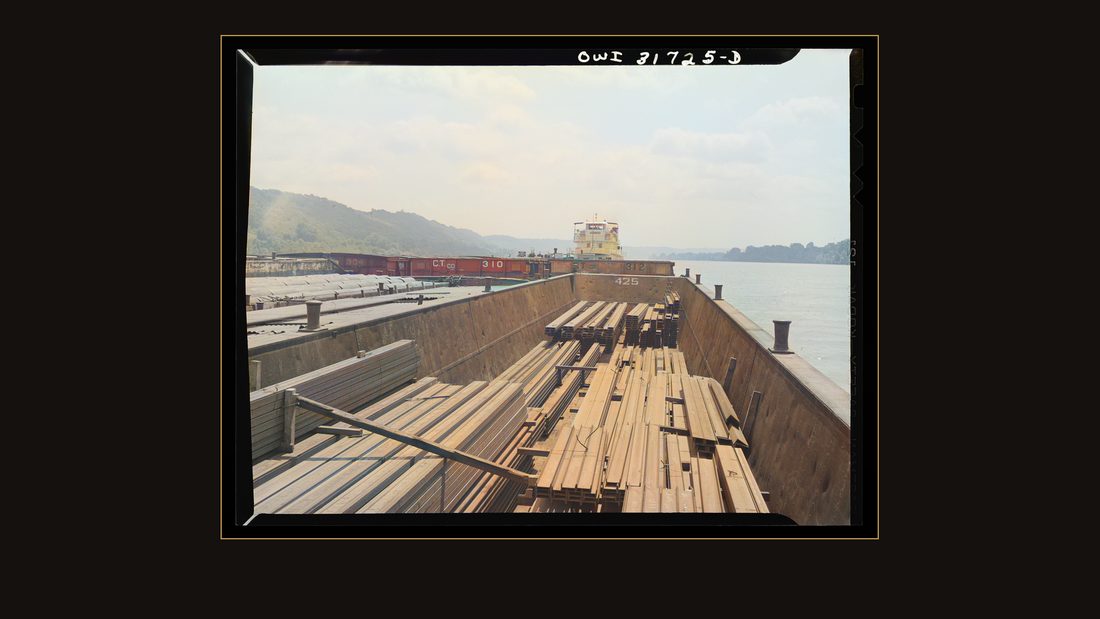
R50 The cargo of steel girders in a barge going down the Ohio River to Cincinnati
Arthur S. Siegel · June 1943 · Library of Congress · FSA/OWI · AI-colorized. View the original.
The tow ahead of her: barges of steel girders.
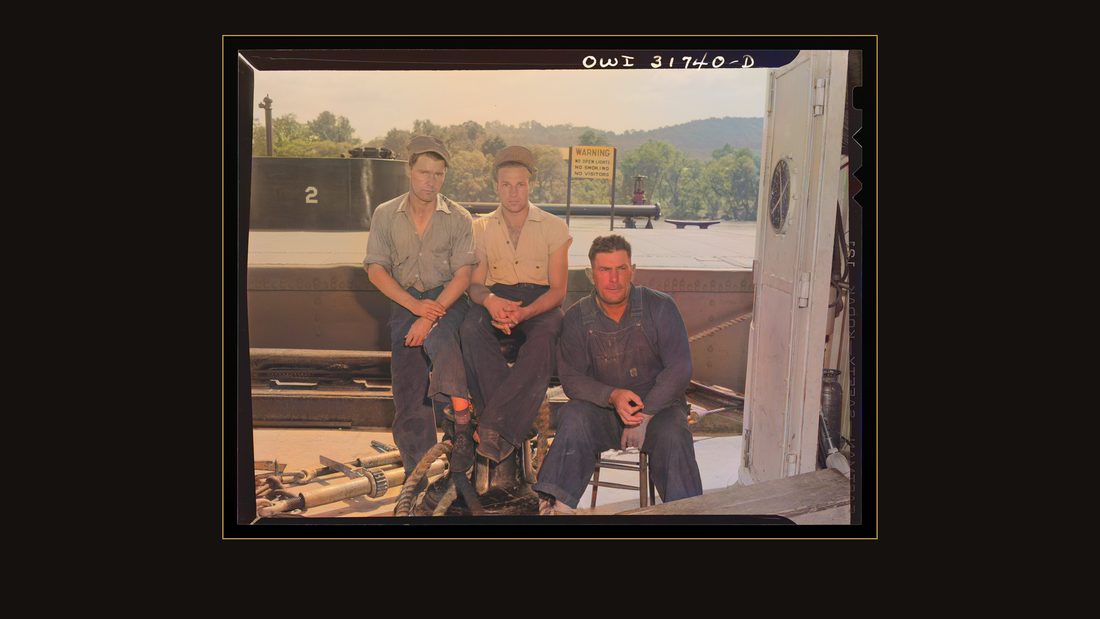
R52 Deckhands aboard the towboat Ernest T. Weir going down the Ohio River to Cincinnati
Arthur S. Siegel · June 1943 · Library of Congress · FSA/OWI · AI-colorized. View the original.
The deckhands.
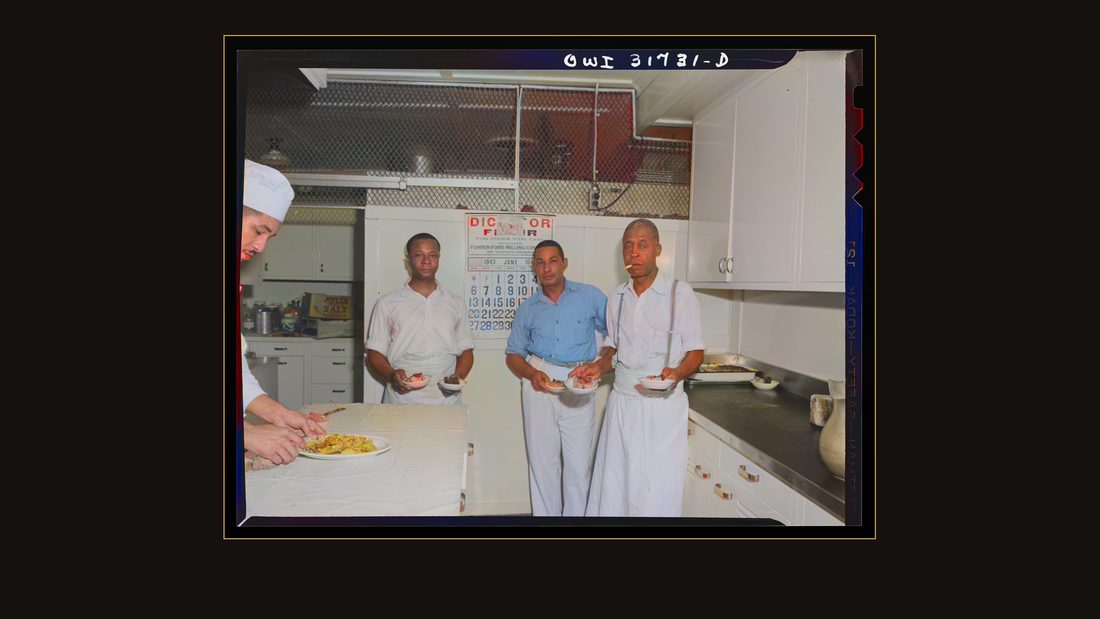
R51 Cooks aboard the towboat Ernest T. Weir going down the river on the way to Cincinnati
Arthur S. Siegel · June 1943 · Library of Congress · FSA/OWI · AI-colorized. View the original.
The cooks.
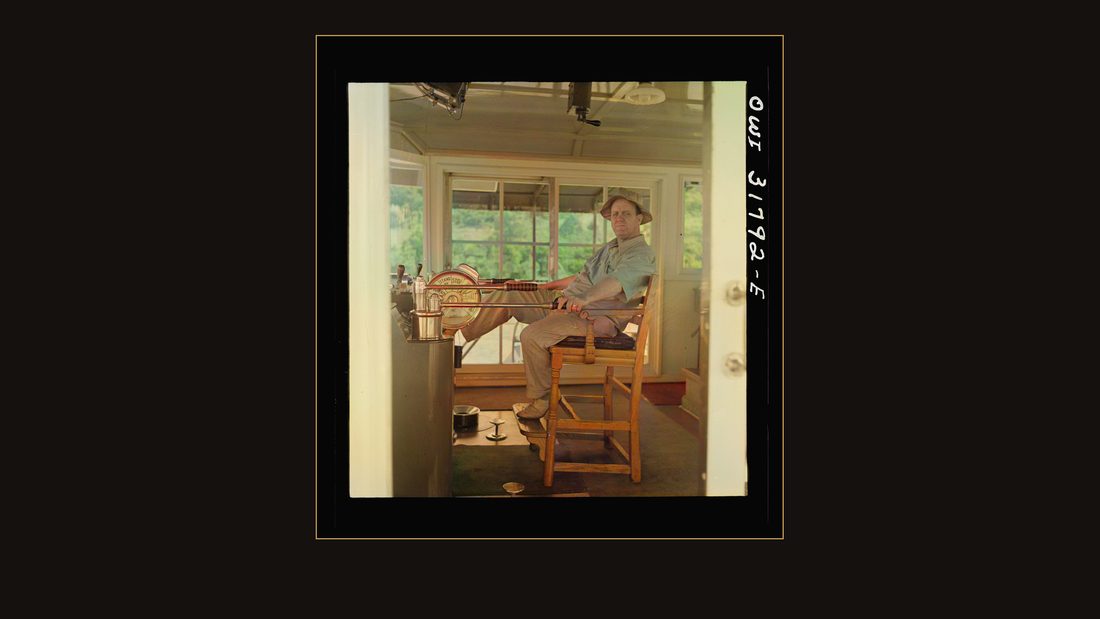
R56 The pilot of the towboat Ernest T. Weir going down the Ohio River to Cincinnati
Arthur S. Siegel · June 1943 · Library of Congress · FSA/OWI · AI-colorized. View the original.
The pilot.
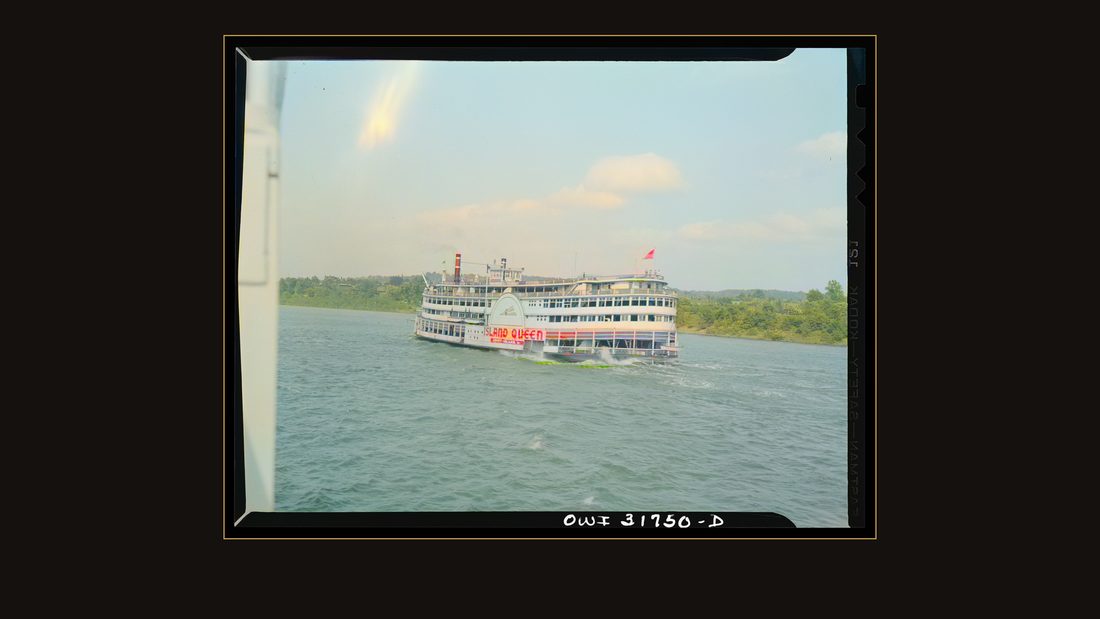
R53 Cincinnati (vicinity), Ohio. The pleasure boat Island Queen on the Ohio River
Arthur S. Siegel · June 1943 · Library of Congress · FSA/OWI · AI-colorized. View the original.
Near the city, the excursion boat Island Queen crossed her bow — a side-wheeler, still working the river.
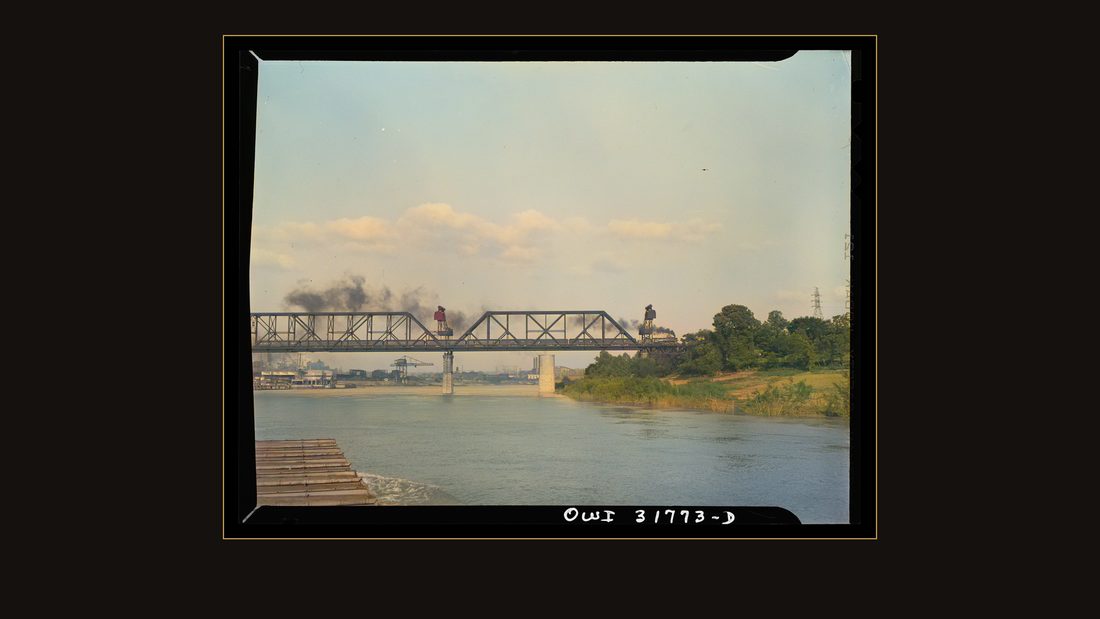
R55 Cincinnati, Ohio. A train crossing the Cincinnati bridge as seen from the towboat Ernest T. Weir on the Ohio River
Arthur S. Siegel · June 1943 · Library of Congress · FSA/OWI · AI-colorized. View the original.
A train on the Cincinnati bridge, shot from the water.
The war kitchen
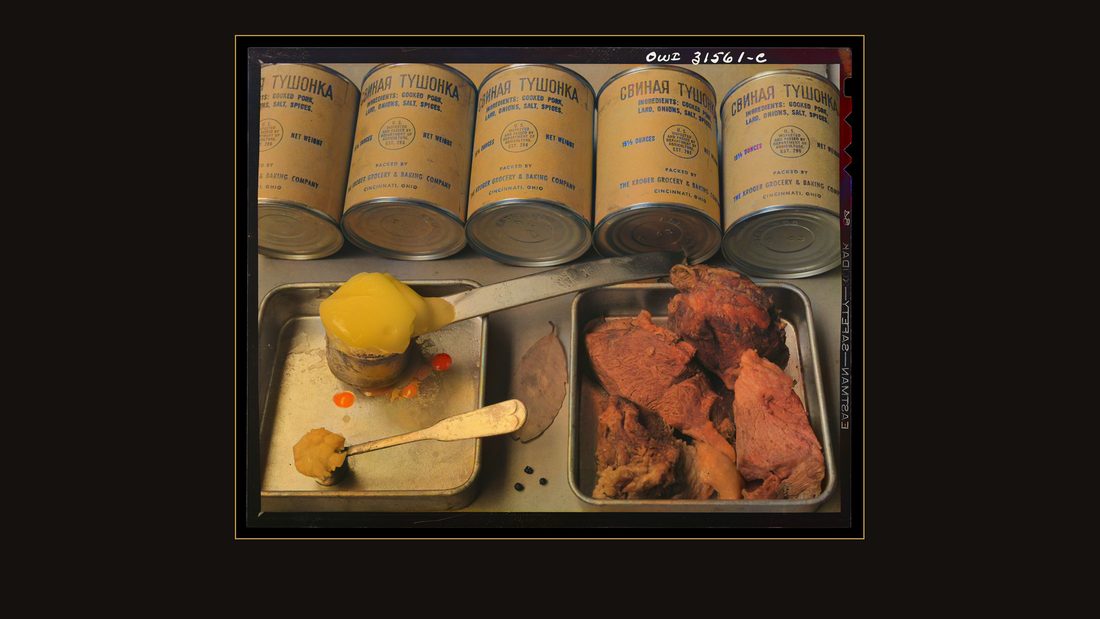
R57 Cincinnati, Ohio. Preparing canned pork (Russian: "svinaia tushonka") for lend-lease shipment to the USSR at the Kroger grocery and baking company. One pound of pork, lard, onions, and spice go into each can
Howard R. Hollem · June 1943 · Library of Congress · FSA/OWI · AI-colorized. View the original.
The same June, in a Kroger plant in the city, pork was going into cans stencilled in Russian: svinaia tushonka. Lend-lease rations, bound for the Soviet Union.
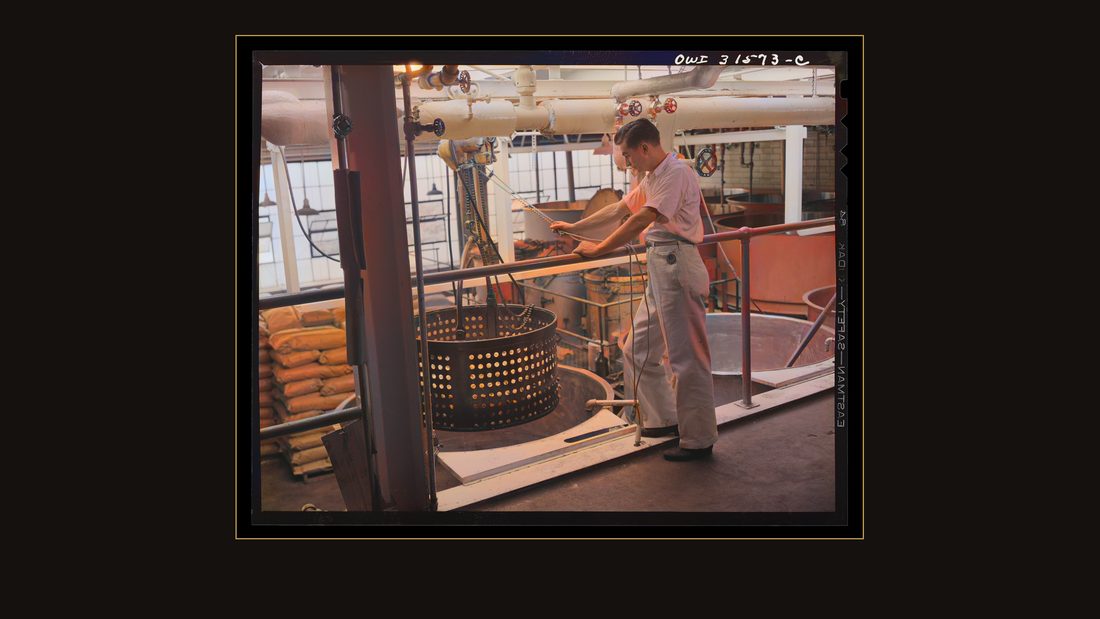
R58 Cincinnati, Ohio. Preparing canned pork (Russian: "svinaia tushonka") for lend-lease shipment to the USSR at the Kroger grocery and baking company. Removing pork after it has been cooked for the twenty percent pre-shrinkage and eight minutes at 180 degrees
Howard R. Hollem · June 1943 · Library of Congress · FSA/OWI · AI-colorized. View the original.
The captions read like a procedure manual — cooked eight minutes at one hundred eighty degrees, treated for twenty percent pre-shrinkage.
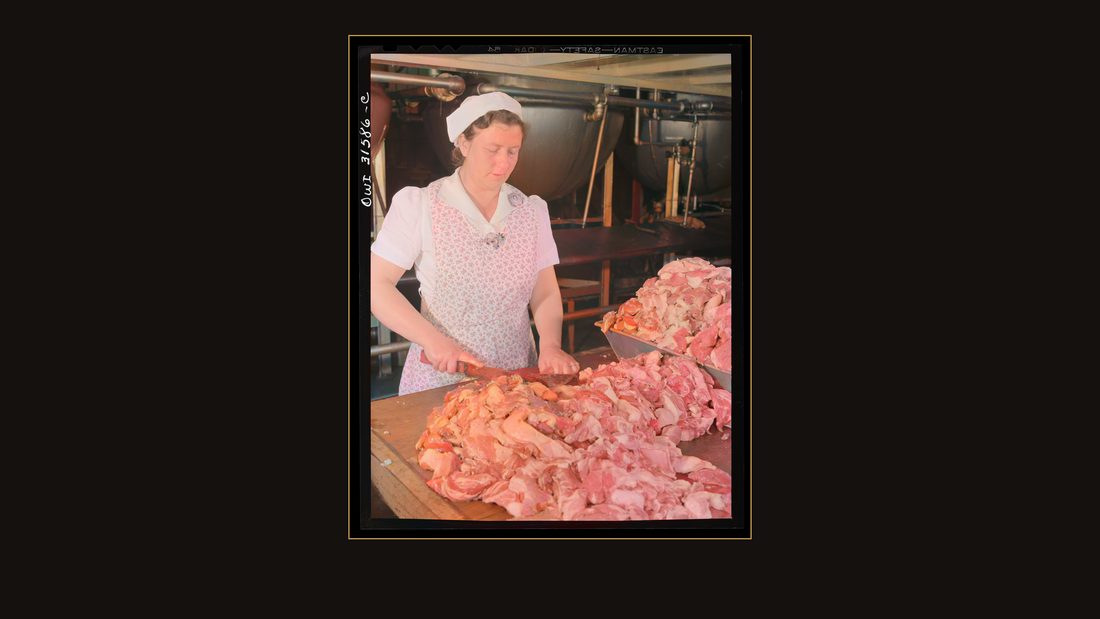
R59 Cincinnati, Ohio. Preparing canned pork (Russian: "svinaia tushonka") for lend-lease shipment to the USSR, at the Kroger grocery and baking company. Mrs. M. Bery, trimming down pork to size before twenty percent pre-shrinkage treatment. Her husband is in defense work, and her three sons are in the United States Army, one in North Africa
Howard R. Hollem · June 1943 · Library of Congress · FSA/OWI · AI-colorized. View the original.
Mrs. M. Bery, trimming down pork to size. The file kept her name.
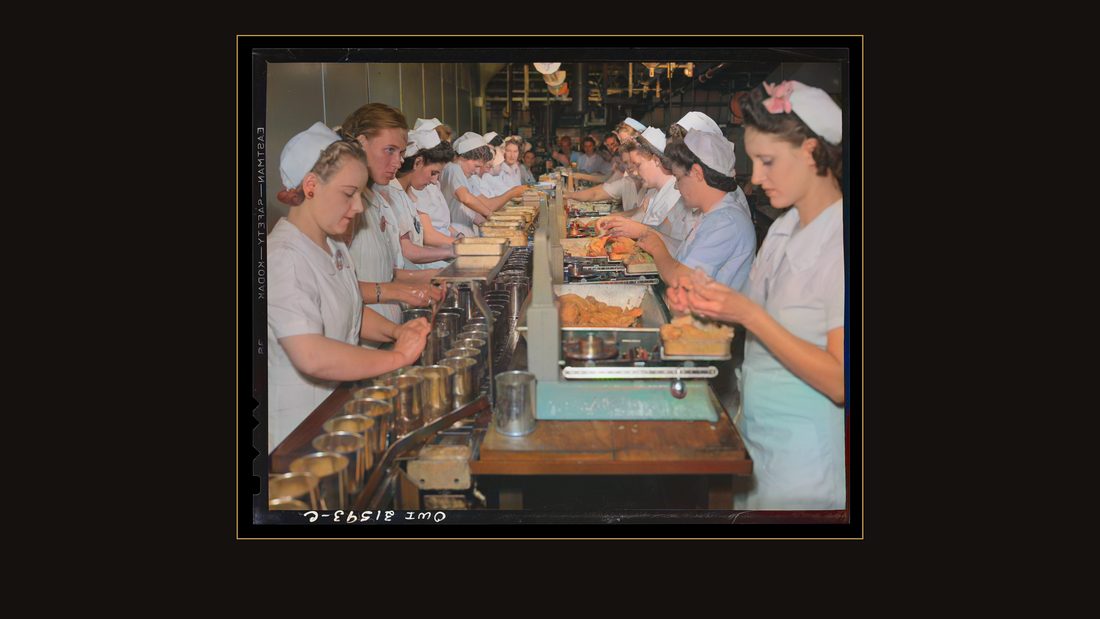
R60 Cincinnati, Ohio. Preparing canned pork (Russian: "svinaia tushonka") for lend-lease shipment to the USSR at the Kroger grocery and baking company
Howard R. Hollem · June 1943 · Library of Congress · FSA/OWI · AI-colorized. View the original.
The canning line.
![[Untitled photo, possibly related to: Proctor [i.e. Procter] and Gamble Distributing Company, Cincinnati, Ohio. Drums of glycerine ready for shipment]](img/R61.jpg)
R61 [Untitled photo, possibly related to: Proctor [i.e. Procter] and Gamble Distributing Company, Cincinnati, Ohio. Drums of glycerine ready for shipment]
Howard R. Hollem · June 1943 · Library of Congress · FSA/OWI · AI-colorized. View the original.
At Procter and Gamble, the soap company explained its war chemistry to the camera: soap has to be made before glycerine can be obtained from the waste fat.
![Proctor [i.e. Procter] and Gamble Distributing Company, Cincinnati, Ohio. Filling a drum with dynamite glycerine](img/R62.jpg)
R62 Proctor [i.e. Procter] and Gamble Distributing Company, Cincinnati, Ohio. Filling a drum with dynamite glycerine
Howard R. Hollem · June 1943 · Library of Congress · FSA/OWI · AI-colorized. View the original.
And the next caption says where the glycerine goes. It reads: filling a drum with dynamite glycerine.
The bus, 1943
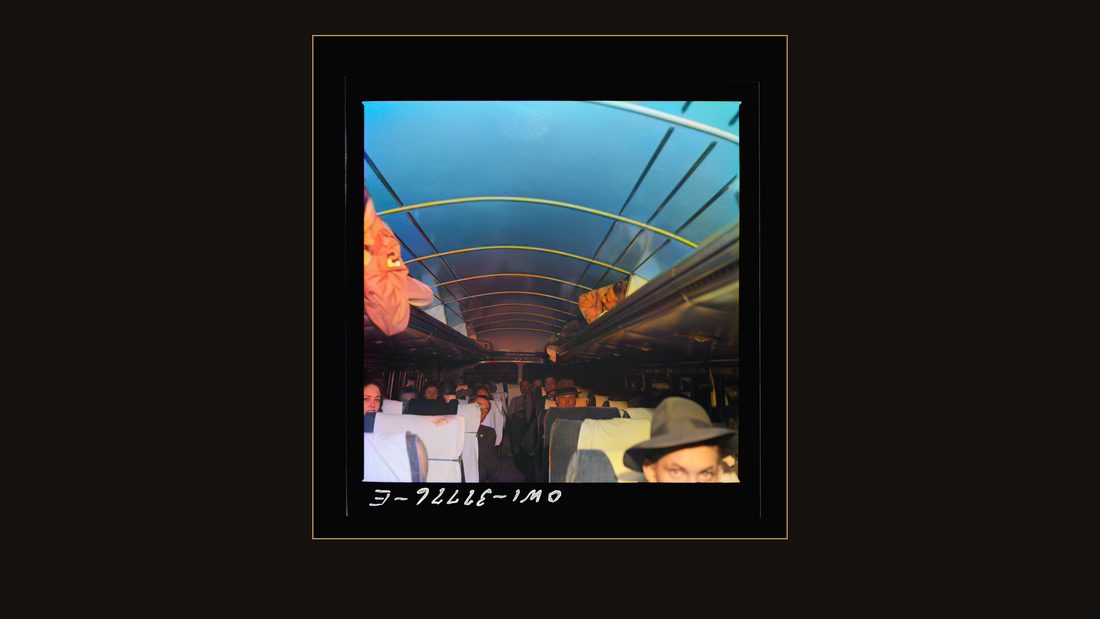
R63 Bus passengers on their way from Cincinnati, Ohio to Louisville, Kentucky on a Greyhound bus
Esther Bubley · September 1943 · Library of Congress · FSA/OWI · AI-colorized. View the original.
September, nineteen forty-three. Esther Bubley — twenty-two years old, hired the year before as a darkroom assistant — was sent out to ride the buses with a camera. Cincinnati to Louisville.
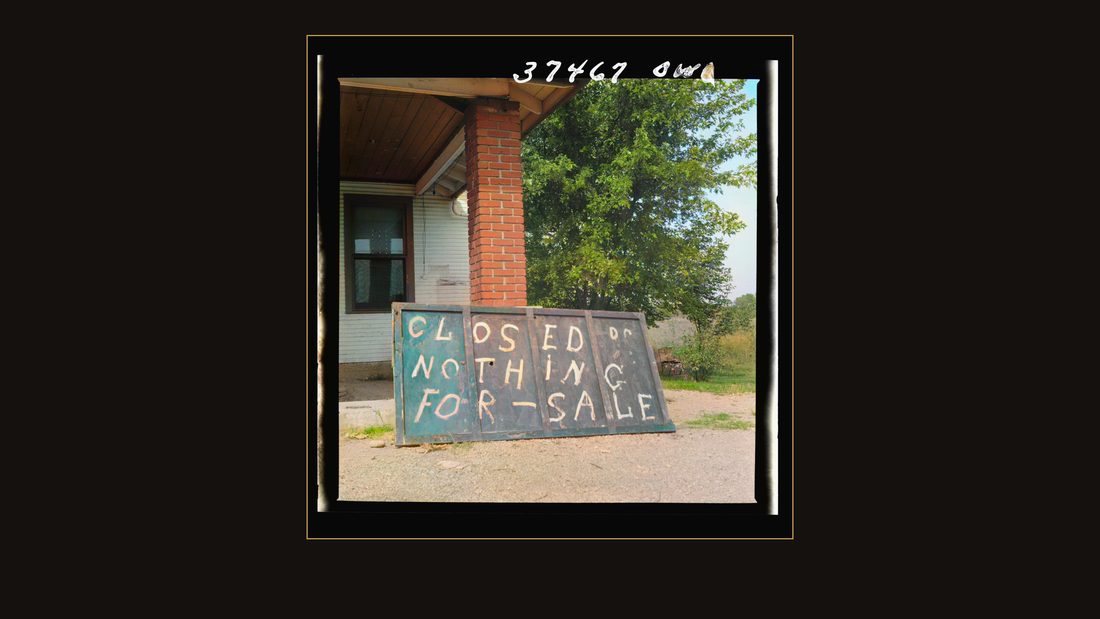
R64 A sign in front of a former gas station on the road between Columbus and Cincinnati, Ohio
Esther Bubley · September 1943 · Library of Congress · FSA/OWI · AI-colorized. View the original.
On the road between Columbus and Cincinnati she shot what the war had done to the roadside. A sign in front of a former gas station: closed, nothing for sale.
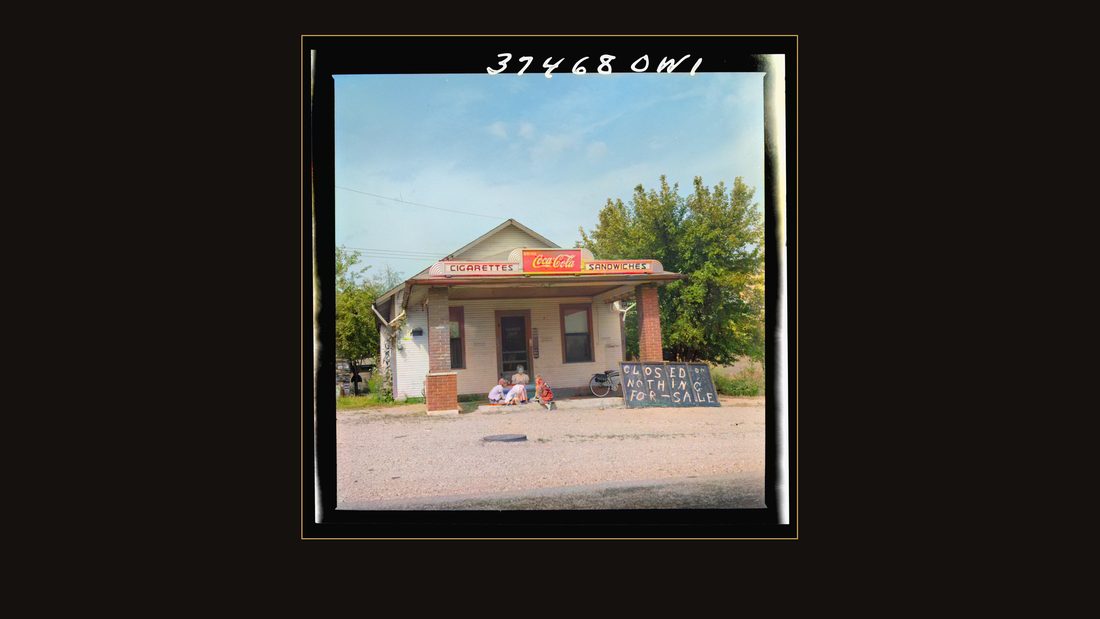
R65 A gas station on the road between Columbus and Cincinnati, Ohio, which is now used as a home. It is only one of many which are so converted
Esther Bubley · September 1943 · Library of Congress · FSA/OWI · AI-colorized. View the original.
Another gas station had become a house — only one of many, her caption says, which are so converted.
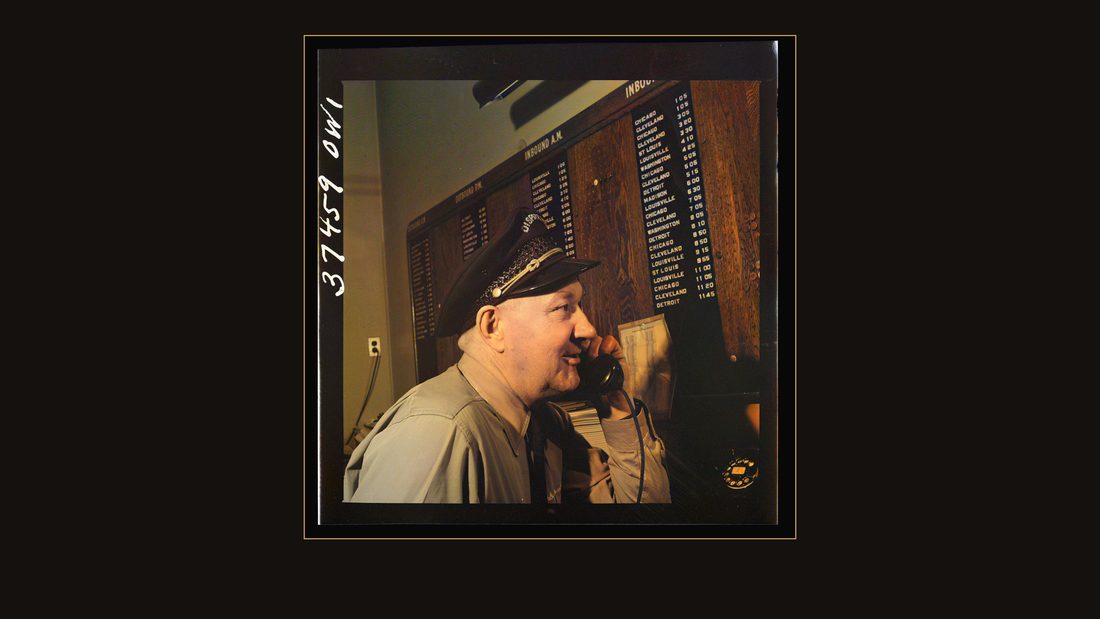
R66 Cincinnati, Ohio. A dispatcher at the Greyhound bus terminal
Esther Bubley · September 1943 · Library of Congress · FSA/OWI · AI-colorized. View the original.
The Cincinnati Greyhound terminal. The dispatcher.
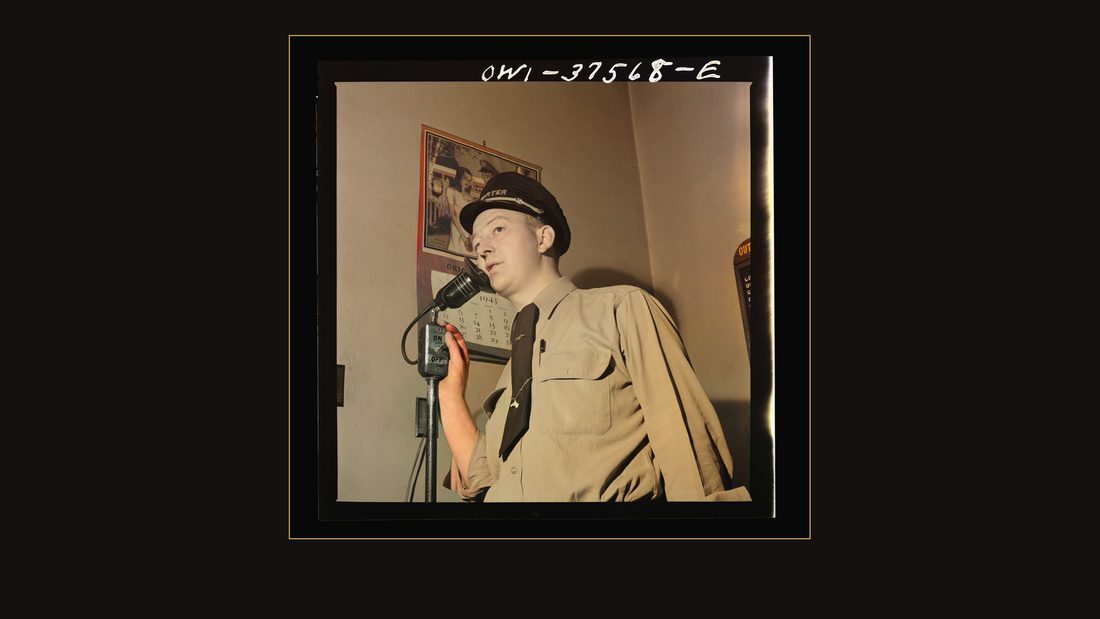
R67 Cincinnati, Ohio. Calling buses at the Greyhound bus terminal
Esther Bubley · September 1943 · Library of Congress · FSA/OWI · AI-colorized. View the original.
Calling the buses.
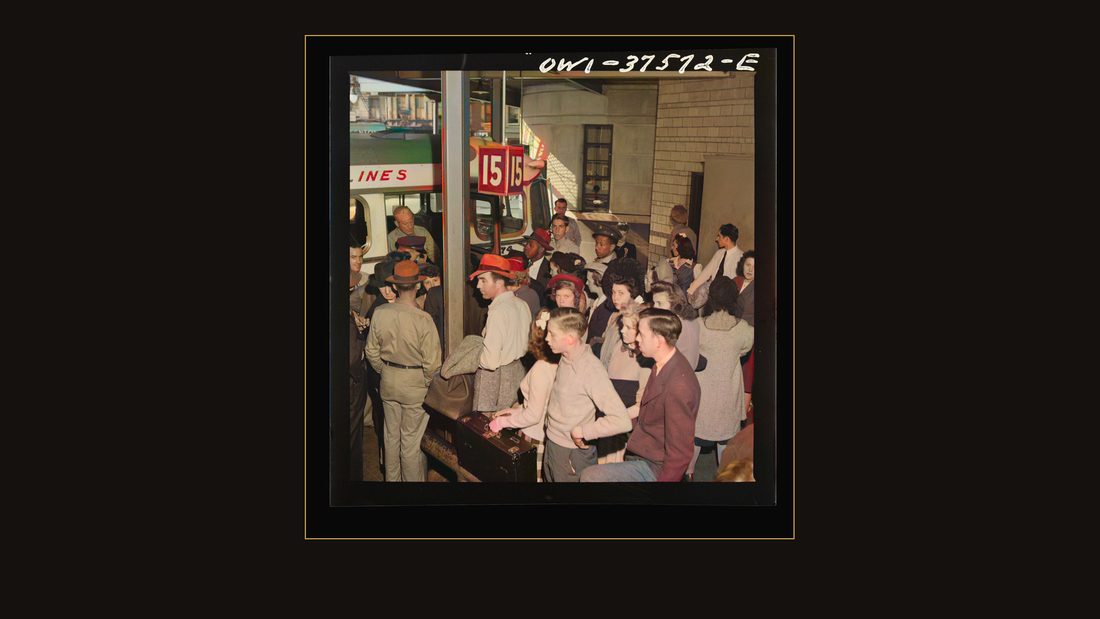
R68 Cincinnati, Ohio. Passengers boarding a Greyhound bus at the bus terminal
Esther Bubley · September 1943 · Library of Congress · FSA/OWI · AI-colorized. View the original.
Boarding.
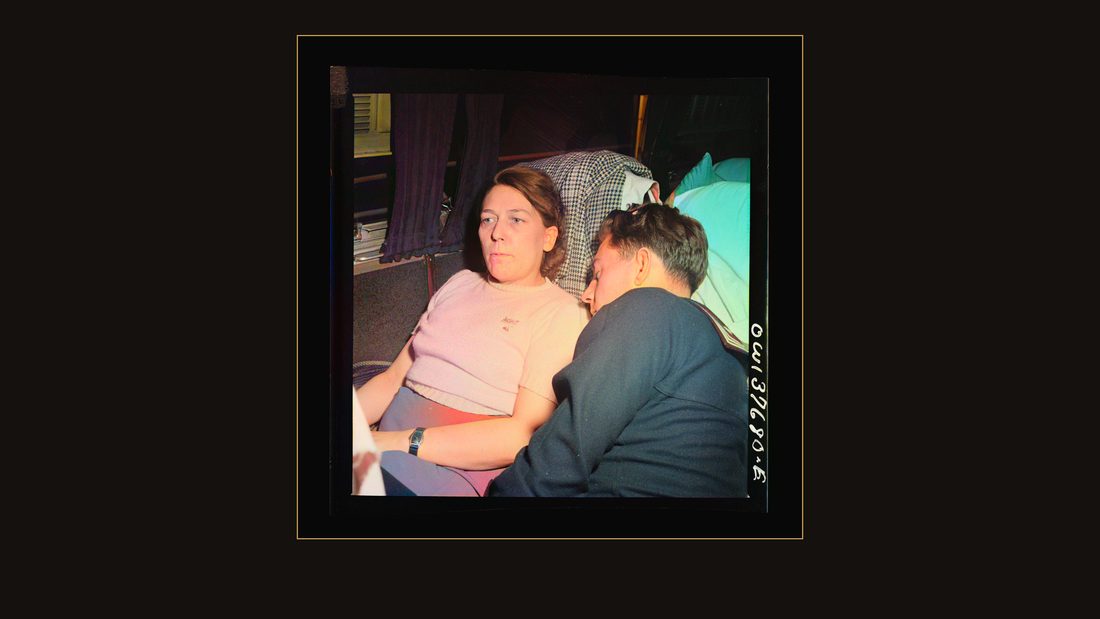
R69 Passengers on a Greyhound bus bound for Chicago, Illinois from Cincinnati, Ohio at two a.m.
Esther Bubley · September 1943 · Library of Congress · FSA/OWI · AI-colorized. View the original.
The two a.m. bus to Chicago.
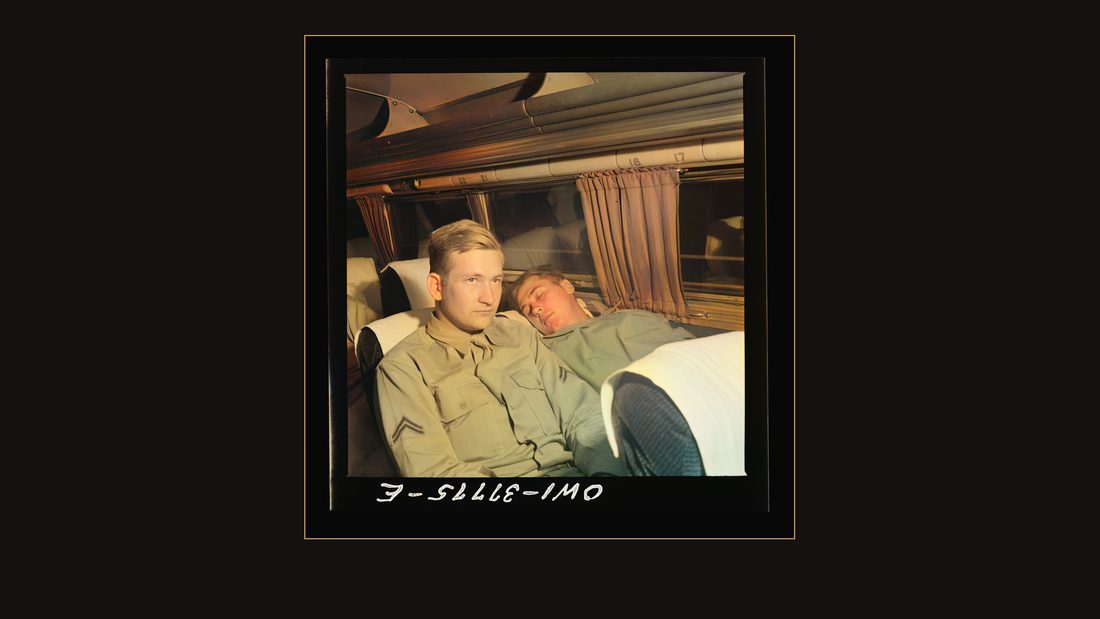
R70 A soldier sleeping on the way from Cincinnati, Ohio to Louisville, Kentucky on a Greyhound bus
Esther Bubley · September 1943 · Library of Congress · FSA/OWI · AI-colorized. View the original.
A soldier sleeping somewhere between Cincinnati and Louisville.
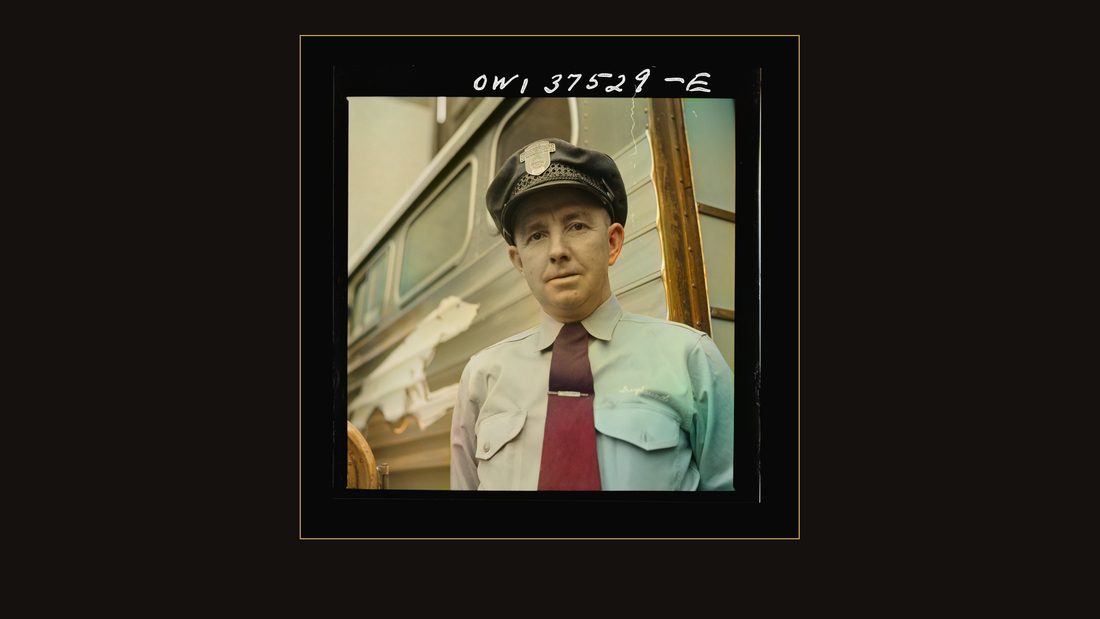
R71 Bernard Cochran, Greyhound bus driver. He has a perfect record of fourteen years, never having had an accident while driving a bus
Esther Bubley · September 1943 · Library of Congress · FSA/OWI · AI-colorized. View the original.
She followed one driver home. Bernard Cochran — fourteen years behind the wheel, her caption says, and never an accident.
![[Untitled photo, possibly related to: Cincinnati, Ohio. The Cochran children on the way from Sunday school]](img/R72.jpg)
R72 [Untitled photo, possibly related to: Cincinnati, Ohio. The Cochran children on the way from Sunday school]
Esther Bubley · September 1943 · Library of Congress · FSA/OWI · AI-colorized. View the original.
His daughters on the way back from Sunday school — Mary Freda, Irma Jean, and Sue Anne.
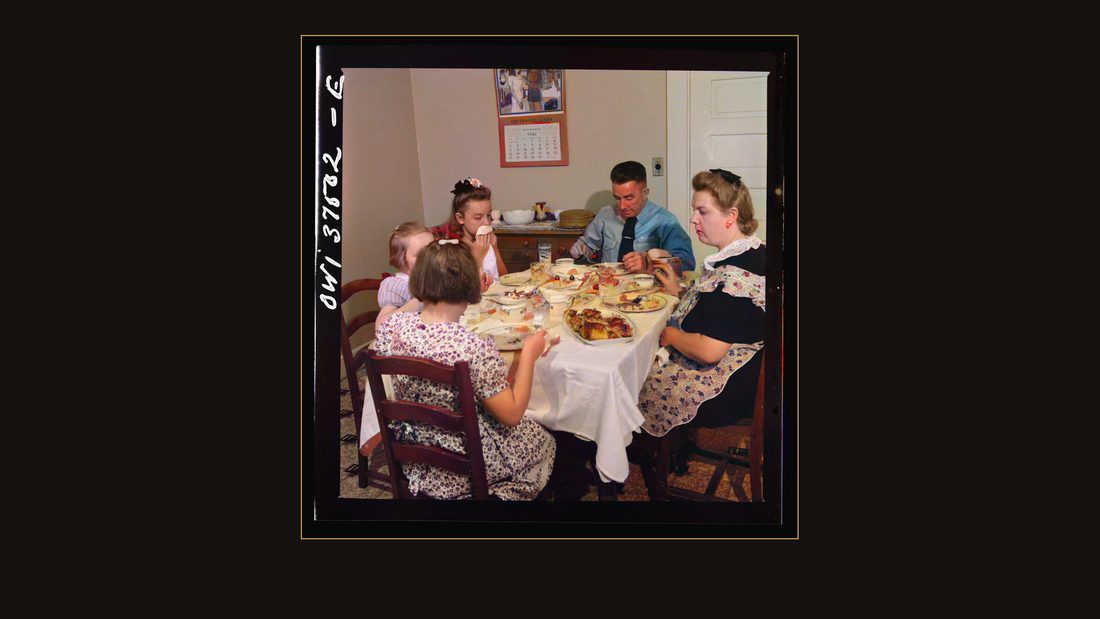
R73 Cincinnati, Ohio. "Red" Cochran, a Greyhound bus driver, and his family eating Sunday dinner
Esther Bubley · September 1943 · Library of Congress · FSA/OWI · AI-colorized. View the original.
Sunday dinner at the Cochrans'.
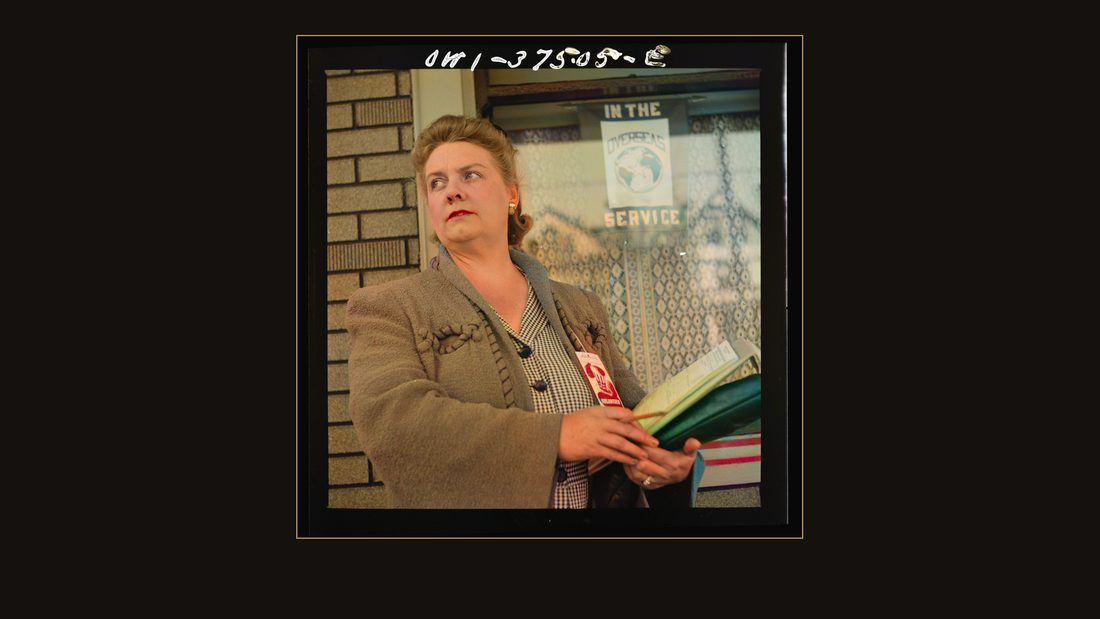
R74 Cincinnati, Ohio. Mrs. Bernard Cochran, wife of a Greyhound bus driver, ready to start on a house-to-house war bond canvas. The service flag in the window is for her brother
Esther Bubley · September 1943 · Library of Congress · FSA/OWI · AI-colorized. View the original.
And Mrs. Cochran heading out to sell war bonds door to door. The service flag in the window is for her brother.
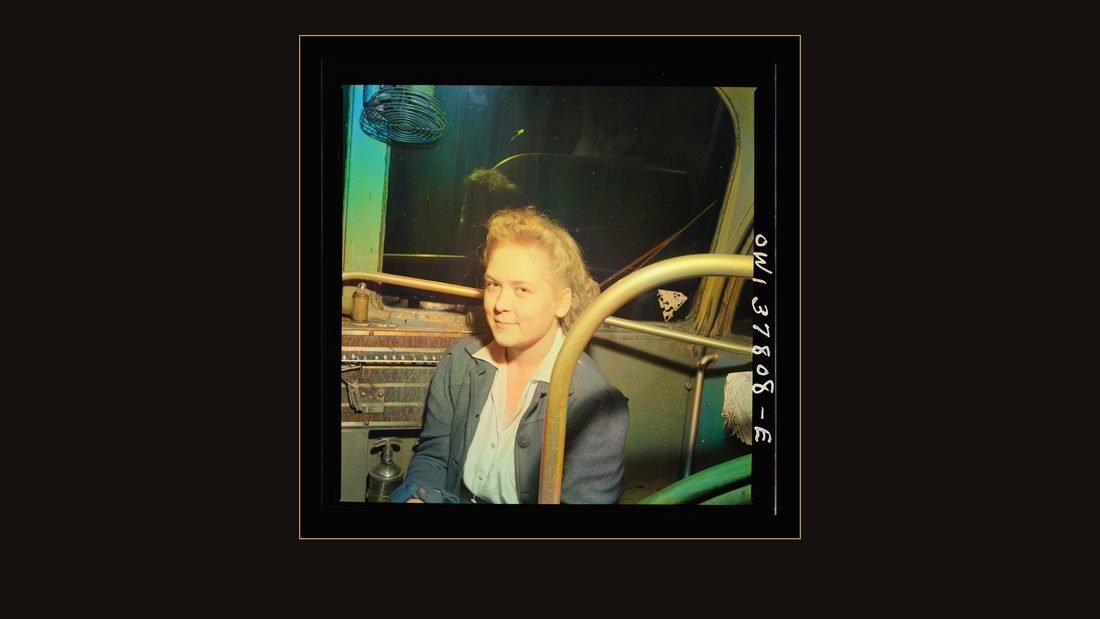
R75 A girl, who is a cook in a roadside restaurant who plans to leave her job and become a nurse, on a Greyhound bus between Cincinnati, Ohio and Chicago, Illinois. She rides for several miles to her home each night
Esther Bubley · September 1943 · Library of Congress · FSA/OWI · AI-colorized. View the original.
On the bus out of town, a girl who cooked in a roadside restaurant told Bubley her plan: she was leaving the job to become a nurse.
One real frame
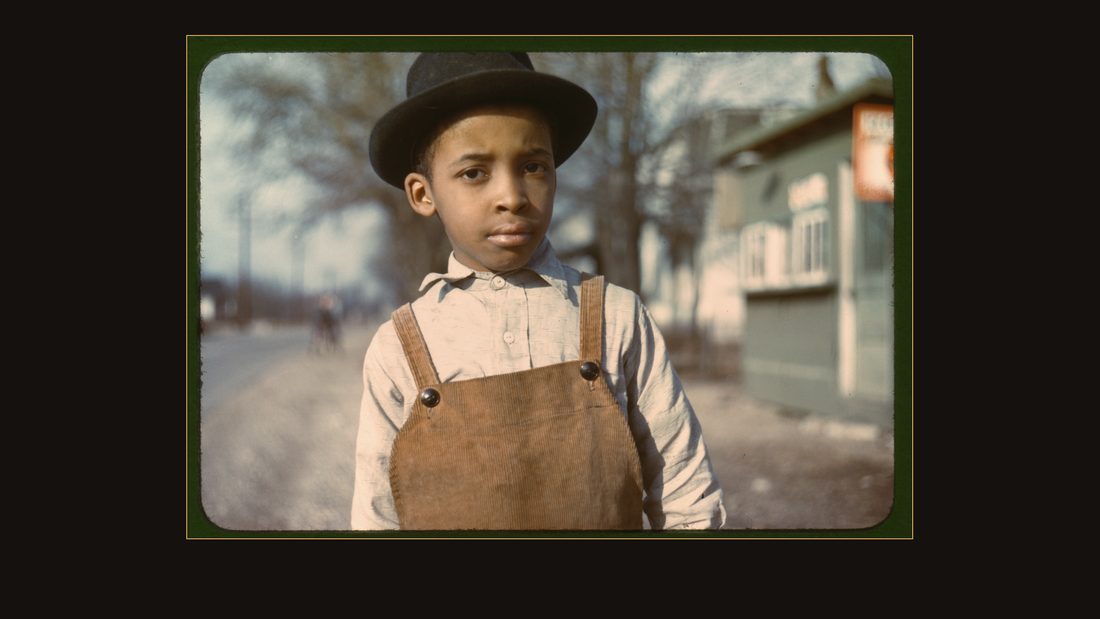
R76 Negro boy near Cincinnati, Ohio
John Vachon · 1942 or 1943 · Library of Congress · FSA/OWI · Kodachrome. View the original.
One more picture — and this one is not ours. Around nineteen forty-two, John Vachon loaded a roll of Kodachrome near Cincinnati, and a boy looked into his camera. This frame is real color, made in the camera, eighty years ago. Set it against everything else you've just seen. That's the honest gap between the record and our guesses — and the originals, all of them, are free at the Library of Congress.
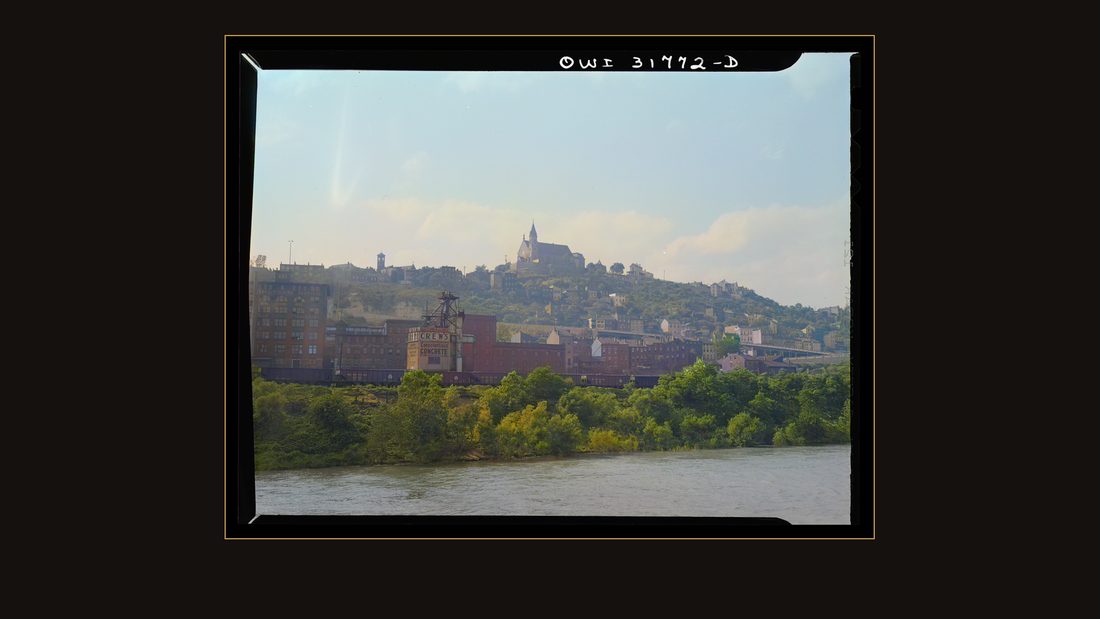
R54 Cincinnati, Ohio. The skyline as seen from the towboat Ernest T. Weir on the Ohio River
Arthur S. Siegel · June 1943 · Library of Congress · FSA/OWI · AI-colorized. View the original.
Sources
- Library of Congress, Prints & Photographs Division, FSA/OWI Collection (loc.gov/pictures). All photographs are federal works in the public domain. Photographers: Carl Mydans (Dec. 1935, Feb. 1936), Theodor Jung (Apr. 1936), Russell Lee (Feb. 1937), John Vachon (Oct. 1938, Sept. 1939, and one Kodachrome transparency, c. 1942–43), Alfred T. Palmer (Feb. 1942), Arthur S. Siegel (June 1943), Howard R. Hollem (June 1943), Esther Bubley (Sept. 1943). All quoted captions are the photographers' own, from the Library's catalog records.
- Resettlement Administration, "Greenbelt Towns: A Demonstration in Suburban Planning" (Washington: GPO, September 1936) — the program's charge, and the 3,000–5,000-family / 750–1,300-dwelling figures. Public domain; digitized copy at archive.org/details/greenbelttowns1936unit. Its staff page lists the Greenhills project planners Mydans photographed.
- National Park Service, "Greenhills Historic District" National Historic Landmark nomination (2016) — 676 dwelling units in 185 buildings (1,000 planned); first tenants April 1, 1938; rents $18–$42/month; application process (up to 14 forms, credit check, social-worker visit, two-income families excluded).
- 1939 World Series: Yankees over Reds, 4–0; Games 3–4 at Crosley Field, Oct. 7–8, 1939; the Reds' previous Series was 1919.
- Colorization: the black-and-white negatives were colorized with DDColor, an AI model. The colors are machine estimates, not the historical record; one frame (the closing Kodachrome) is genuine period color. Original scans of every photograph are freely available at the Library of Congress.
- Narration is AI-generated text-to-speech.