A Flood, a Fiddler, and a Hole Punch | North Carolina's Blue Ridge in Color, 1936-1943
Between 1936 and 1943, photographers on the federal payroll kept returning to the mountains of western North Carolina: Carl Mydans in the snow east of Marshall, Ben Shahn among the fiddlers of Asheville, Marion Post Wolcott through the harvest of 1939 and the flood wreckage of 1940, John Vachon in Boone at three in the morning.
Transcript
A sentence in a survey
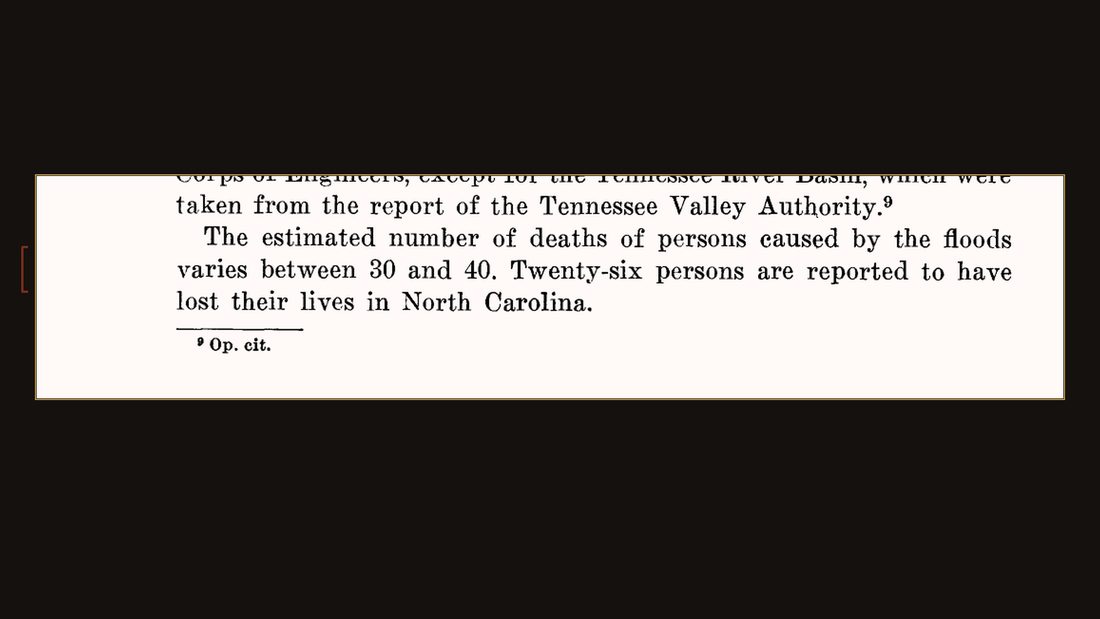
S2
USGS Water-Supply Paper 1066 · 1949 · p. 14.
Twenty-six people are reported to have lost their lives in North Carolina. One sentence, on page fourteen of a federal engineering report, about one August in these mountains. Hold that sentence. We will come back to it.
S1
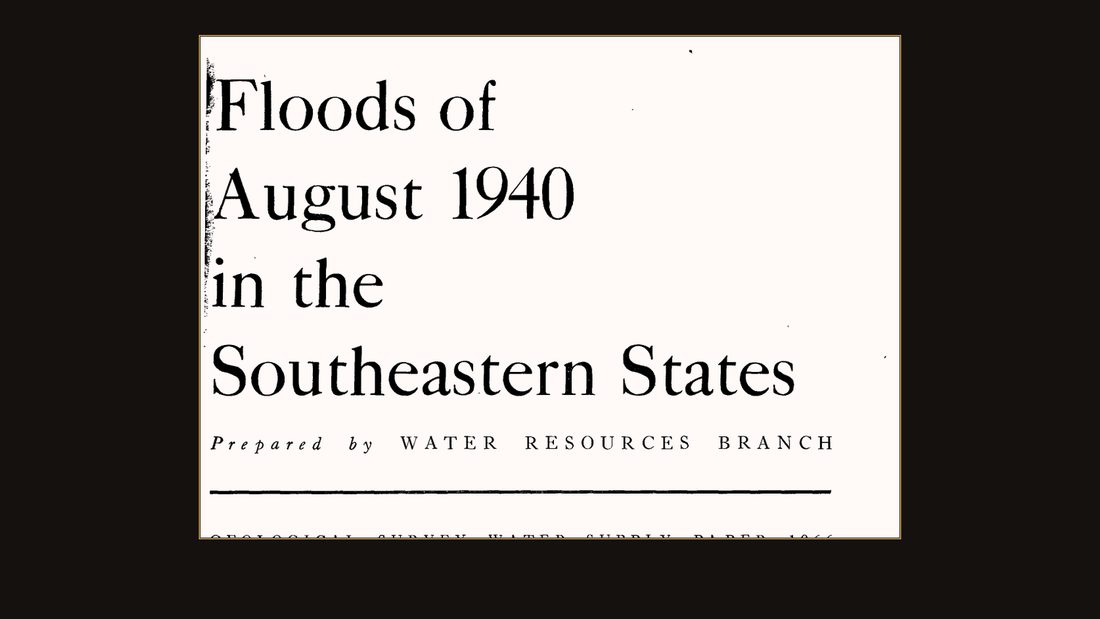
USGS Water-Supply Paper 1066 · 1949.
Between nineteen thirty-six and nineteen forty-three, photographers on the federal payroll kept returning to the mountains of western North Carolina. A cold spring. A fiddlers' summer. A harvest. A flood. A war. Their negatives have sat in Washington ever since, in black and white.
The colors are guesses
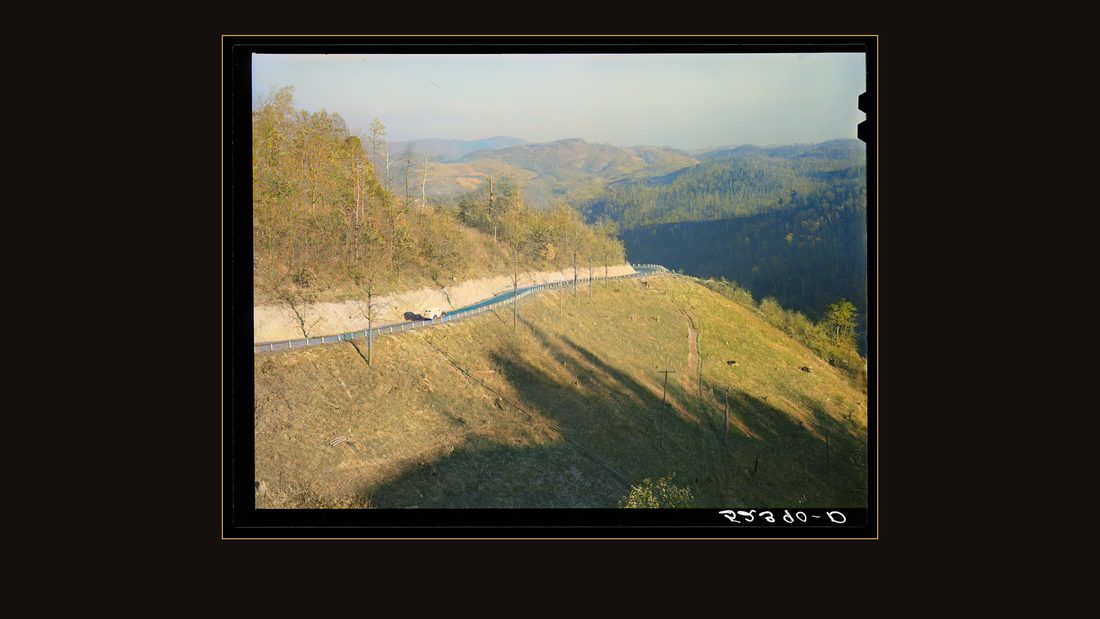
R33 Winding road and general landscape. Smokey Mountains, North Carolina
Marion Post Wolcott · November 1939 · Library of Congress · FSA/OWI · AI-colorized. View the original.
So let's be straight about what you're watching. Every color in this film is a guess — made this year, by a machine, from the gray values on those negatives.
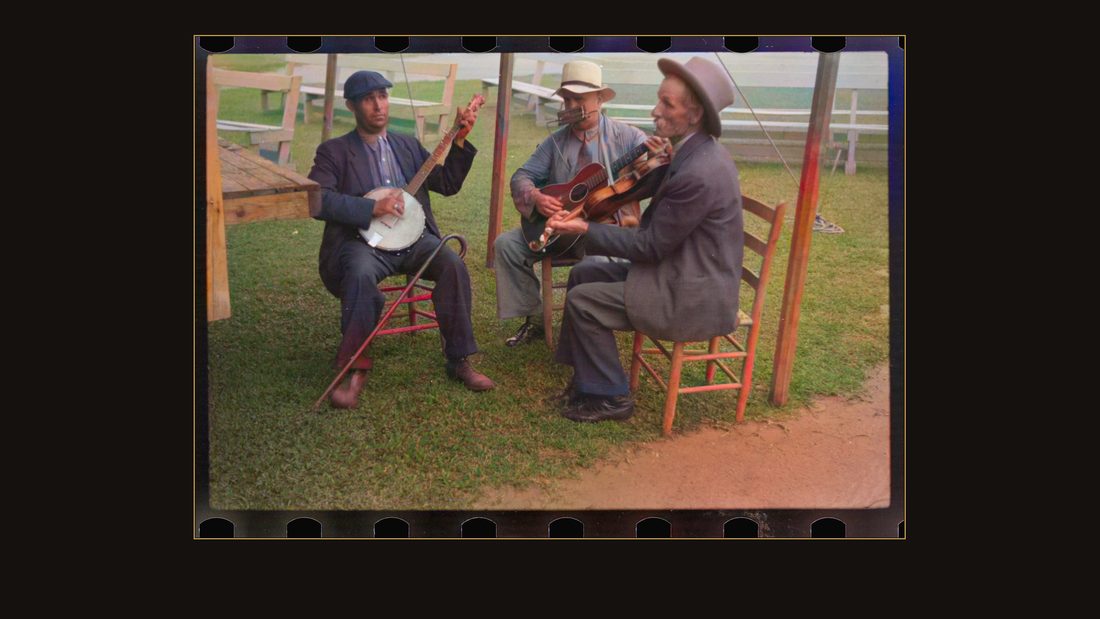
R14 Jeeter Gentry, Elmer Thompson and Fiddlin' Bill Hensley, Asheville, North Carolina
Ben Shahn · 1937 · Library of Congress · FSA/OWI · AI-colorized. View the original.
The faces, the light, the framing — those belong to the photographers, untouched. The colors are estimates. Good ones, mostly. But estimates. Every original is free at the Library of Congress, linked below, in black and white. That's the deal. Keep it in mind and these pictures won't lie to you.
Cold spring, 1936
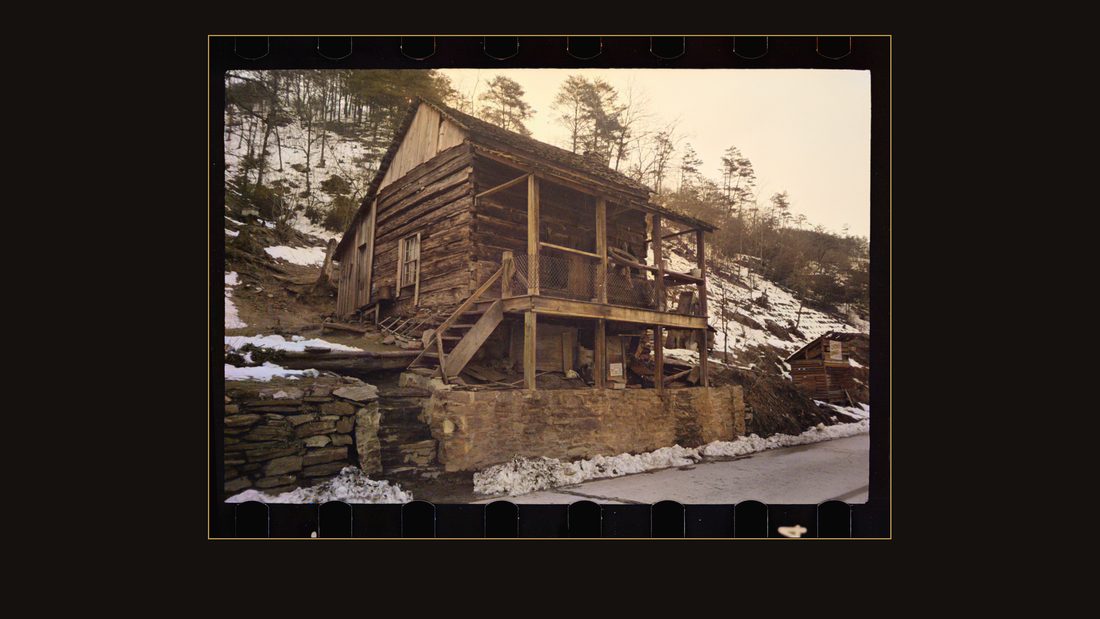
R01 Mountain home, Appalachian Mountains, housed two white families
Carl Mydans · March 1936 · Library of Congress · FSA/OWI · AI-colorized. View the original.
March, nineteen thirty-six. Carl Mydans, a government photographer, drove Route U.S. eleven into the mountains east of Marshall and stopped at a log house on a snowy hillside. His caption says it housed two families.
![[Untitled photo, possibly related to: Kitchen and washroom of two room mountain shack, Route U.S. 11, a few miles east of Marshall, North Carolina]](img/R02.jpg)
R02 [Untitled photo, possibly related to: Kitchen and washroom of two room mountain shack, Route U.S. 11, a few miles east of Marshall, North Carolina]
Carl Mydans · March 1936 · Library of Congress · FSA/OWI · AI-colorized. View the original.
A two-room mountain shack, a few miles east of Marshall. His caption calls this the kitchen and washroom.
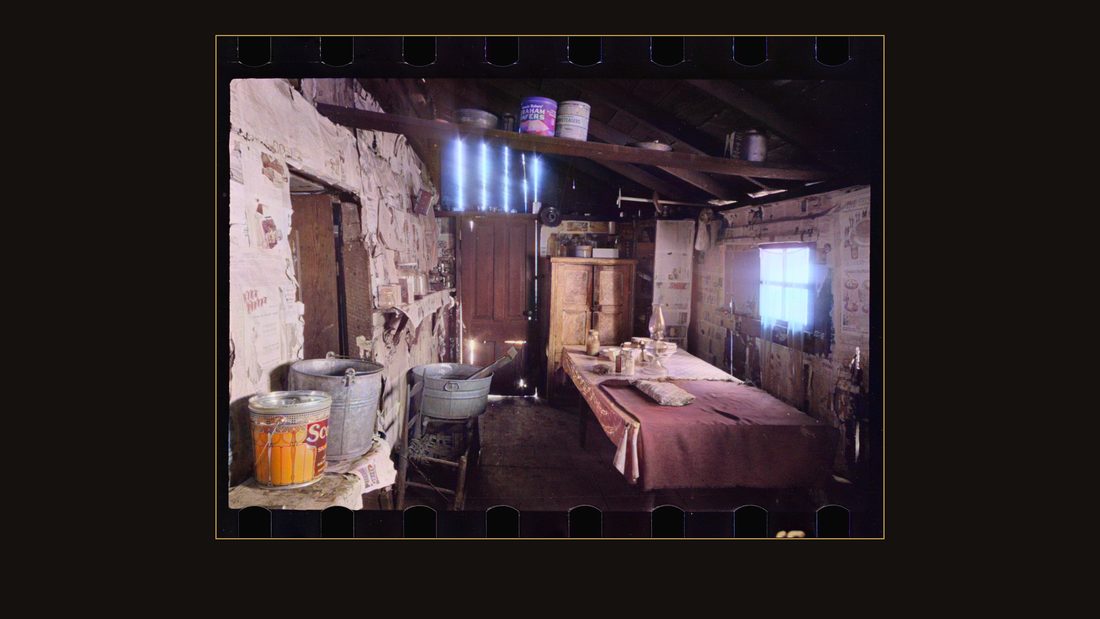
R03 Kitchen and washroom of two room mountain shack, Route U.S. 11, a few miles east of Marshall, North Carolina
Carl Mydans · March 1936 · Library of Congress · FSA/OWI · AI-colorized. View the original.
The kitchen again. The walls are papered with newsprint and magazine pages, against the wind.
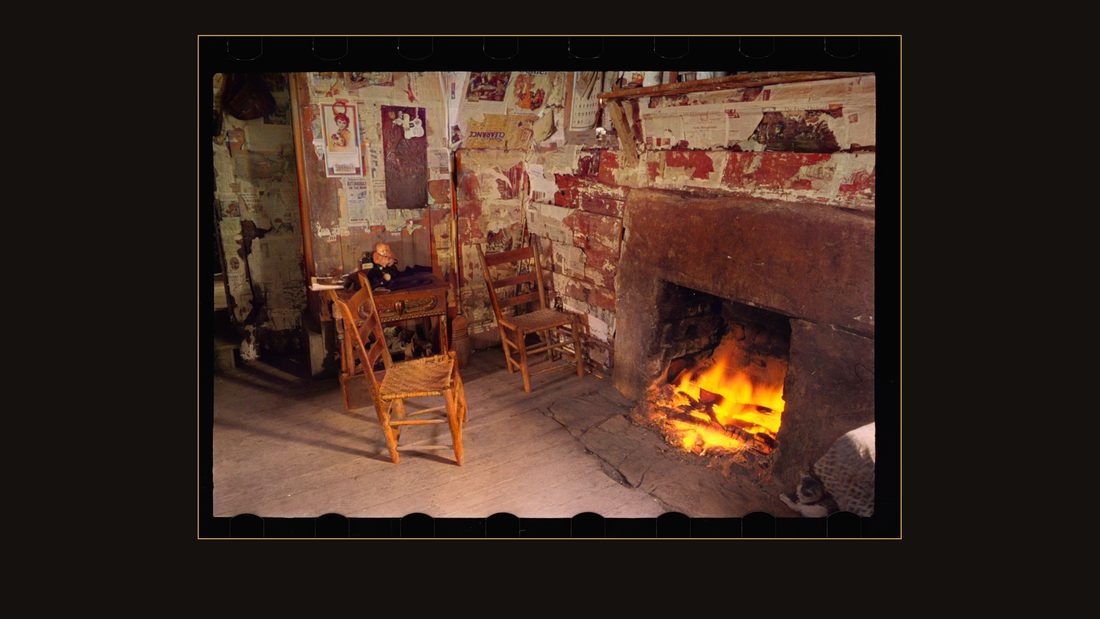
R04 Interior of mountain farmhouse, Appalachian Mountains near Marshall, North Carolina
Carl Mydans · March 1936 · Library of Congress · FSA/OWI · AI-colorized. View the original.
One fireplace, going. March in the mountains.
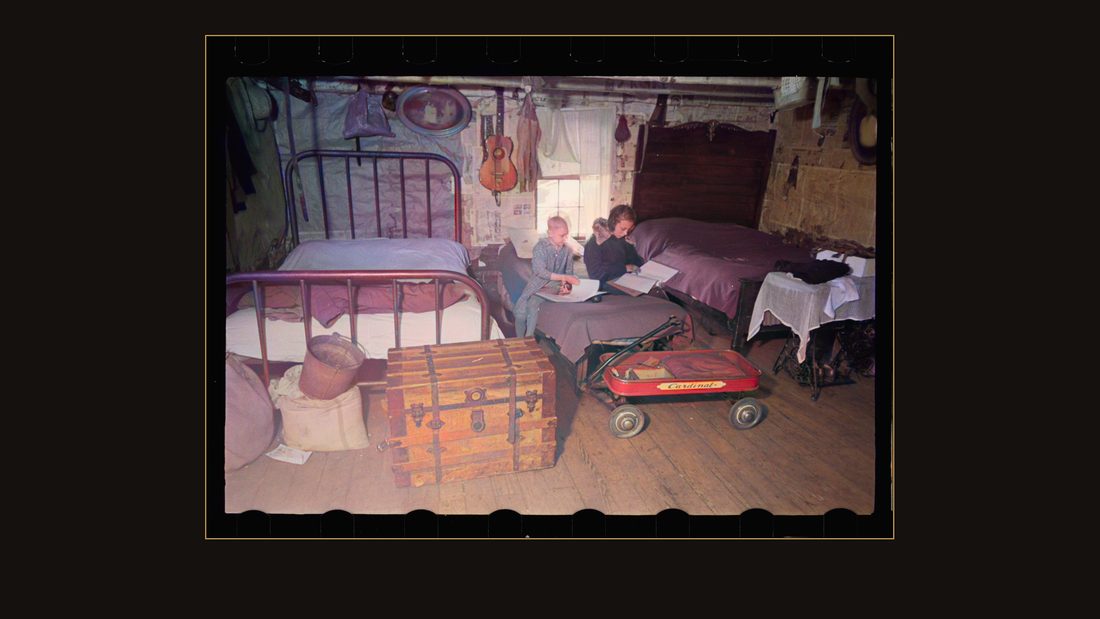
R05 Interior of mountain farmhouse, Appalachian Mountains near Marshall, North Carolina
Carl Mydans · March 1936 · Library of Congress · FSA/OWI · AI-colorized. View the original.
The bedroom. A toy wagon parked by the trunk — the one thing in the room the color machine was surest about.
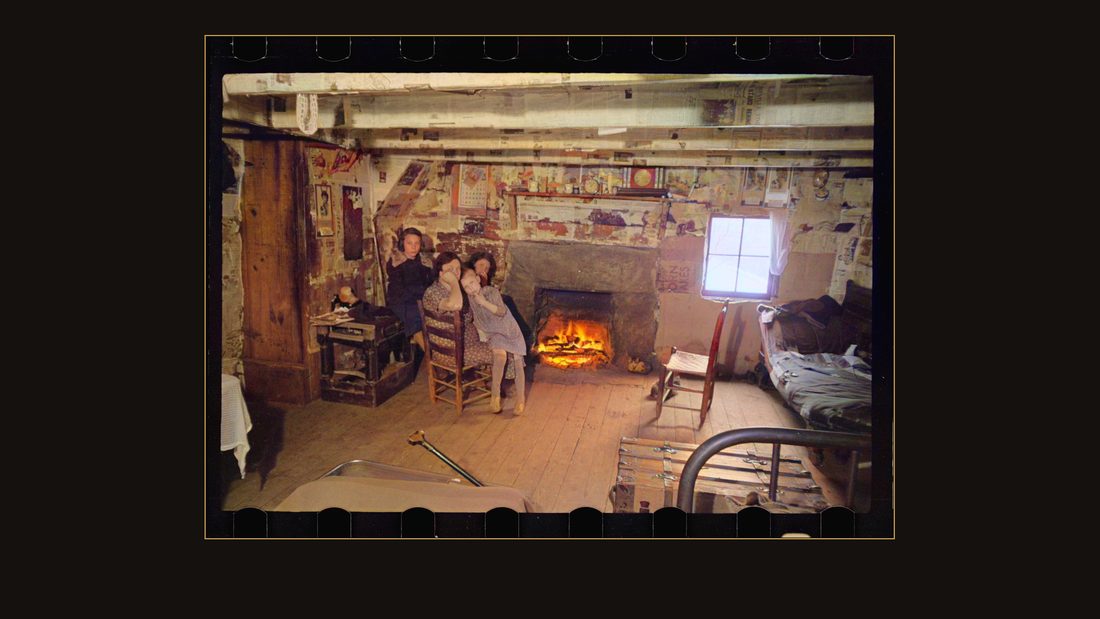
R06 Interior of mountain farmhouse, Appalachian Mountains near Marshall, North Carolina
Carl Mydans · March 1936 · Library of Congress · FSA/OWI · AI-colorized. View the original.
A family by the fire, in a farmhouse on the same road. Mydans did not write down their names.
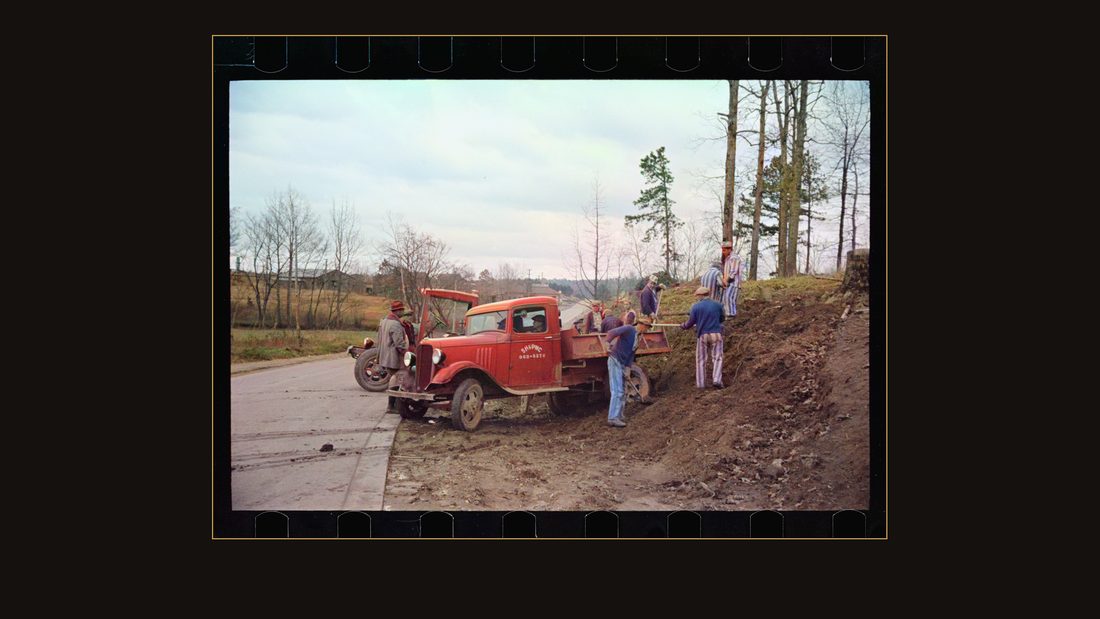
R50 Convicts working on state road, North Carolina
Carl Mydans · March 1936 · Library of Congress · FSA/OWI · AI-colorized. View the original.
On the same rolls, Mydans photographed a convict road gang in stripes, cutting the grade with shovels while a guard watched from the truck.
The killed
![[Untitled photo, possibly related to: Mountain home, Appalachian Mountains, housed two white families]](img/K1.jpg)
K1 [Untitled photo, possibly related to: Mountain home, Appalachian Mountains, housed two white families]
Carl Mydans · March 1936 · Library of Congress · FSA/OWI · killed negative. View the original.
Not every frame survived Washington. The project's editor, Roy Stryker, reviewed the contact prints, and in the early years a rejected negative sometimes took a hole punch, straight through the image. The file calls these killed.
![[Untitled photo, possibly related to: Mountain home, Appalachian Mountains, housed two white families]](img/K2.jpg)
K2 [Untitled photo, possibly related to: Mountain home, Appalachian Mountains, housed two white families]
Carl Mydans · March 1936 · Library of Congress · FSA/OWI · killed negative. View the original.
The same log house you just saw in color — killed. The Library of Congress kept every punched negative anyway, and catalogs them as untitled. We are leaving these in black and white.
![[Untitled photo, possibly related to: Convicts working on a state road, North Carolina]](img/K3.jpg)
K3 [Untitled photo, possibly related to: Convicts working on a state road, North Carolina]
Carl Mydans · March 1936 · Library of Congress · FSA/OWI · killed negative. View the original.
And this frame of the road gang: punched, damaged, never printed. Two other frames of the convicts made it into the file. This one did not. Years later, one of the project's own photographers — Ben Shahn — said of his editor: he used to punch a hole through a negative. Some of them were incredibly valuable.
The festival, 1937
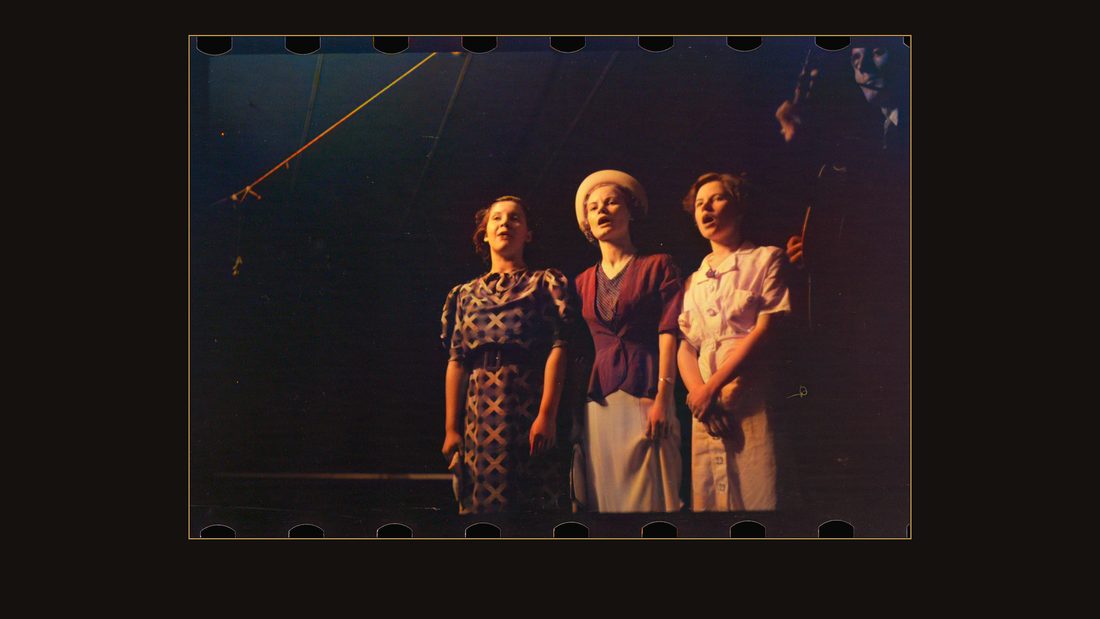
R07 Lovengood sisters, Asheville, North Carolina
Ben Shahn · 1937 · Library of Congress · FSA/OWI · AI-colorized. View the original.
Summer, nineteen thirty-seven. Ben Shahn — a painter who carried a thirty-five millimeter camera — reached Asheville. His caption cards say only: Asheville, North Carolina. The Library's subject heading adds three words: music festivals, North Carolina.
![[Untitled photo, possibly related to: Lovengood sisters, Asheville, North Carolina]](img/R08.jpg)
R08 [Untitled photo, possibly related to: Lovengood sisters, Asheville, North Carolina]
Ben Shahn · 1937 · Library of Congress · FSA/OWI · AI-colorized. View the original.
Asheville's festival in those years was the Mountain Dance and Folk Festival, started in nineteen twenty-eight by a song collector named Bascom Lamar Lunsford. No caption card names it. The pictures speak for themselves.
![[Untitled photo, possibly related to: Child musicians at Asheville, North Carolina]](img/R09.jpg)
R09 [Untitled photo, possibly related to: Child musicians at Asheville, North Carolina]
Ben Shahn · 1937 · Library of Congress · FSA/OWI · AI-colorized. View the original.
A boy with a guitar, a girl singing into the same microphone's reach.
![[Untitled photo, possibly related to: Child musicians at Asheville, North Carolina]](img/R10.jpg)
R10 [Untitled photo, possibly related to: Child musicians at Asheville, North Carolina]
Ben Shahn · 1937 · Library of Congress · FSA/OWI · AI-colorized. View the original.
When the music ran past dark, Shahn kept shooting, handheld, into the stage light.
![Aunt Samantha Baumgarner [i.e. Bumgarner], fiddler, banjoist, guitarist, North Carolina, Asheville](img/R11.jpg)
R11 Aunt Samantha Baumgarner [i.e. Bumgarner], fiddler, banjoist, guitarist, North Carolina, Asheville
Ben Shahn · 1937 · Library of Congress · FSA/OWI · AI-colorized. View the original.
Aunt Samantha Bumgarner, of Dillsboro, with her fiddle. In nineteen twenty-four she went to New York with Eva Davis and recorded for Columbia. They are credited as the first women to record country music, on some of the first records to feature the five-string banjo.
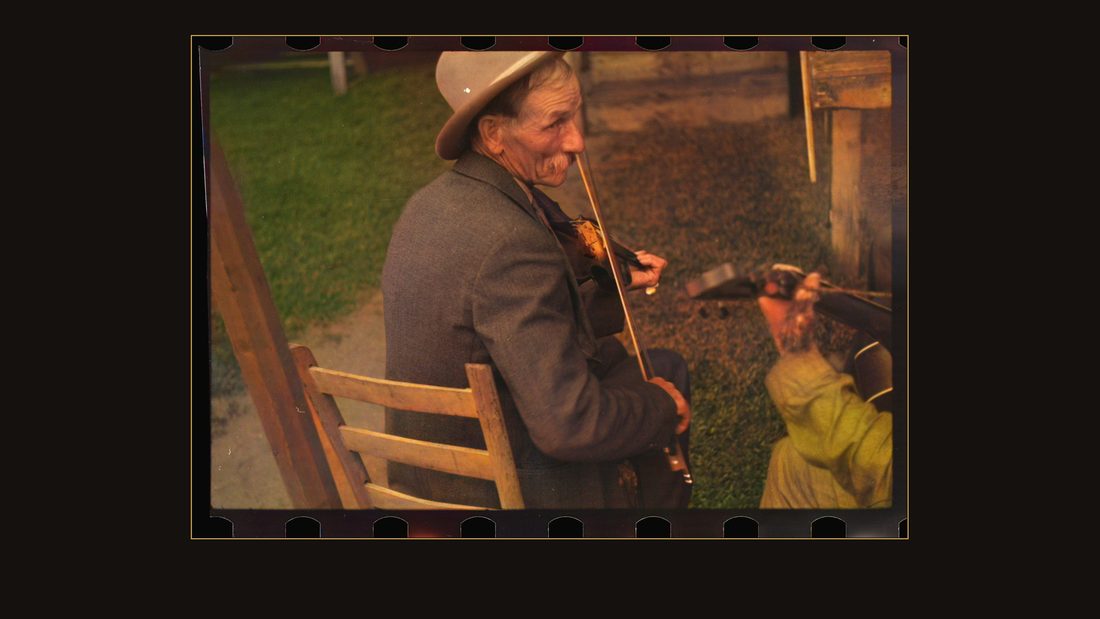
R12 Fiddlin' Bill Hensley, Asheville, North Carolina
Ben Shahn · 1937 · Library of Congress · FSA/OWI · AI-colorized. View the original.
Two years after this frame, she played the White House — for the Roosevelts, and for the King and Queen of England.
![[Untitled photo, possibly related to: Jeeter Gentry, Elmer Thompson and Fiddlin' Bill Hensley, Asheville, North Carolina]](img/R13.jpg)
R13 [Untitled photo, possibly related to: Jeeter Gentry, Elmer Thompson and Fiddlin' Bill Hensley, Asheville, North Carolina]
Ben Shahn · 1937 · Library of Congress · FSA/OWI · AI-colorized. View the original.
A face on the same roll. No name survives on the card.
R14 Jeeter Gentry, Elmer Thompson and Fiddlin' Bill Hensley, Asheville, North Carolina
Ben Shahn · 1937 · Library of Congress · FSA/OWI · AI-colorized. View the original.
Jeeter Gentry, Elmer Thompson, and Fiddlin' Bill Hensley, seated in the yard like men who had played together a long time.
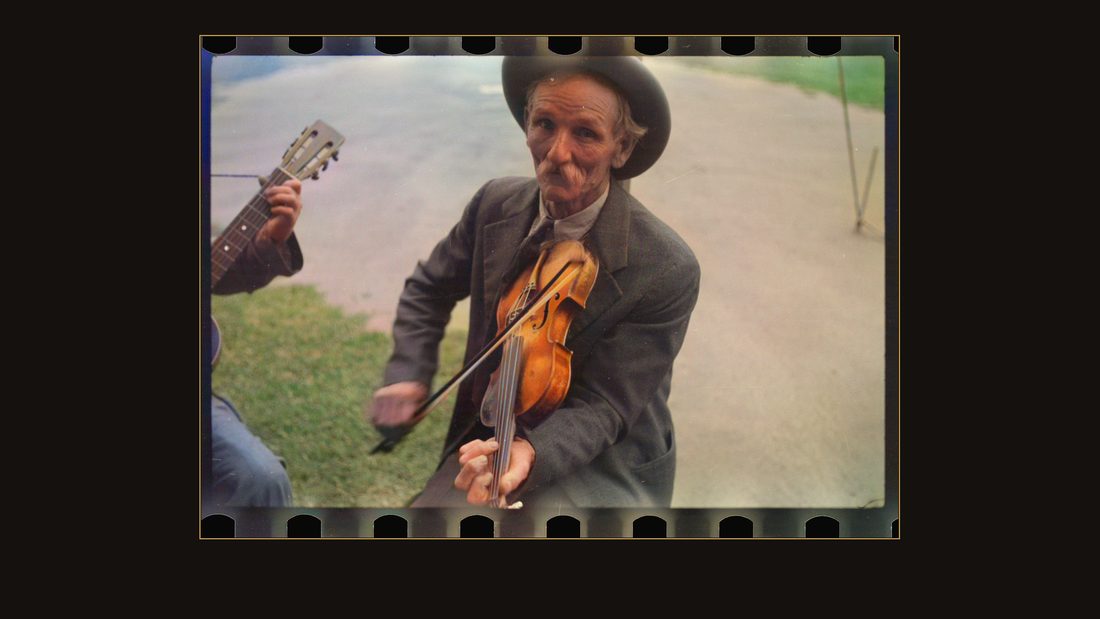
R15 Fiddlin' Bill Hensley, mountain fiddler, Asheville, North Carolina
Ben Shahn · 1937 · Library of Congress · FSA/OWI · AI-colorized. View the original.
Hensley, up close. The caption card calls him mountain fiddler, and that was credential enough.
![[Untitled photo, possibly related to: Jeeter Gentry, Elmer Thompson and Fiddlin' Bill Hensley, Asheville, North Carolina]](img/R16.jpg)
R16 [Untitled photo, possibly related to: Jeeter Gentry, Elmer Thompson and Fiddlin' Bill Hensley, Asheville, North Carolina]
Ben Shahn · 1937 · Library of Congress · FSA/OWI · AI-colorized. View the original.
Harmonica in a rack, guitar on the knee.
![[Untitled photo, possibly related to: Jeeter Gentry, Elmer Thompson and Fiddlin' Bill Hensley, Asheville, North Carolina]](img/R17.jpg)
R17 [Untitled photo, possibly related to: Jeeter Gentry, Elmer Thompson and Fiddlin' Bill Hensley, Asheville, North Carolina]
Ben Shahn · 1937 · Library of Congress · FSA/OWI · AI-colorized. View the original.
A banjo player in a flat cap.
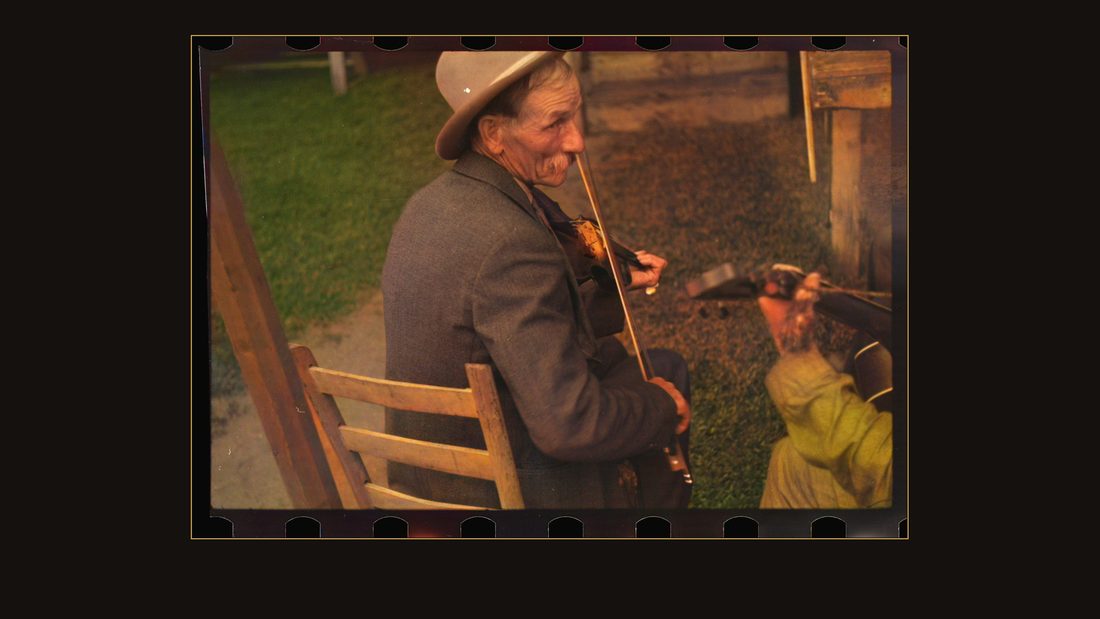
R18 Fiddlin' Bill Hensley. Asheville, North Carolina
Ben Shahn · 1937 · Library of Congress · FSA/OWI · AI-colorized. View the original.
Shahn's Asheville rolls run past thirty frames. He shot musicians the way he painted people — close, and from below, and without asking anyone to hold still.
High harvest, 1939
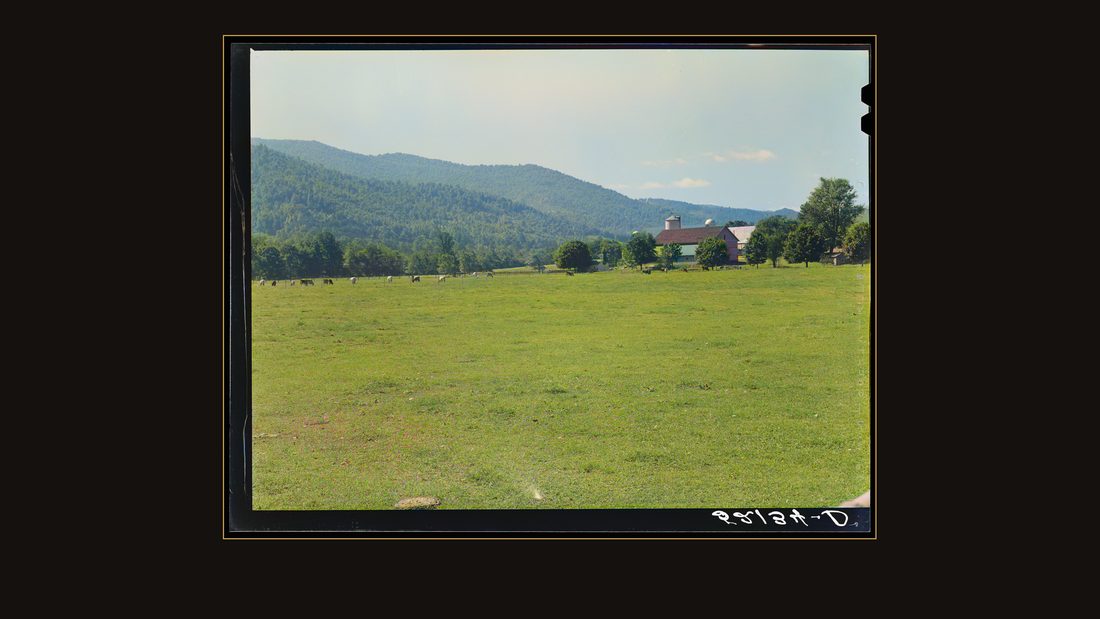
R20 State agricultural experiment station near Black Mountain, North Carolina
Marion Post Wolcott · September 1939 · Library of Congress · FSA/OWI · AI-colorized. View the original.
September, nineteen thirty-nine. Marion Post — the photographer this channel has followed through West Virginia — worked the valleys east of Asheville. She was twenty-nine.
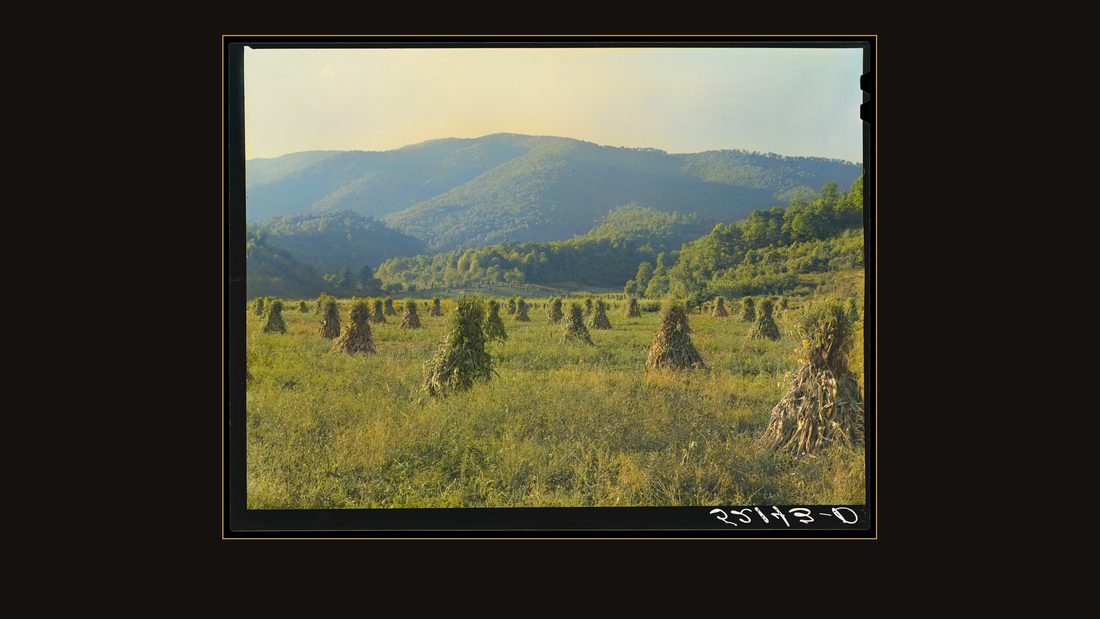
R21 Shocks of corn. Smokey Mountains near Asheville, North Carolina
Marion Post Wolcott · September 1939 · Library of Congress · FSA/OWI · AI-colorized. View the original.
Corn shocks near Asheville. Her caption spells it Smokey Mountains, with an E.
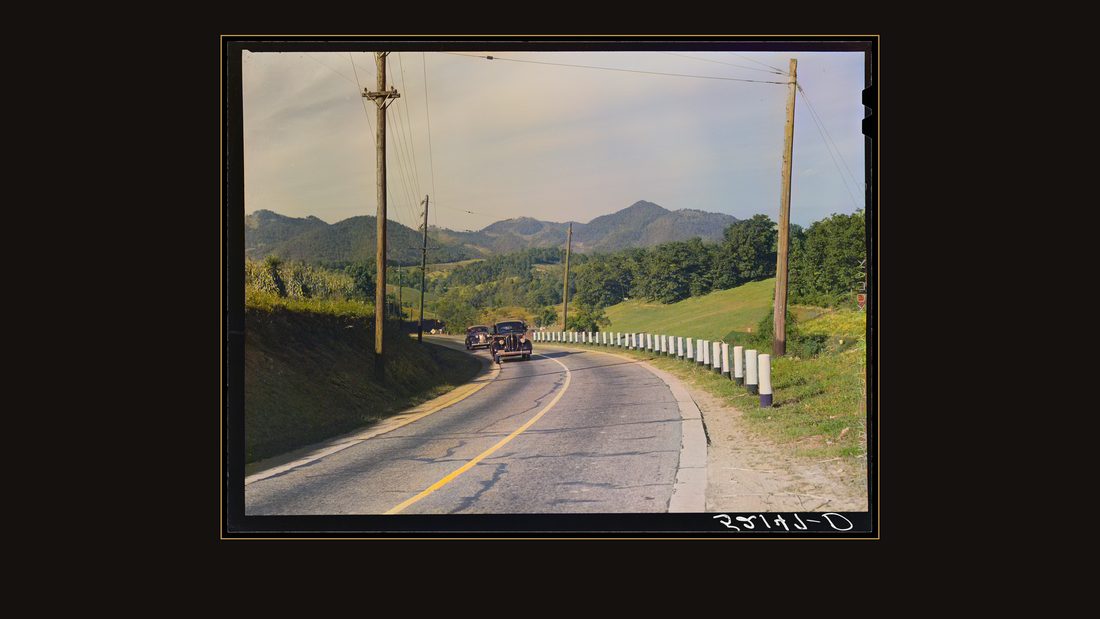
R22 Asheville (vicinity), North Carolina. A highway
Marion Post Wolcott · September 1939 · Library of Congress · FSA/OWI · AI-colorized. View the original.
A highway. Her caption does not say which one.
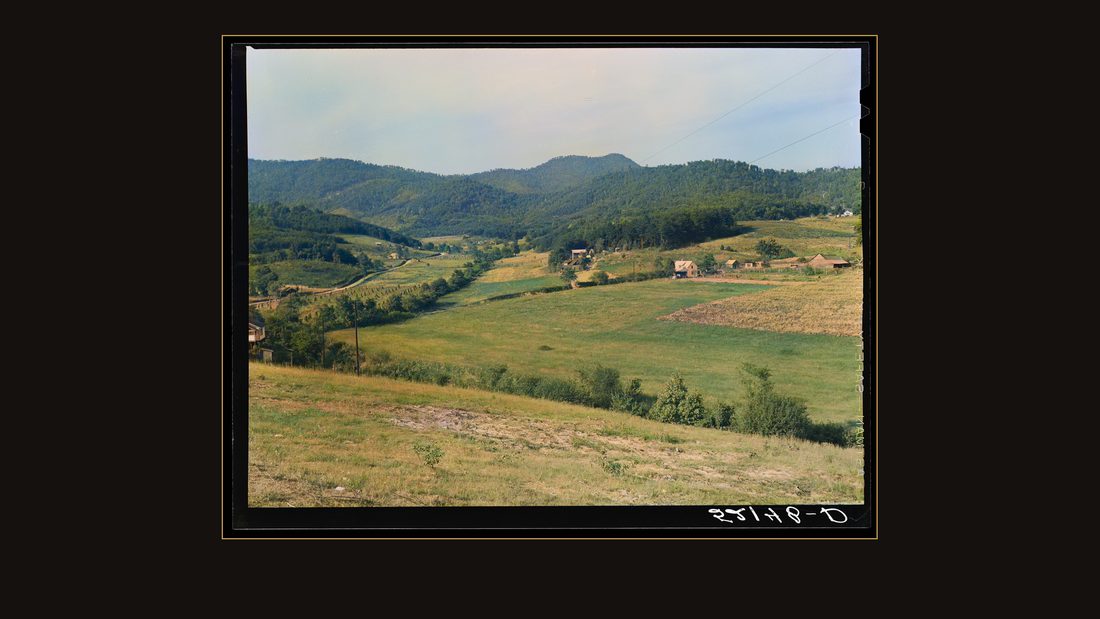
R23 General landscape near Asheville, North Carolina
Marion Post Wolcott · September 1939 · Library of Congress · FSA/OWI · AI-colorized. View the original.
The general landscape — her phrase — near Asheville.
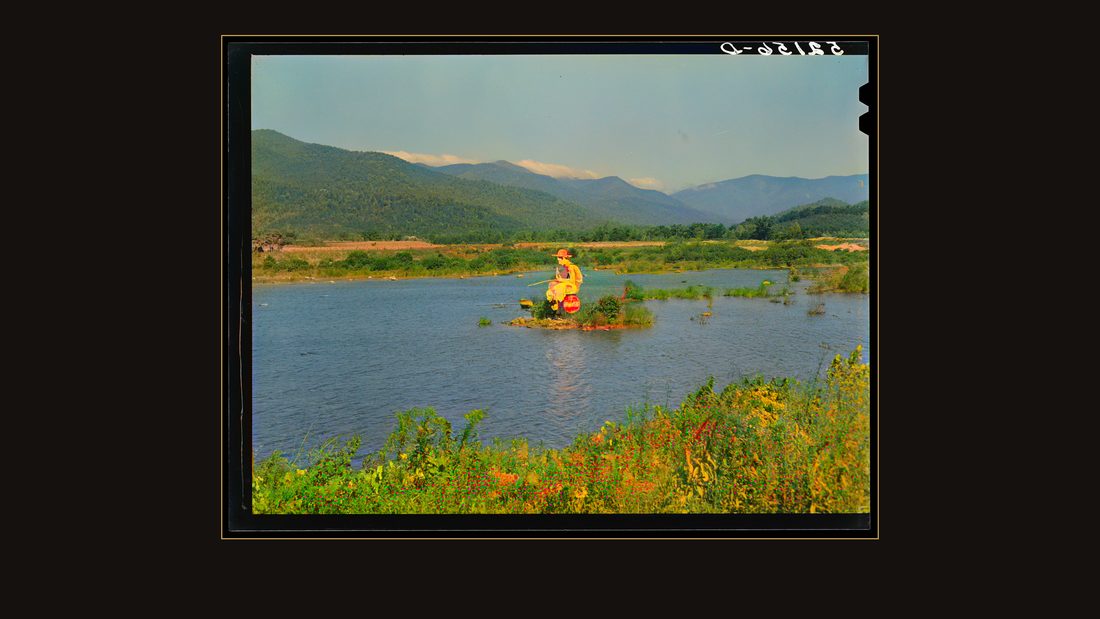
R24 Coca Cola. General landscape near Black Mountain. North Carolina
Marion Post Wolcott · September 1939 · Library of Congress · FSA/OWI · AI-colorized. View the original.
A lake near Black Mountain. Her caption for this view begins with two words: Coca Cola.
![[Untitled photo, possibly related to: Coca Cola. General landscape near Black Mountain. North Carolina]](img/R25.jpg)
R25 [Untitled photo, possibly related to: Coca Cola. General landscape near Black Mountain. North Carolina]
Marion Post Wolcott · September 1939 · Library of Congress · FSA/OWI · AI-colorized. View the original.
Because of this. The billboard across the water. Even here.
![[Untitled photo, possibly related to: View from steps of Black Mountain College. Black Mountain, North Carolina]](img/R26.jpg)
R26 [Untitled photo, possibly related to: View from steps of Black Mountain College. Black Mountain, North Carolina]
Marion Post Wolcott · September 1939 · Library of Congress · FSA/OWI · AI-colorized. View the original.
The next frames on her roll are catalogued as the view from the steps of Black Mountain College. The experimental school on the hill was six years old that fall.
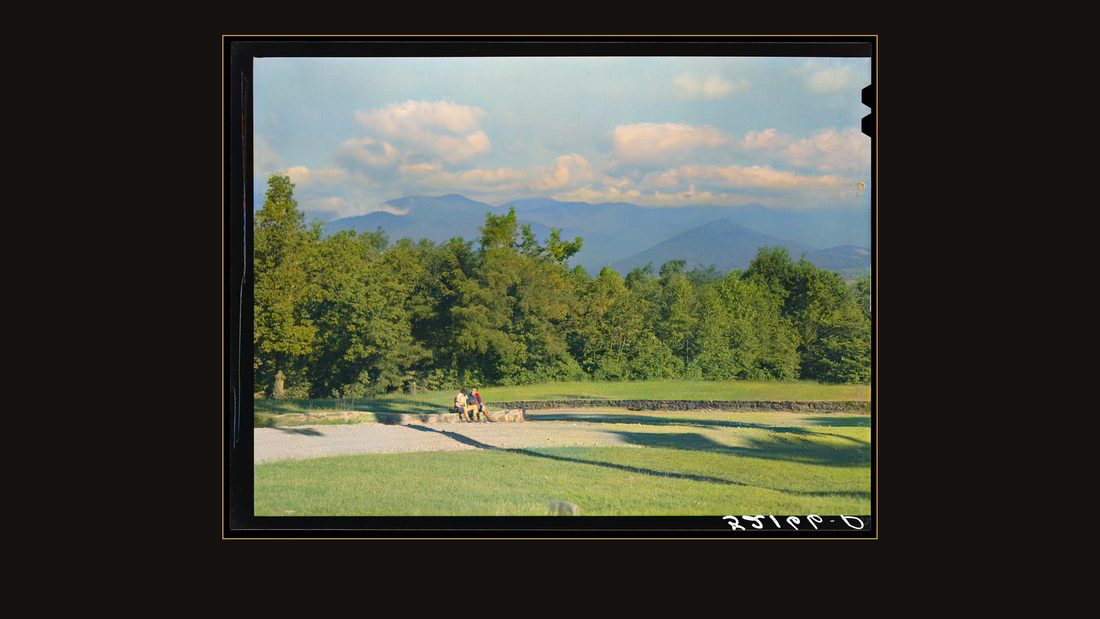
R27 View from steps of Black Mountain College. Black Mountain, North Carolina
Marion Post Wolcott · September 1939 · Library of Congress · FSA/OWI · AI-colorized. View the original.
The same view from the steps, wider — pasture, treeline, and the ridge behind.
![[Untitled photo, possibly related to: Shocks of corn. Smokey Mountains near Asheville, North Carolina]](img/R29.jpg)
R29 [Untitled photo, possibly related to: Shocks of corn. Smokey Mountains near Asheville, North Carolina]
Marion Post Wolcott · September 1939 · Library of Congress · FSA/OWI · AI-colorized. View the original.
Corn shocks, right up against the mountain wall.
November roads
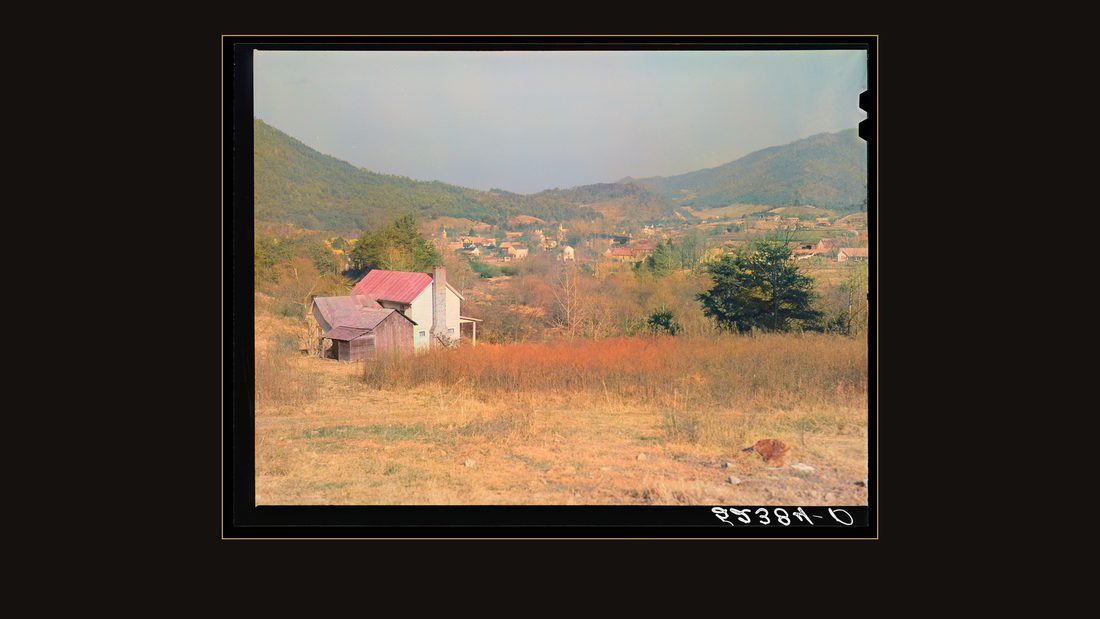
R30 Town in Watauga County, North Carolina
Marion Post Wolcott · November 1939 · Library of Congress · FSA/OWI · AI-colorized. View the original.
She came back in November, when the valleys had gone brown. A town in Watauga County — the caption names no town.
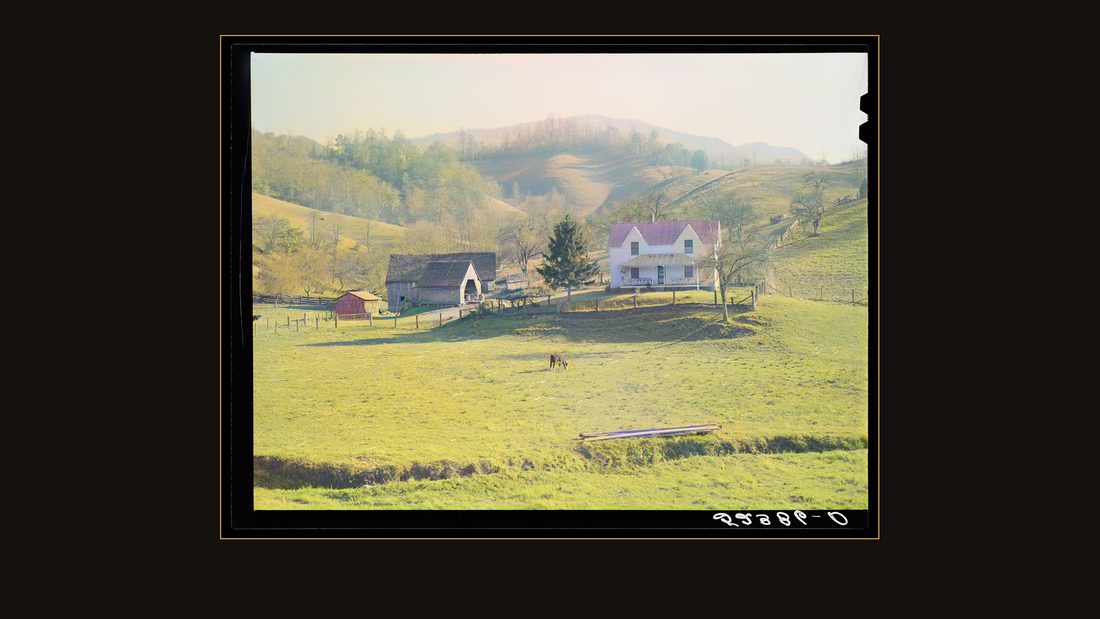
R31 Farmhouse and barns near Asheville, North Carolina
Marion Post Wolcott · November 1939 · Library of Congress · FSA/OWI · AI-colorized. View the original.
A farmhouse and barns near Asheville.
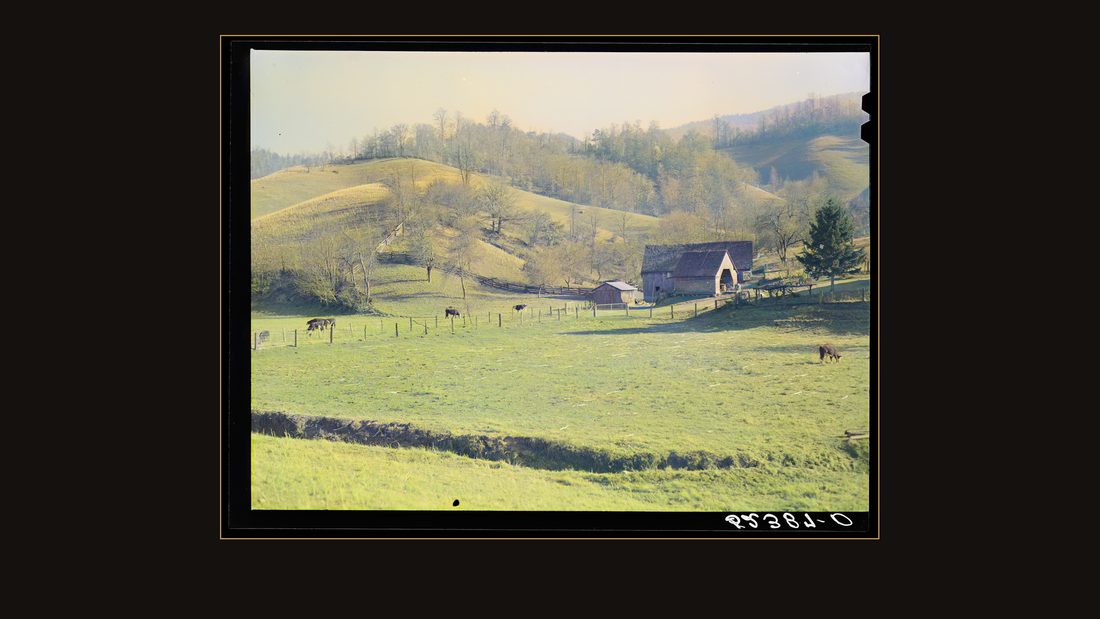
R32 Farm scene near Asheville, North Carolina
Marion Post Wolcott · November 1939 · Library of Congress · FSA/OWI · AI-colorized. View the original.
A farm scene. Her file gives it three words.
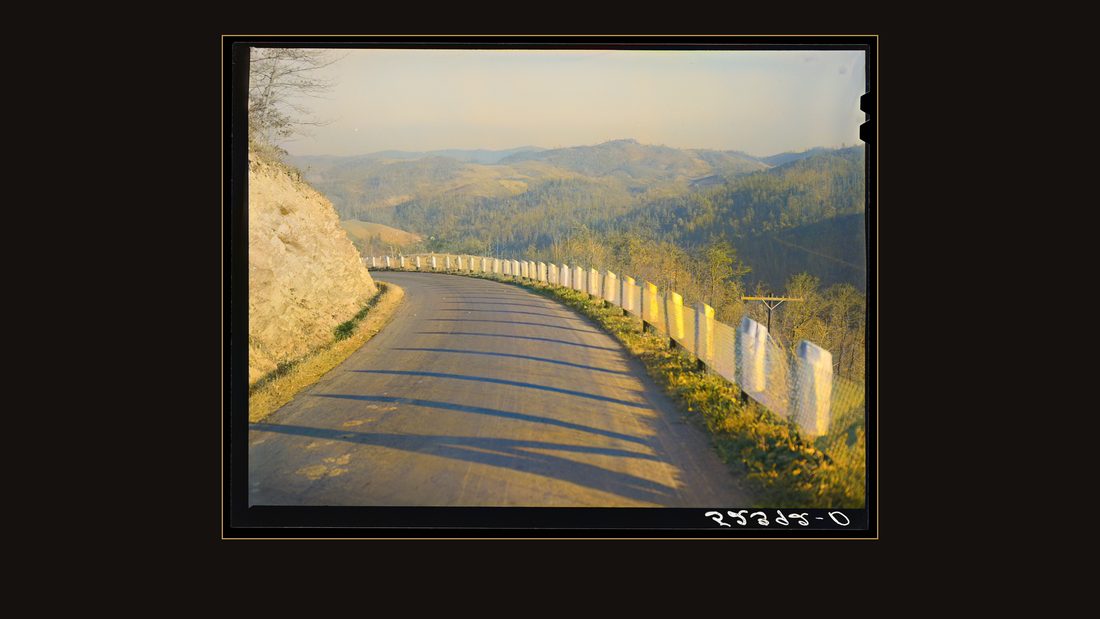
R34 Winding road and general landscape. Smokey Mountains, North Carolina
Marion Post Wolcott · November 1939 · Library of Congress · FSA/OWI · AI-colorized. View the original.
Whitewashed guardrails on a road cut into the grade.
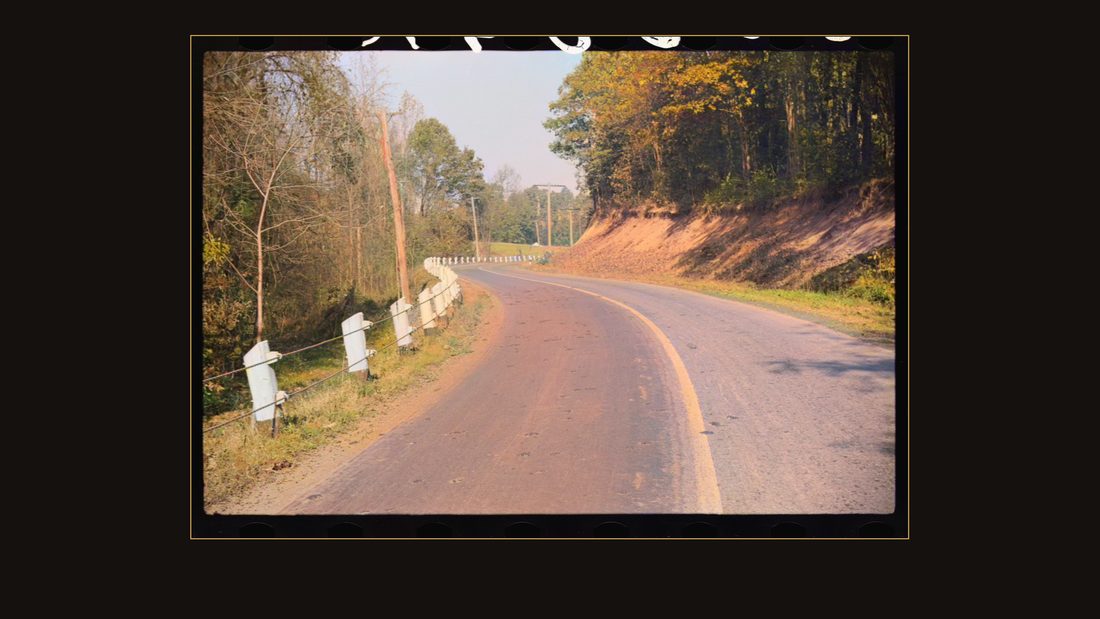
R35 Highway near Asheville, North Carolina
Marion Post Wolcott · Fall 1939 · Library of Congress · FSA/OWI · AI-colorized. View the original.
Fall on a highway near Asheville. Even the date in the file carries a question mark — October, November, nineteen thirty-nine.
The flood, 1940
S3
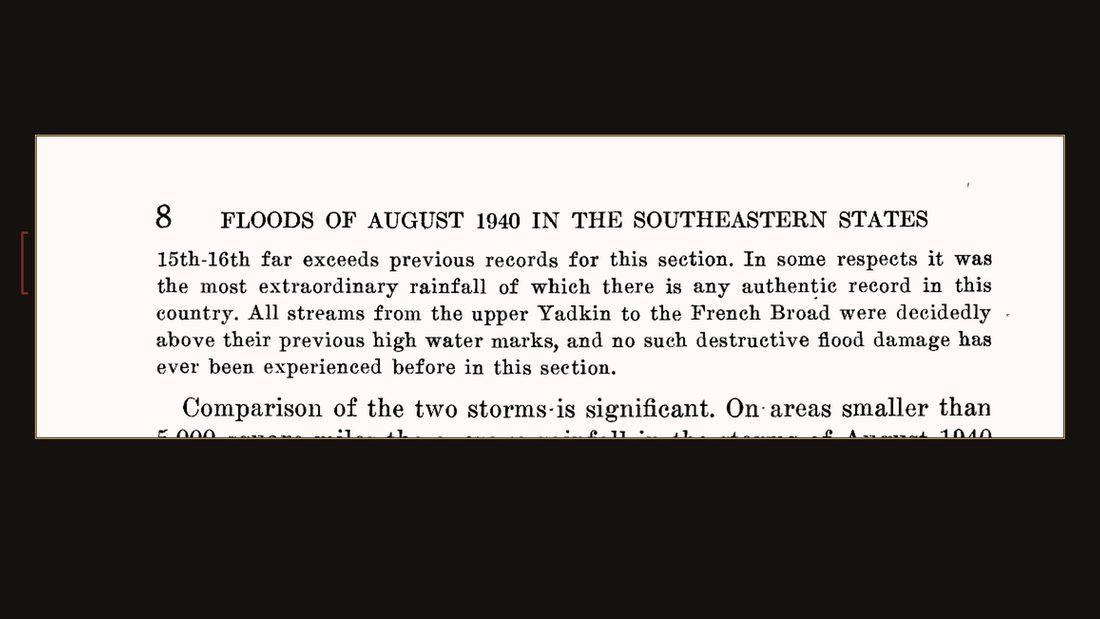
USGS Water-Supply Paper 1066 · 1949 · p. 8.
The next August, a hurricane came ashore near Savannah and drove its rain into the Blue Ridge. The federal engineers who measured it later quoted the Weather Bureau: in some respects, the most extraordinary rainfall of which there is any authentic record in this country.
S5
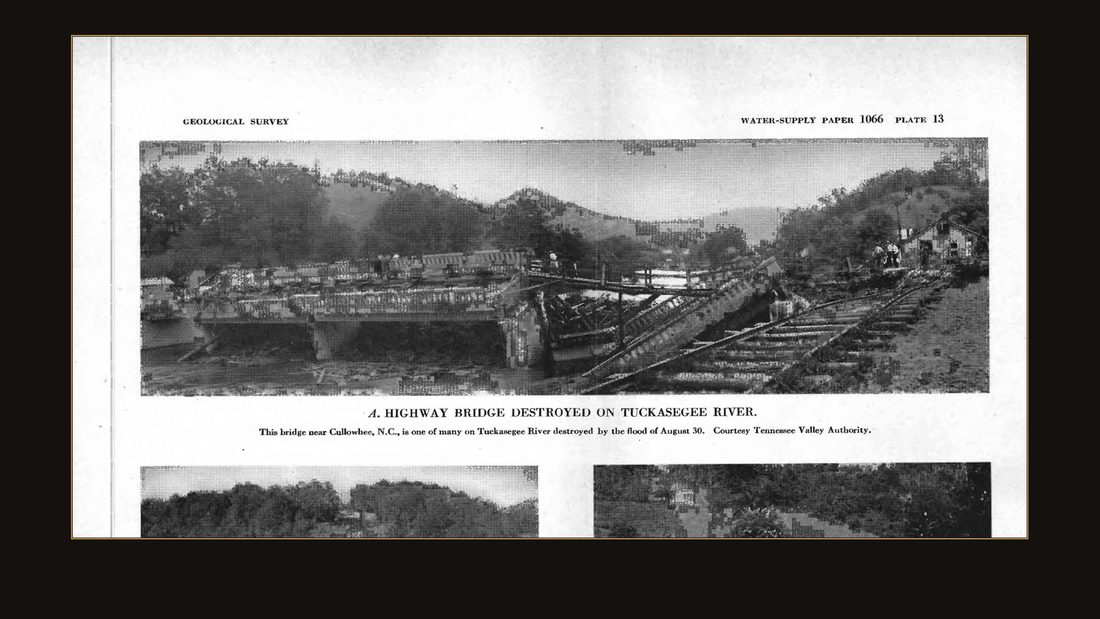
USGS Water-Supply Paper 1066 · 1949 · pl. 13.
And there were two storms, sixteen days apart, which almost nobody remembers. This bridge over the Tucka-seejee, near Culla-whee, went out in the second one, at the end of August.
S4
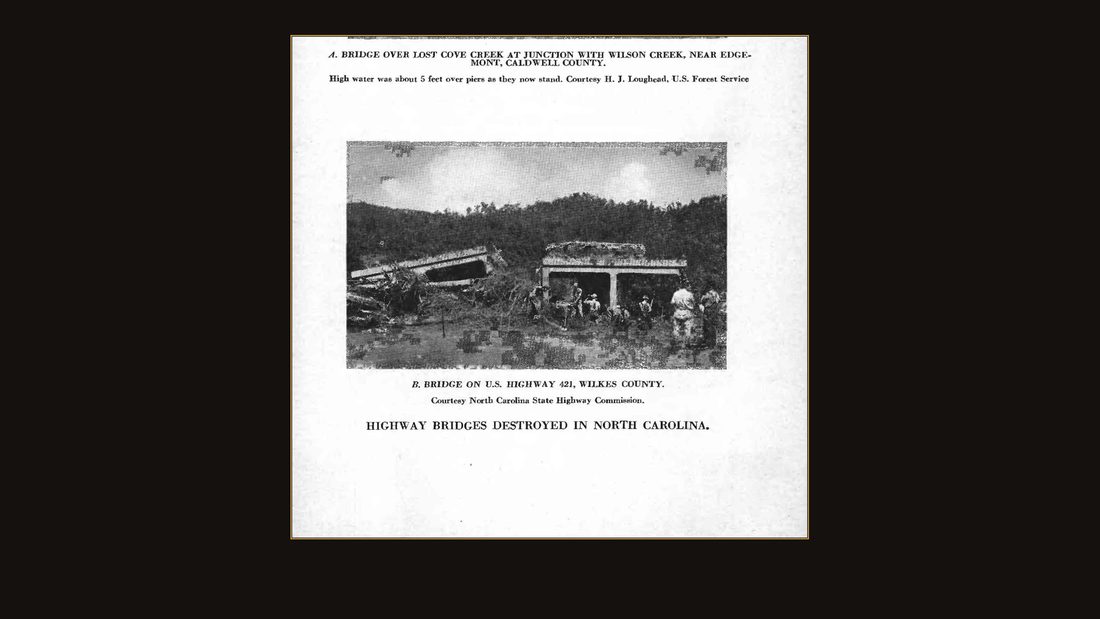
USGS Water-Supply Paper 1066 · 1949 · pl. 3.
U.S. Highway four twenty-one, Wilkes County. The landslides came down with the water. The Survey wrote that the biggest ones made a clean sweep of everything in their paths, and turned the valley streams into what its engineers called a mud-boulder flow.
S2
USGS Water-Supply Paper 1066 · 1949 · p. 14.
The damage section, page fourteen. The estimated number of deaths varies between thirty and forty. Twenty-six of them in North Carolina.
What the camera found
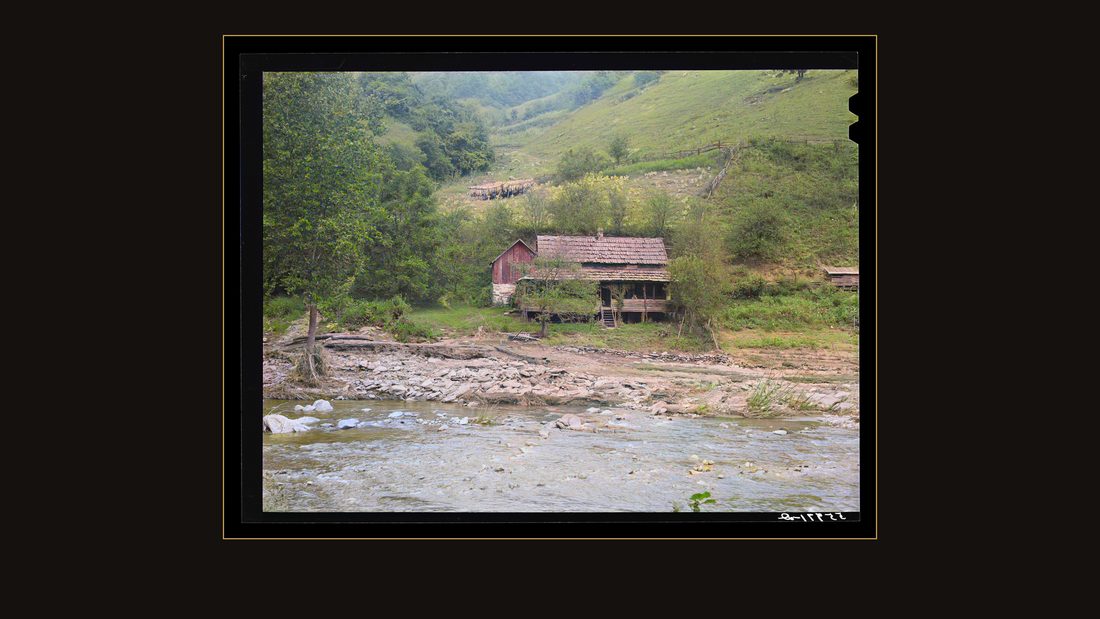
R36 Farm house along creek bed in recently flooded area northwest of Asheville, North Carolina
Marion Post Wolcott · September 1940 · Library of Congress · FSA/OWI · AI-colorized. View the original.
A month later, September nineteen forty, Marion Post photographed the creek bottoms northwest of Asheville, where the water had been.
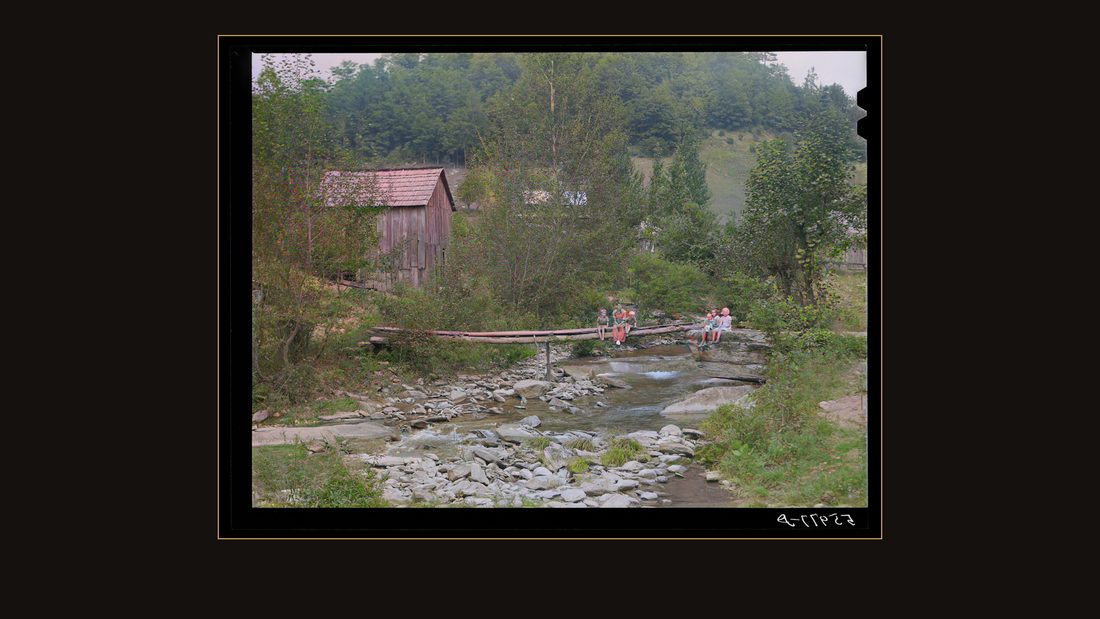
R37 Farmhouses along creek bed in recently flooded area northwest of Asheville, North Carolina
Marion Post Wolcott · September 1940 · Library of Congress · FSA/OWI · AI-colorized. View the original.
Farmhouses along a creek bed, recently flooded — her caption. The creek had rearranged its floor.
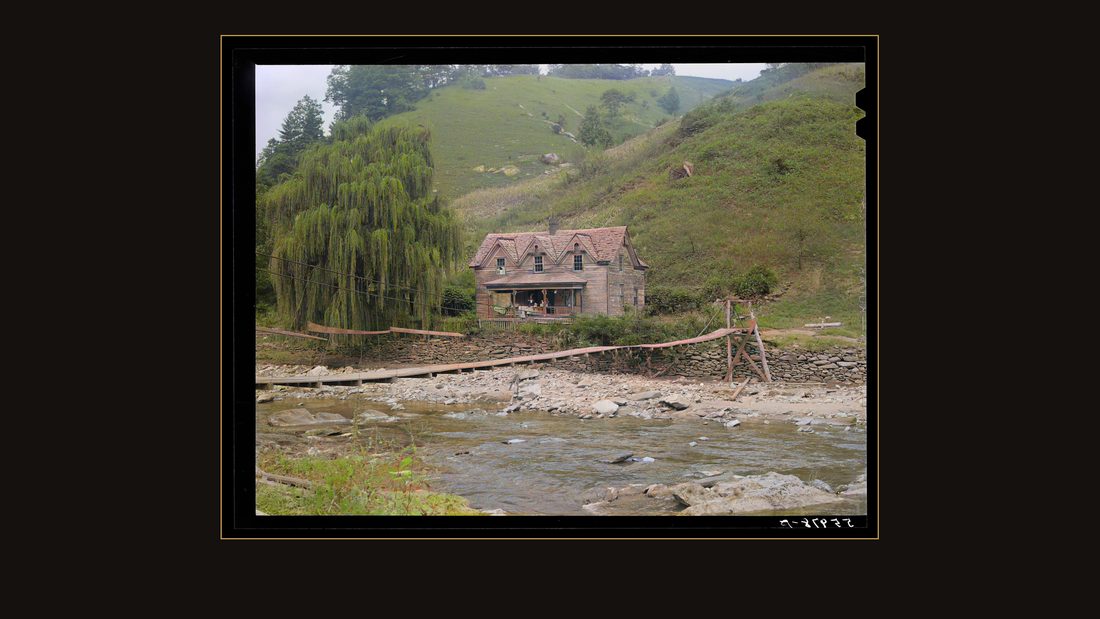
R38 Farmhouses along creek bed in recently flooded area northwest of Asheville, North Carolina
Marion Post Wolcott · September 1940 · Library of Congress · FSA/OWI · AI-colorized. View the original.
A house behind a willow, and a footlog back up on its posts.
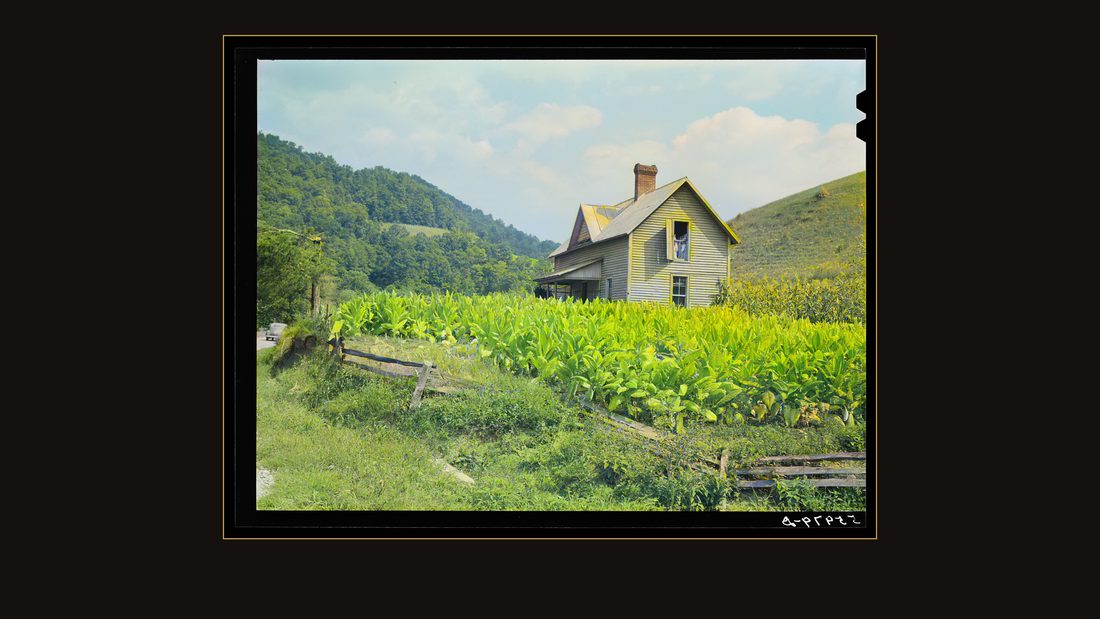
R39 Tobacco around farmhouse and in attic. Northwest of Asheville, North Carolina
Marion Post Wolcott · September 1940 · Library of Congress · FSA/OWI · AI-colorized. View the original.
Tobacco standing around a farmhouse, and curing in its attic. The crop had to come in regardless.
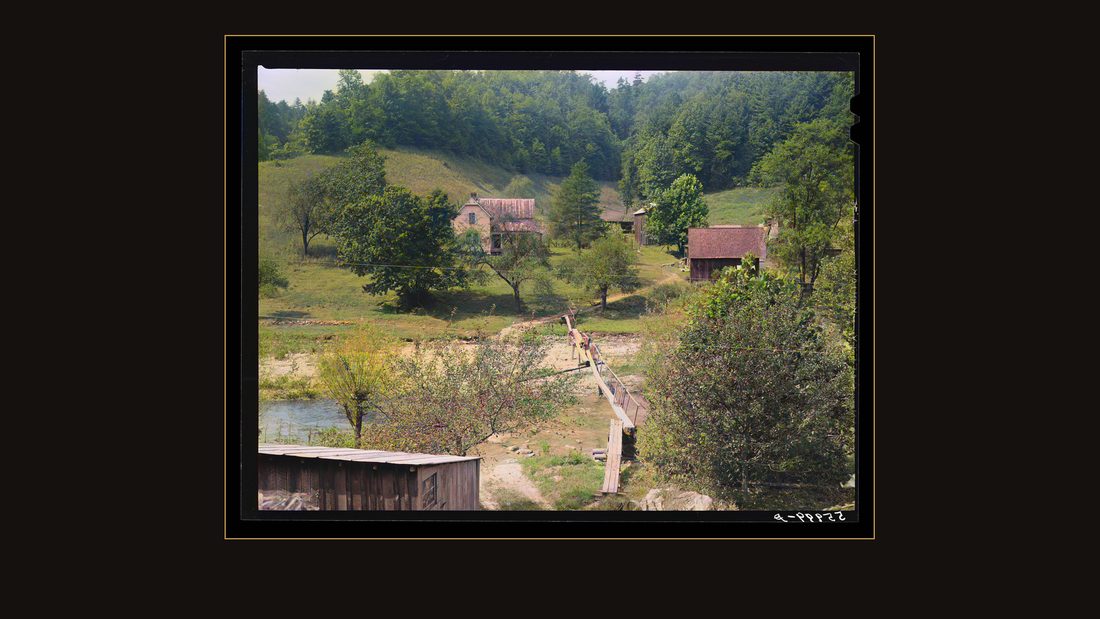
R40 Farmhouses along creek bed on recently flooded area northwest of Asheville, North Carolina
Marion Post Wolcott · September 1940 · Library of Congress · FSA/OWI · AI-colorized. View the original.
Another farm, another scoured channel.
![[Untitled photo, possibly related to: Farmhouses along creek bed in recently flooded area northwest of Asheville, North Carolina]](img/R41.jpg)
R41 [Untitled photo, possibly related to: Farmhouses along creek bed in recently flooded area northwest of Asheville, North Carolina]
Marion Post Wolcott · September 1940 · Library of Congress · FSA/OWI · AI-colorized. View the original.
Children out on the new footlog. The color of the water is a guess. The rocks are not.
Scrap, 1942
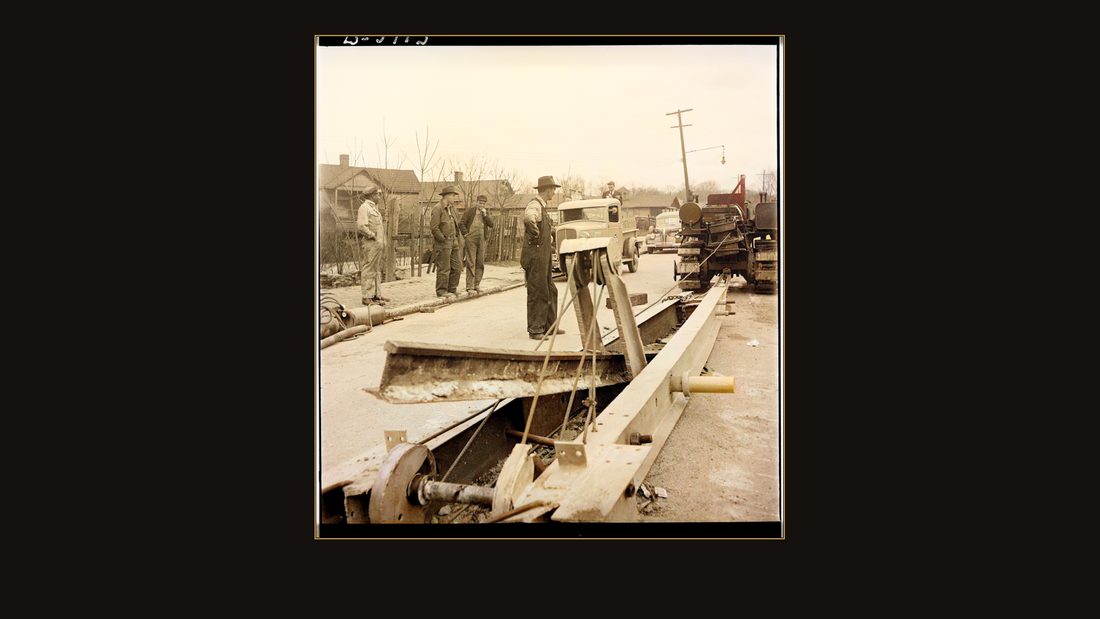
R42 Buried trolley tracks salvaged to aid war program. Removing abandoned trolley tracks to provide much needed scrap for Uncle Sam. Here, in Asheville, North Carolina, a local inventor demonstrates his "railjerk" for doing the trick. He claims his device, employing three men, can pry loose a mile of track a day
FSA/OWI photographer · May 1942 · Library of Congress · FSA/OWI · AI-colorized. View the original.
May, nineteen forty-two. The war reached Asheville's pavement. A local inventor demonstrated a machine he called the railjerk, built to tear the city's abandoned trolley tracks out of the street for scrap.
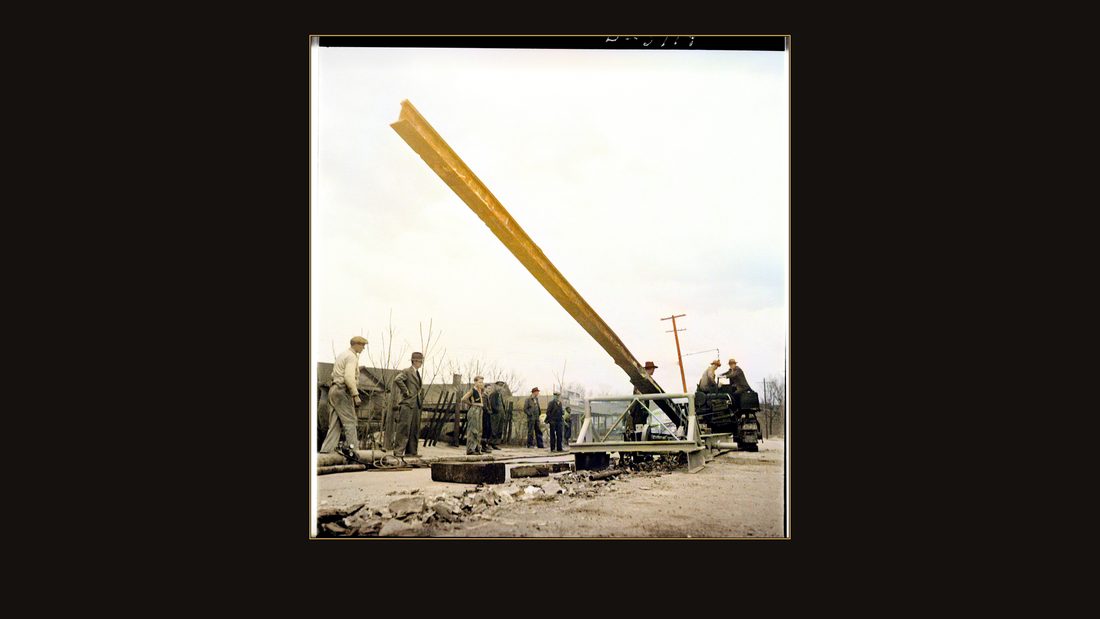
R43 Buried trolley tracks salvaged to aid war program. Old tracks for new guns. One of the ways many American cities are responding to Uncle Sam's call for scrap is by pulling out abandoned trolley tracks. This apparatus, developed by an Asheville, North Carolina machine shop operator, is being used to tear out the old buried tracks in his city. With three men, the device can remove twenty-five tons of rail per day
FSA/OWI photographer · May 1942 · Library of Congress · FSA/OWI · AI-colorized. View the original.
The government caption takes down his claim: three men, a mile of track a day.
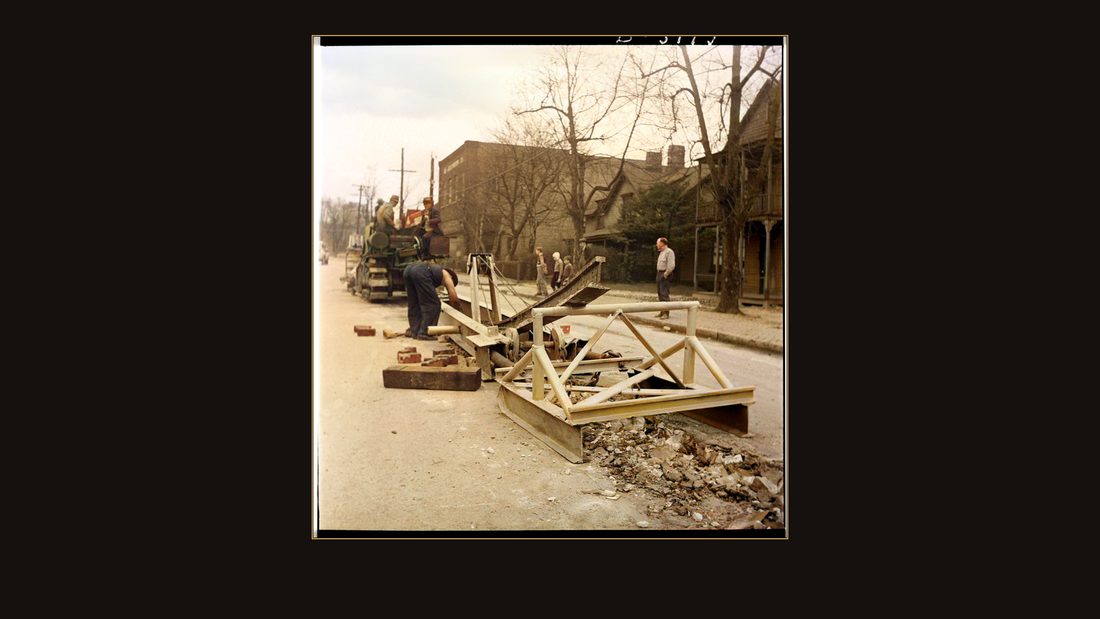
R44 Buried trolley tracks salvaged to aid war program. It's no good under the ground, but it can be used to smash the Axis. Thousands of tons of buried trolley tracks are being unearthed these days to answer Uncle Sam's call for scrap. An Asheville, North Carolina machine shop operator is shown here demonstrating his "railjerk" which he claims can remove a mile of track a day
FSA/OWI photographer · May 1942 · Library of Congress · FSA/OWI · AI-colorized. View the original.
Old tracks for new guns, the caption says. Twenty-five tons of rail a day, out of the ground and off to war.
Night run, 1943
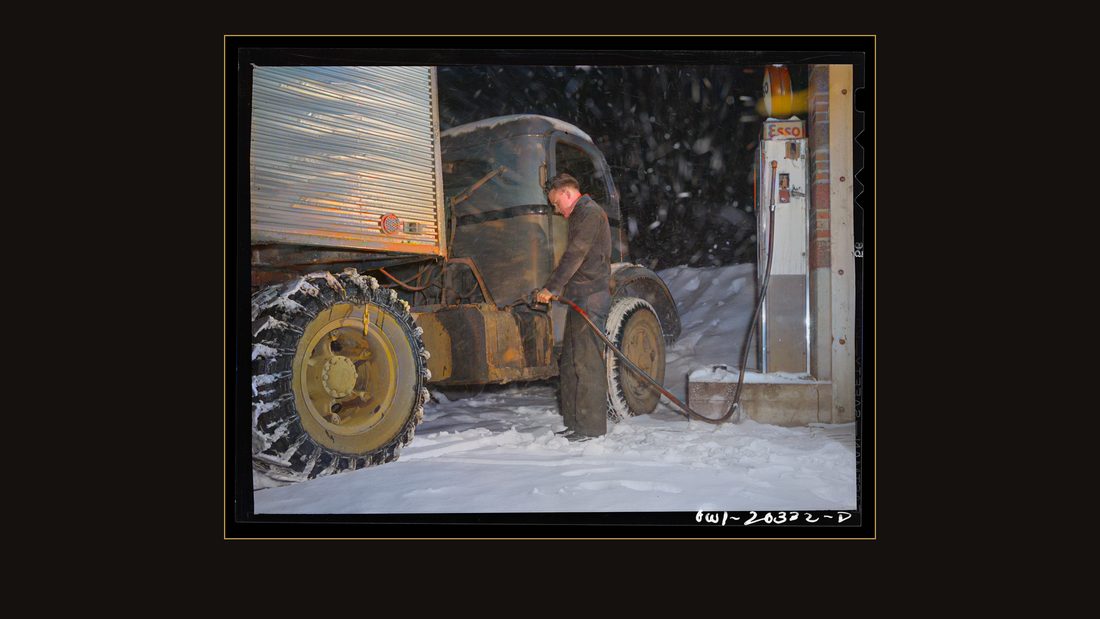
R45 Boone, North Carolina. A night attendant filling a truck with gas at three in the morning. The truck is going on to Winston-Salem
John Vachon · March 1943 · Library of Congress · FSA/OWI · AI-colorized. View the original.
March, nineteen forty-three. John Vachon stood in falling snow in Boone at three in the morning, photographing a night attendant filling a truck bound for Winston-Salem.
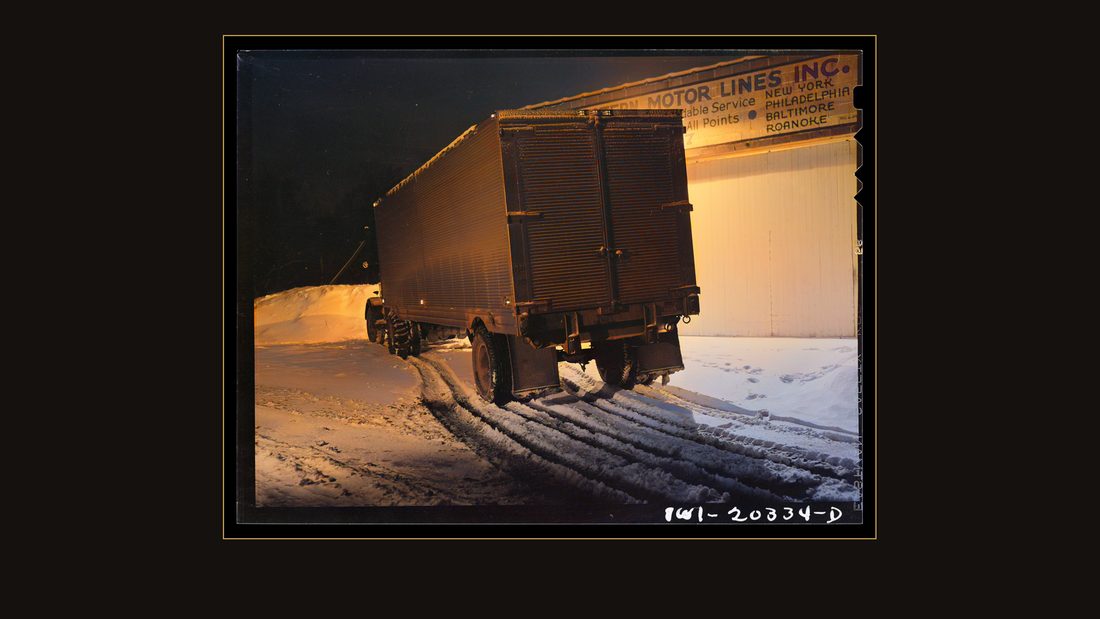
R46 Boone, North Carolina. Truck stopped for refueling
John Vachon · March 1943 · Library of Congress · FSA/OWI · AI-colorized. View the original.
The overnight freight run crossed these mountains between Bristol, Tennessee and Winston-Salem, and the trucks stopped in Boone for gas, all night, every night.
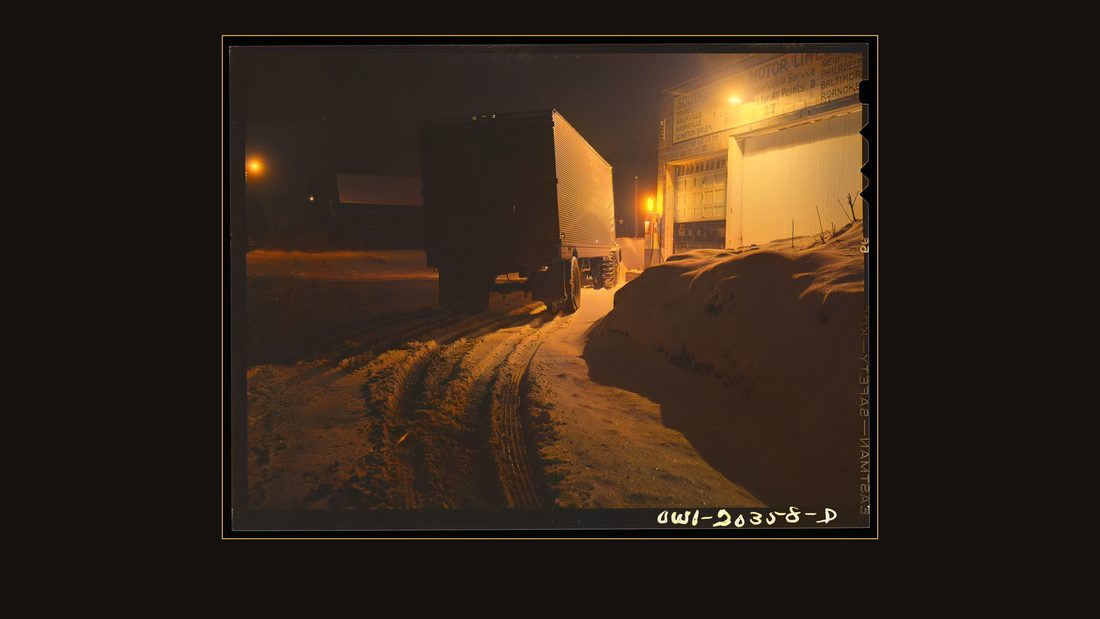
R47 Boone, North Carolina. Truck stopped for refueling
John Vachon · March 1943 · Library of Congress · FSA/OWI · AI-colorized. View the original.
The motor lines garage, open to the snow.
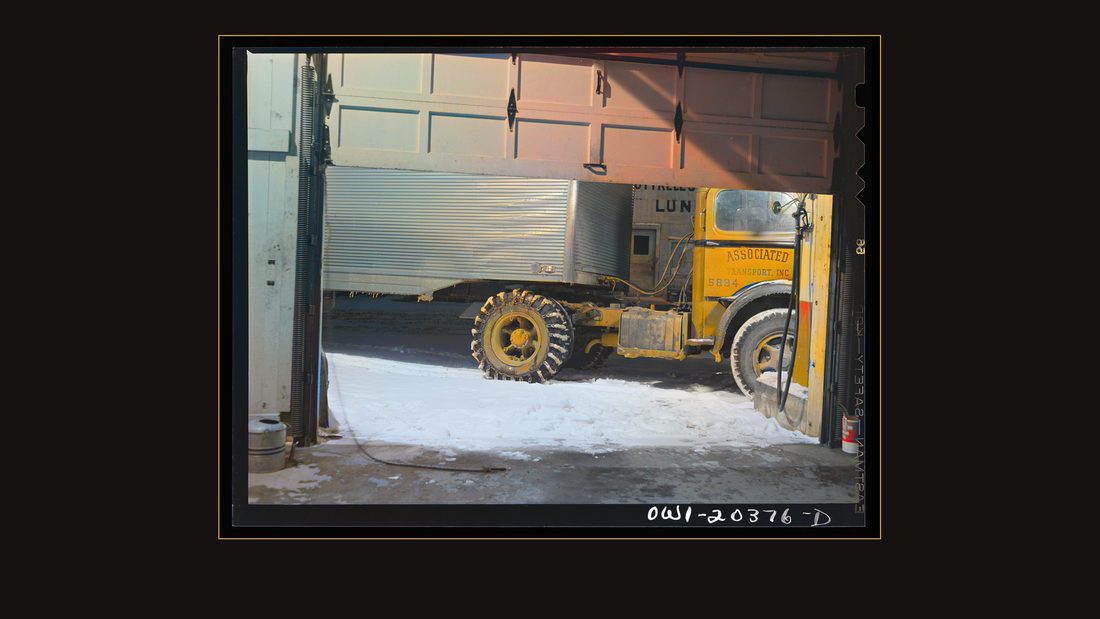
R48 [Untitled photo, possibly related to: Boone, North Carolina. Jim Fletcher's truck stopping for gas on his overnight run, between Bristol, Tennessee and Winston-Salem, North Carolina]
John Vachon · March 1943 · Library of Congress · FSA/OWI · AI-colorized. View the original.
Jim Fletcher's truck. The caption gives the driver's name, the route, and nothing else.
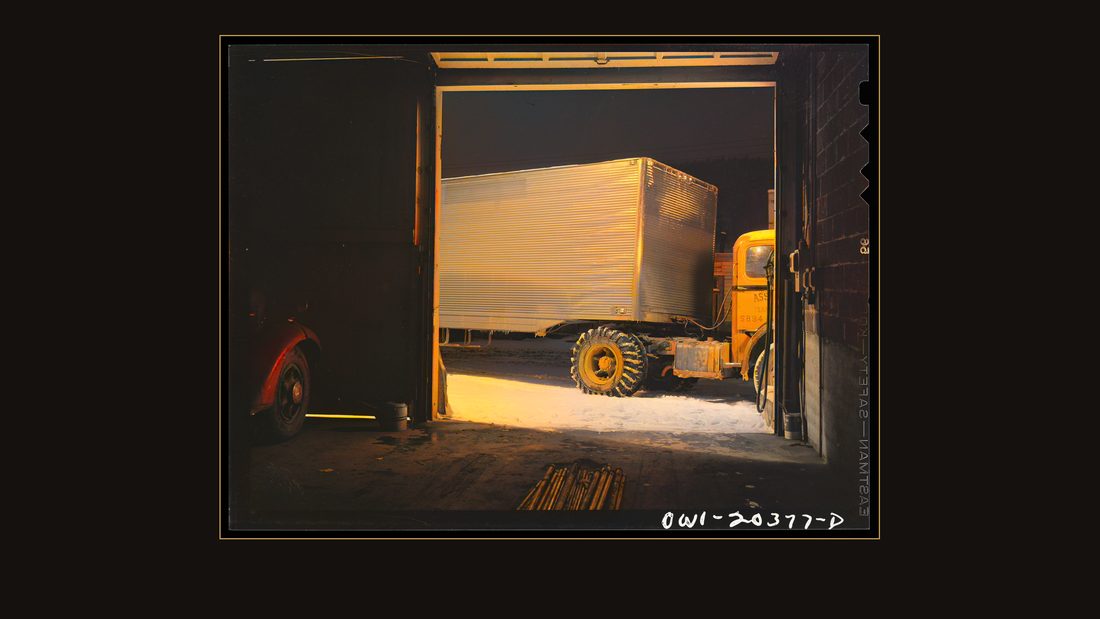
R49 Boone, North Carolina. Jim Fletcher's truck stopping for gas on his overnight run, between Bristol, Tennessee and Winston-Salem, North Carolina
John Vachon · March 1943 · Library of Congress · FSA/OWI · AI-colorized. View the original.
Flash, at three in the morning, in nineteen forty-three. These are the last mountain frames in the file. The next year, the whole collection — about one hundred seventy-five thousand negatives, the printed and the killed alike — was transferred to the Library of Congress.
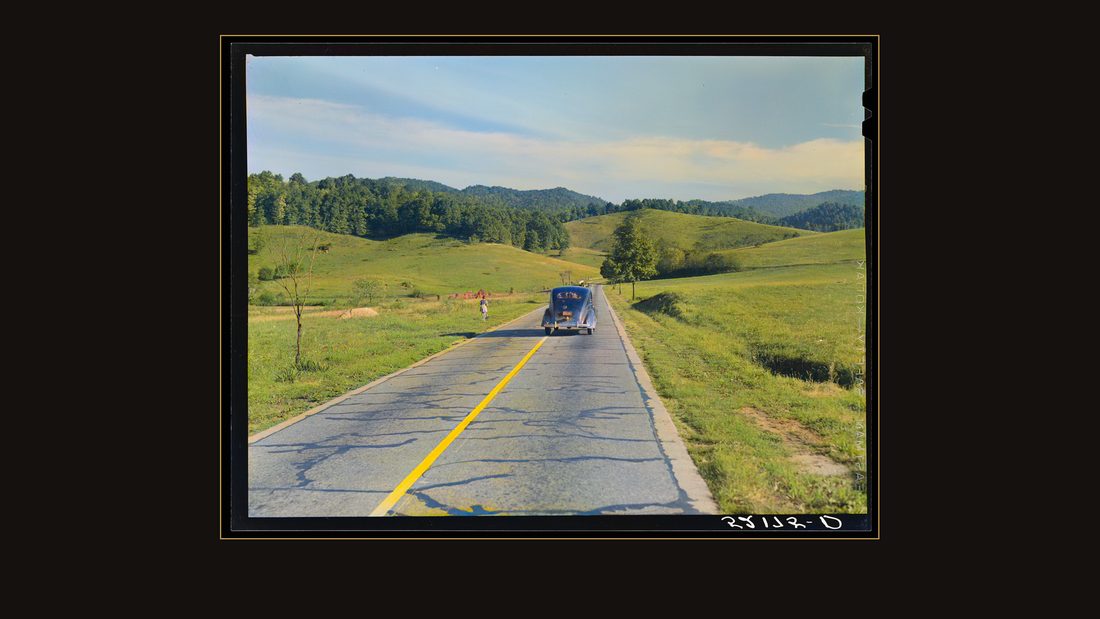
R28 Highway going west from Asheville, North Carolina
Marion Post Wolcott · September 1939 · Library of Congress · FSA/OWI · AI-colorized. View the original.
Where it has waited, in black and white, ever since. The negatives are yours — they always were. Every frame in this film is linked below, in the original black and white, at the Library of Congress. And if you want more of Marion Post's file in color, the carnival she found in West Virginia the year before this harvest is already on this channel.
Sources
- Carl Mydans, March 1936 — mountain homes and interiors near Marshall, N.C., and convict road gangs: loc.gov/pictures (search "Mydans North Carolina 1936"); key items 2017715140, 2017715143, 2017715156–58, 2017715171
- "Killed" negatives (hole-punched rejects), incl. items 2017715155, 2017715139, 2017715200. On the practice: Library of Congress, FSA/OWI Collection, "Background and Scope — How the Photographs Were Produced": "Rejected images were classified as 'killed.' In earlier phases of the project a hole was sometimes punched through the 'killed' negatives" (loc.gov/pictures/collection/fsa/background.html)
- Ben Shahn on the hole punch: Oral history interview with Ben Shahn, April 14, 1964, conducted by Richard Doud, Archives of American Art, Smithsonian Institution (aaa.si.edu/collections/interviews/oral-history-interview-ben-shahn-12760)
- Ben Shahn, 1937 — Asheville musicians: items 2017730908–2017730930, 2017767079. LOC subject heading: "Music festivals—North Carolina." On the Mountain Dance and Folk Festival (founded 1928 by Bascom Lamar Lunsford): Folk Heritage Committee, folkheritage.org/our-history
- Samantha Bumgarner: N.C. Department of Natural and Cultural Resources, "Samantha Bumgarner, Banjo-Picking Pioneer" (dncr.nc.gov, Dec. 23, 2016); UNC Libraries, "Hillbilly Music: Source & Symbol" (biography after Robert K. Oermann, Encyclopedia of Country Music, Oxford, 1998)
- Marion Post Wolcott, Sept. 1939, Nov. 1939, and Sept. 1940 — landscapes and flood aftermath northwest of Asheville: items incl. 2017801378–2017801666, 2017805318–2017805351
- The August 1940 floods: U.S. Geological Survey, *Floods of August 1940 in the Southeastern States*, Water-Supply Paper 1066 (GPO, 1949) — deaths p. 14; Weather Bureau quotation p. 8; landslides pp. 14–15; plates 3 and 13. Full report free at pubs.usgs.gov/wsp/1066
- Office of War Information, May 1942 — Asheville trolley-track salvage ("railjerk"): items 2017692808–2017692810
- John Vachon, March 1943 — Boone, N.C., overnight trucking run between Bristol, Tenn. and Winston-Salem: items 2017848188–2017848233
- Colorization: DDColor (open-source model), run locally on downsampled copies of the Library's master scans. The colors are machine estimates, not restorations. Two scenes in the film state this on screen; the original black-and-white scans are linked above.