"Third of U.S. Pot Is in D.B. Forest": Kentucky's Marijuana War
In August 1983, the DEA sprayed the herbicide paraquat on marijuana plots in the Daniel Boone National Forest — and five weeks later a federal judge shut the program down, in an opinion that found the government had acted "in open violation of both the letter and spirit" of federal law.
Transcript
The headline
K4
Sentinel-Echo (London, Ky.) · Aug. 4, 1989 · via KSP annual report.
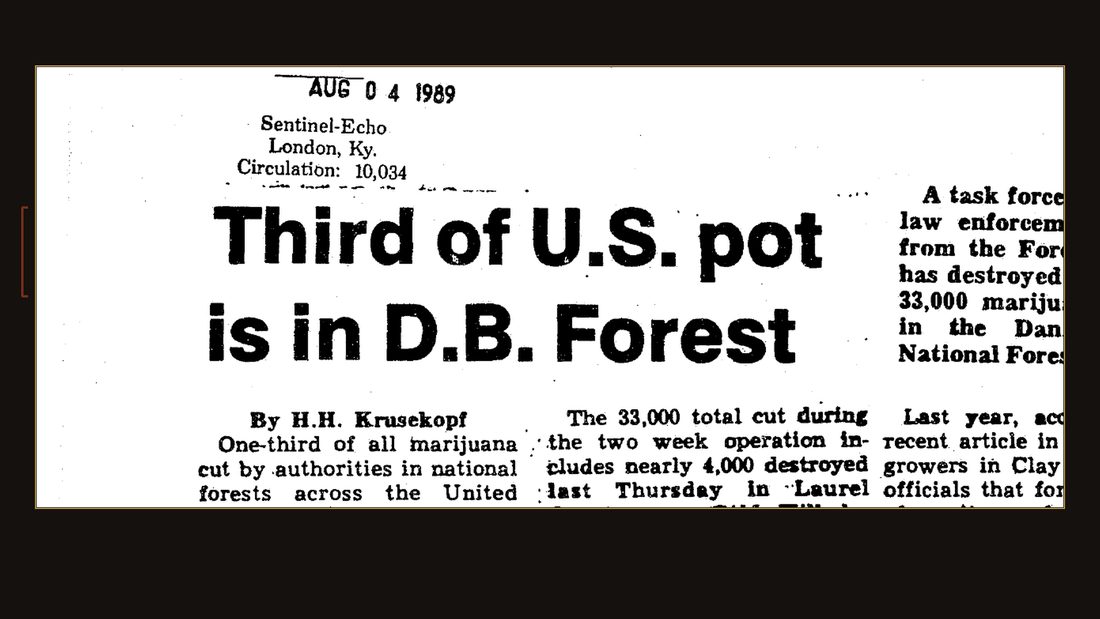
On August fourth, nineteen eighty-nine, the newspaper in London, Kentucky ran a headline across its front page. A third of U.S. pot is in D.B. Forest. One third of all the marijuana cut in every national forest in America — found in one forest, in eastern Kentucky.
H1
R.F. Collins, A History of the Daniel Boone National Forest 1770-1970 · U.S. Forest Service, 1975.
This is how the Daniel Boone National Forest became the busiest front in the federal government's war on homegrown marijuana. Why the first weapon was poison sprayed from the air. And why a federal judge took that weapon away after five weeks. Everything on screen comes from the record.
The trade comes home
The Daniel Boone runs down the eastern edge of Kentucky in a long broken band. Cliff lines, narrow hollows, about seven hundred thousand federal acres threaded between private farms and coal camps. The Forest Service manages it from London, in Laurel County.
C1
H. Rept. 98-598 · Select Committee on Narcotics Abuse and Control · Feb. 1984 · p. 127.
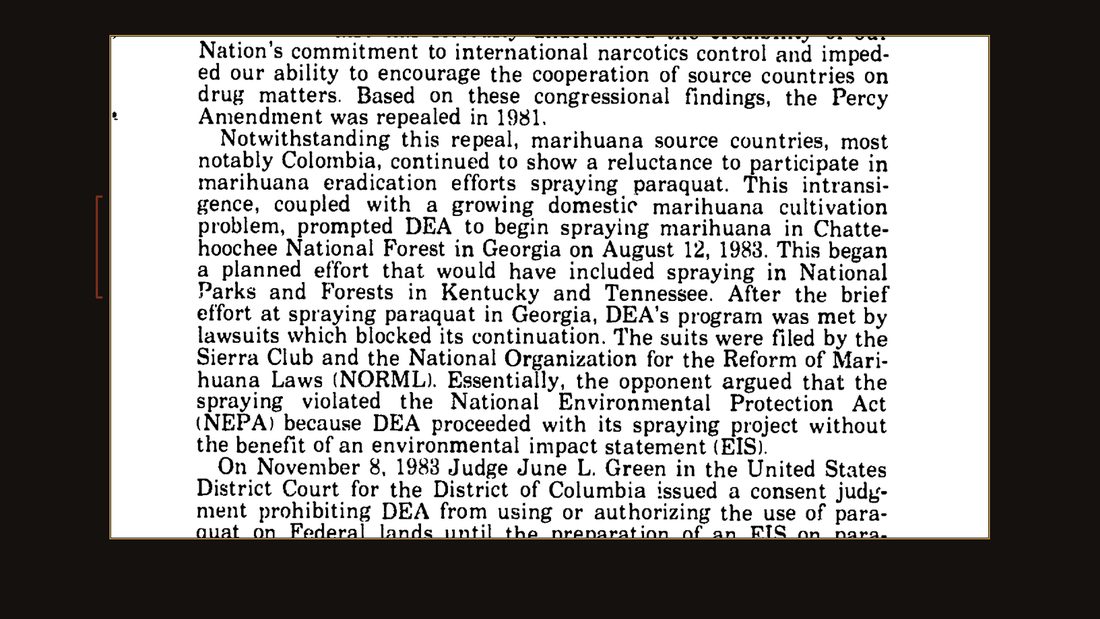
Through the nineteen seventies, almost all the marijuana smoked in America was imported. Then the United States helped Mexico spray its fields with a weed killer called paraquat, and American buyers lost their taste for Mexican product. Customs tightened the coast around Florida. A congressional committee later wrote down what happened next. The trade came home.
G1
GAO, GGD-84-77 · May 25, 1984 · p. 2.
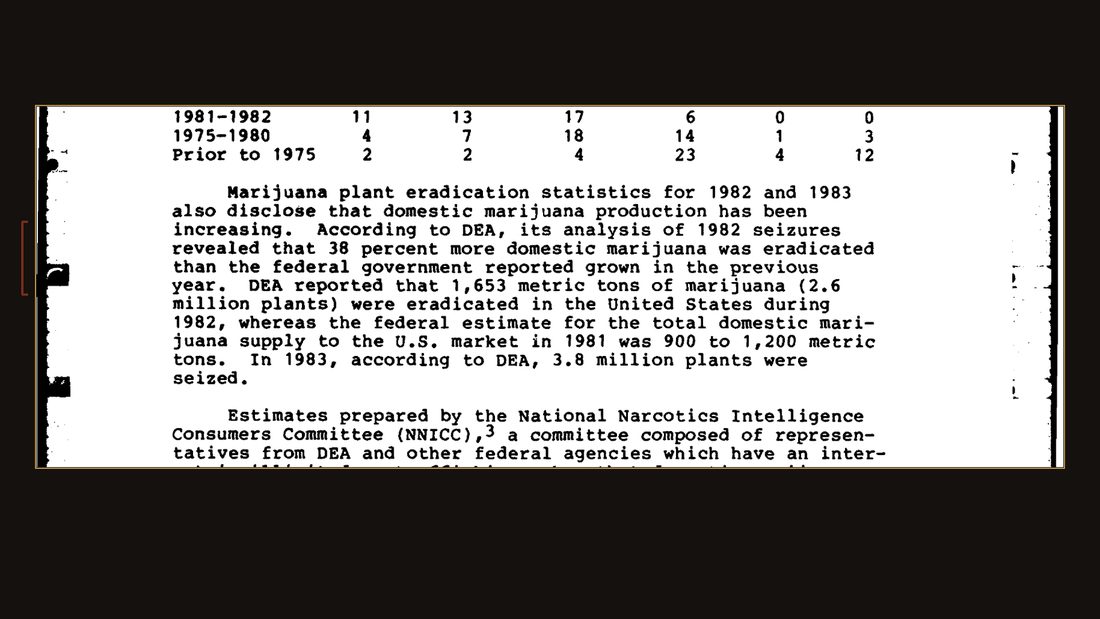
The numbers moved fast. In nineteen eighty-two, law enforcement destroyed about two point six million domestic plants. In nineteen eighty-three, according to the Drug Enforcement Administration, three point eight million. Marijuana was being seized in all fifty states.
C2
Field hearings, House Select Committee on Narcotics Abuse and Control, 1983-84 · p. 40.
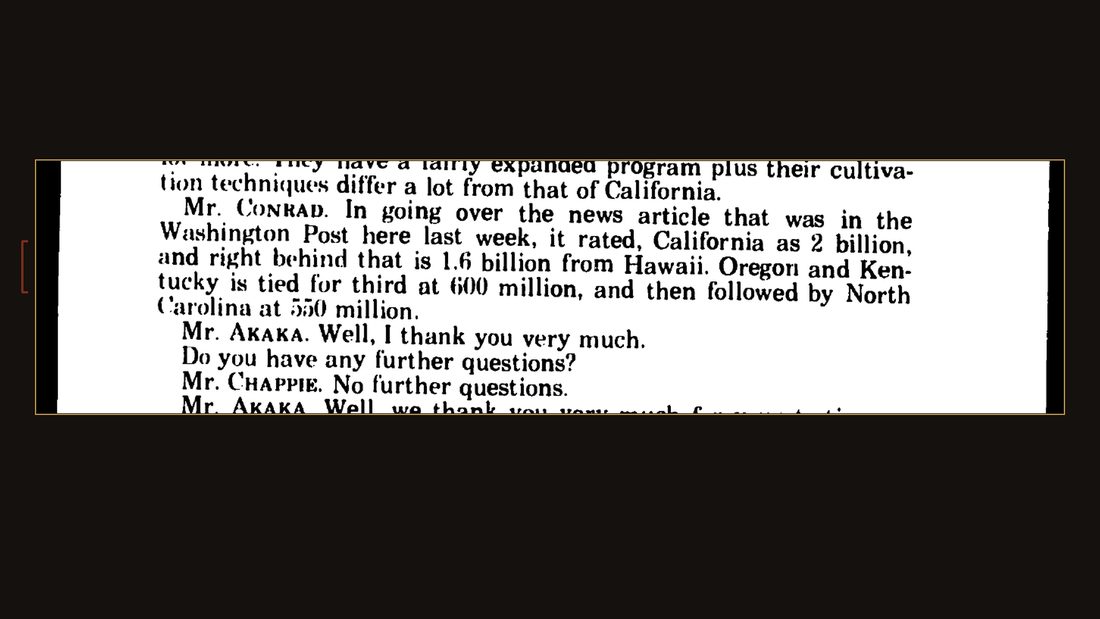
And a dollar figure started making the rounds. Six hundred million a year for Kentucky's crop, tied for third in the nation. At a congressional hearing, a witness read it out of a Washington Post article. Trace the number to its source and you find a publication from NORML — the marijuana lobby. The government's own audit reprinted it, with a footnote.
G1
GAO, GGD-84-77 · May 25, 1984 · p. 2.
Kentucky's own state agency told federal auditors something else about the crop: eighty percent of it left the state. This was not local vice. It was an export economy.
Growers moved onto federal ground for a plain reason. A plot on your own land can cost you the land. A plot in a national forest sits on nobody's deed. By the fall of nineteen eighty-two, marijuana had been found in every one of the one hundred fifty-five national forests, in forty-three states.
Open fields
The law was already clearing the way, and the case that cleared it came from Kentucky. In July nineteen eighty, two state narcotics agents got a tip about the farm of a retired farmer named Ray Oliver. They drove past his house to a locked gate with a No Trespassing sign, and walked around it.
Somebody standing by a camper shouted at them. No hunting is allowed, come back up here. The agents kept going. Over a mile from the house, they found a field of marijuana.
The Supreme Court decided the case in April nineteen eighty-four, and ruled for the agents. Open fields, the Court held, are not private. The signs and the fence made no difference. And both sides conceded one more thing on the record — that police may lawfully survey lands from the air. The helicopters had their permission.
Paraquat summer
But in August nineteen eighty-three, the Drug Enforcement Administration was not thinking about helicopters and machetes. It decided to treat the national forests the way Mexico had treated its fields. Same chemical. Paraquat.
It began in Georgia on August twelfth, in the Chattahoochee National Forest. The administration filmed the spraying, to show Colombia that America was willing to use the herbicide at home. Within days, the Daniel Boone was sprayed too.
In the Kentucky forest, a D.E.A. spokesman said, agents staked out the sprayed plots for three days to keep people away. That reassured no one. Ministers, farmers and county officials organized against the program. In Georgia, four hundred people packed a church for a protest meeting two days after the planes flew.
Opponents in Kentucky went to federal court to stop the spraying, and lost. The program rolled on. Then, on September first, the Sierra Club and NORML filed suit in Washington. The argument was procedural, and it was lethal. The government had sprayed first and studied never. No environmental impact statement. NORML's lawyer told the court the government had proceeded, quote, like a thief in the night.
On September thirteenth, Judge June Green stopped it. Her restraining order found the spraying appeared to violate two federal statutes, and barred any further aerial spraying of paraquat on federal land. The next day, the government told the plaintiffs it would not spray again without the study.
On November eighth, nineteen eighty-three, a consent judgment made it permanent. No paraquat on federal lands until a full environmental impact statement was done. The spraying of the Daniel Boone had lasted about five weeks, start to court order.
When the fees were settled two years later, the court used plainer language. The defendants, it wrote, had conducted their paraquat operation in open violation of both the letter and the spirit of the law.
C1
H. Rept. 98-598 · Select Committee on Narcotics Abuse and Control · Feb. 1984 · p. 127.
Congress's own narcotics committee was furious — at the delay, not the spraying. Paraquat, the committee wrote, was the most effective and environmentally safe herbicide for the job, and it urged the D.E.A. to be ready to spray again in nineteen eighty-four.
F1
61 Fed. Reg. 42056 · Aug. 13, 1996.
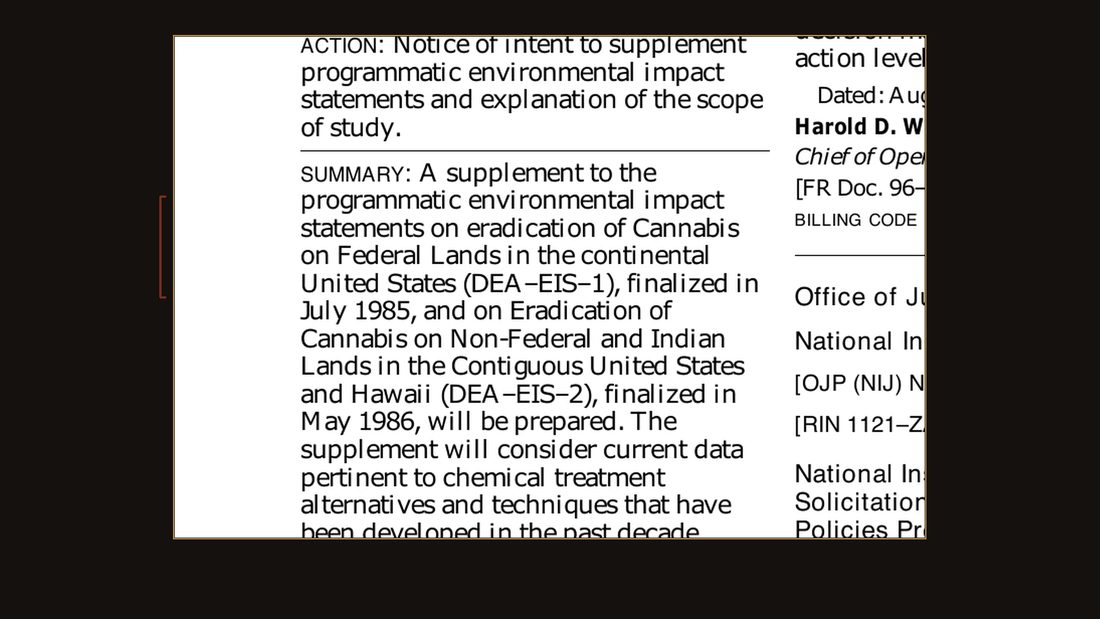
The environmental study the court demanded took until July of nineteen eighty-five. By then the moment had passed. In the Daniel Boone there would be no more poison from the sky. Eradication would be done the hard way. Helicopters to find the plots. Crews on the ground to cut the plants, pile them, and burn them.
Cut and burn
In August nineteen eighty-five, the D.E.A. ran a three-day nationwide sweep it called Operation Delta Nine. Press accounts that week counted more than two thousand officers in all fifty states, and more than two thousand plots destroyed. In Kentucky, the sweep teams found something waiting for them. Bear traps.
G2
GAO, RCED-85-18 · Nov. 28, 1984 · p. 28.
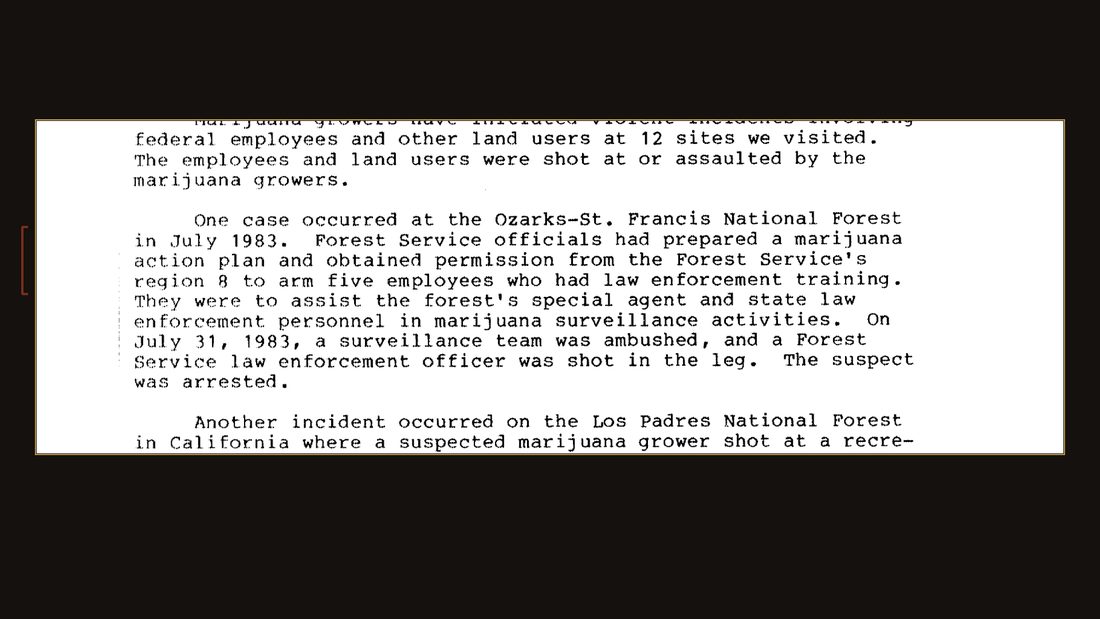
The violence was already in the government's files. In July nineteen eighty-three, a Forest Service surveillance team in an Arkansas national forest was ambushed, and an officer was shot in the leg.
G5
GAO, RCED-85-18 · Nov. 28, 1984 · p. 28.
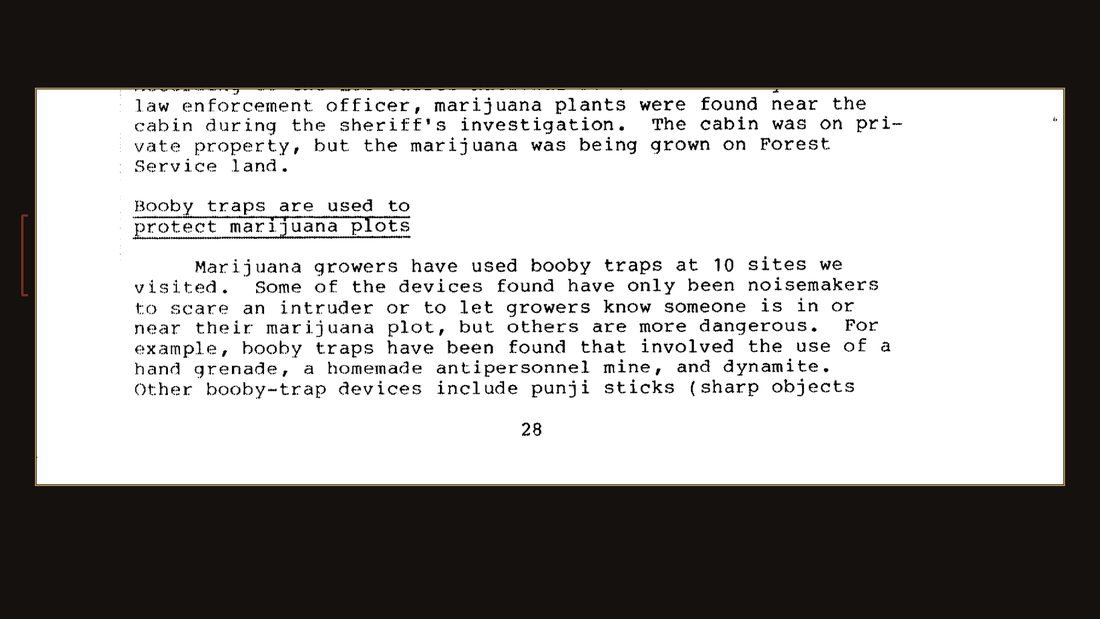
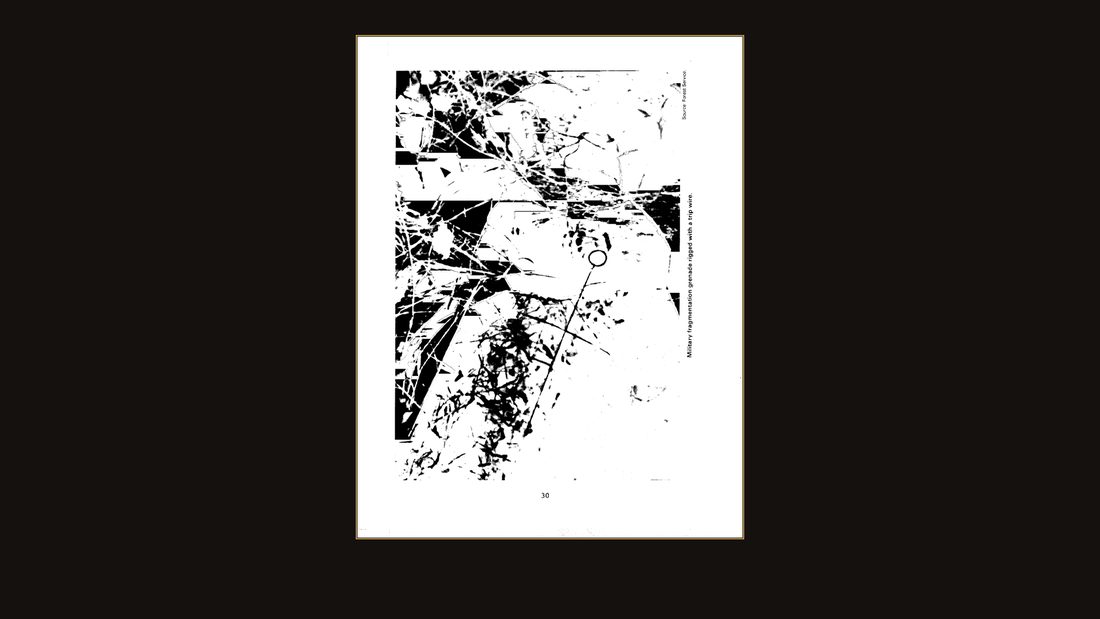
Federal auditors listed what growers were leaving in the woods to guard their crops. Punji sticks. Rat traps rigged to fire shotgun shells. Bear traps. Fishhooks hung across trails at eye level. A hand grenade. Dynamite. A homemade antipersonnel mine.
G3
Forest Service photo · GAO RCED-85-18 · p. 30.
The photograph the auditors printed is barely legible. A Forest Service picture, with a circle drawn around a military fragmentation grenade rigged to a trip wire.
D1
DEA, 1987 Domestic Cannabis Eradication/Suppression Program · p. 13.
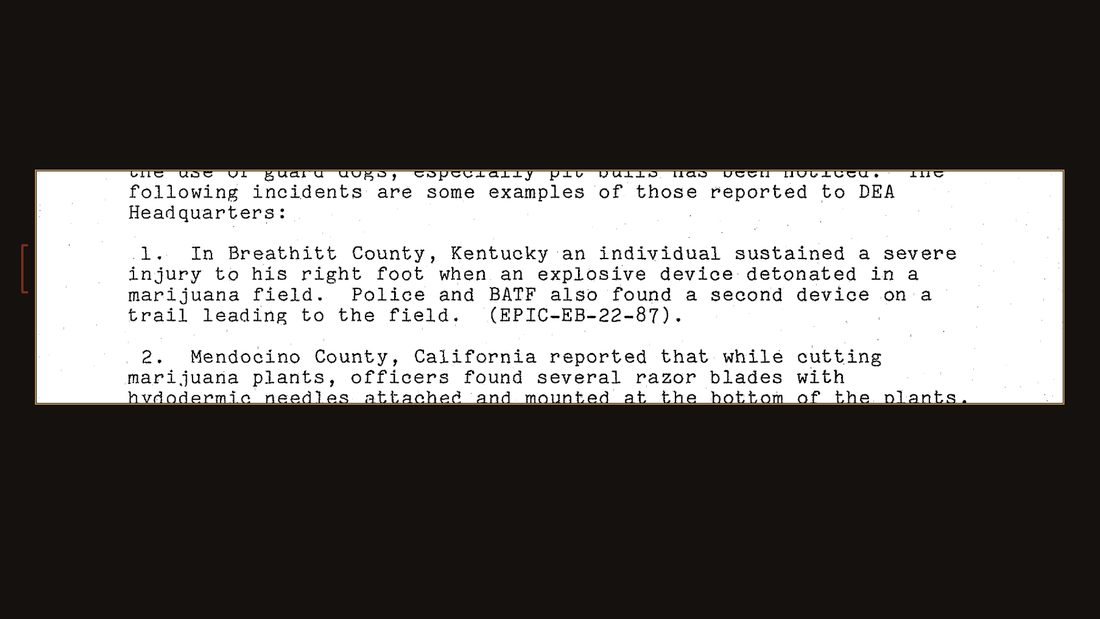
By nineteen eighty-seven the incident lists reached Kentucky. In Brethitt County, a man's right foot was severely injured when an explosive device went off in a marijuana field. Police found a second device on the trail leading in.
The Boone in the crosshairs
K1
Kentucky State Police, 1988-89 Marijuana Annual Report · p. 6.
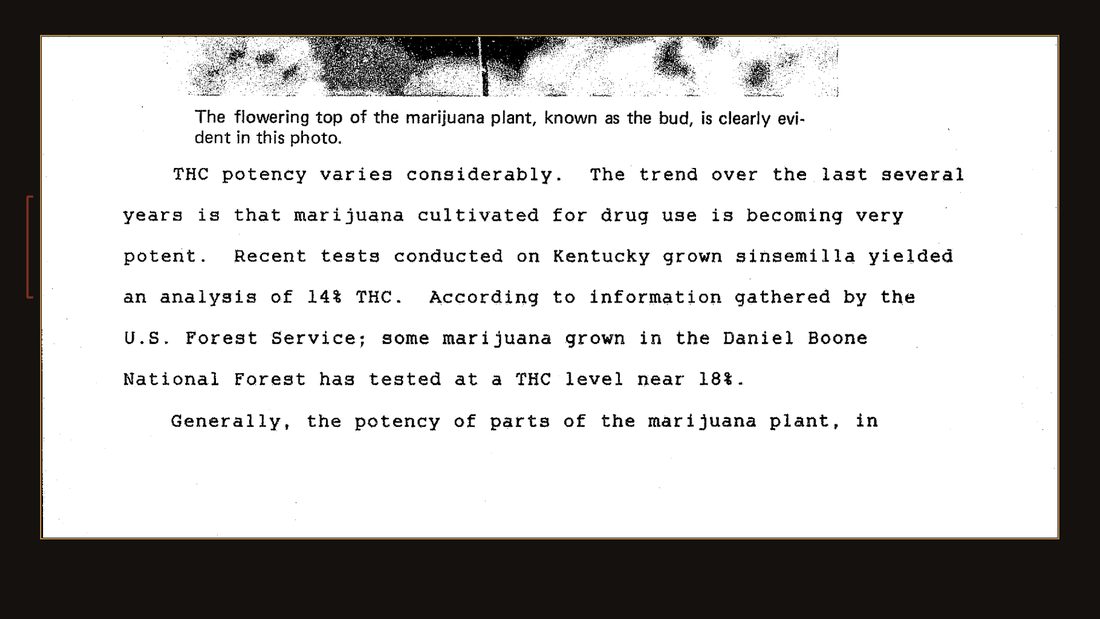
The crop itself had changed. Recent tests, the Kentucky State Police wrote, showed Kentucky-grown plants at fourteen percent THC. And according to information gathered by the U.S. Forest Service, some marijuana grown in the Daniel Boone National Forest tested near eighteen percent. Whatever this was, it was not ditch weed.
August twenty-fourth, nineteen eighty-eight. Forest Service agents walked into the Arnett Fork area of Clay County to cut two plots growing on federal land. Two people were waiting near the plants. There was a stand-off. Both surrendered, and both gave up the same two names.
Delbert and Idell Bowling. A footpath ran from the marijuana patches to their trailer. The county sheriff read the search warrant out loud at the trailer's back door, because nobody was home. In the inventory: ammunition, plant food, camping gear, a bottle of marijuana seeds, and two issues of High Times.
The Guard comes in
K2
Kentucky State Police, 1988-89 Marijuana Annual Report · p. 37.
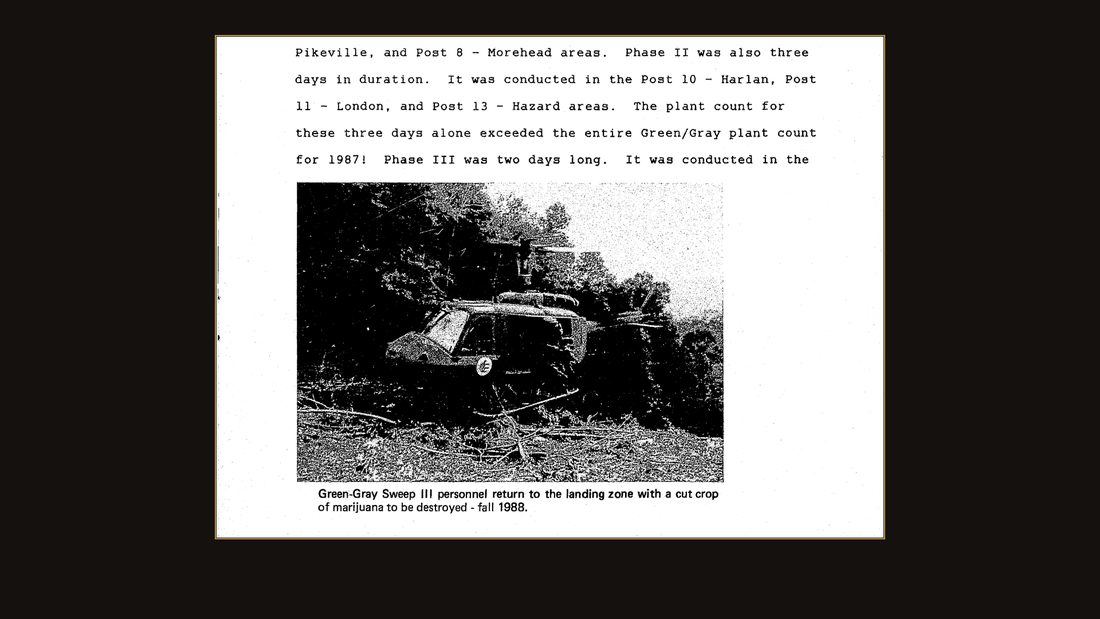
That same year the National Guard came into the fields — personnel and equipment to help the state police cut and haul the crop. The operation was called the Green Gray Sweep. Nine state police posts. Sixty-four eastern counties. Eight days. The state police annual report prints the picture: a helicopter at a landing zone, loaded with cut marijuana, in the fall of nineteen eighty-eight.
K3
Kentucky State Police, 1988-89 Marijuana Annual Report · p. 40.
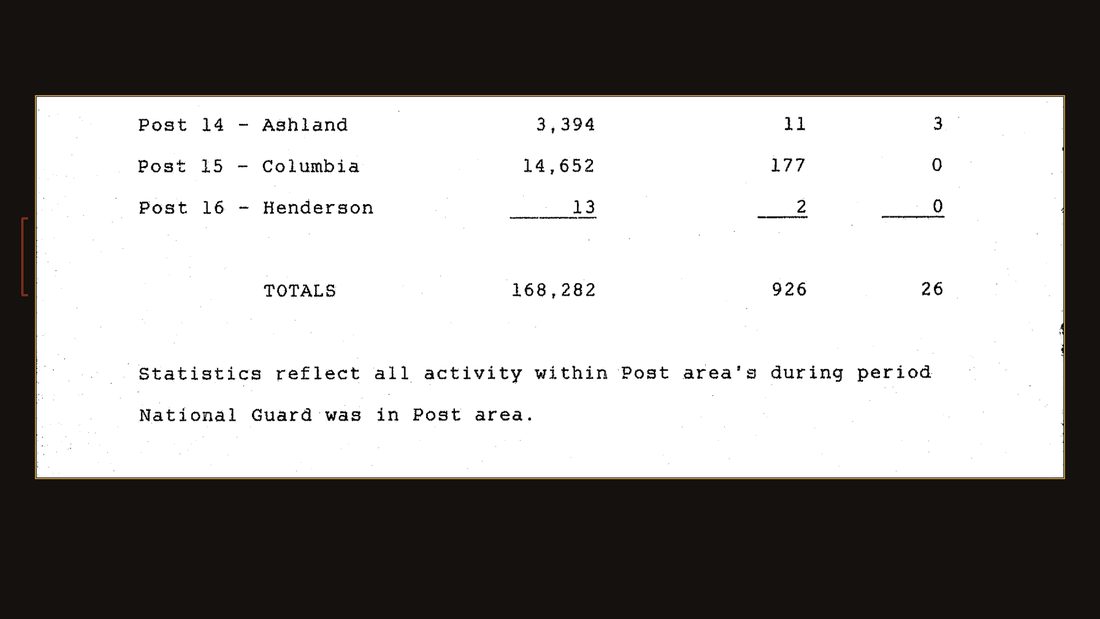
In nineteen eighty-nine, the sweep cut one hundred sixty-eight thousand plants from nine hundred twenty-six plots across the state. It made twenty-six arrests. That is more than six thousand plants cut for every arrest made. The plants were easy to find. The people were not.
D2
DEA, 1989 DCE/SP Final Report · p. 15.
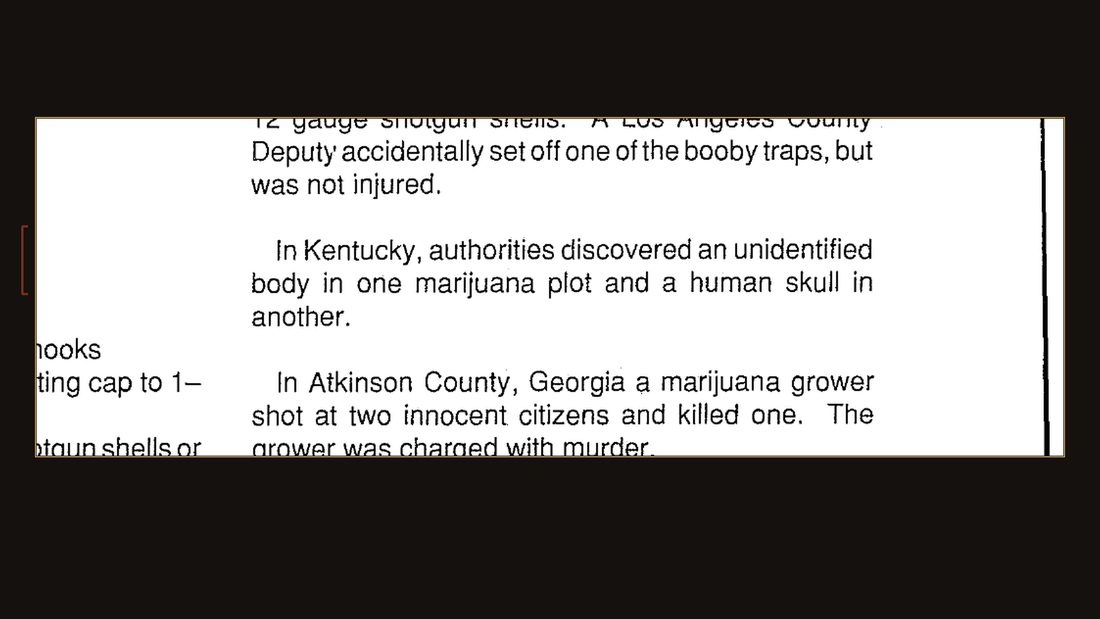
The D.E.A.'s national report for nineteen eighty-nine carries one Kentucky item, with no names and no county attached. Authorities discovered an unidentified body in one marijuana plot. And a human skull in another.
Two weeks in August
K4
Sentinel-Echo (London, Ky.) · Aug. 4, 1989 · via KSP annual report.
Which brings us back to the headline. In late July nineteen eighty-nine, a task force led by Forest Service law enforcement spent two weeks in the southern Daniel Boone. Laurel, Clay and Owsley counties, and over into Rockcastle, Pulaski and McCreary.
They cut more than thirty-three thousand plants from two hundred fifty-two plots. Agents came in from Virginia, Florida and Mississippi to help. Three people were arrested. Eleven thousand plants for each of them.
K5
Sentinel-Echo (London, Ky.) · Aug. 4, 1989 · via KSP annual report.
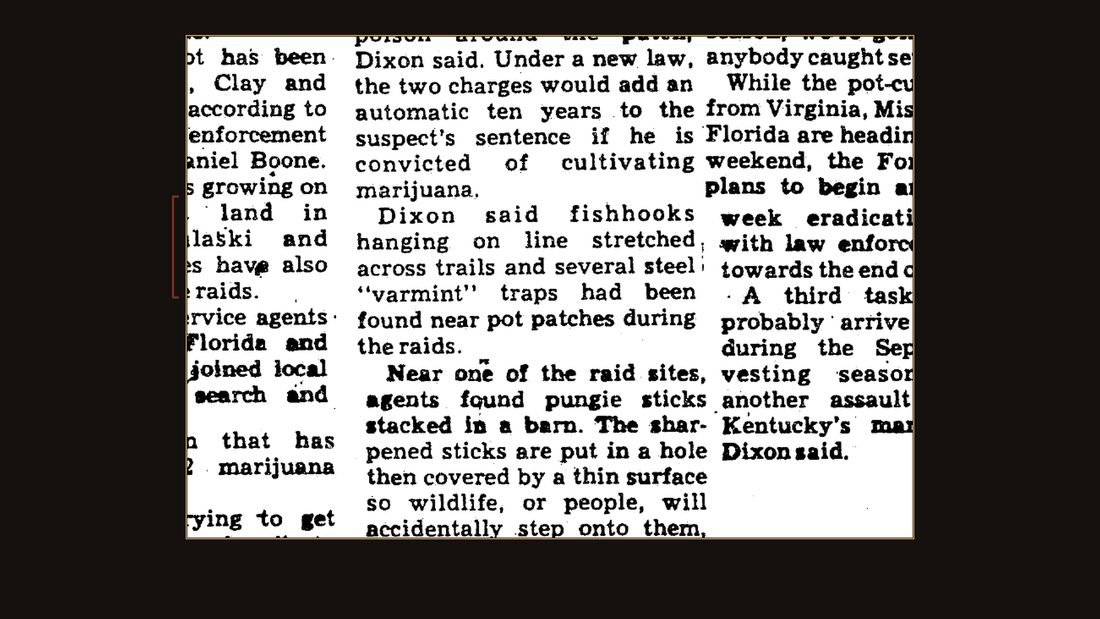
Near one raid site, agents found punji sticks stacked in a barn. Sharpened stakes, set in covered holes, so that wildlife — or people — would step down onto them. Fishhooks hung on lines across the trails. Steel varmint traps set near the patches.
K6
Sentinel-Echo (London, Ky.) · Aug. 4, 1989 · via KSP annual report.
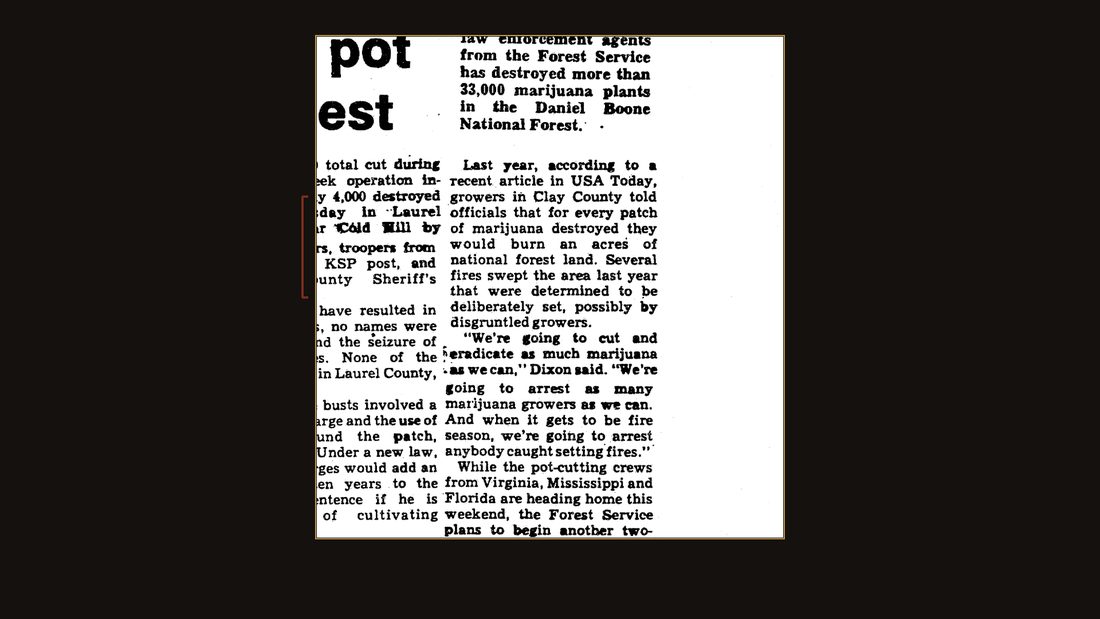
And the growers had an answer ready. Growers in Clay County had told officials that for every patch destroyed, they would burn an acre of national forest. Several fires the year before had been ruled deliberately set.
The forest's law enforcement ranger, Bill Dixon, gave the local paper his plan. We're going to cut and eradicate as much marijuana as we can. We're going to arrest as many marijuana growers as we can. And when it gets to be fire season, we're going to arrest anybody caught setting fires.
Two weeks before that story ran, across the state line in Tennessee, a task force helicopter was lifting cut plants out of a mountain patch when the agents on the ground heard a gunshot. No one was shooting at them. A twelve-gauge shotgun, rigged to a camouflaged trip wire stretched across the trail, had just fired on its own.
The nineties
In April nineteen ninety-one, a federal grand jury indicted an entire family in Knott County. Husband, wife, son, daughter-in-law. Thousands of plants, protected by booby traps. The two men were convicted on every count. The daughter-in-law was acquitted. Then the government took the land itself — fifty-one acres, and twenty-nine thousand one hundred dollars in cash found in a bag in a car trunk. The father testified the money was the settlement of his black lung claim, from his years in the mines.
Not every case held. In Perry County, a partially disabled man was convicted because eighty plants grew three feet behind his trailer — on land that belonged to a neighbor's cousin. The appeals court threw the conviction out. There was no evidence against him, it said, beyond where he lived.
In July nineteen ninety, the governor of Kentucky created a Marijuana Strike Force by executive order. State police, the National Guard, the Forest Service, the D.E.A. — more than fifteen agencies. By its own report, in nineteen ninety-two it cut nearly nine hundred twenty-three thousand plants, found in every one of Kentucky's one hundred twenty counties, and logged more than five thousand helicopter hours doing it.
A1
Appalachia HIDTA Drug Market Analysis · NDIC, 2010 · p. 2.
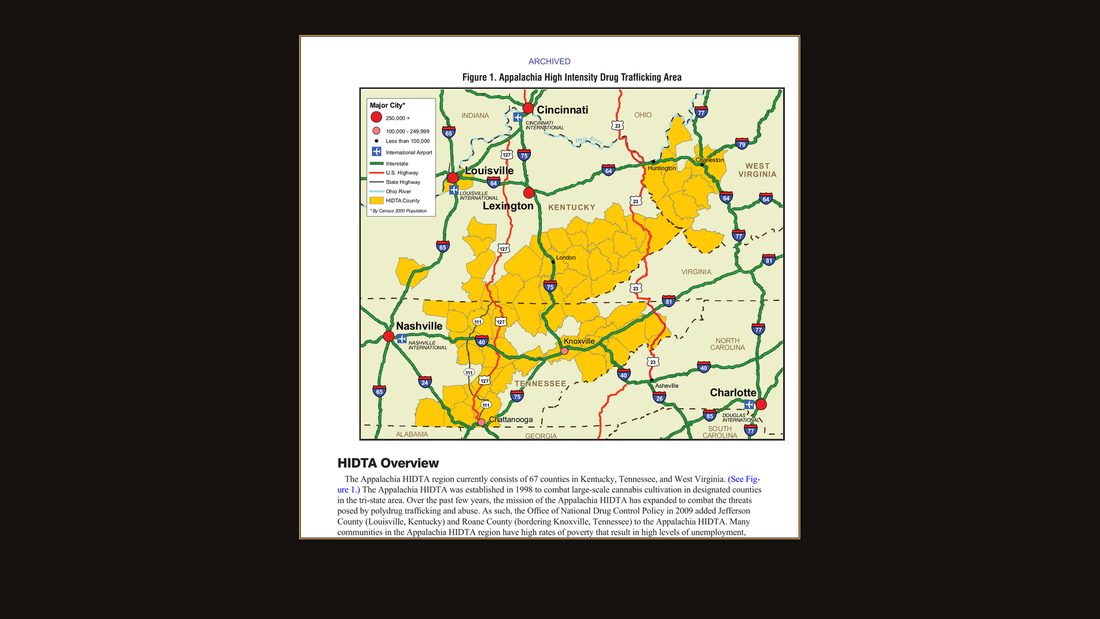
The D.E.A.'s state rankings for nineteen ninety-three put Kentucky third in the nation. The war had not been won. It had become a budget line. In nineteen ninety-eight, Washington drew a new map — the Appalachia High Intensity Drug Trafficking Area. Sixty-seven counties in Kentucky, Tennessee and West Virginia. A federal designation created, in its own words, to combat large-scale cannabis cultivation.
H1
R.F. Collins, A History of the Daniel Boone National Forest 1770-1970 · U.S. Forest Service, 1975.
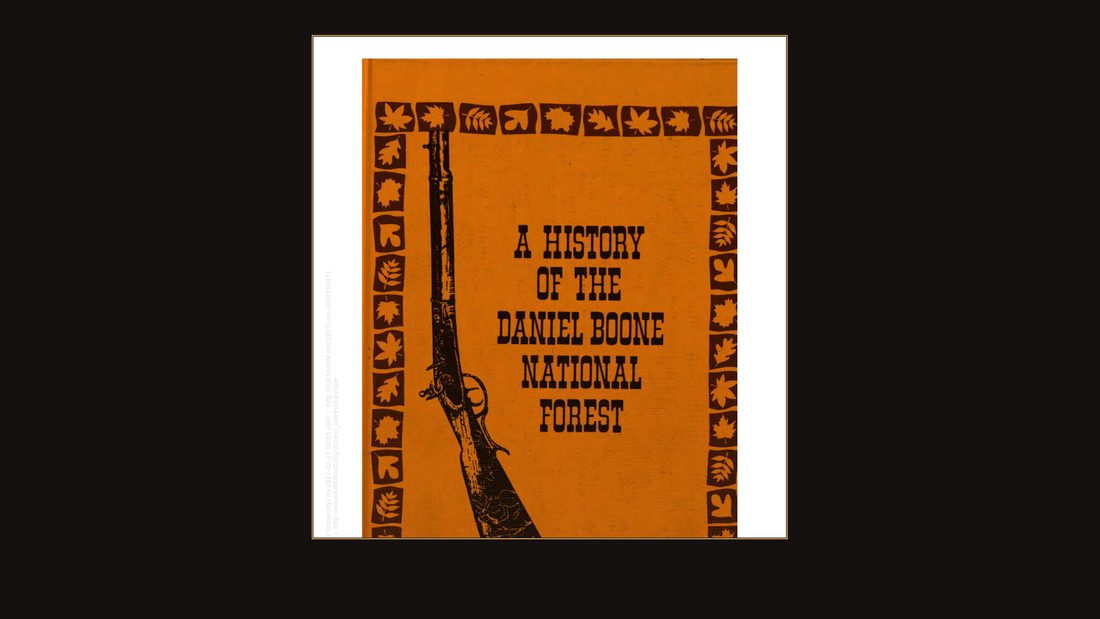
The Forest Service published its official history of the Daniel Boone in nineteen seventy-five. Two hundred years, from Boone's road to nineteen seventy. The story that began in its hollows just a few years after that has never gotten a book.
What is still buried
D2
DEA, 1989 DCE/SP Final Report · p. 15.
Here is what the record leaves open. The body found in a Kentucky marijuana plot in nineteen eighty-nine is unidentified in every document we could find, and so is the skull. The biggest Kentucky growing cases of the era ended in unpublished opinions that were never printed anywhere. And every dollar figure ever put on this crop was an estimate — some of them written by the marijuana lobby, and repeated by the government that was fighting it.
K4
Sentinel-Echo (London, Ky.) · Aug. 4, 1989 · via KSP annual report.
Kentucky went to war over a cash crop once before. Night riders, burned warehouses, tobacco. That story is on this channel — episode four, the Black Patch War. And if your people farmed these counties in the eighties, or wore a badge in these woods, the comments are open.
Sources
- Sierra Club v. Mullen, 619 F. Supp. 1244 (D.D.C. 1985) — the paraquat litigation: August 1983 spraying of the Chattahoochee and Daniel Boone National Forests, Sept. 13, 1983 TRO, Nov. 8, 1983 consent judgment, "open violation" finding
- Oliver v. United States, 466 U.S. 170 (1984) — the Kentucky open-fields case; aerial surveillance concession
- United States v. Bowling, 900 F.2d 926 (6th Cir. 1990) — Aug. 24, 1988 Forest Service eradication and stand-off, Arnett Fork, Clay County
- United States v. Rigsby, 943 F.2d 631 (6th Cir. 1991) — July 1989 Tennessee task-force raid; trip-wired shotgun fired during airlift
- United States v. Three Tracts of Property (Beaver Creek, Knott County), 994 F.2d 287 (6th Cir. 1993) — Hall family prosecution and forfeiture
- United States v. White, 932 F.2d 588 (6th Cir. 1991) — Perry County conviction reversed for insufficient evidence
- GAO, "Federal, State Law Enforcement Efforts To Control Domestically Grown Marijuana," GGD-84-77 (May 25, 1984) — national eradication statistics; Kentucky out-of-state distribution estimate; NORML-sourced value figures (footnoted)
- GAO, "Additional Actions Taken To Control Marihuana Cultivation and Other Crimes on Federal Lands," RCED-85-18 (Nov. 28, 1984) — booby-trap inventory, July 1983 Arkansas ambush, grenade photograph (Forest Service)
- DEA, Domestic Cannabis Eradication/Suppression Program reports: 1987 (NCJ 114531 — Breathitt County booby-trap injury), 1989 (NCJ 126492 — unidentified body and skull found in Kentucky plots), 1993 (NCJ 152429 — state rankings)
- Kentucky State Police, 1988 and 1989 Marijuana Annual Report (NCJ 125700) — Green/Gray Sweep operations and statistics, National Guard role, THC testing incl. the Forest Service's 18% Daniel Boone figure, reproduced press clippings
- Sentinel-Echo (London, Ky.), Aug. 4, 1989, "Third of U.S. pot is in D.B. Forest" (H.H. Krusekopf) — as reproduced in the KSP annual report; fair-use excerpt
- Annual Report for 1983, House Select Committee on Narcotics Abuse and Control, H. Rept. 98-598 — paraquat program history, Percy Amendment, committee position
- Field hearings update, House Select Committee on Narcotics Abuse and Control, 1983-84 (ERIC ED255820) — cash-crop figures read into the record
- 61 Fed. Reg. 42056 (Aug. 13, 1996) — DEA notice dating the cannabis-eradication environmental impact statements (DEA-EIS-1, July 1985; DEA-EIS-2, May 1986)
- Appalachia HIDTA Drug Market Analysis, National Drug Intelligence Center (2010) — 1998 HIDTA designation "to combat large-scale cannabis cultivation"
- UPI wire reports: Sept. 18, 1982 (growers on federal land; all 155 national forests); Aug. 12, 1983 (Georgia spraying begins); Sept. 14, 1983 (TRO; both forests sprayed)
- The Washington Post, Aug. 25, 1983, "Use of Paraquat to Kill Marijuana Stirs Protests" (Dale Russakoff) — Kentucky stakeout detail, filming for Colombia, protest movement, failed Kentucky court challenge
- The Christian Science Monitor, Aug. 9, 1985 (Warren Richey) — Operation Delta 9; bear traps reported in Kentucky
- R.F. Collins, "A History of the Daniel Boone National Forest, 1770-1970," U.S. Forest Service (1975)