Congress Blamed the Second Explosion on the Government Itself | Scotia 1976
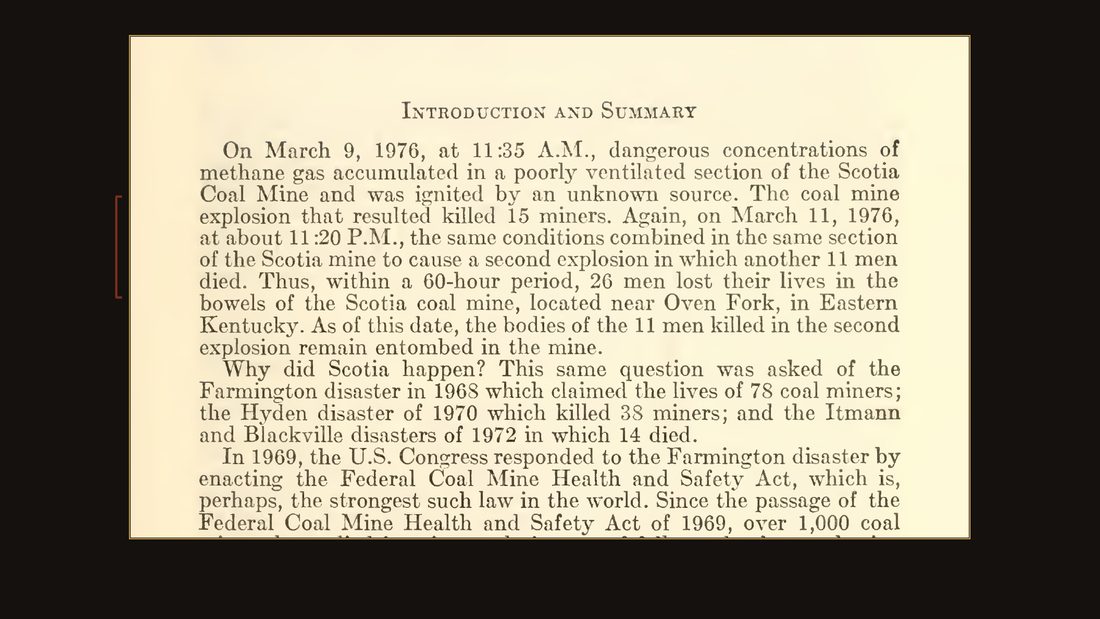
On March 9, 1976, an explosion in the 2 Southeast main section of the Scotia mine at Oven Fork, in Letcher County, Kentucky, killed fifteen men. Sixty hours later the same section exploded again and killed eleven more, including three federal mine inspectors. Twenty-six dead in one week.
Transcript
Cold open
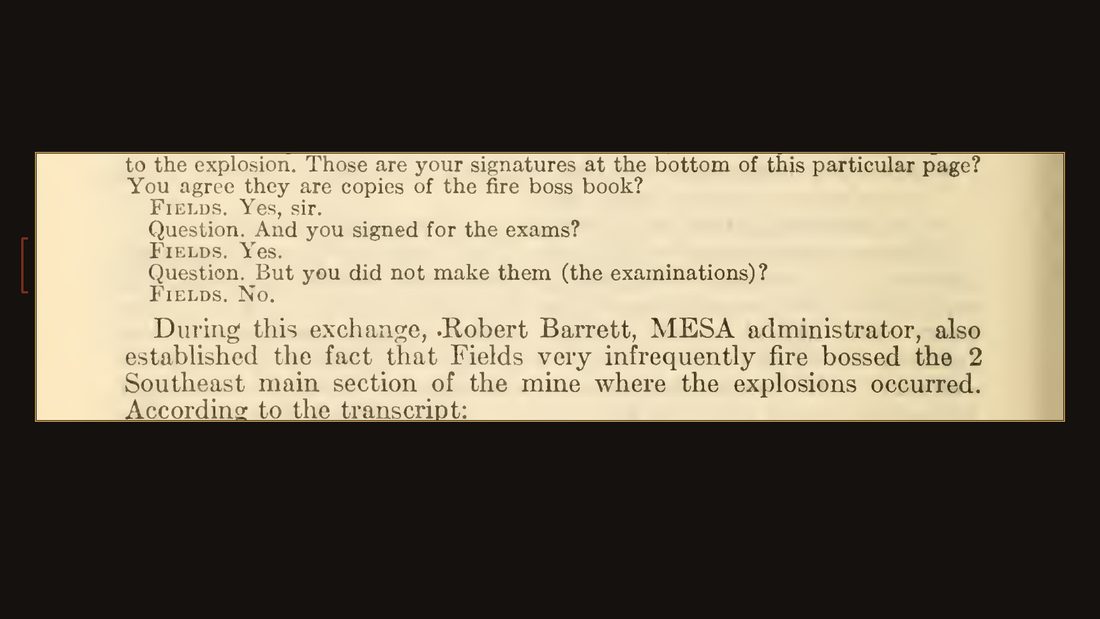
On the morning of March ninth, nineteen seventy-six, two men were sent up a tunnel in eastern Kentucky to store steel rail.
S37
House Educ. & Labor, Subcomm. on Labor Standards · Staff Report · Oct. 15, 1976 · p. 12.
Nobody had checked that tunnel for gas before they went in. The law required it. The book said it had been done. It had not.
S54
House Educ. & Labor, Subcomm. on Labor Standards · Staff Report · Oct. 15, 1976 · p. 42.
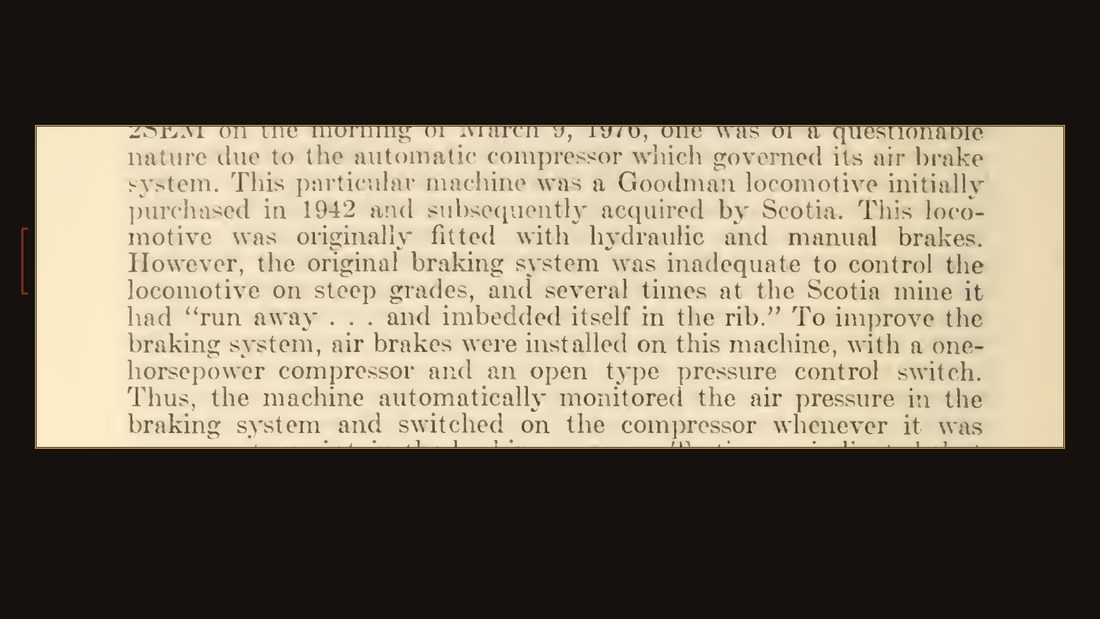
They pushed two locomotives up the section. One of them had first been bought in nineteen forty-two, and it had an air compressor that threw a spark every fifteen or twenty minutes.
S24
House Educ. & Labor, Subcomm. on Labor Standards · Staff Report · Oct. 15, 1976 · p. 7.
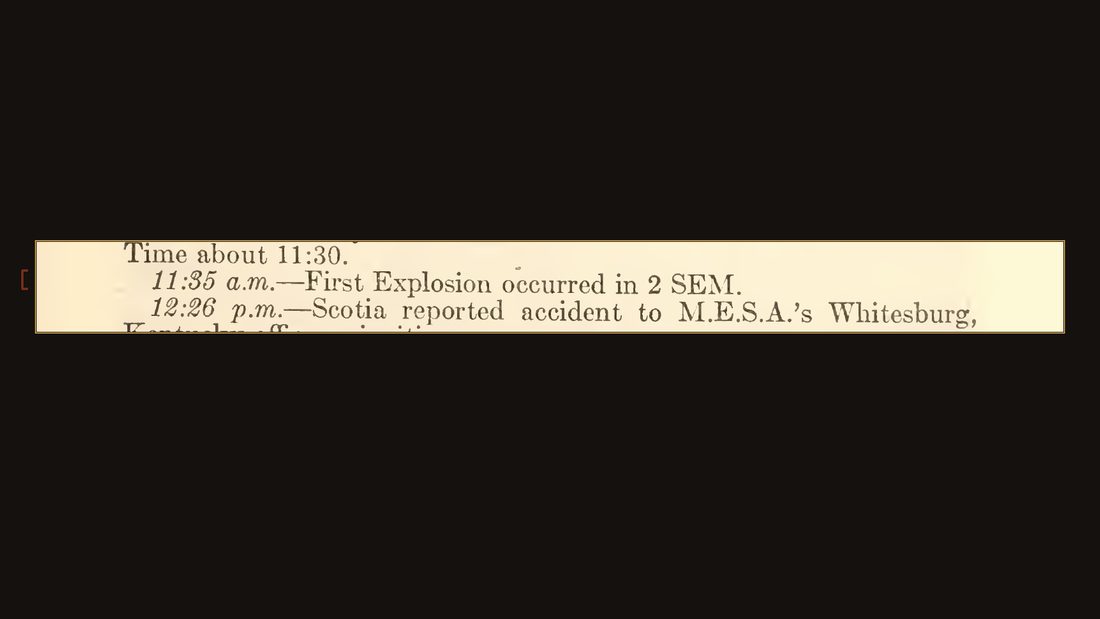
At eleven thirty-five in the morning, the section exploded and killed fifteen men.
S30
House Educ. & Labor, Subcomm. on Labor Standards · Staff Report · Oct. 15, 1976 · p. 9.
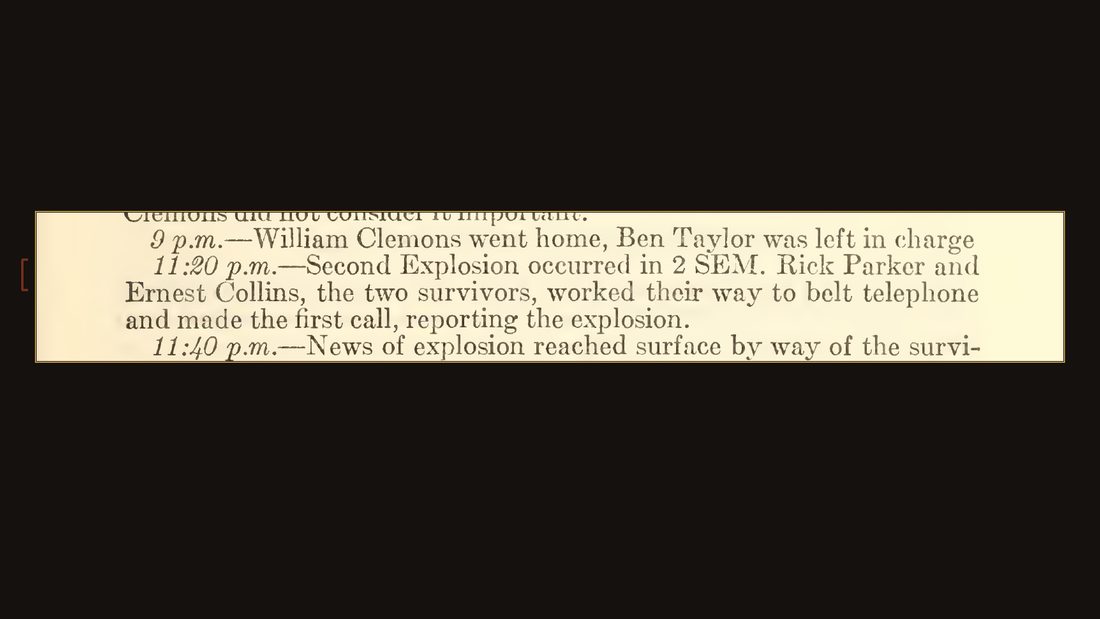
Sixty hours later the same section exploded again, and killed eleven more.
What the record holds
This is the story of what the United States government wrote down about how that happened. It is not a story about a mystery. Almost everything in it was known in advance, in writing, by people whose job was to stop it.
L1
Legislative History of the Federal Mine Safety and Health Act of 1977 · GPO 1978 · p. 592.
Twenty-six men died at the Scotia mine near Oven Fork, in Letcher County, Kentucky. Twenty-three of them were miners. Three were federal inspectors.
S1
House Educ. & Labor, Subcomm. on Labor Standards · Staff Report · Oct. 15, 1976 · p. 1.
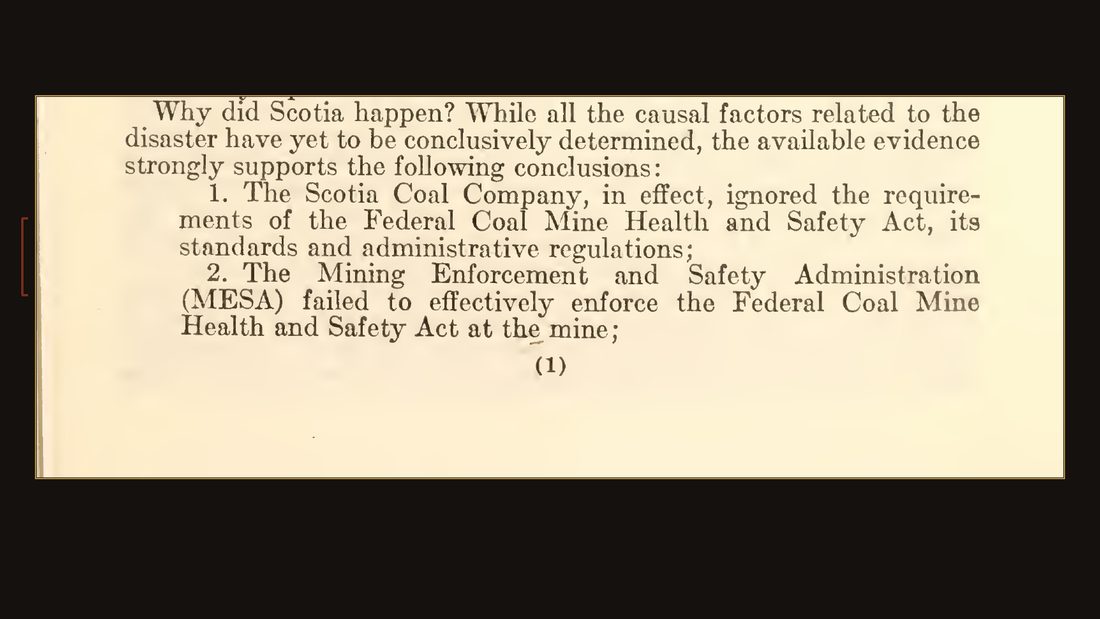
Seven months later a committee of the House of Representatives published a report on it. That report is fifty-three pages long, and you can read the whole thing.
S3
House Educ. & Labor, Subcomm. on Labor Standards · Staff Report · Oct. 15, 1976 · p. 1.
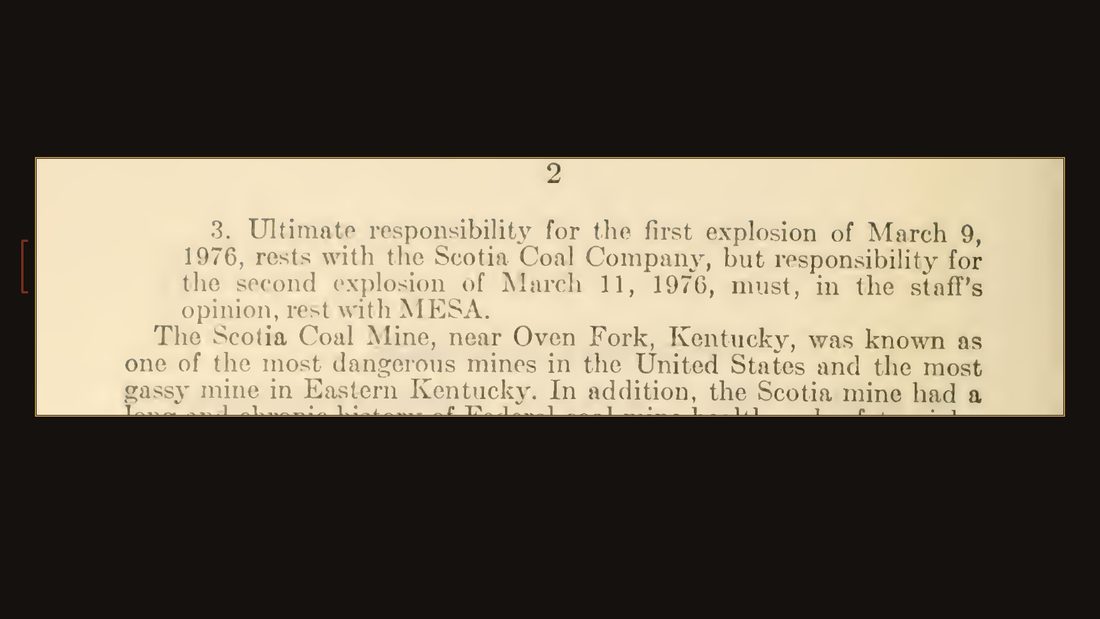
It reaches three conclusions. The first is that the coal company ignored the law. The second is that the federal agency responsible for enforcing that law did not enforce it.
S4
House Educ. & Labor, Subcomm. on Labor Standards · Staff Report · Oct. 15, 1976 · p. 2.
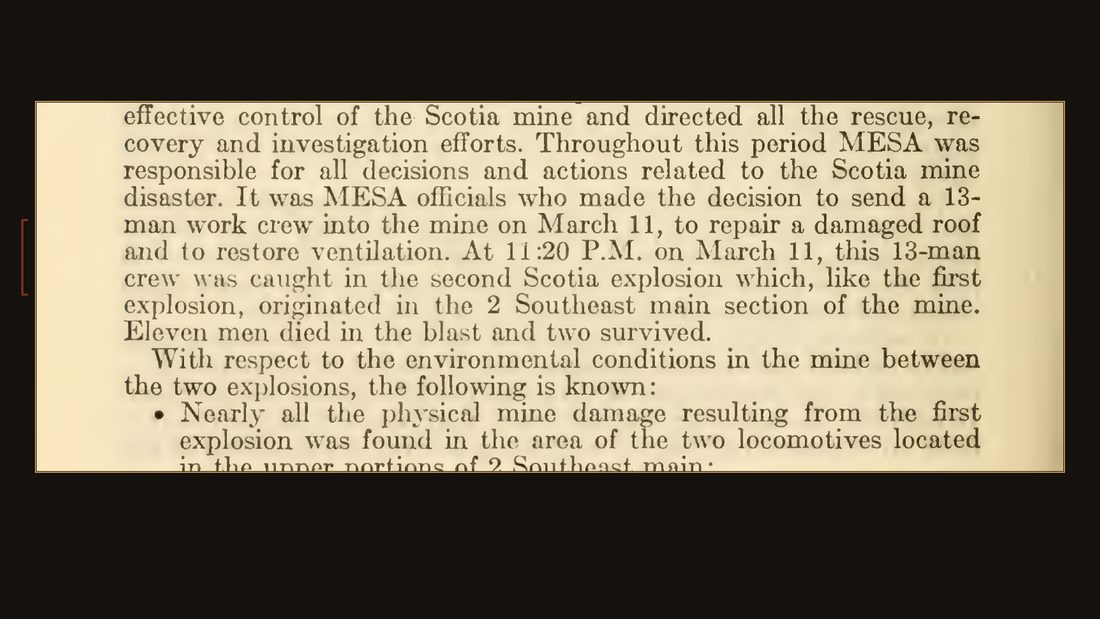
And the third. Ultimate responsibility for the first explosion rests with the Scotia Coal Company. But responsibility for the second explosion must, in the staff's opinion, rest with Mesa.
Mesa was the Mining Enforcement and Safety Administration, the federal mine safety agency of the day. That sentence is a congressional committee saying the second explosion was the government's fault.
S15
House Educ. & Labor, Subcomm. on Labor Standards · Staff Report · Oct. 15, 1976 · p. 4.
They wrote it because within hours of the first blast the agency had taken control of the mine, and every decision after that was its own.
The mine
S19
House Educ. & Labor, Subcomm. on Labor Standards · Staff Report · Oct. 15, 1976 · p. 6.
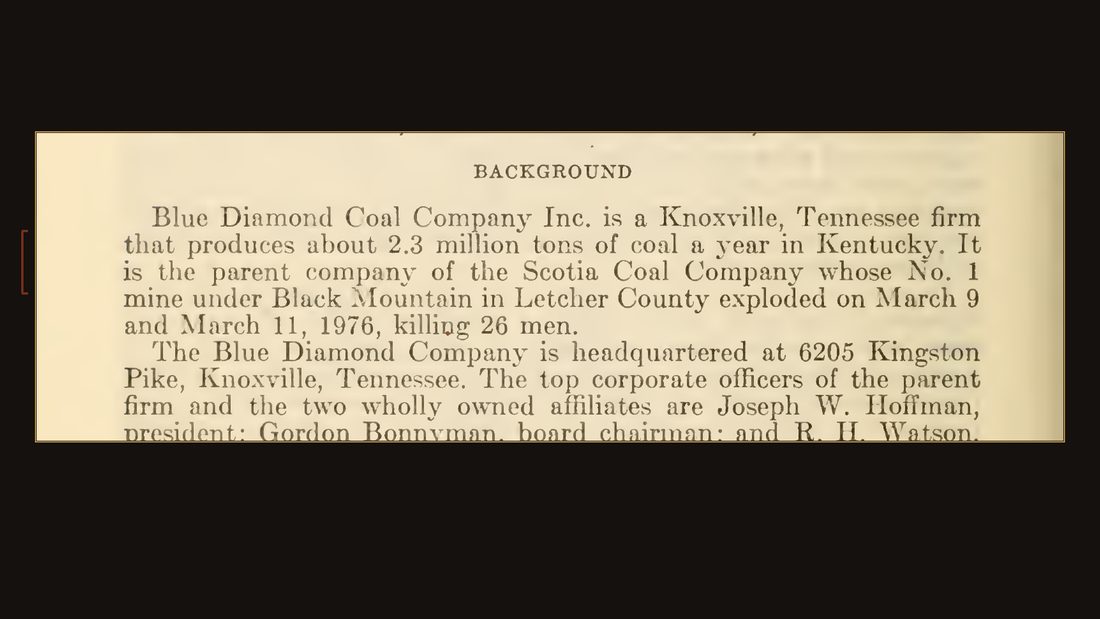
The Scotia mine was owned by the Scotia Coal Company, which was owned by Blue Diamond Coal Company of Knoxville, Tennessee.
S20
House Educ. & Labor, Subcomm. on Labor Standards · Staff Report · Oct. 15, 1976 · p. 6.
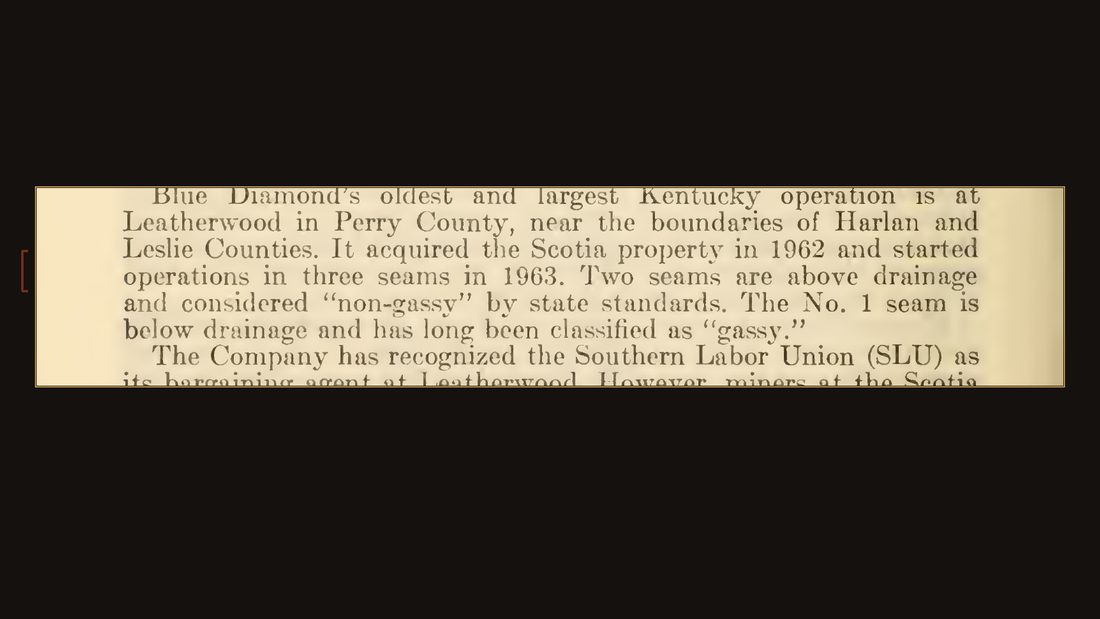
Blue Diamond bought the Scotia property in nineteen sixty-two and started mining the next year. The seam they worked lay below drainage, and it had always been classified as gassy.
S34
House Educ. & Labor, Subcomm. on Labor Standards · Staff Report · Oct. 15, 1976 · p. 10.
Scotia gave off between two hundred fifty thousand and five hundred thousand cubic feet of methane every twenty-four hours. Federal officials called it the most gassy mine in eastern Kentucky.
Methane explodes when it makes up between five and fifteen percent of the air. Below that it will not burn. Above that there is not enough oxygen. In between, almost anything will set it off.
Eight hundred and fifty-five notices
S5
House Educ. & Labor, Subcomm. on Labor Standards · Staff Report · Oct. 15, 1976 · p. 2.
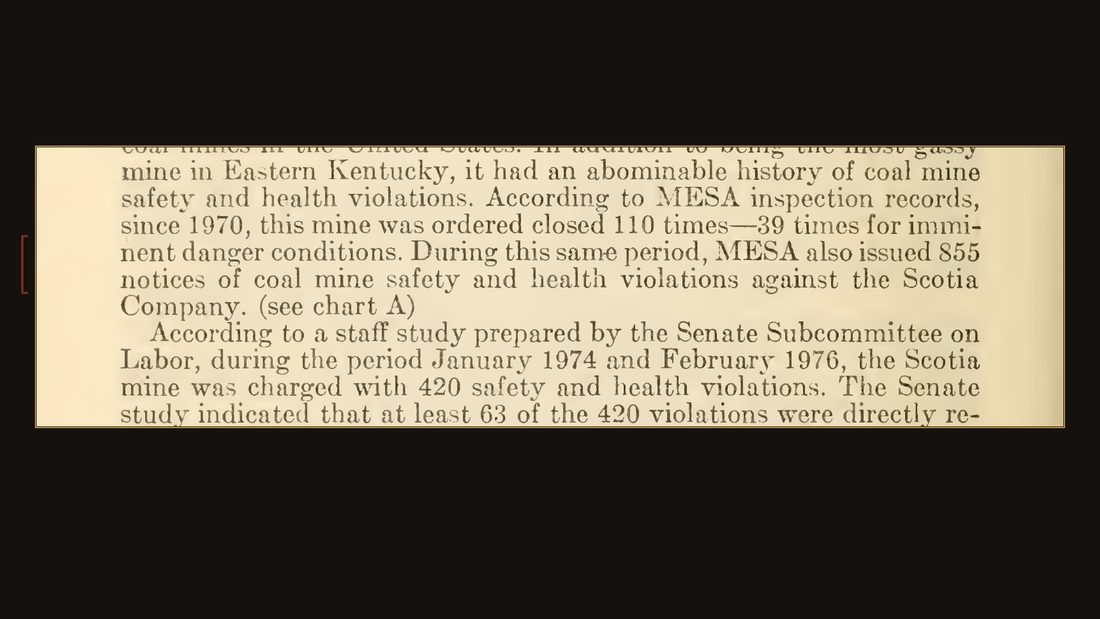
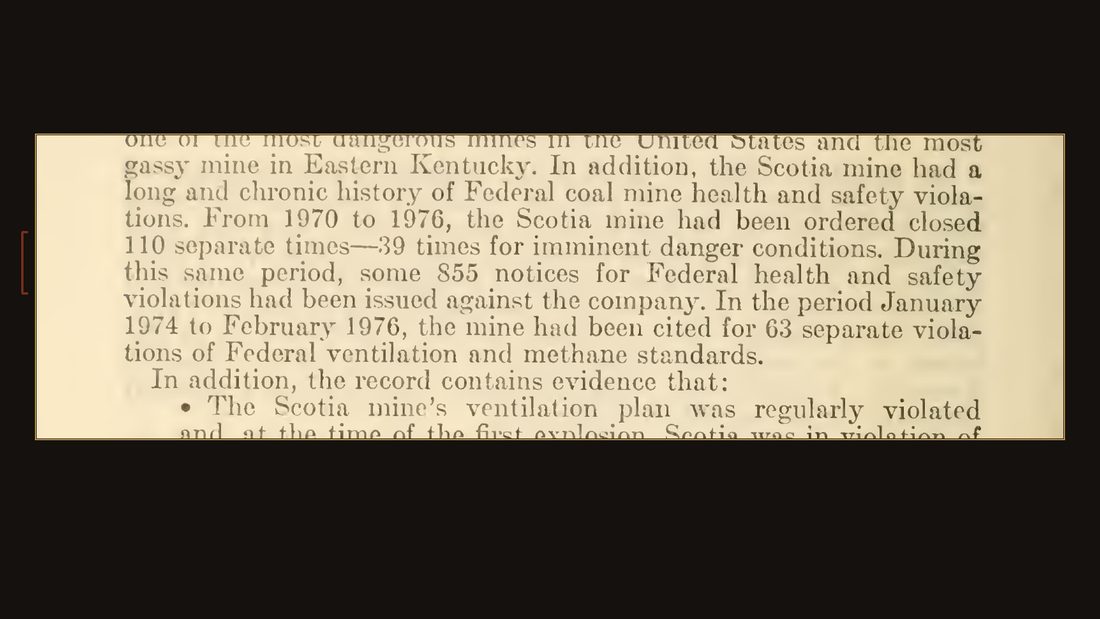
Between nineteen seventy and nineteen seventy-six, federal inspectors ordered the Scotia mine closed one hundred and ten separate times. Thirty-nine of those were for imminent danger.
S63
House Educ. & Labor, Subcomm. on Labor Standards · Staff Report · Oct. 15, 1976 · p. 53.
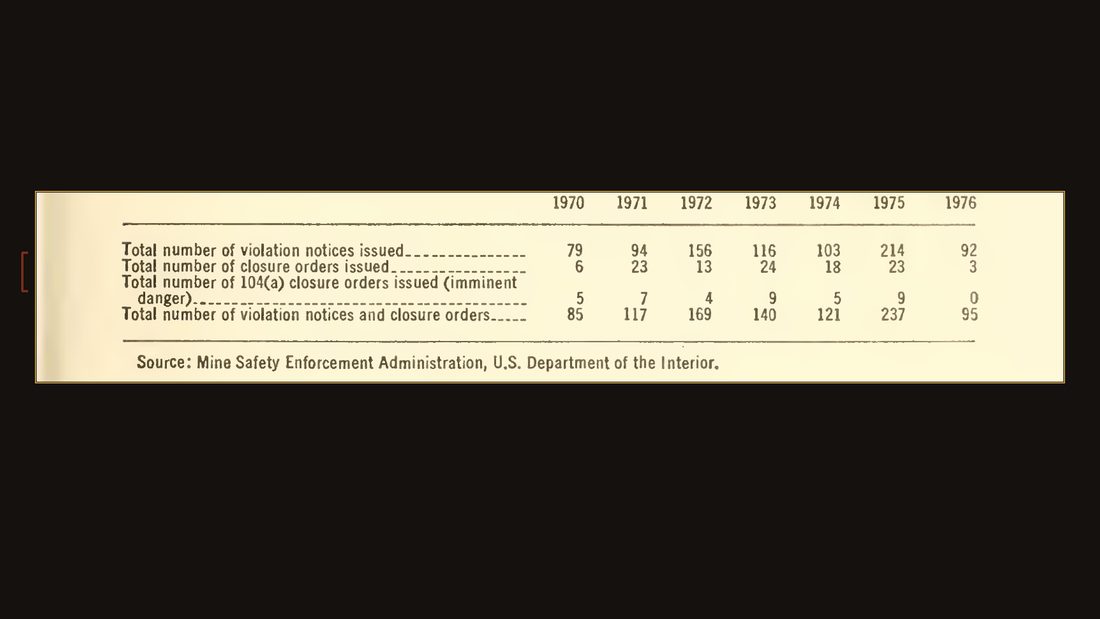
Over those same six years they issued the company eight hundred and fifty-five notices of federal health and safety violations. Here is the government's own table of it, year by year.
S64
House Educ. & Labor, Subcomm. on Labor Standards · Staff Report · Oct. 15, 1976 · p. 53.
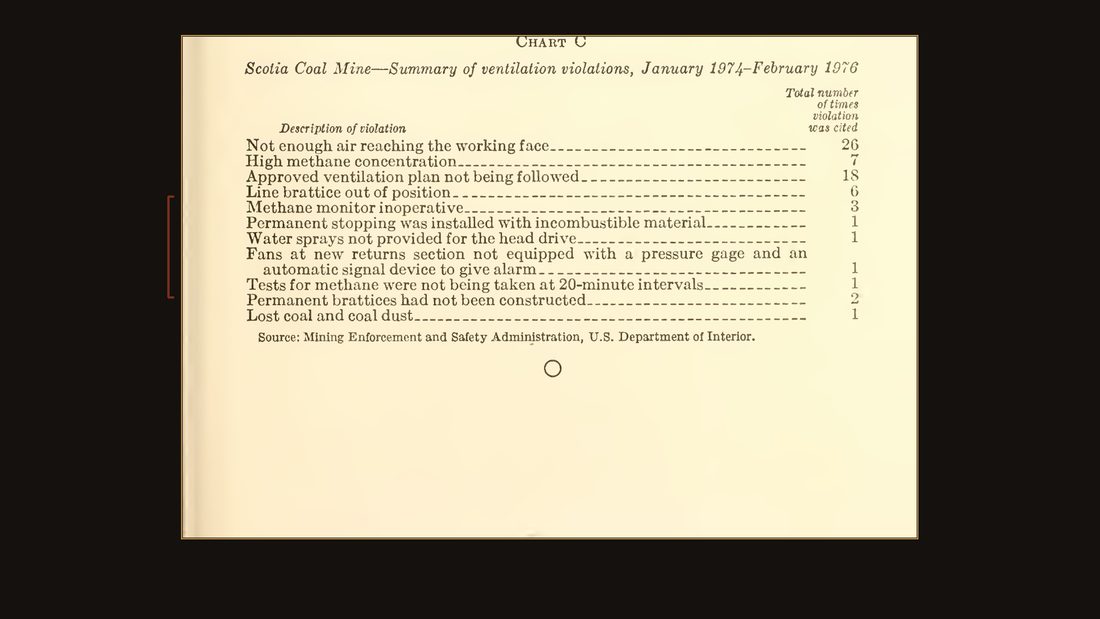
In the two years before the explosions, the mine was cited sixty-three separate times for ventilation and methane violations alone.
Twenty-six of those were for not enough air reaching the working face. Eighteen were for not following the ventilation plan the government itself had approved.
S6
House Educ. & Labor, Subcomm. on Labor Standards · Staff Report · Oct. 15, 1976 · p. 2.
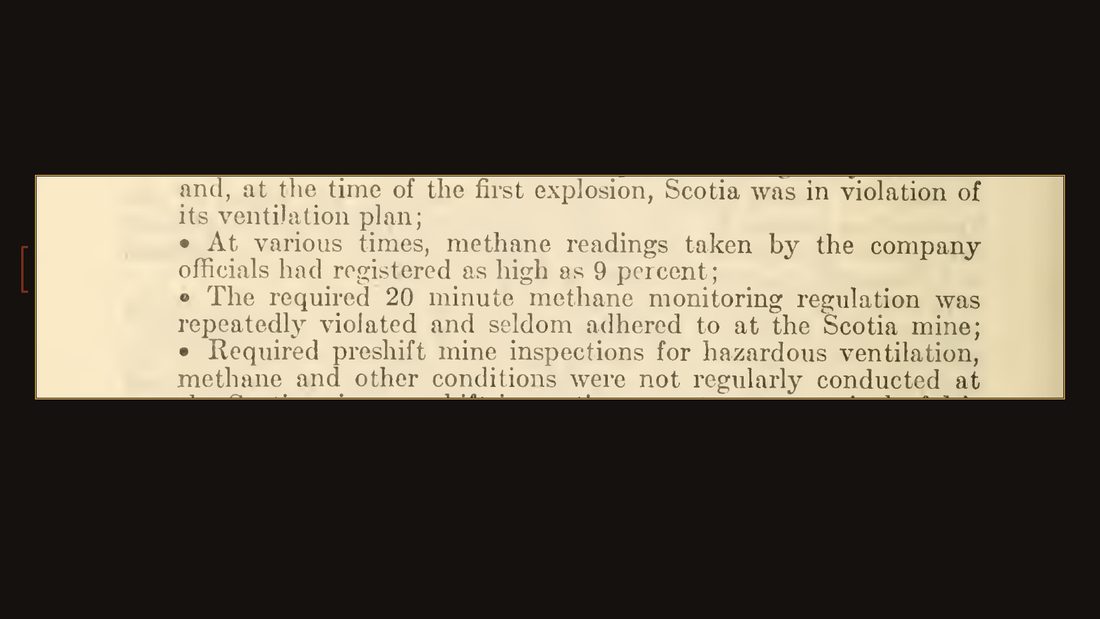
Company officials had recorded methane readings as high as nine percent. Above one percent, you are not supposed to be running electrical equipment at all.
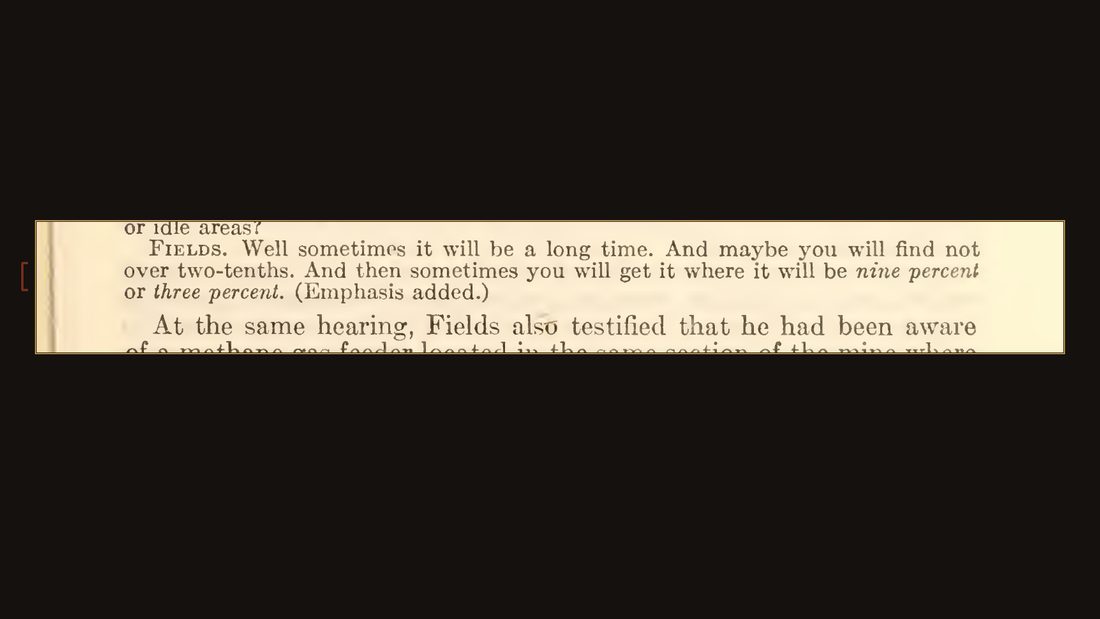
The third shift fireboss, a man named Charles Fields, told investigators how the gas came and went.
S35
House Educ. & Labor, Subcomm. on Labor Standards · Staff Report · Oct. 15, 1976 · p. 11.
Sometimes it will be a long time. And maybe you will find not over two tenths. And then sometimes you will get it where it will be nine percent, or three percent.
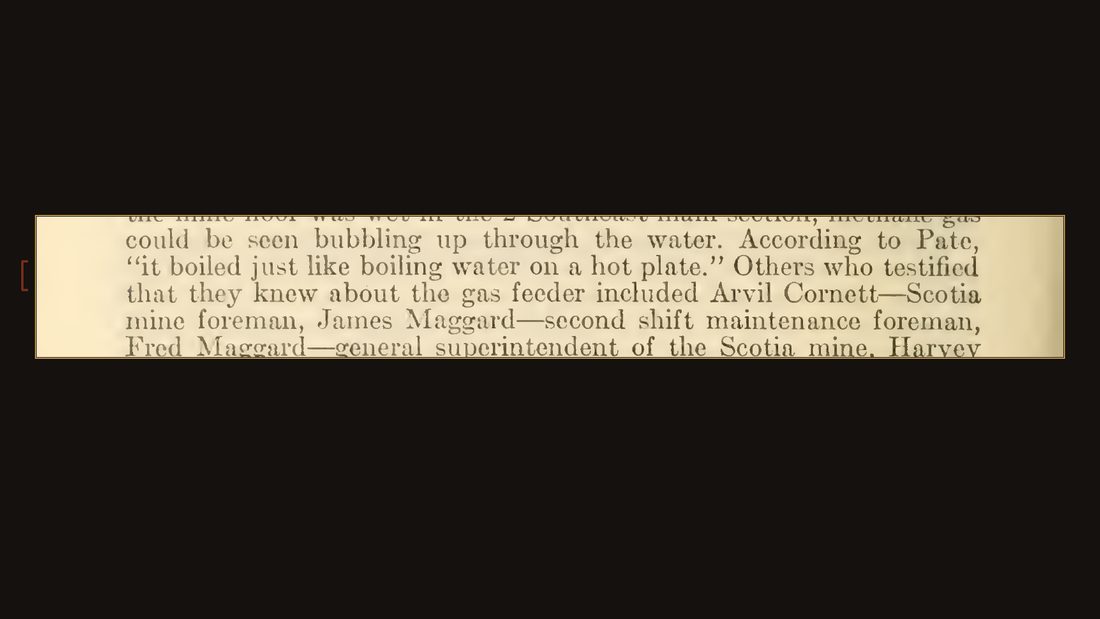
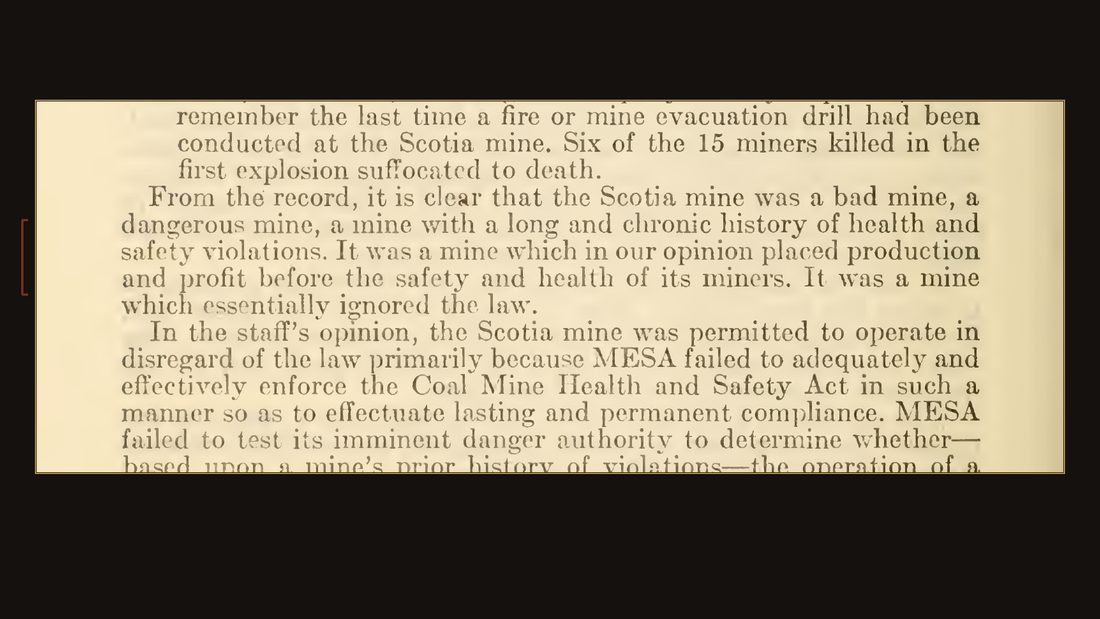
There was a spot in the section that would explode where gas came up out of the mine floor on its own. The miners all knew about it. A shuttle car operator named Pat Pate described what it looked like when the floor was wet.
S36
House Educ. & Labor, Subcomm. on Labor Standards · Staff Report · Oct. 15, 1976 · p. 12.
It boiled just like boiling water on a hot plate.
S6
House Educ. & Labor, Subcomm. on Labor Standards · Staff Report · Oct. 15, 1976 · p. 2.
Fields measured that feeder at five percent methane down at the floor. He said the reading might have been higher, but his instrument only went up to five.
S9
House Educ. & Labor, Subcomm. on Labor Standards · Staff Report · Oct. 15, 1976 · p. 2.
All of this was written down before anyone died. Which is why the committee kept asking the same question, in those words. Why did Scotia happen.
The price of a violation
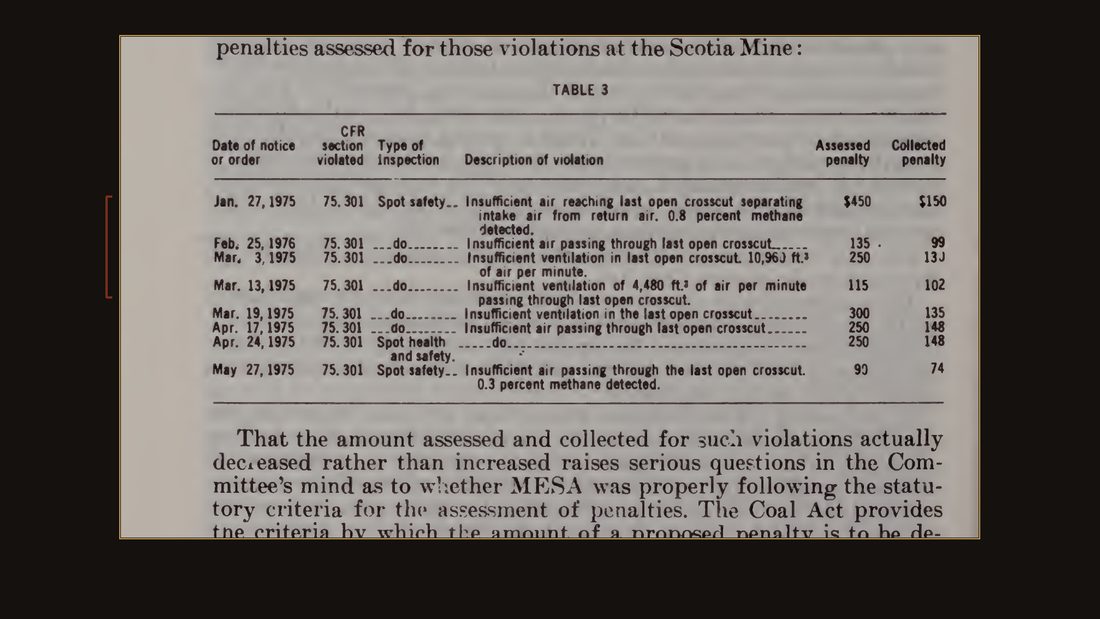
Part of the answer is what a violation cost.
L4
Legislative History of the Federal Mine Safety and Health Act of 1977 · GPO 1978 · p. 630.
Senate investigators pulled eight notices issued to Scotia over four months in nineteen seventy-five. Every one of them was for the same ventilation rule. Not enough air reaching the face.
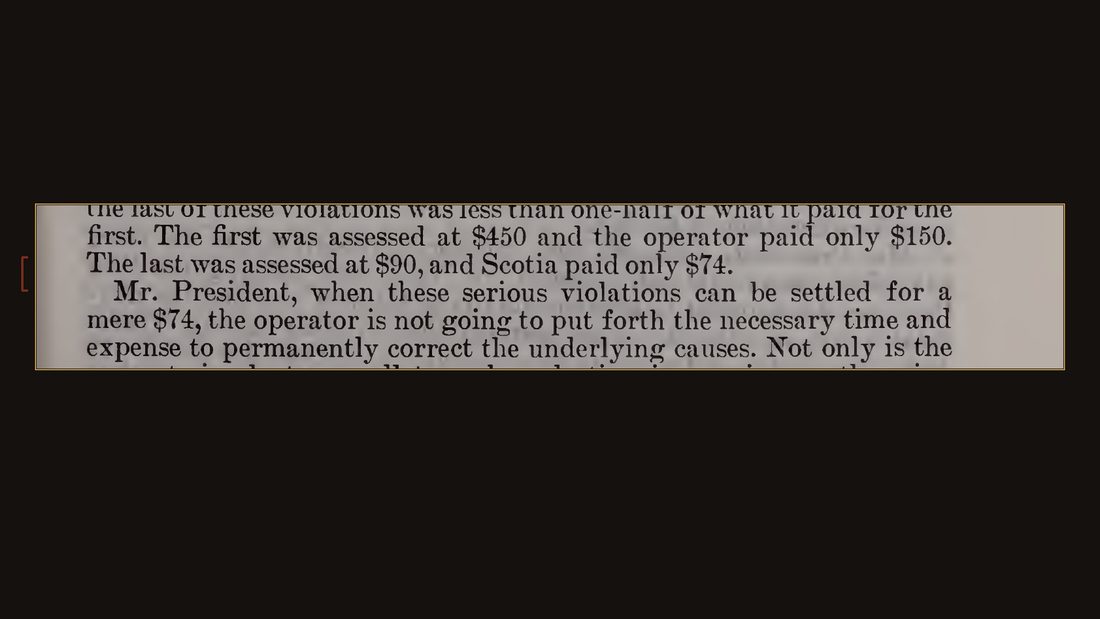
The first was assessed at four hundred and fifty dollars. Scotia paid one hundred and fifty.
L3
Legislative History of the Federal Mine Safety and Health Act of 1977 · GPO 1978 · p. 921.
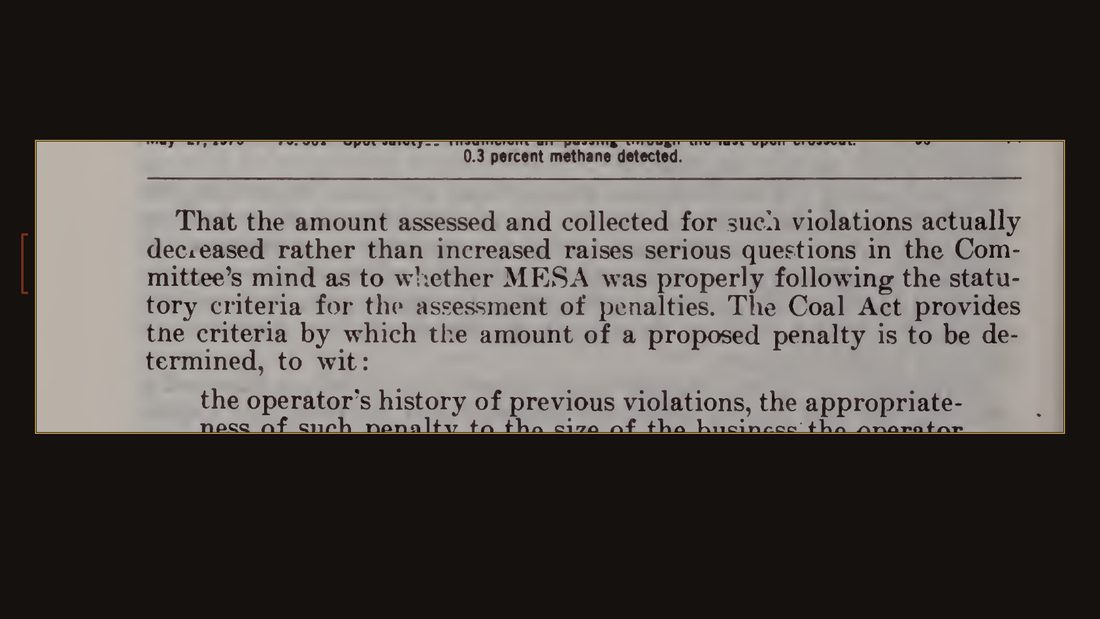
The eighth was assessed at ninety dollars. Scotia paid seventy-four.
L5
Legislative History of the Federal Mine Safety and Health Act of 1977 · GPO 1978 · p. 630.
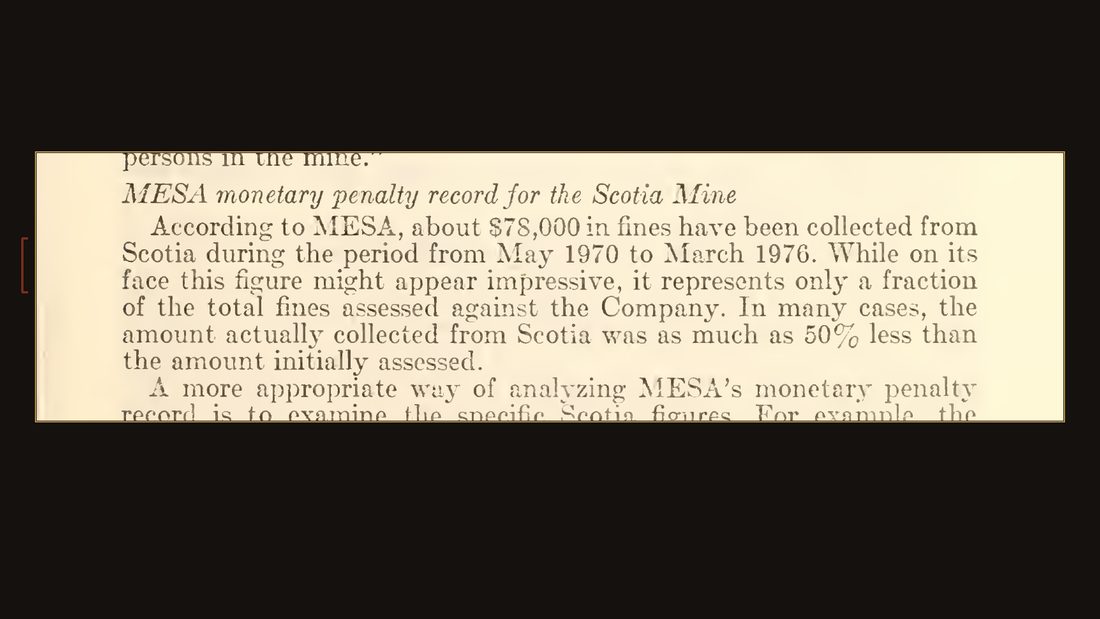
The fines went down as the violations piled up. The Senate committee said it in writing. The amount assessed and collected actually decreased rather than increased.
S47
House Educ. & Labor, Subcomm. on Labor Standards · Staff Report · Oct. 15, 1976 · p. 23.
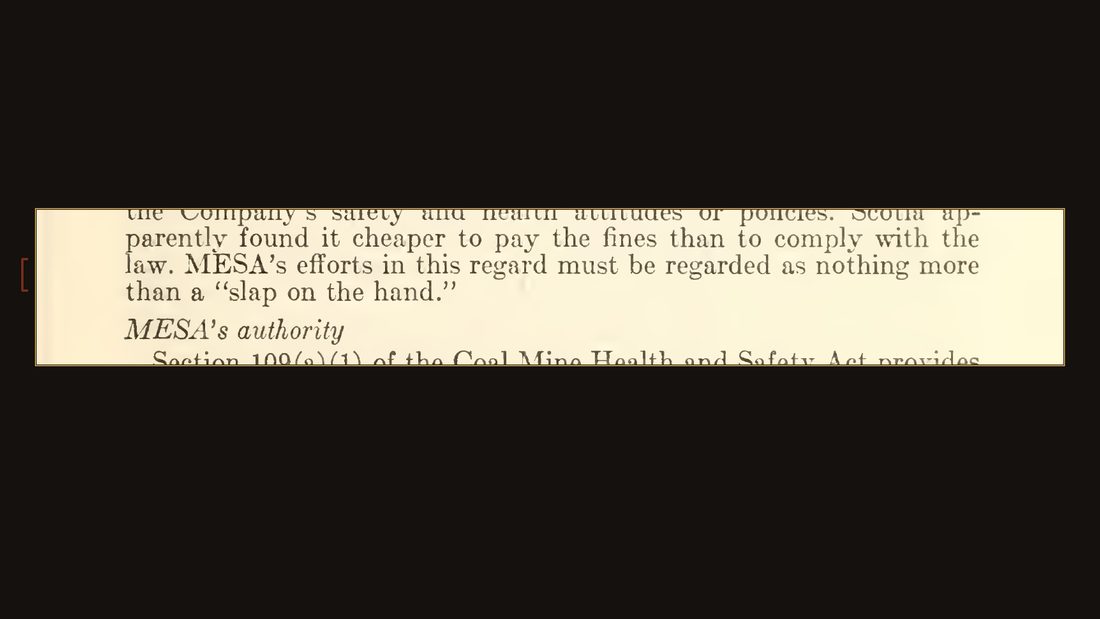
Across six years, everything the federal government ever collected from this mine in safety fines came to about seventy-eight thousand dollars.
S46
House Educ. & Labor, Subcomm. on Labor Standards · Staff Report · Oct. 15, 1976 · p. 23.
The House staff had a phrase for that. Nothing more than a slap on the hand.
S11
House Educ. & Labor, Subcomm. on Labor Standards · Staff Report · Oct. 15, 1976 · p. 3.
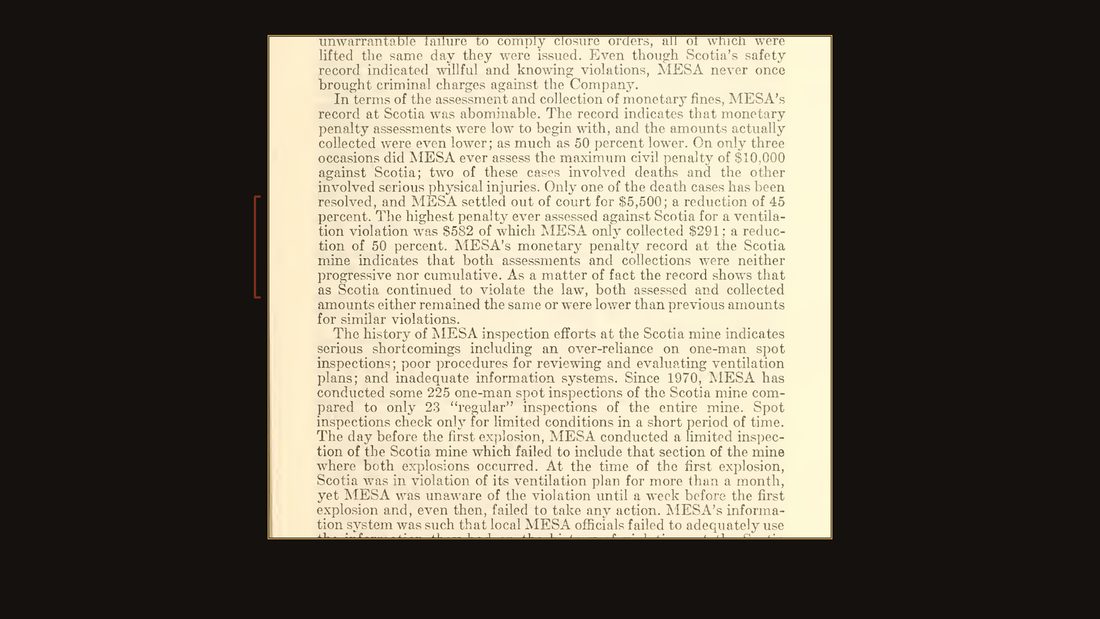
Three times in six years the agency assessed the maximum penalty the law allowed, ten thousand dollars. Two of those three were cases where a man had already been killed.
S44
House Educ. & Labor, Subcomm. on Labor Standards · Staff Report · Oct. 15, 1976 · p. 21.
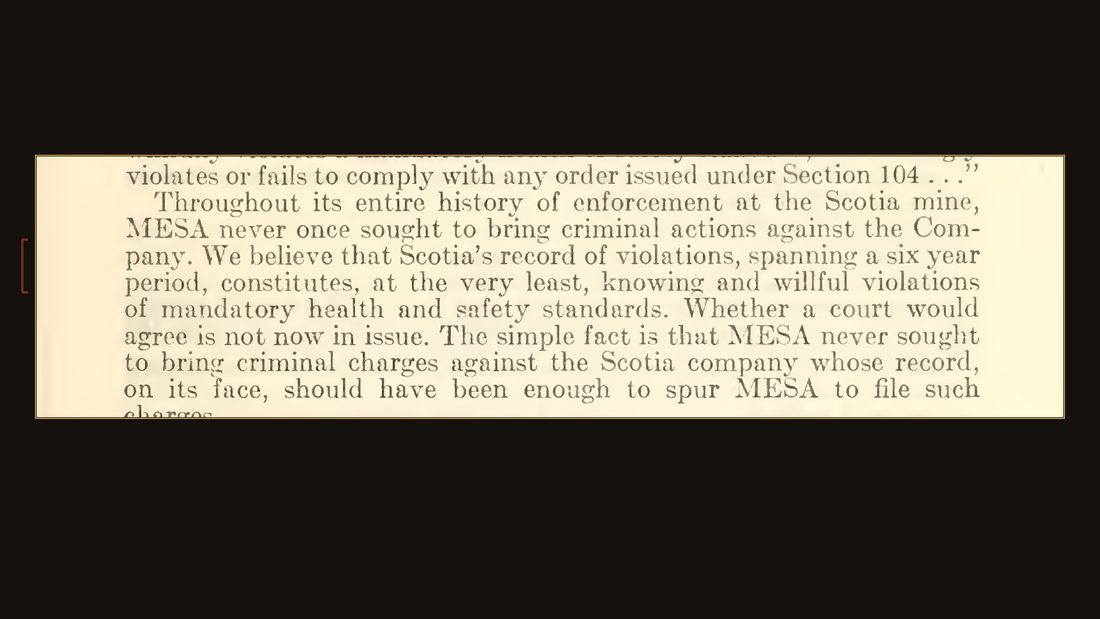
The law also let the government bring criminal charges against an operator who willfully violated a safety standard. In six years, at the most inspected mine in eastern Kentucky, it never once did.
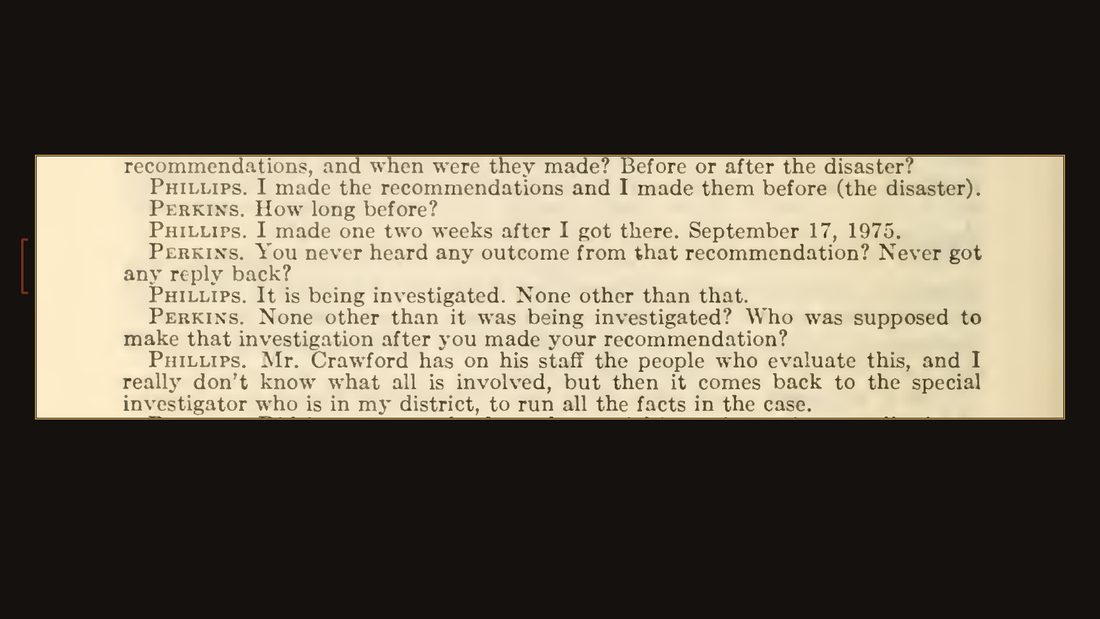
That was not for lack of anyone asking. The agency's district manager for that part of Kentucky told Congress he had recommended willful violation charges against Scotia himself.
S45
House Educ. & Labor, Subcomm. on Labor Standards · Staff Report · Oct. 15, 1976 · p. 22.
He was asked when. He said September seventeenth, nineteen seventy-five. Five months before the mine exploded.
He was asked what came of it. It is being investigated, he said. It was still being investigated on the day he testified.
Two hundred and twenty-five
S49
House Educ. & Labor, Subcomm. on Labor Standards · Staff Report · Oct. 15, 1976 · p. 27.
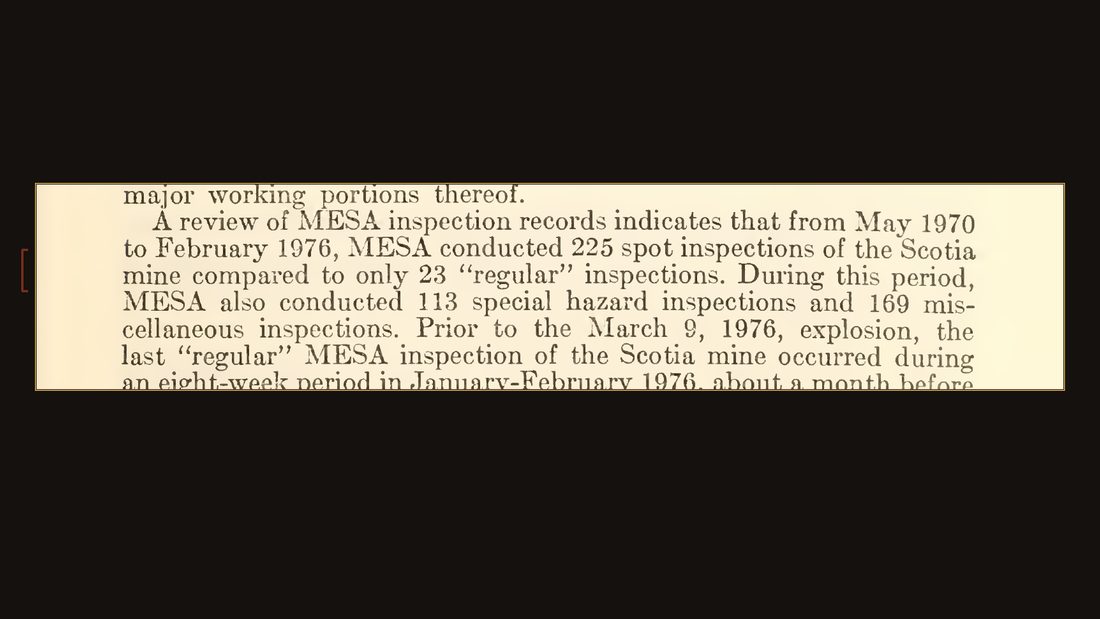
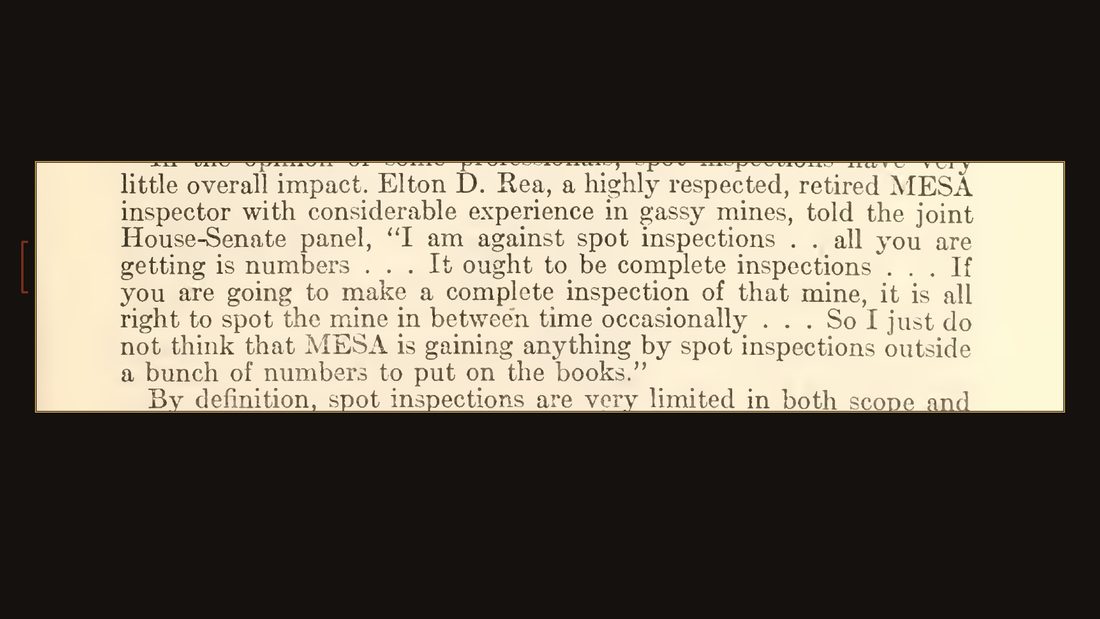
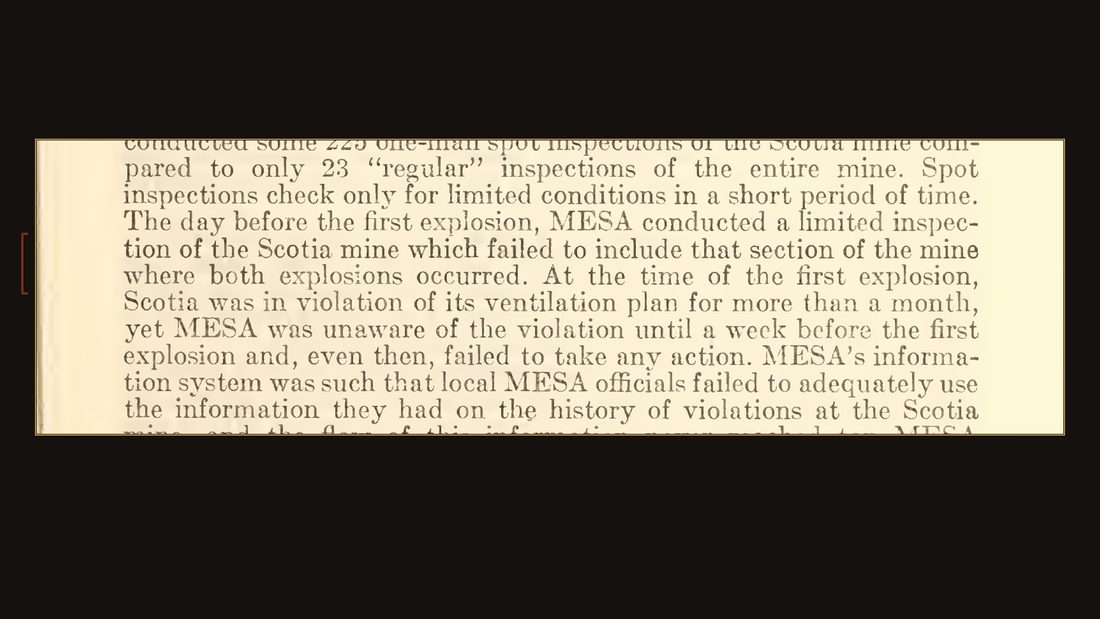
Inspectors came to Scotia constantly. They came the wrong way. Between nineteen seventy and nineteen seventy-six the agency made two hundred and twenty-five spot inspections of this mine, and twenty-three inspections of the whole mine.
S65
House Educ. & Labor, Subcomm. on Labor Standards · Staff Report · Oct. 15, 1976 · p. 27.
I am against spot inspections. All you are getting is numbers.
S21
House Educ. & Labor, Subcomm. on Labor Standards · Staff Report · Oct. 15, 1976 · p. 7.
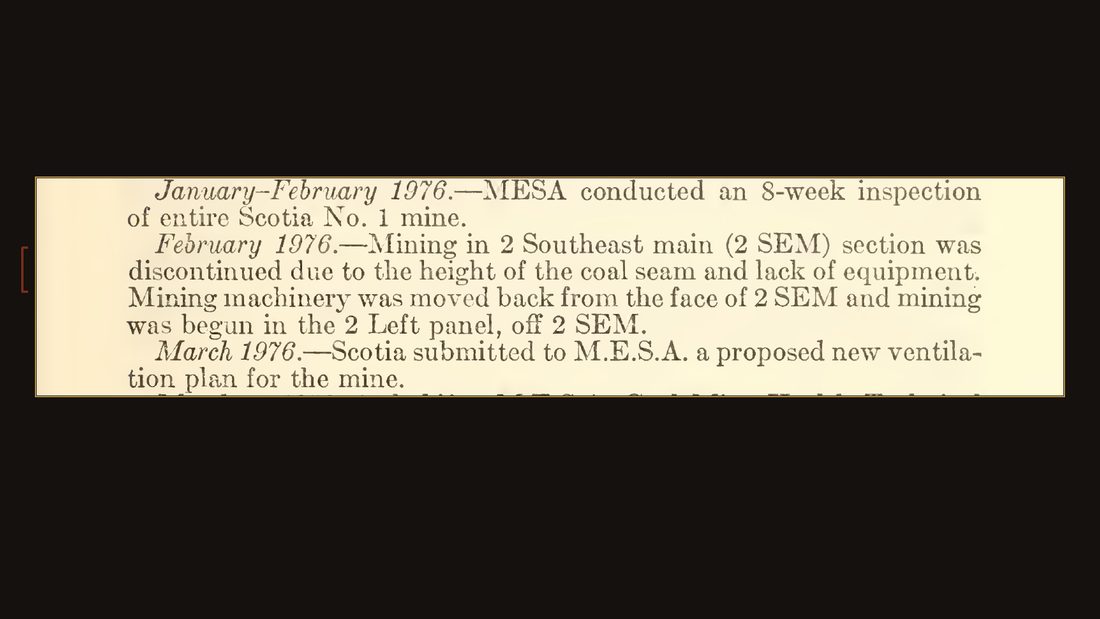
In early February of nineteen seventy-six, Scotia stopped mining at the face of the section called two southeast main. The coal there was too high for the equipment they had.
S12
House Educ. & Labor, Subcomm. on Labor Standards · Staff Report · Oct. 15, 1976 · p. 3.
They never told the federal government they had done any of it. From February onward the mine was running in violation of its own approved ventilation plan. The government's mining engineer found out on the first of March, eight days before the explosion. Nobody did anything.
March eighth
S22
House Educ. & Labor, Subcomm. on Labor Standards · Staff Report · Oct. 15, 1976 · p. 7.
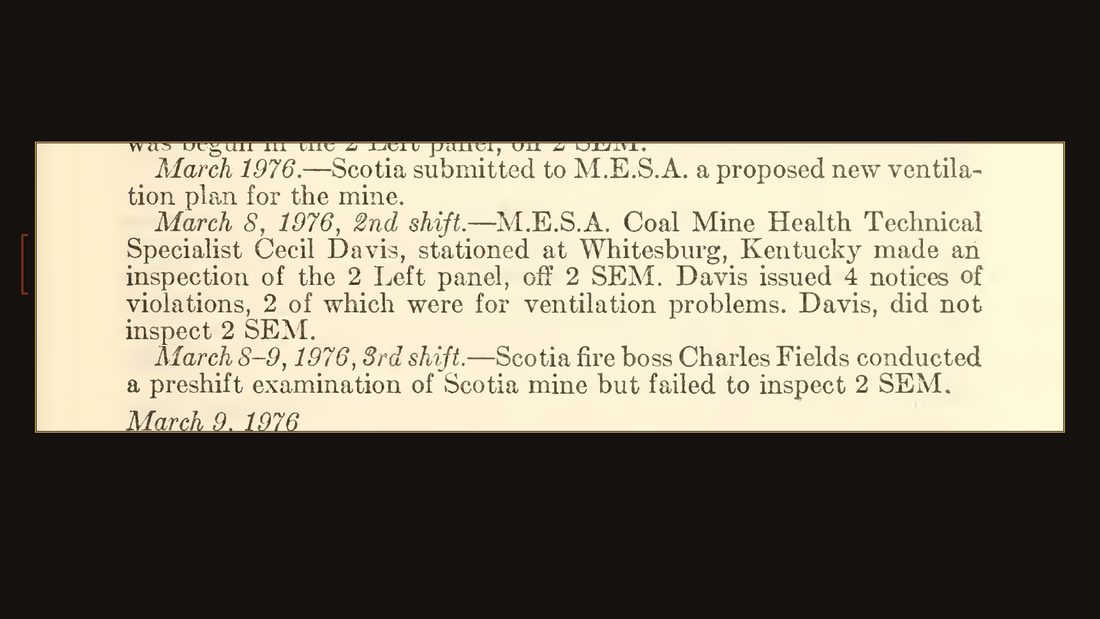
On the eighth of March, a federal inspector went underground at Scotia and spent about eight hours there. His name was Cecil Davis. He was a coal mine health technical specialist, and his assignment was breathable dust.
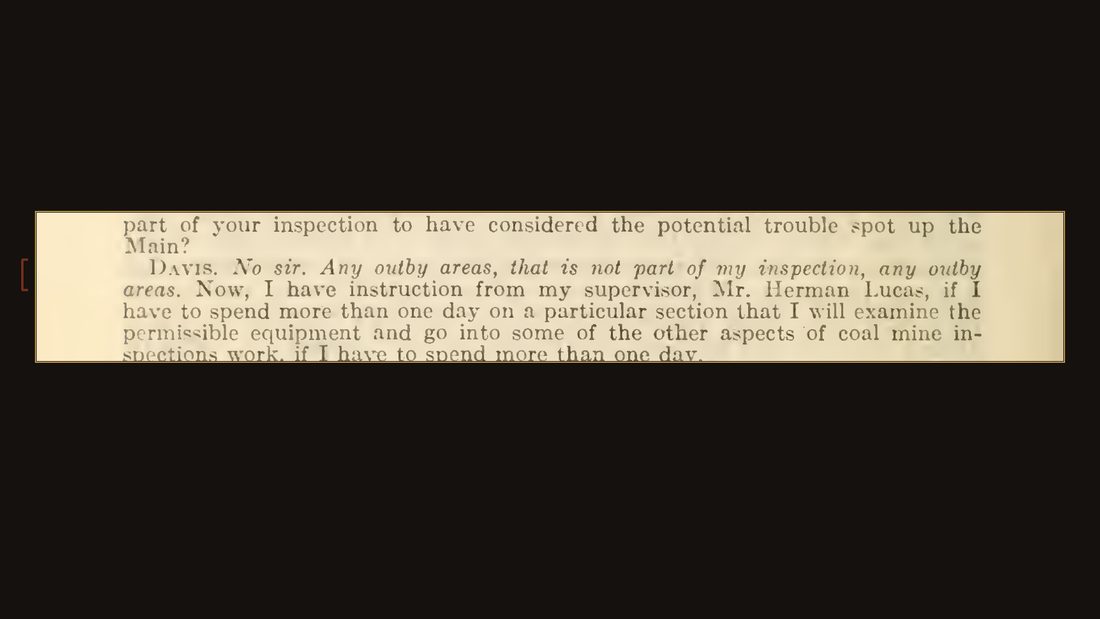
He inspected the new panel. He did not go up into the section that would explode the next day. Investigators asked him about that afterward.
S50
House Educ. & Labor, Subcomm. on Labor Standards · Staff Report · Oct. 15, 1976 · p. 28.
Any outby areas, he said. That is not part of my inspection.
S66
House Educ. & Labor, Subcomm. on Labor Standards · Staff Report · Oct. 15, 1976 · p. 28.
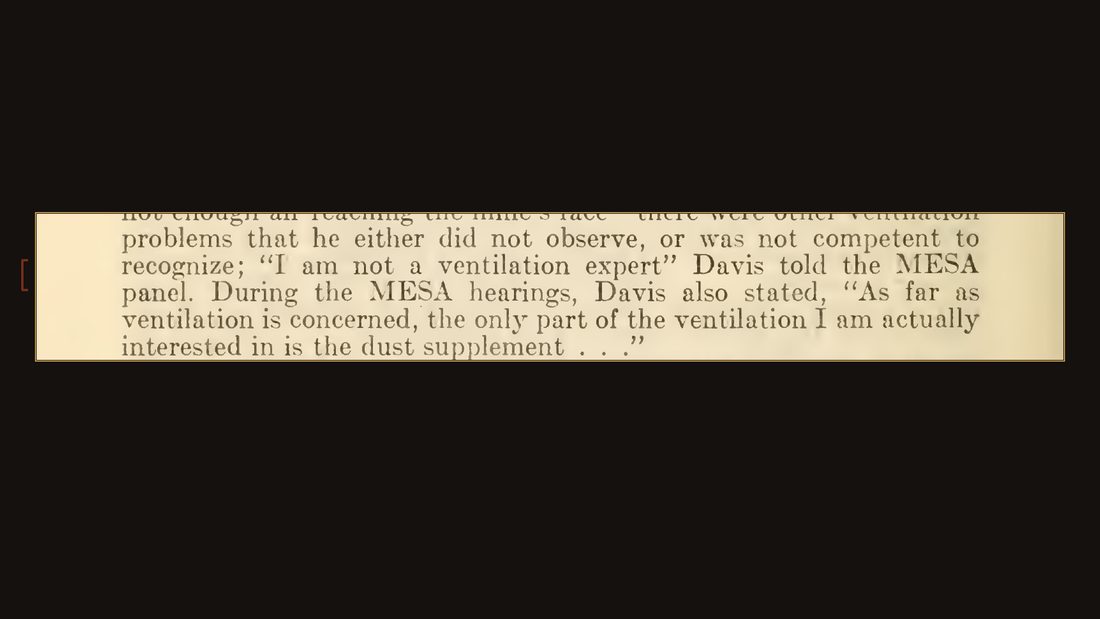
He also told them, plainly, I am not a ventilation expert.
He did find something. Late that afternoon he measured the air reaching the working face, and it was too low. He wrote the company a violation notice.
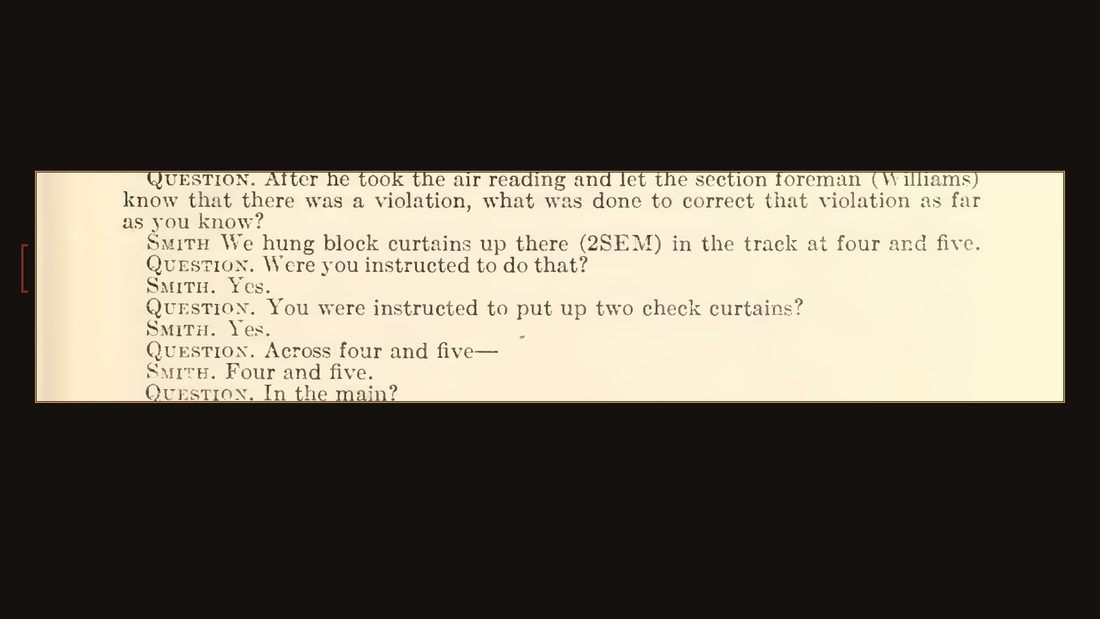
A utility man named Gary Smith later told the investigation exactly where it came from.
S51
House Educ. & Labor, Subcomm. on Labor Standards · Staff Report · Oct. 15, 1976 · p. 35.
We hung block curtains up there in the track, he said.
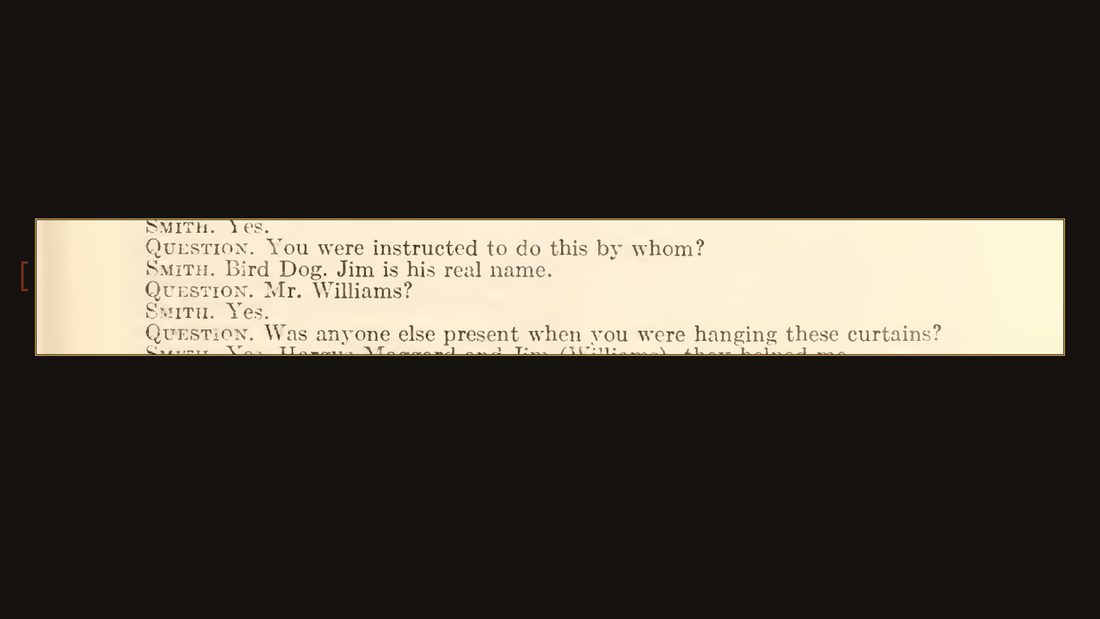
They had hung curtains across the main tunnel, choking off the air going up into the section that would explode, and pushing it into the panel where the inspector was standing.
S52
House Educ. & Labor, Subcomm. on Labor Standards · Staff Report · Oct. 15, 1976 · p. 35.
Smith was asked whether the inspector knew. He said no. He was asked why. He said his foreman told him they did not have enough air, and that was good enough.
S67
House Educ. & Labor, Subcomm. on Labor Standards · Staff Report · Oct. 15, 1976 · p. 35.
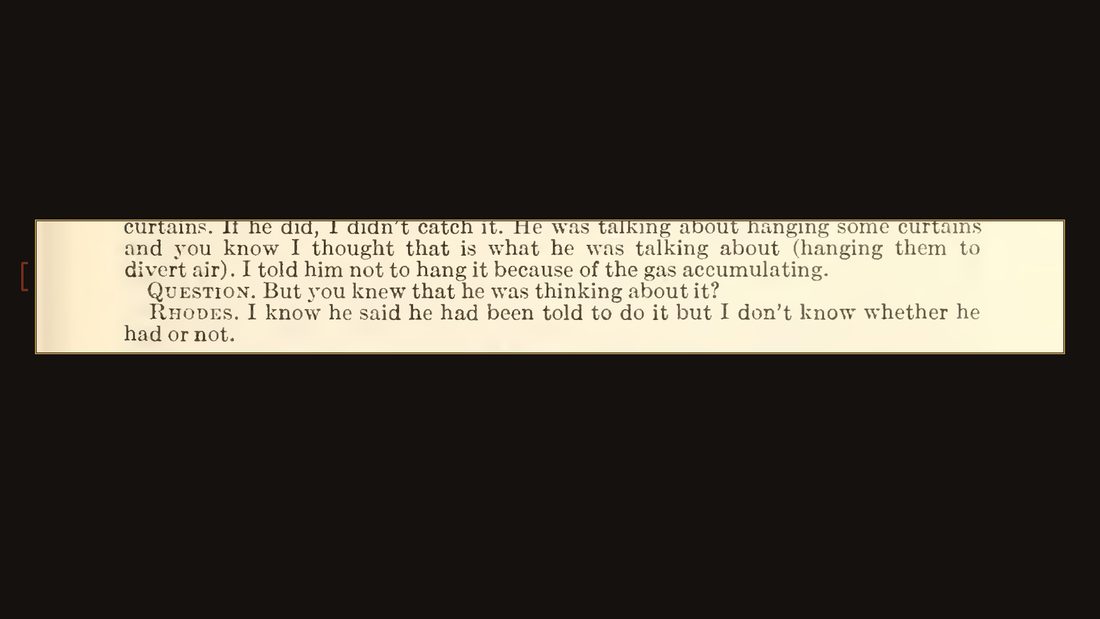
An assistant foreman named Merle Rhodes had already argued against hanging those curtains, and he had said exactly why. I told him not to hang it because of the gas accumulating.
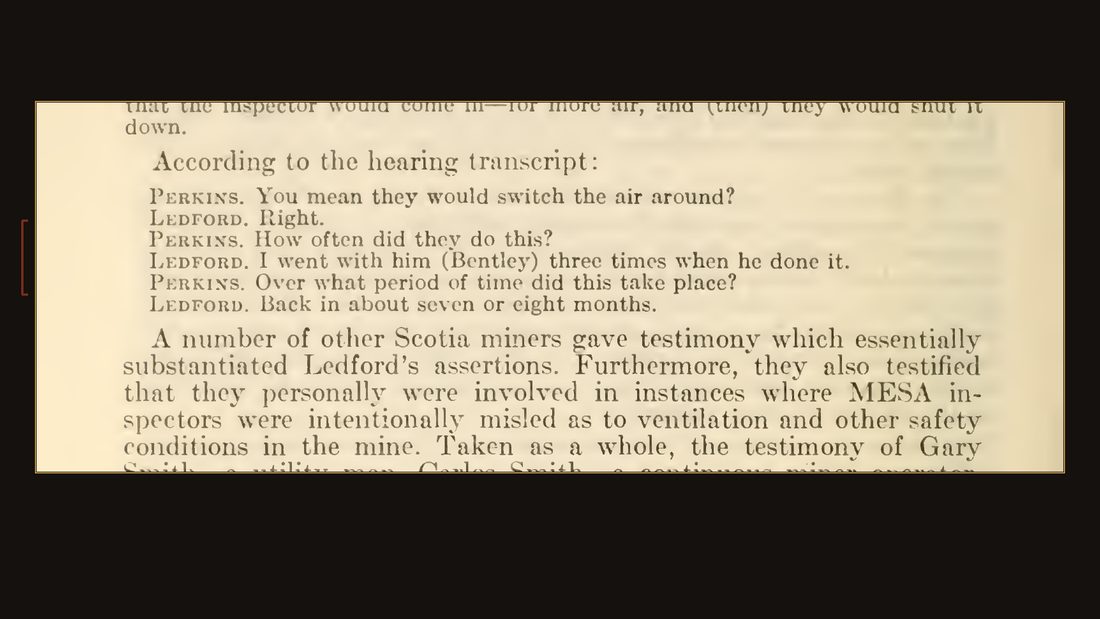
None of this was new. A former miner named Ronald Ledford told the joint committee he had personally gone along three times while air was moved around the mine ahead of an inspection.
S38
House Educ. & Labor, Subcomm. on Labor Standards · Staff Report · Oct. 15, 1976 · p. 14.
The chairman asked him what he meant. You mean they would switch the air around. Right, he said.
The book
The last requirement is the preshift examination. Before any shift goes into a working section, somebody qualified has to walk it, test it for gas, and write down what he found.
S37
House Educ. & Labor, Subcomm. on Labor Standards · Staff Report · Oct. 15, 1976 · p. 12.
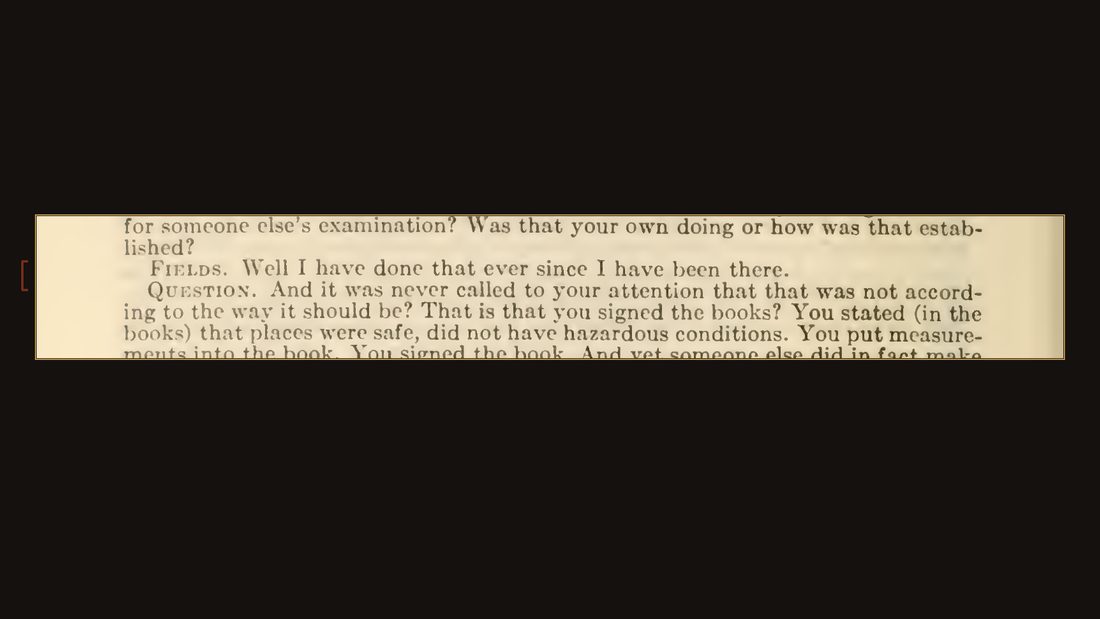
And you signed for the exams. Yes. But you did not make them. No.
S53
House Educ. & Labor, Subcomm. on Labor Standards · Staff Report · Oct. 15, 1976 · p. 38.
He was asked how that had been allowed to start. Well, I have done that ever since I have been there.
S7
House Educ. & Labor, Subcomm. on Labor Standards · Staff Report · Oct. 15, 1976 · p. 2.
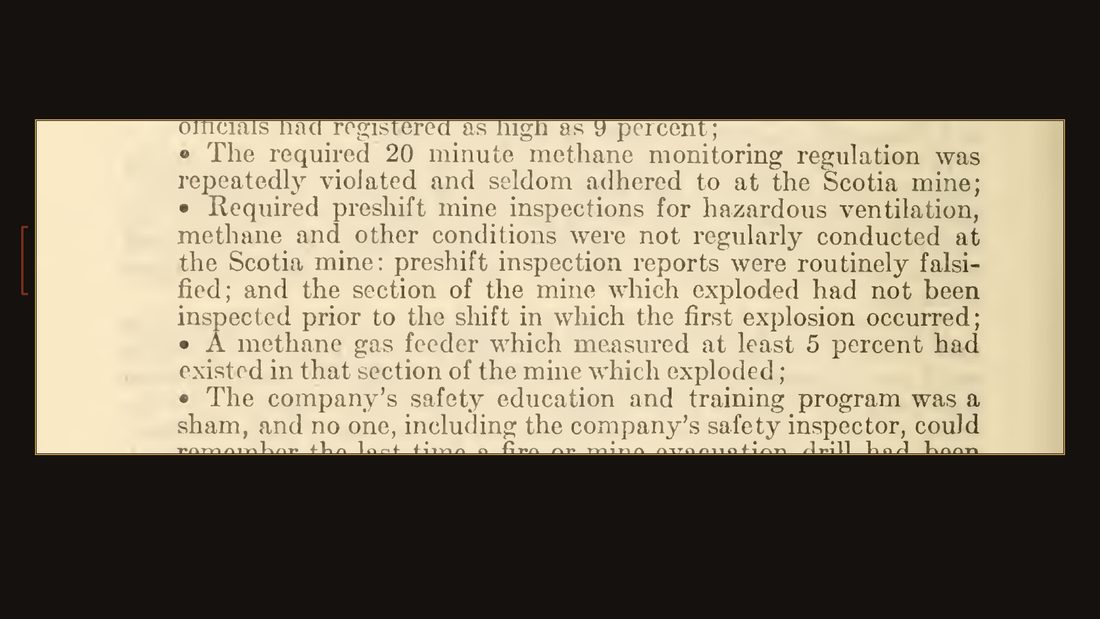
The report puts it in one sentence. Preshift inspection reports were routinely falsified, and the section of the mine which exploded had not been inspected prior to the shift in which the first explosion occurred.
The morning
The ninth of March, nineteen seventy-six, was a Tuesday.
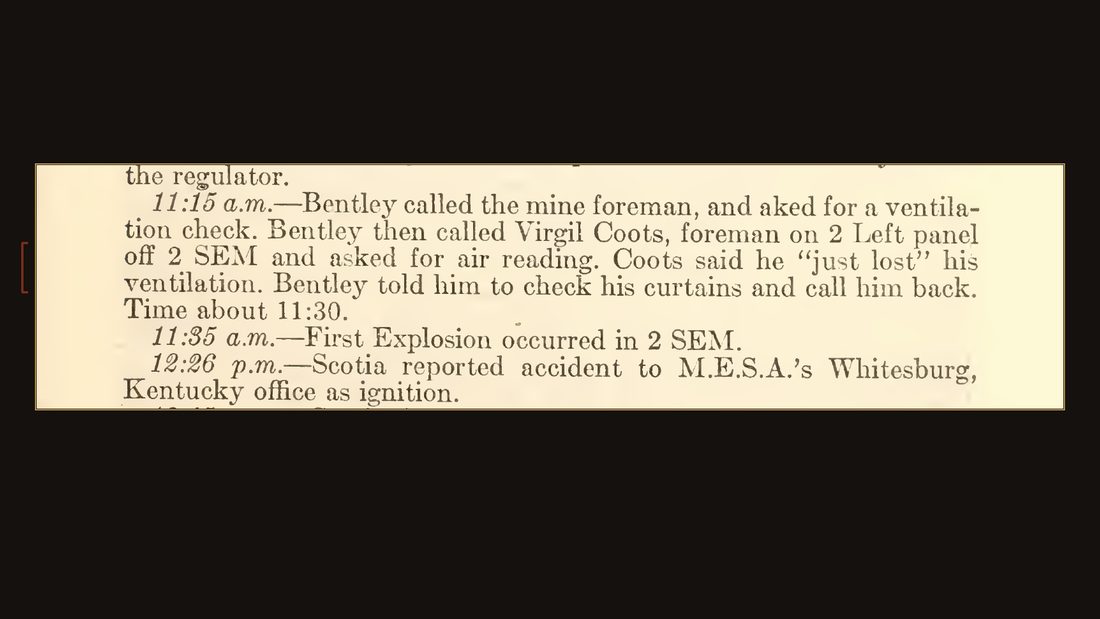
At eleven o'clock, an assistant foreman named James Bentley noticed a regulator controlling the mine's air had been left open, changing where the air was going. He closed it.
S23
House Educ. & Labor, Subcomm. on Labor Standards · Staff Report · Oct. 15, 1976 · p. 7.
At eleven fifteen he called for a ventilation check. Then he called the foreman working in the new panel, a man named Virgil Coots, and asked him for an air reading.
Coots told him he had just lost his air. Bentley told him to check his curtains and call back. That call was about eleven thirty.
S24
House Educ. & Labor, Subcomm. on Labor Standards · Staff Report · Oct. 15, 1976 · p. 7.
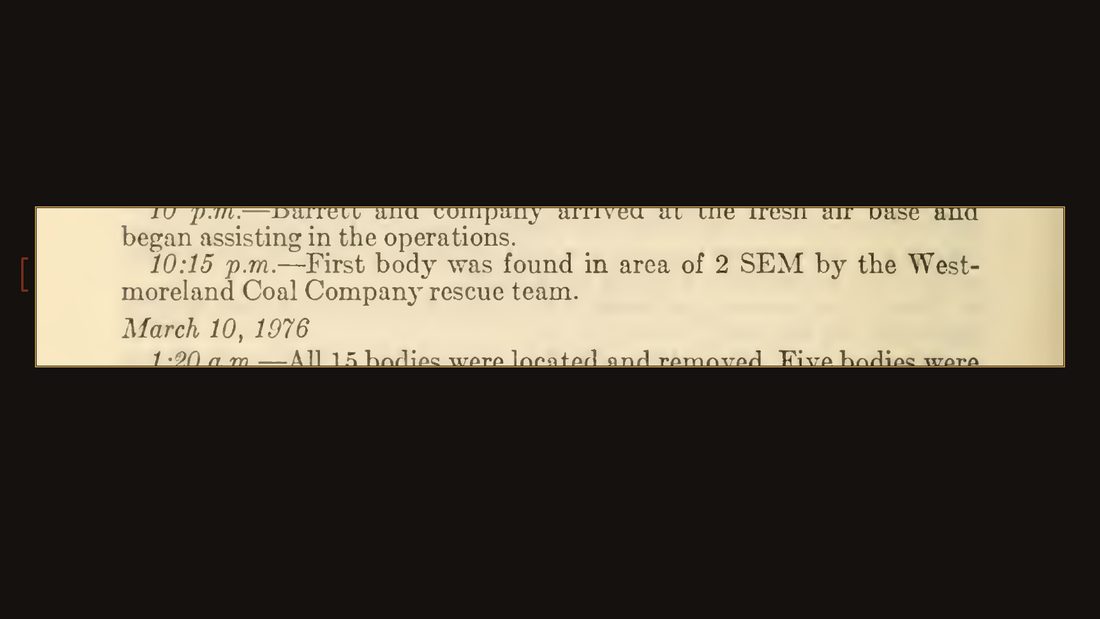
At eleven thirty-five the section exploded.
S25
House Educ. & Labor, Subcomm. on Labor Standards · Staff Report · Oct. 15, 1976 · p. 8.
Scotia telephoned the federal office in Whitesburg at twenty-six minutes past noon and called it an ignition. Nineteen minutes later they called back and said it was an explosion, with sixteen men unaccounted for.
Fifteen
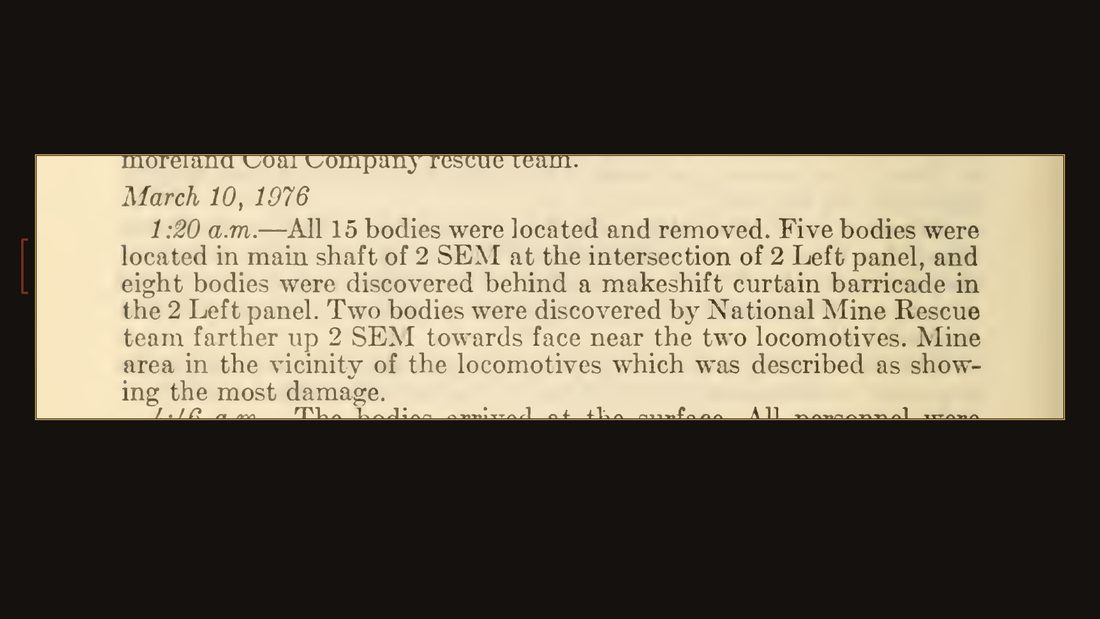
The first body was found at quarter past ten that night.
S26
House Educ. & Labor, Subcomm. on Labor Standards · Staff Report · Oct. 15, 1976 · p. 8.
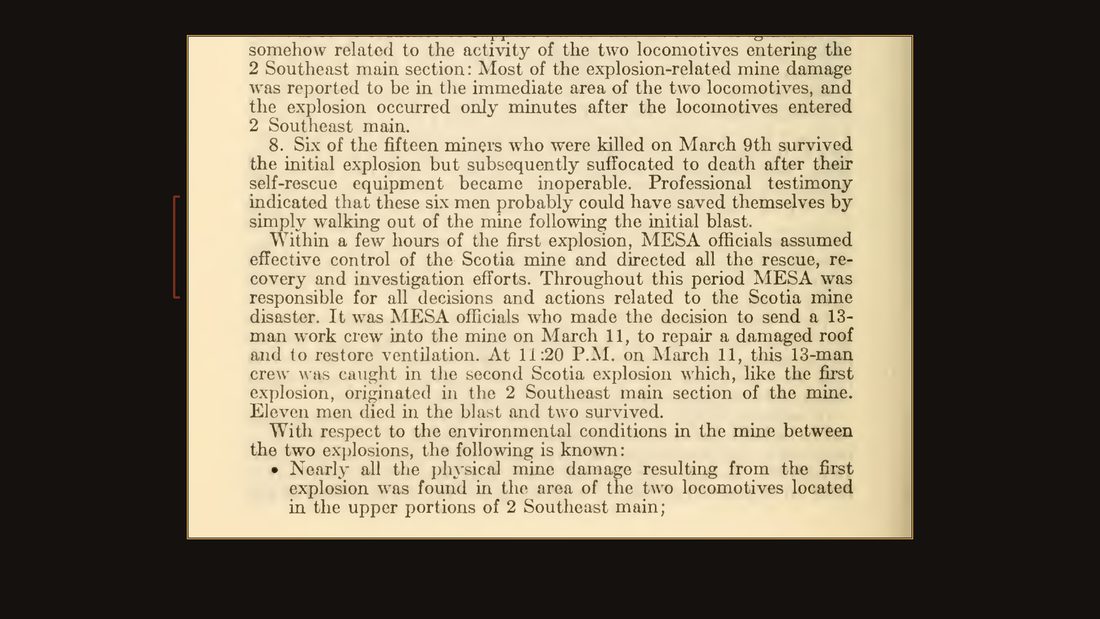
By twenty past one in the morning all fifteen were located.
Five were in the main tunnel. Eight were behind a makeshift curtain barricade in the new panel. Two were far up the section near the locomotives, where the damage was worst.
S14
House Educ. & Labor, Subcomm. on Labor Standards · Staff Report · Oct. 15, 1976 · p. 4.
Six of those fifteen men had lived through the blast. They got behind the barricade and put on their self-rescuers, which are small emergency breathing units good for about an hour. When the units stopped working, they suffocated.
S68
House Educ. & Labor, Subcomm. on Labor Standards · Staff Report · Oct. 15, 1976 · p. 14.
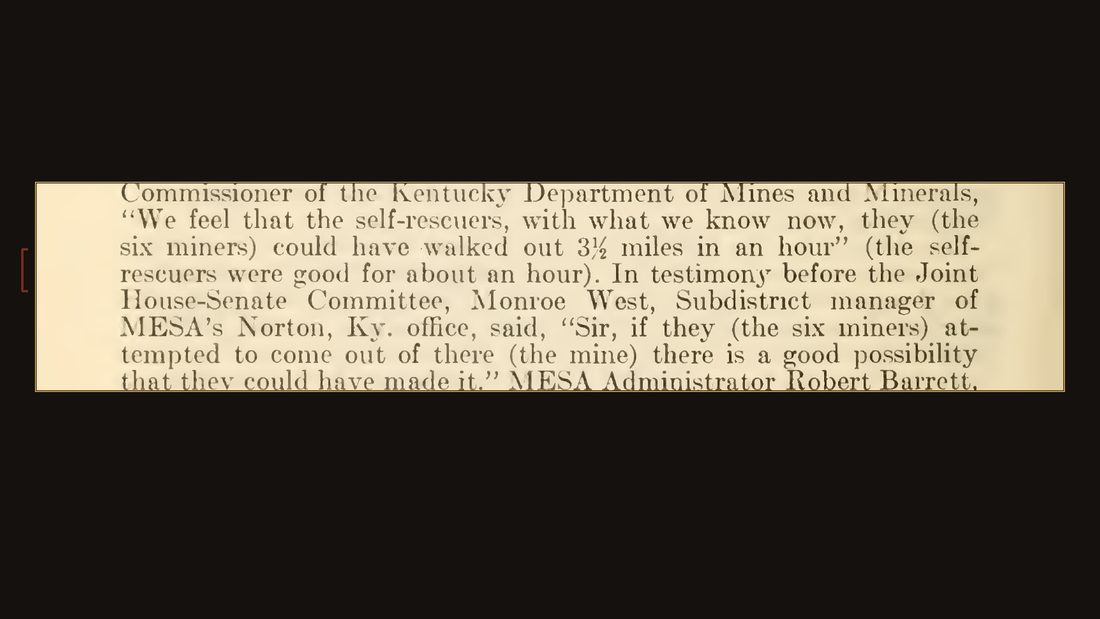
Officials said afterward that those six could probably have walked out. Kentucky's mines commissioner put it at three and a half miles in an hour, and the self-rescuers were good for about an hour.
S40
House Educ. & Labor, Subcomm. on Labor Standards · Staff Report · Oct. 15, 1976 · p. 15.
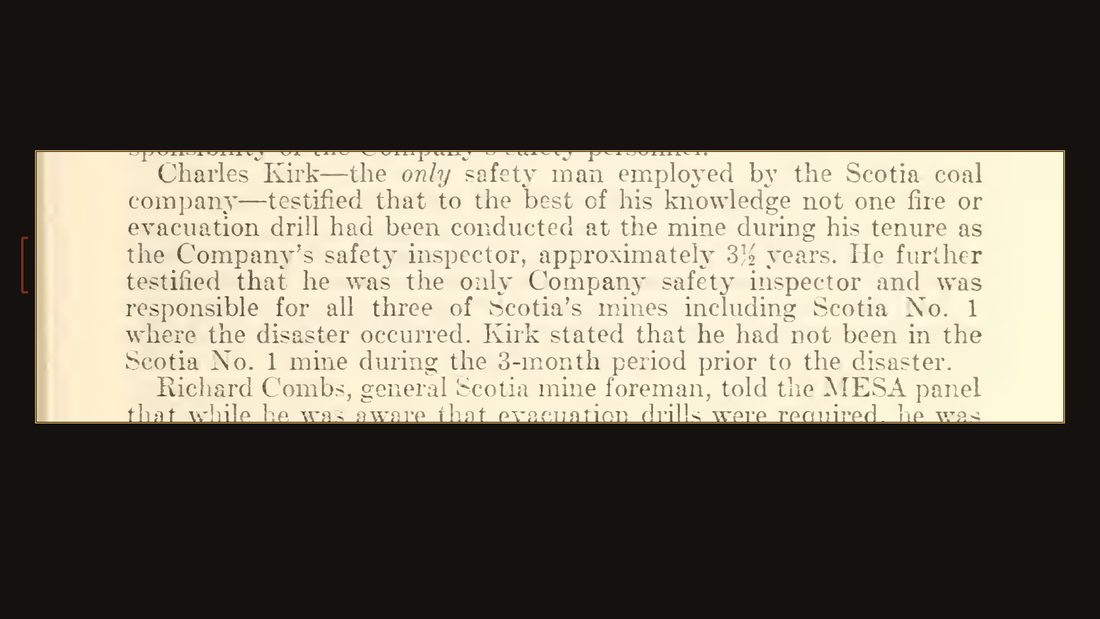
The company's only safety inspector testified that in about three and a half years on the job he could not remember one fire or evacuation drill at the mine.
S41
House Educ. & Labor, Subcomm. on Labor Standards · Staff Report · Oct. 15, 1976 · p. 15.
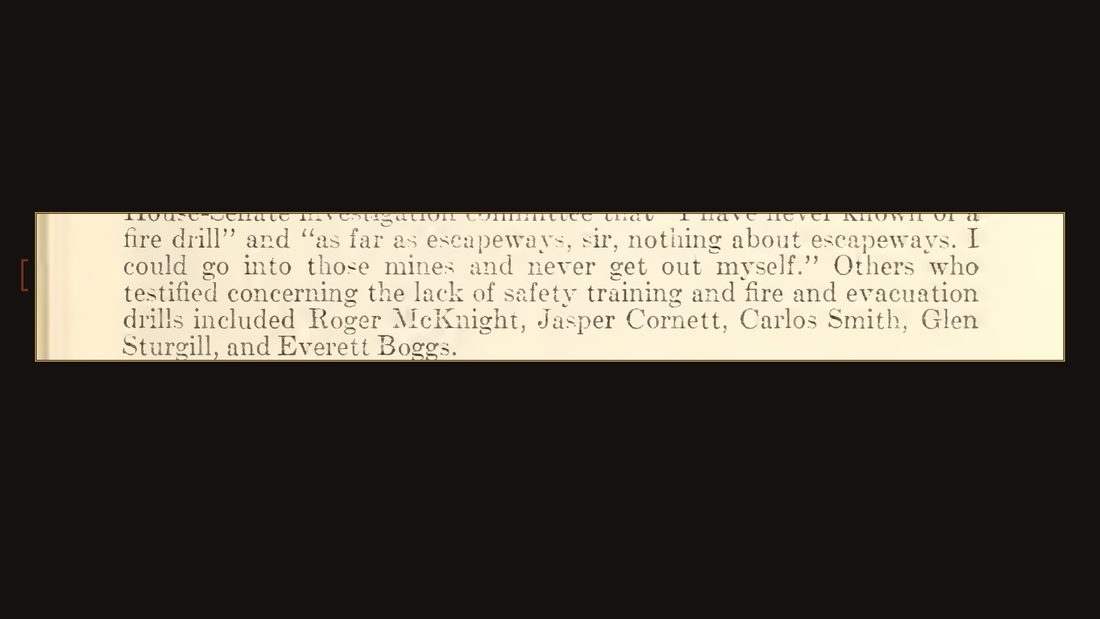
The president of the miners' own association told the chairman what that meant in practice. As far as escapeways, sir, nothing about escapeways. I could go into those mines and never get out myself.
S39
House Educ. & Labor, Subcomm. on Labor Standards · Staff Report · Oct. 15, 1976 · p. 14.
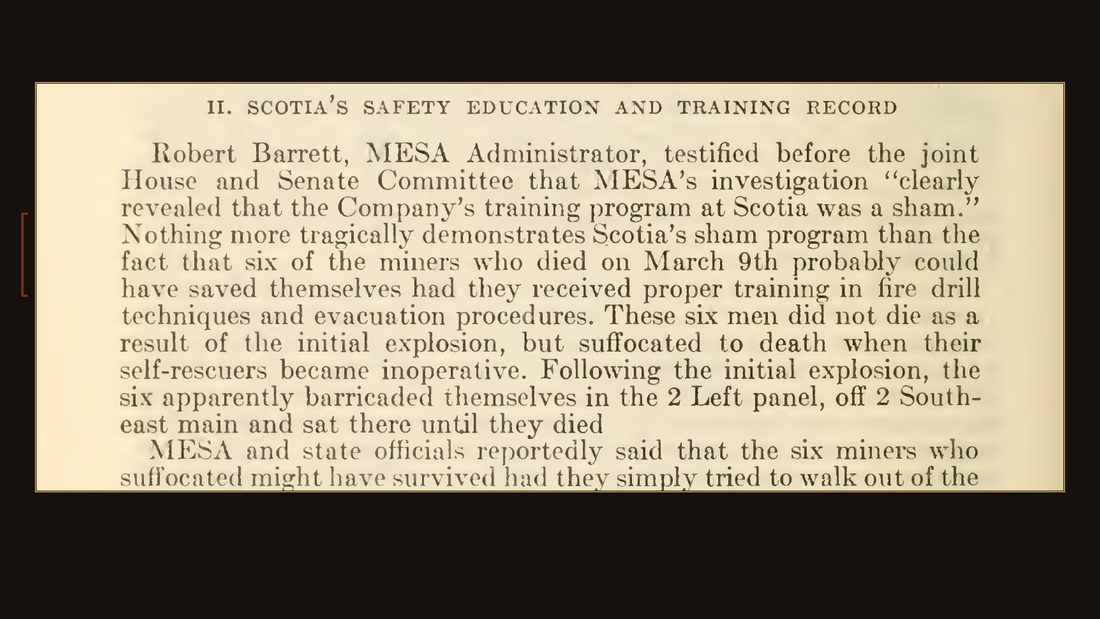
The federal administrator's word for the company's training program, under oath, was a sham.
Sixty hours
By the small hours of the tenth of March, the mine belonged to the federal government. What happened over the next two days is the part the committee could not get past.
S17
House Educ. & Labor, Subcomm. on Labor Standards · Staff Report · Oct. 15, 1976 · p. 5.
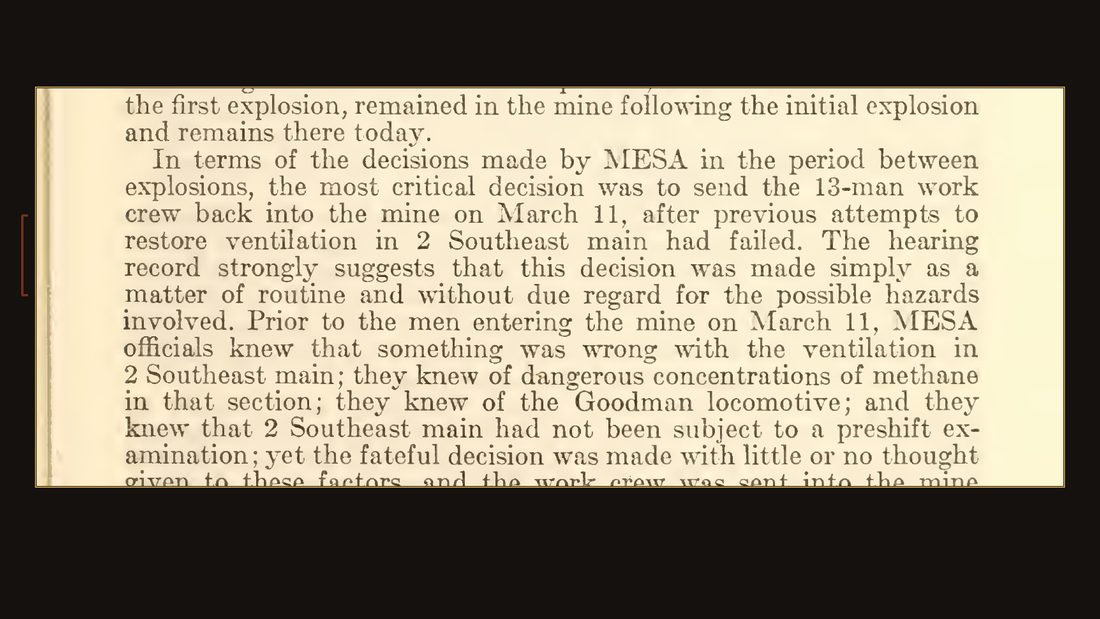
At five in the morning on the tenth, with the bodies barely out, senior officials met and decided to start investigating the cause of the explosion the next day.
The man in charge on site later explained his thinking. He expected the remaining work in that section to be a matter of routine, and said the other conferees shared his views.
Here is what was known when he said that. Rescue teams had measured dangerous methane and carbon monoxide up that section. Crews had worked until midnight trying to restore the ventilation, and failed.
The locomotive
And then there was the locomotive.
S54
House Educ. & Labor, Subcomm. on Labor Standards · Staff Report · Oct. 15, 1976 · p. 42.
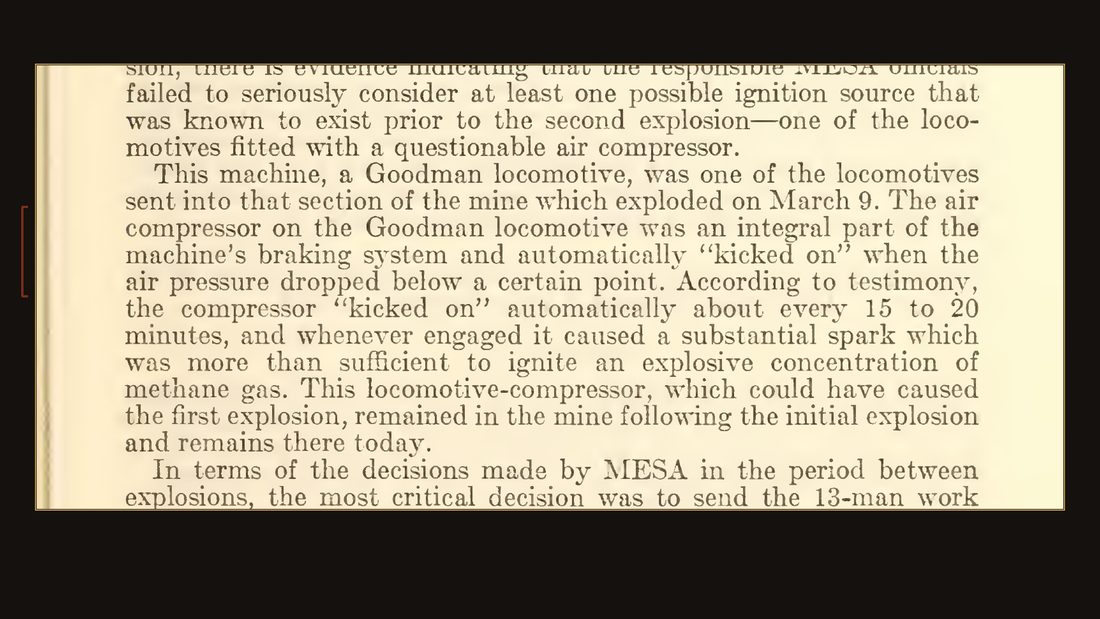
It was a Goodman locomotive, first purchased in nineteen forty-two and later acquired secondhand by Scotia. Its brakes had never been good enough for the grades. It had run away more than once and buried itself in the wall of the tunnel.
S16
House Educ. & Labor, Subcomm. on Labor Standards · Staff Report · Oct. 15, 1976 · p. 5.
So somebody fitted it with air brakes. Air brakes need a compressor, and this one switched itself on automatically whenever the pressure dropped, about every fifteen or twenty minutes. Every time it did, the open switch threw an arc.
The testimony agreed unanimously that this arc was more than enough to ignite methane. The report notes, in the flattest possible language, that the machine probably should not have been used in that section of the mine.
That locomotive was one of the two pushed up into the section on the morning of the ninth. It was still up there. Nobody had brought it out, and nobody could say it had stopped switching itself on.
S27
House Educ. & Labor, Subcomm. on Labor Standards · Staff Report · Oct. 15, 1976 · p. 8.
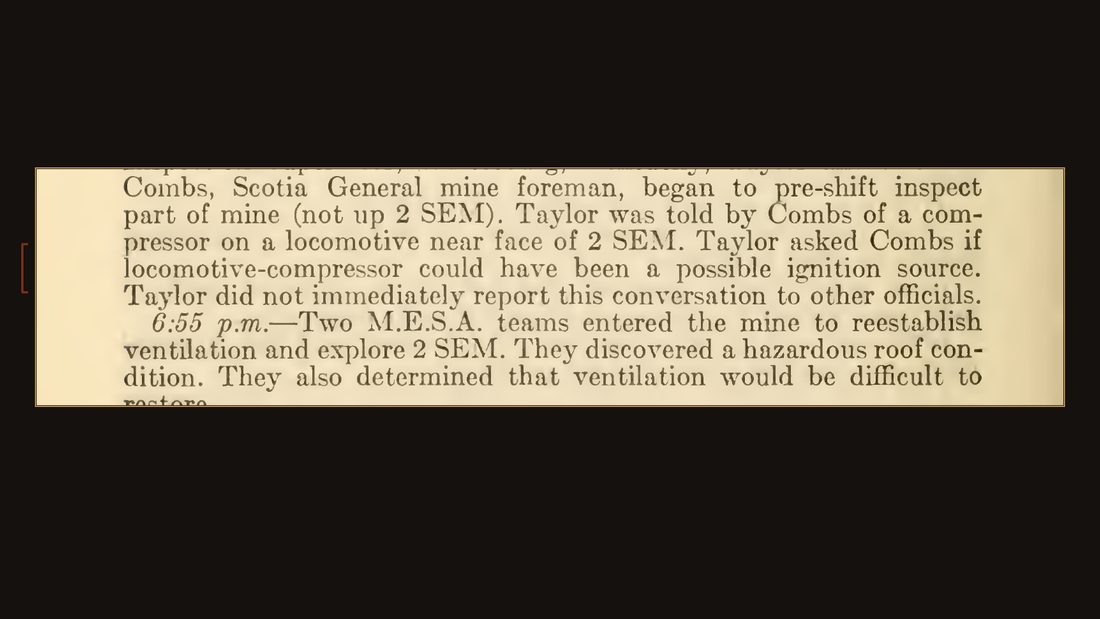
On the evening of the tenth, a federal inspection supervisor named Ben Taylor was told about the compressor by a Scotia foreman while the two of them were walking the mine. Taylor asked whether it could have been the ignition source.
He did not report the conversation to anyone that night.
S17
House Educ. & Labor, Subcomm. on Labor Standards · Staff Report · Oct. 15, 1976 · p. 5.
In the early hours of the eleventh, senior officials met again and decided to send a work crew back in that day to bolt the roof and restore the ventilation.
S56
House Educ. & Labor, Subcomm. on Labor Standards · Staff Report · Oct. 15, 1976 · p. 48.
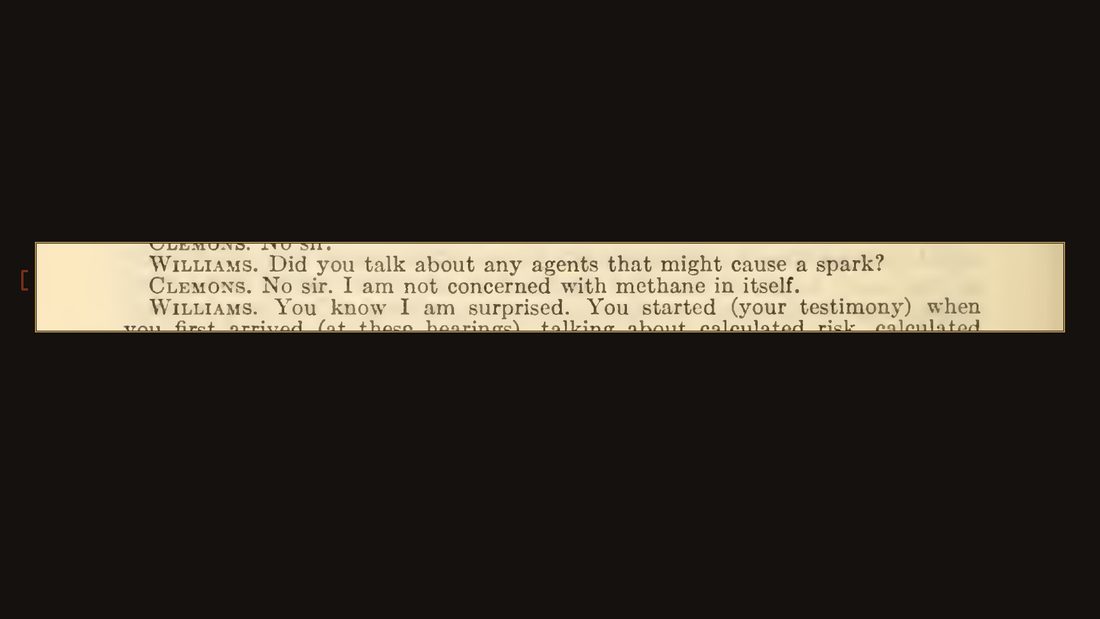
The senator running the hearing asked the man who made that decision a simple question. At that meeting, did you talk about the amount of methane that you knew was down there.
No sir. Did you talk about any agents that might cause a spark.
No sir. I am not concerned with methane in itself.
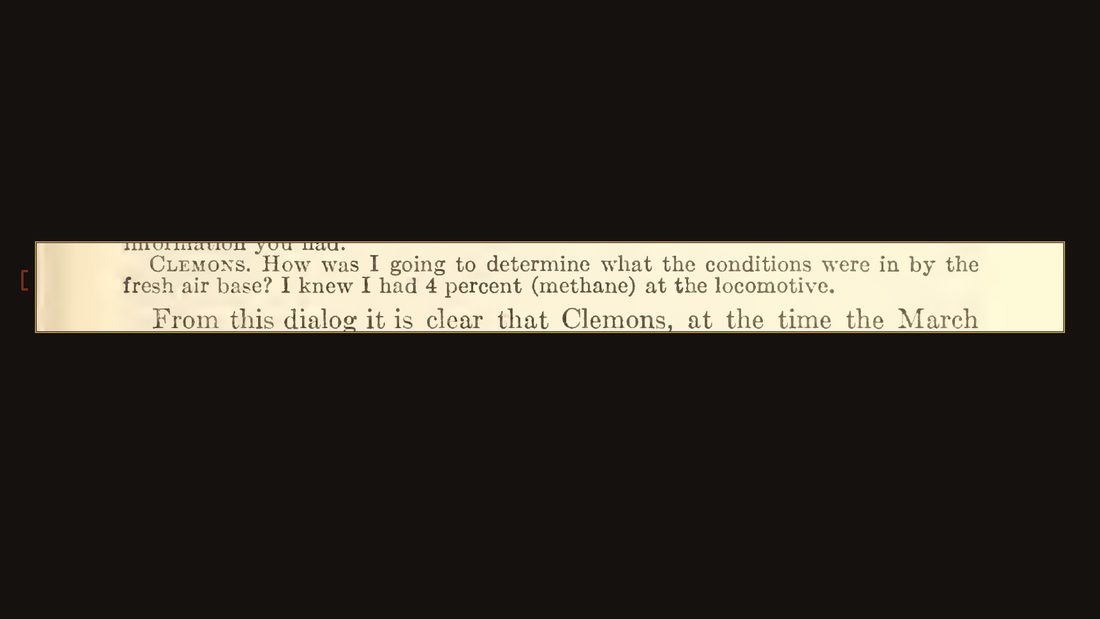
S57
House Educ. & Labor, Subcomm. on Labor Standards · Staff Report · Oct. 15, 1976 · p. 49.
Pressed on what the last readings actually were before he sent men back in, he answered. I knew I had four percent at the locomotive.
Four percent. The explosive range starts at five.
Thirteen men
S59
House Educ. & Labor, Subcomm. on Labor Standards · Staff Report · Oct. 15, 1976 · p. 50.
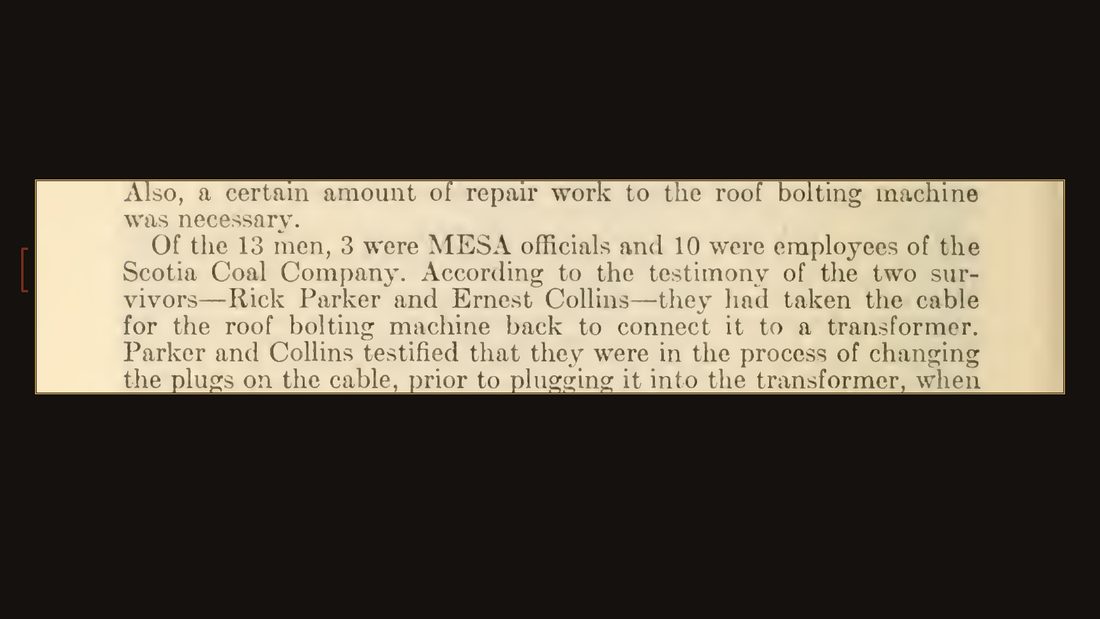
Thirteen men went underground at quarter past four in the afternoon on the eleventh of March. Three of them were federal inspectors. Ten worked for the coal company.
S29
House Educ. & Labor, Subcomm. on Labor Standards · Staff Report · Oct. 15, 1976 · p. 9.
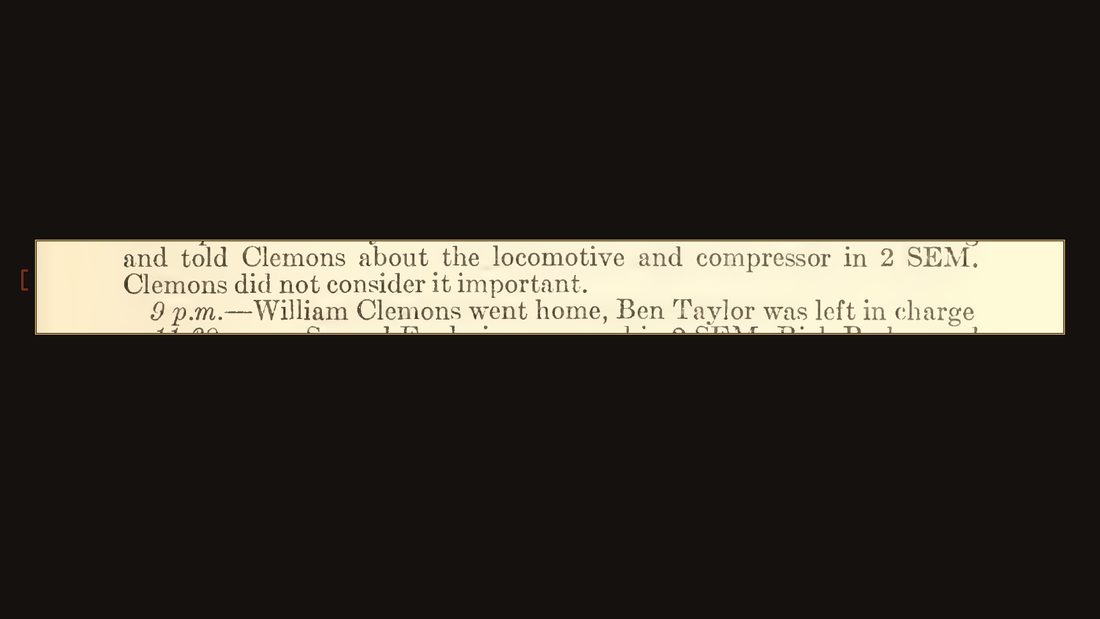
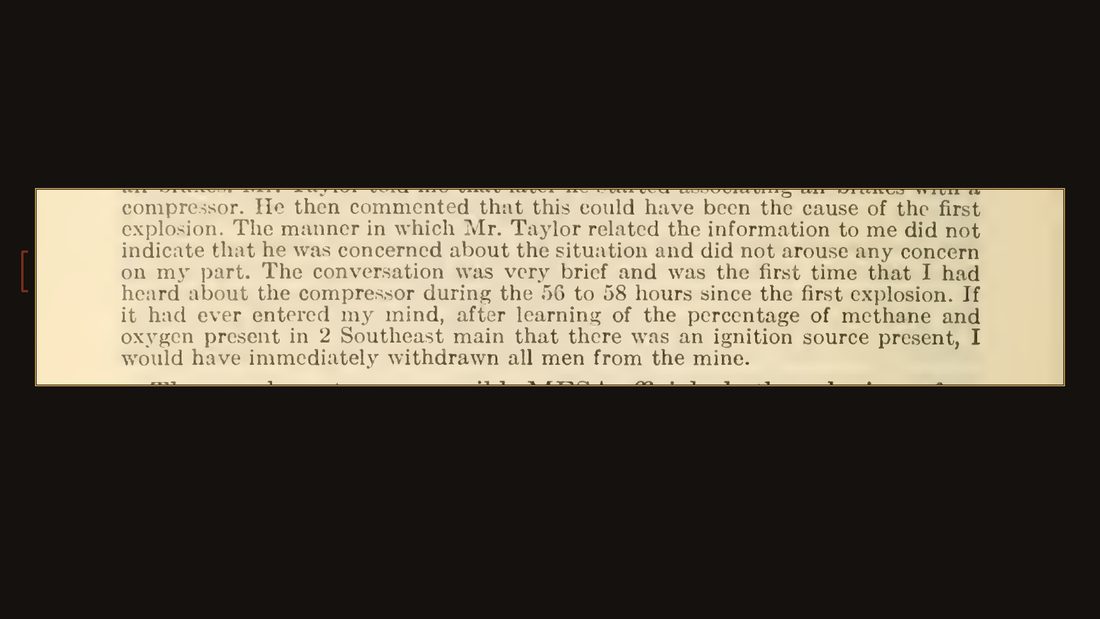
Sometime between seven and nine that evening, Taylor finally told the man in charge about the locomotive compressor. That man went home at nine.
S55
House Educ. & Labor, Subcomm. on Labor Standards · Staff Report · Oct. 15, 1976 · p. 46.
He described that conversation to Congress himself. The manner in which Mister Taylor related the information to me did not indicate that he was concerned about the situation, and did not arouse any concern on my part.
And then this. If it had ever entered my mind, after learning of the percentage of methane and oxygen present in two southeast main, that there was an ignition source present, I would have immediately withdrawn all men from the mine.
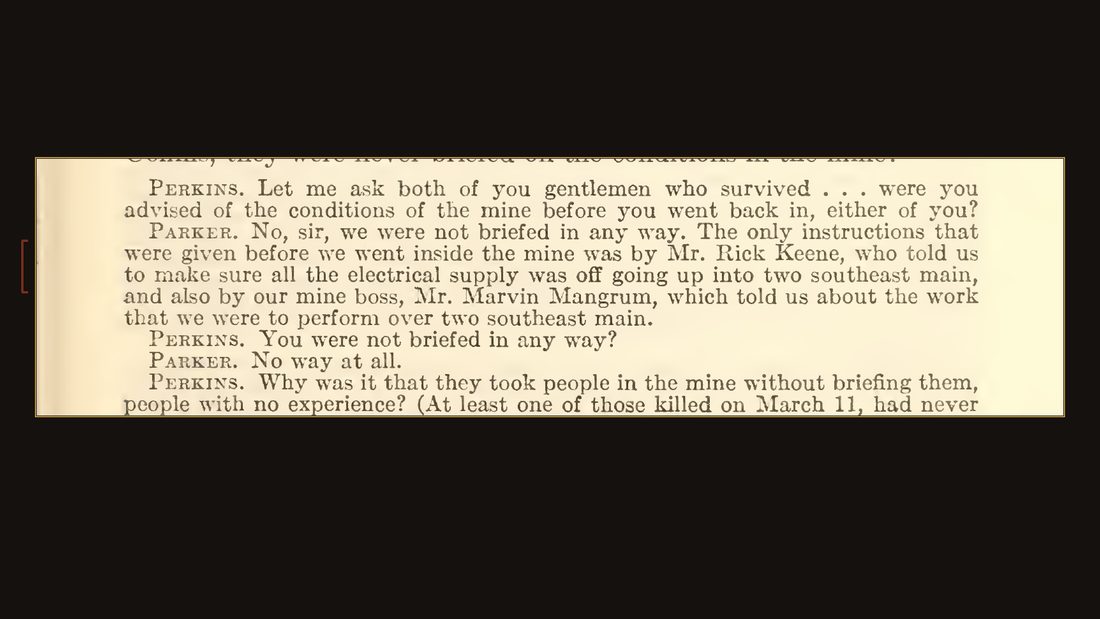
S58
House Educ. & Labor, Subcomm. on Labor Standards · Staff Report · Oct. 15, 1976 · p. 49.
No sir, we were not briefed in any way. No way at all.
S30
House Educ. & Labor, Subcomm. on Labor Standards · Staff Report · Oct. 15, 1976 · p. 9.
At twenty past eleven that night the section exploded a second time.
Rick Parker and Ernest Collins were about a hundred and fifty feet from the rest of the crew. They put on their self-rescuers and walked out, and they stopped at a belt telephone on the way to report the explosion themselves. That call is how the surface found out.
Eleven
S31
House Educ. & Labor, Subcomm. on Labor Standards · Staff Report · Oct. 15, 1976 · p. 9.
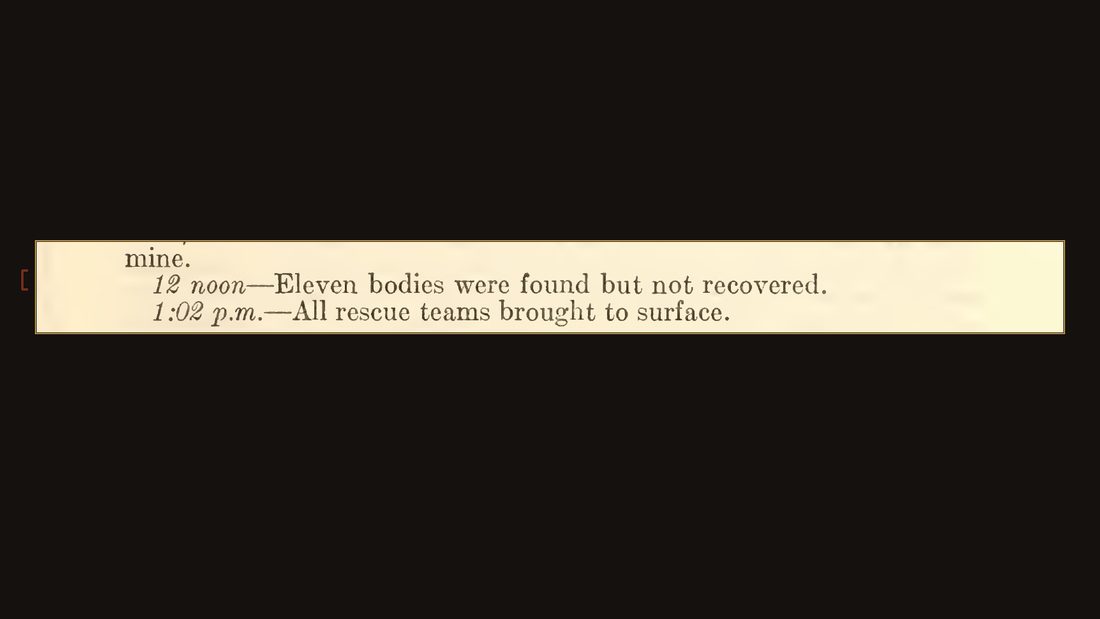
The other eleven were found the next day at noon.
S60
House Educ. & Labor, Subcomm. on Labor Standards · Staff Report · Oct. 15, 1976 · p. 51.
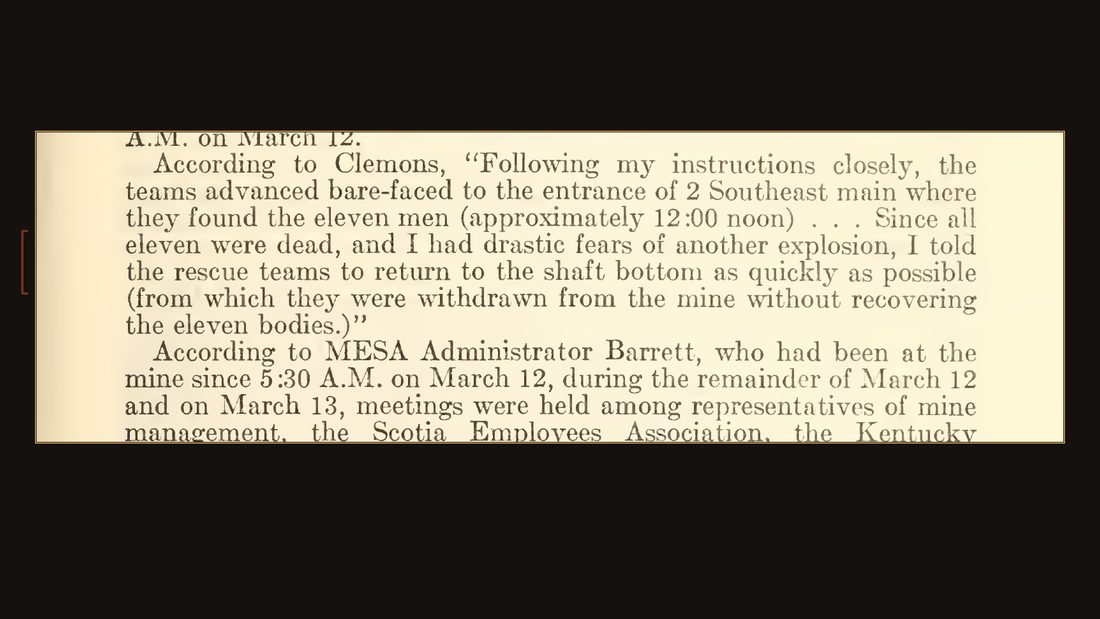
Rescue teams came down the air shaft and advanced to the entrance of the section, and there they were. The official in charge described the decision he made then.
Since all eleven were dead, and I had drastic fears of another explosion, I told the rescue teams to return to the shaft bottom as quickly as possible.
They came out without the bodies. That was the right call. It was also the last time anyone was near those men for eight months.
Sealed
S32
House Educ. & Labor, Subcomm. on Labor Standards · Staff Report · Oct. 15, 1976 · p. 9.
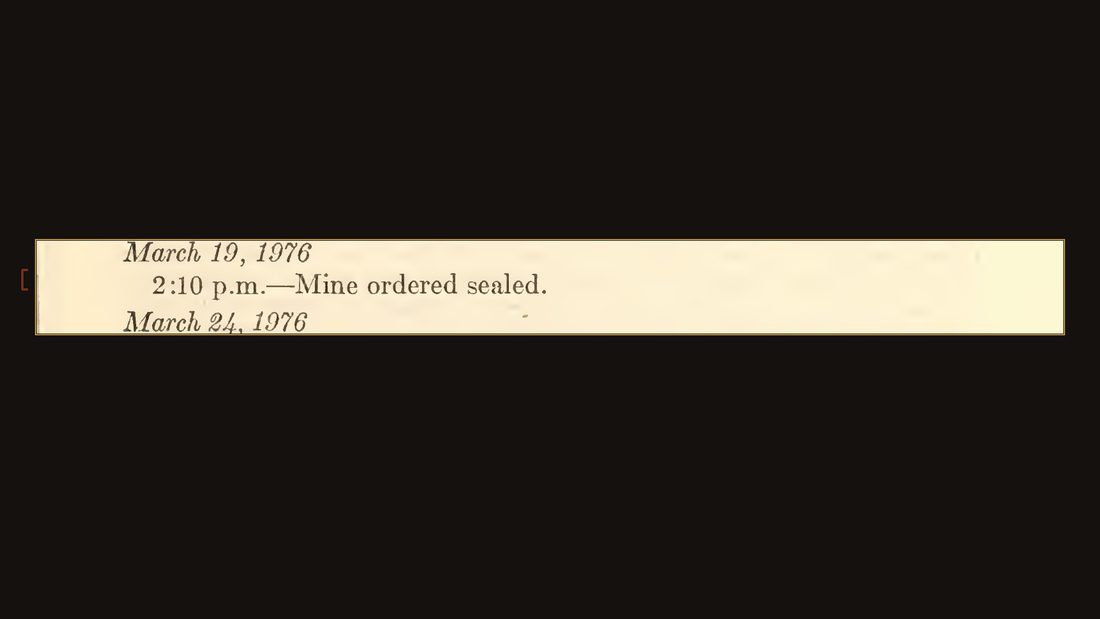
On the nineteenth of March, at ten past two in the afternoon, every opening into the Scotia mine was sealed shut.
Eleven men were inside it.
Reopened
S33
House Educ. & Labor, Subcomm. on Labor Standards · Staff Report · Oct. 15, 1976 · p. 10.
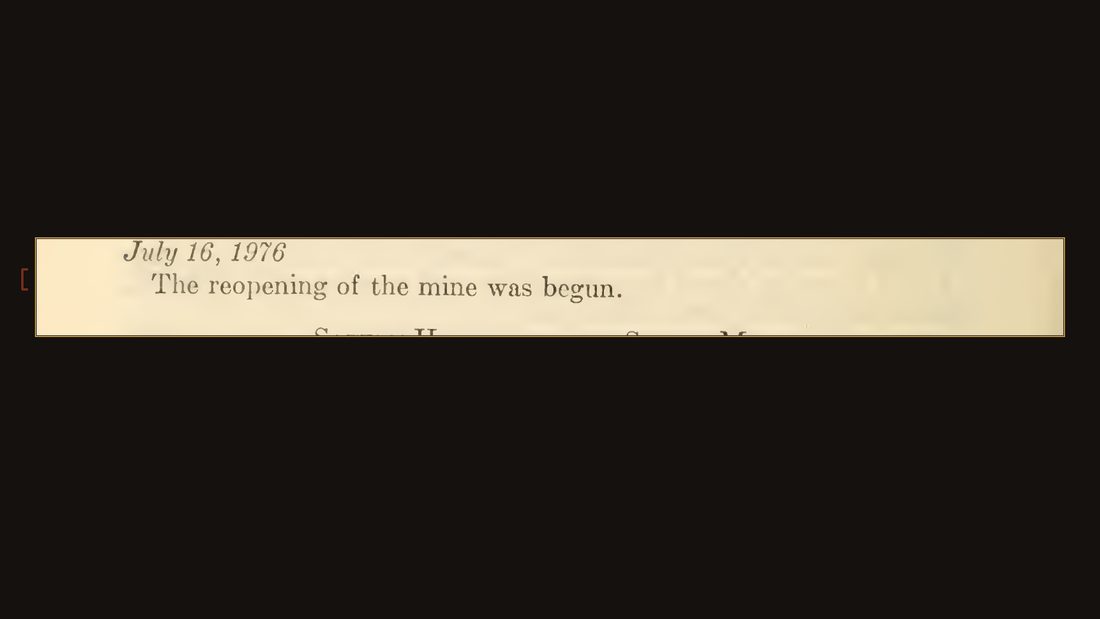
On the eighteenth of June the agency announced tentative plans to reopen the mine. On the sixteenth of July, the reopening began.
The eleven men were still in it.
S61
House Educ. & Labor, Subcomm. on Labor Standards · Staff Report · Oct. 15, 1976 · p. 52.
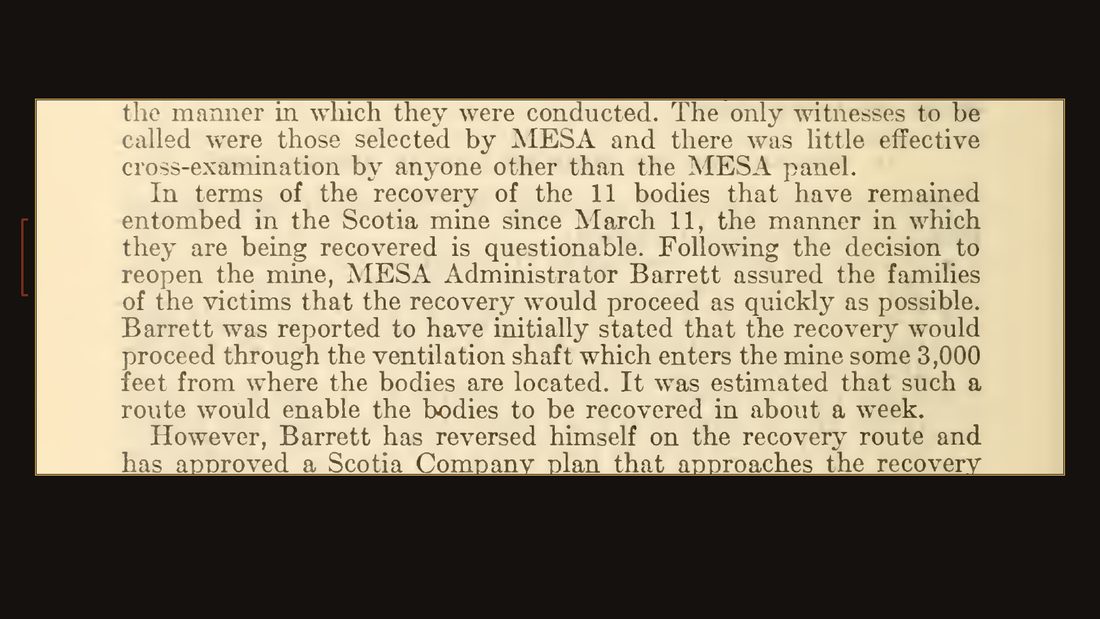
There were two ways to reach them. The federal administrator first told the families the recovery would come down the ventilation shaft, which enters the mine about three thousand feet from where the bodies lay. That route was estimated at about a week.
He then reversed himself and approved the company's plan instead, which came at the bodies the long way, through the main shaft. That route was estimated at a minimum of sixty days.
S62
House Educ. & Labor, Subcomm. on Labor Standards · Staff Report · Oct. 15, 1976 · p. 52.
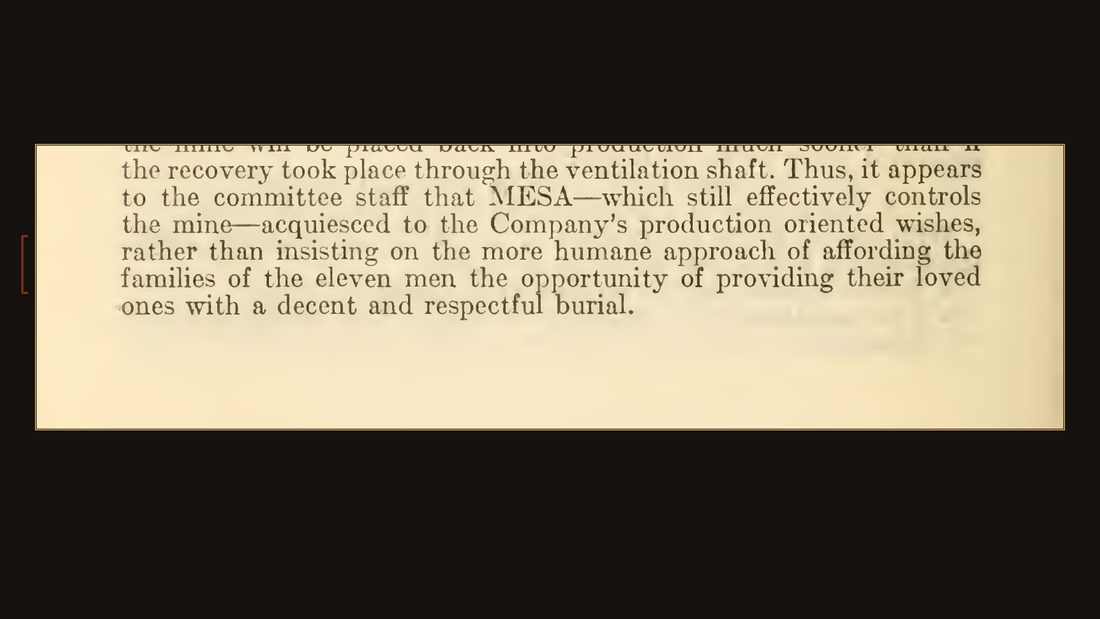
The committee staff said out loud why they thought that happened. By following the company's plan the mine will be placed back into production much sooner than if the recovery took place through the ventilation shaft.
And then, in a United States government document, this. It appears to the committee staff that Mesa, which still effectively controls the mine, acquiesced to the company's production oriented wishes, rather than insisting on the more humane approach of affording the families of the eleven men the opportunity of providing their loved ones with a decent and respectful burial.
S2
House Educ. & Labor, Subcomm. on Labor Standards · Staff Report · Oct. 15, 1976 · p. 1.
That was published on the fifteenth of October, nineteen seventy-six. On that date, this sentence was still true.
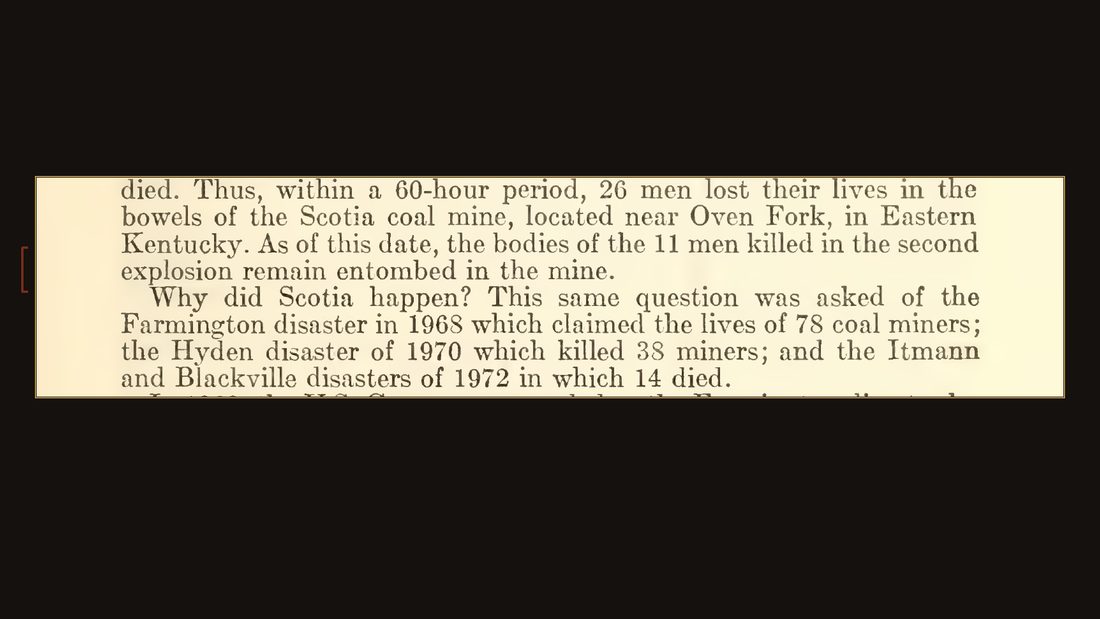
As of this date, the bodies of the eleven men killed in the second explosion remain entombed in the mine.
November
The eleven were brought out in November of nineteen seventy-six, about eight months after they died. Local accounts put it on the nineteenth. I could not tie that exact day to a document, so I am telling you it is November and leaving it there.
The widows
Then the litigation started, and it took a great deal longer than the recovery did.
Fifteen widows of the men killed in the first explosion sued Blue Diamond, the parent company in Knoxville, for sixty million dollars. Their case was that the parent ran mine safety at Scotia, knew the ventilation needed fixing, delayed it, and hid the changes from federal inspectors.
Blue Diamond's answer was that it should count as the miners' employer, which under Kentucky's workers' compensation law would have made it immune from being sued at all. The district judge agreed with the company and threw the case out.
In January of nineteen seventy-nine the Sixth Circuit reversed and sent it back for trial. A parent company, the court held, cannot claim to be the employer when that helps and hide behind separate corporations when it does not.
One of the fifteen women who filed that case never saw the end of it. Geraldine Coots, whose husband Virgil was the foreman who called in to say he had just lost his air, died on the twenty-fifth of January, nineteen seventy-eight.
In August of nineteen eighty, four and a half years after the explosions, the case settled. The Tennessee Supreme Court, in a later fight between Blue Diamond and its own insurers, put the figure at approximately five point eight million dollars.
The books
The criminal case took longer still, and it turned on twenty books.
On the night of the first explosion, with fifteen men still unaccounted for underground, a federal official ordered a subordinate to go and take the company's inspection books. An inspector carried twenty of them out of the mine office and the electrical shop.
On the twenty-fifth of June, nineteen seventy-nine, more than three years after the explosions, a federal grand jury in Kentucky indicted the two companies. Four counts of willfully violating a mandatory safety standard, and two counts of making false statements in records the operator was required to keep.
The companies moved to suppress the books, and the district judge agreed with them. There had been no warrant, and he found the emergency did not excuse it, because taking the books had nothing to do with rescuing anybody.
The court reversed. Because mining is a heavily regulated industry, and because the law required those books to be kept open for anyone to inspect, the company's interest in them was too thin to justify throwing out the evidence.
One judge dissented. The law let inspectors read those books at the mine, he wrote. It did not let them carry the books away. When the government wants a company's property, it is supposed to go to court and ask.
Eighty thousand dollars
In nineteen eighty-two, six years after the deaths of twenty-six men, it ended in front of a federal judge named G. Wix Unthank.
According to the University of Kentucky's history of the federal courts in Kentucky, Scotia pleaded guilty to two charges and no contest to three more, and the rest were dropped.
Prosecutors recommended a fine of eighty thousand dollars. The judge ordered the company to pay it, or instead to give sixty thousand dollars to the charities that had helped after the disaster.
S47
House Educ. & Labor, Subcomm. on Labor Standards · Staff Report · Oct. 15, 1976 · p. 23.
Hold that number against the other one. In the six years before the explosions, the federal government collected about seventy-eight thousand dollars in safety fines from this mine.
Twenty-six men later, the criminal penalty was eighty thousand.
What the law became
One thing did change, and it changed nationally.
L1
Legislative History of the Federal Mine Safety and Health Act of 1977 · GPO 1978 · p. 592.
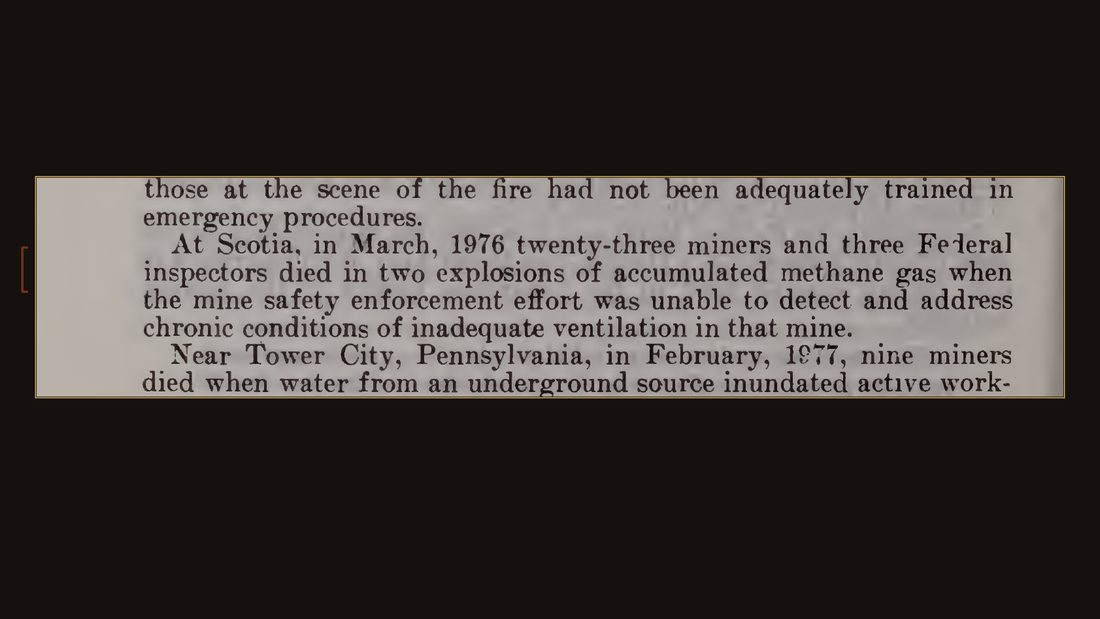
Congress was already rewriting the mine safety laws when Scotia exploded, and Scotia went straight into the record as the reason to finish the job.
The committee report listed the disasters that made the case. Farmington. Buffalo Creek. Blacksville. And Scotia, where twenty-three miners and three federal inspectors died in two explosions of accumulated methane gas when the mine safety enforcement effort was unable to detect and address chronic conditions of inadequate ventilation in that mine.
L9
Legislative History of the Federal Mine Safety and Health Act of 1977 · GPO 1978 · p. 921.
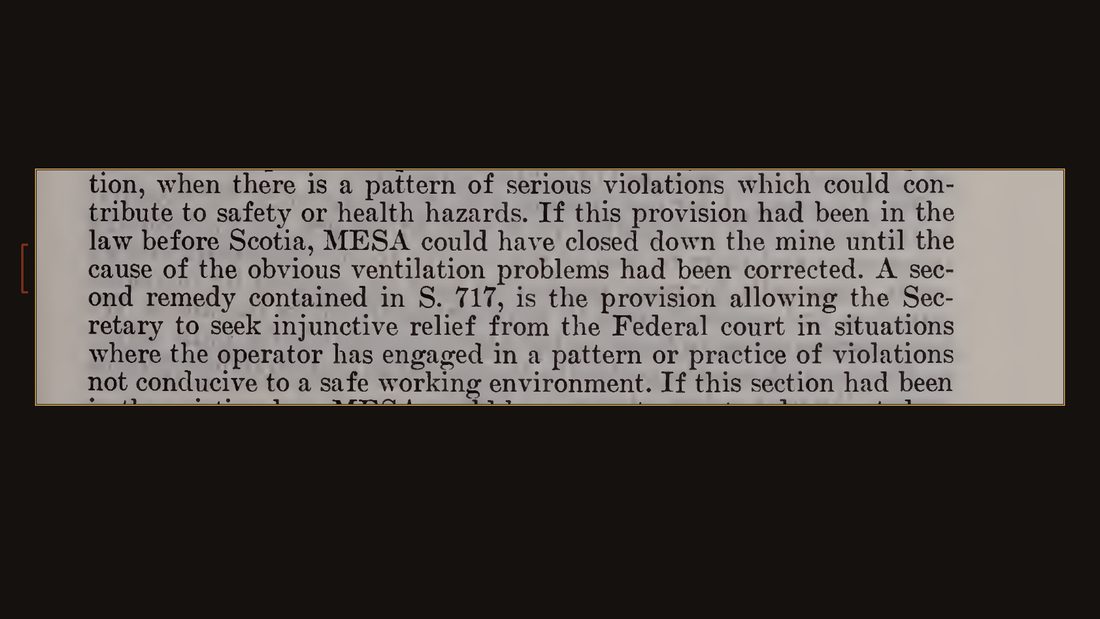
The Senate said plainly what the old law had lacked. If this provision had been in the law before Scotia, the agency could have closed down the mine until the cause of the obvious ventilation problems had been corrected.
The Federal Mine Safety and Health Act passed in nineteen seventy-seven. It moved enforcement out of the Interior Department and into the Department of Labor, and it renamed the agency. Mesa became M S H A, which is still its name today.
L2
Legislative History of the Federal Mine Safety and Health Act of 1977 · GPO 1978 · p. 905.
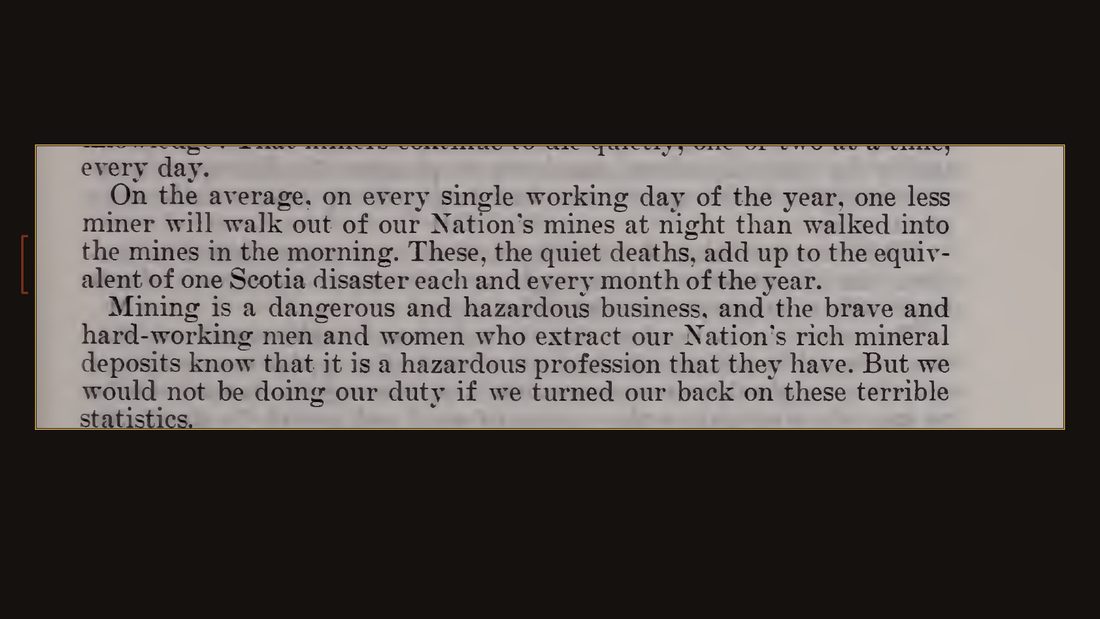
During the debate, a senator put the ordinary deaths next to the famous ones. On the average, on every single working day of the year, one less miner will walk out of our nation's mines at night than walked into the mines in the morning.
These, the quiet deaths, add up to the equivalent of one Scotia disaster each and every month of the year.
What is still buried
So what is still buried here.
S16
House Educ. & Labor, Subcomm. on Labor Standards · Staff Report · Oct. 15, 1976 · p. 5.
The first thing is the simplest. Nobody ever established what lit either explosion. The report walks through the possibilities for the ninth of March and rules most of them out for want of evidence, then says that because the second blast tore up the same ground, the answer may never be settled.
S64
House Educ. & Labor, Subcomm. on Labor Standards · Staff Report · Oct. 15, 1976 · p. 53.
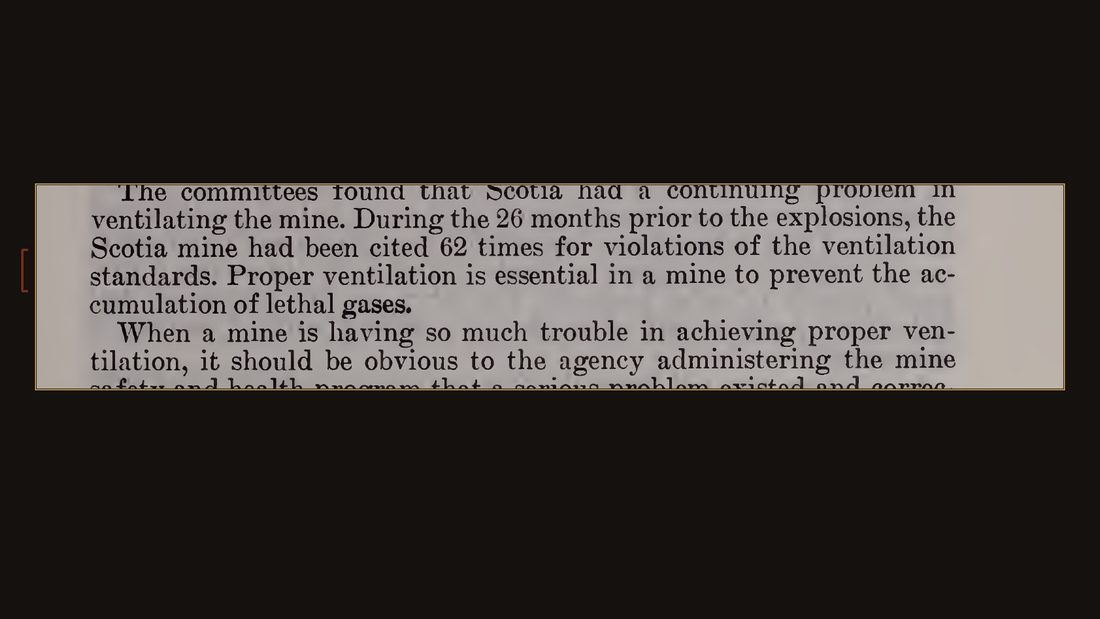
The House staff report says sixty-three ventilation violations in the two years before the explosions. It says it twice.
Its own chart, on its own last page, lists those violations by description. Add the column up and you get sixty-seven.
L8
Legislative History of the Federal Mine Safety and Health Act of 1977 · GPO 1978 · p. 921.
The Senate committee, working the same records, says sixty-two.
S63
House Educ. & Labor, Subcomm. on Labor Standards · Staff Report · Oct. 15, 1976 · p. 53.
The report says eight hundred and fifty-five violation notices in six years. Its own chart, year by year, adds up to eight hundred and fifty-four.
And on that one printed page, the source line under one chart calls the agency the Mine Safety Enforcement Administration, and the source line under another calls it the Mining Enforcement and Safety Administration.
S45
House Educ. & Labor, Subcomm. on Labor Standards · Staff Report · Oct. 15, 1976 · p. 22.
Everything needed to prevent the ninth of March was written down before the ninth of March. The gas readings. The falsified books. The moved air. The recommendation for criminal charges, filed five months early, still being investigated.
S16
House Educ. & Labor, Subcomm. on Labor Standards · Staff Report · Oct. 15, 1976 · p. 5.
And everything needed to prevent the eleventh of March was known on the tenth. The methane. The failed ventilation. And a nineteen forty-two locomotive with a compressor that sparked every twenty minutes, sitting up there in the dark, that nobody thought was worth a second sentence.
S9
House Educ. & Labor, Subcomm. on Labor Standards · Staff Report · Oct. 15, 1976 · p. 2.
The House staff put it in one line. We further believe that the March ninth and March eleventh disasters could and should have been prevented.
Twenty-six men. Two explosions, sixty hours apart. Eleven of them left in the ground for eight months while the mine went back into production above them.
If your people worked at Scotia, or anywhere under Black Mountain in those years, I would like to know what you were told about it at the time. The comments are open.
Sources
- [S1] Scotia Coal Mine Disaster, March 9 and 11, 1976: A Staff Report. Prepared by the staff of the House Committee on Education and Labor, Subcommittee on Labor Standards (John H. Dent, Chairman). Committee Print, U.S. Government Printing Office, October 15, 1976. 53 pp. Public domain. https://archive.org/details/scotiacodi00unit
- [L] Legislative History of the Federal Mine Safety and Health Act of 1977. U.S. Government Printing Office, 1978. Public domain. https://archive.org/details/legislativehisto00unit_5
- [C1] United States v. Blue Diamond Coal Co. and Scotia Coal Co., 667 F.2d 510 (6th Cir., argued Sept. 17, 1980, decided Dec. 17, 1981, rehearing denied Feb. 8, 1982). https://www.courtlistener.com/opinion/398254/united-states-v-blue-diamond-coal-company-scotia-coal-company/
- [C2] Boggs v. Blue Diamond Coal Co., 590 F.2d 655 (6th Cir., Jan. 23, 1979). https://www.courtlistener.com/opinion/362819/boggs-v-blue-diamond-coal-company/
- [C3] Boggs v. Blue Diamond Coal Co., 497 F. Supp. 1105 (E.D. Ky., Sept. 8, 1980). https://www.courtlistener.com/opinion/1614518/boggs-v-blue-diamond-coal-co/
- [C4] Blue Diamond Coal Co. v. Holland-America Insurance Co., 671 S.W.2d 829 (Tenn., May 7, 1984). https://www.courtlistener.com/opinion/2367238/blue-diamond-coal-co-v-holland-america-insurance-co/
- [R1] The Scotia Mine Disaster. John G. Heyburn II Initiative for Excellence in the Federal Judiciary, University of Kentucky. https://heyburncollections.org/exhibits/show/scotia/scotia Supports (attributed on screen): the $60 million suit; Judge Hermansdorfer's dismissal and his stepping aside; Judge Bertelsman's reassignment; and the 1982 disposition before Judge G. Wix Unthank — guilty pleas to two charges, no contest to three, the rest dropped, an $80,000 fine or $60,000 to disaster-relief charities.
- The ignition source of neither explosion was ever established. The staff report rules most candidates out for want of evidence and says the answer may never be settled because the second blast destroyed the same ground. The Goodman locomotive's compressor is presented as what it is in the record — the possibility officials knew about and did not act on — not as a finding.
- The date the eleven bodies came out is not nailed down. The staff report of October 15, 1976 proves they were still in the mine on that date. Local histories give November 19, 1976 and "253 days," others say mid-November and "243 days"; none of them is a primary source and they disagree. The narration says November 1976 and says plainly that the exact day is unsourced.
- The settlement figure differs by source. The Tennessee Supreme Court says "approximately 5.8 million dollars"; the University of Kentucky's account says $5.5 million in August 1980. The episode uses the court's figure and names the court.
- The ventilation-violation count differs across the government's own documents: 63 (House staff report text), 67 (that report's own Chart C, added up), and 62 (Senate committee). Likewise 855 notices in the text against 854 in Chart A. These are stated as what they are — small errors in the paperwork — and are not used to imply anything was concealed.
- Judge Hermansdorfer's recusal. The claim that he stepped aside after criticism over coal investments comes from the University of Kentucky account and is attributed in narration to that source. No court document in this episode's set says it.
- No home addresses appear, and no crime-scene, body-recovery or autopsy imagery is used. The AI-generated images fill gaps only; none depicts a real identifiable person and none depicts a document, headline, record or casualty.
- Nothing here rests on newspaper coverage. 1976 newspapers are still in copyright, so no newspaper page is shown; every exhibit is a public-domain U.S. government document or a public court opinion.