They Widened the Tunnel to Sell the Rock That Was Killing the Men | 1930
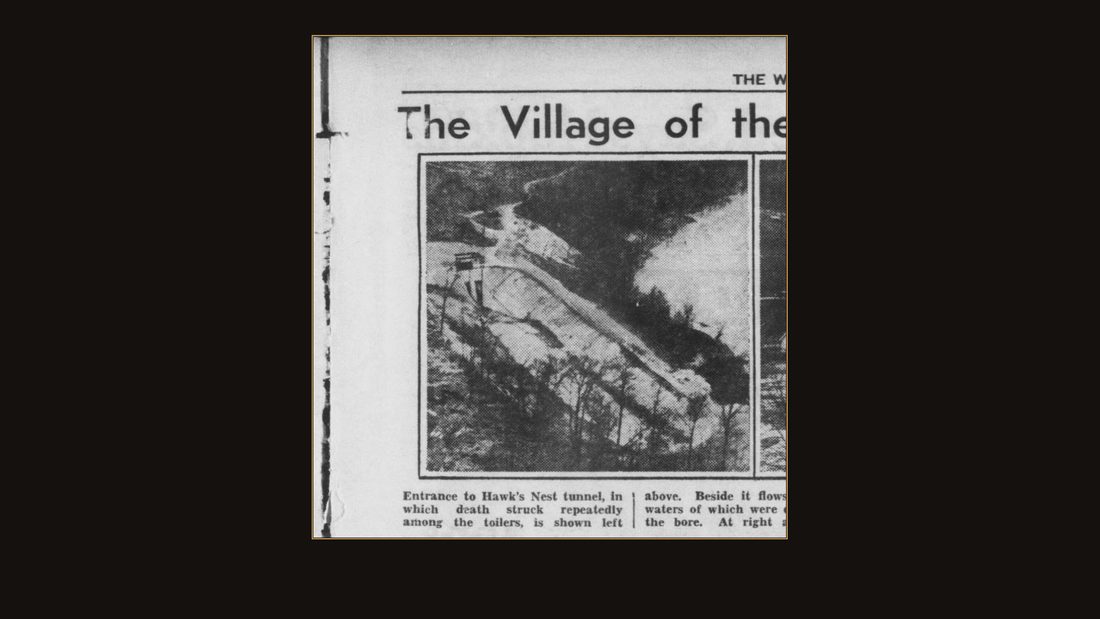
Hawks Nest Mountain, West Virginia. Work began on the 13th of June, 1930. Union Carbide & Carbon wanted cheap power, so its subsidiary the New-Kanawha Power Company hired Rinehart & Dennis of Charlottesville to bore a water tunnel through the mountain the New River loops around.
Transcript
Cold open
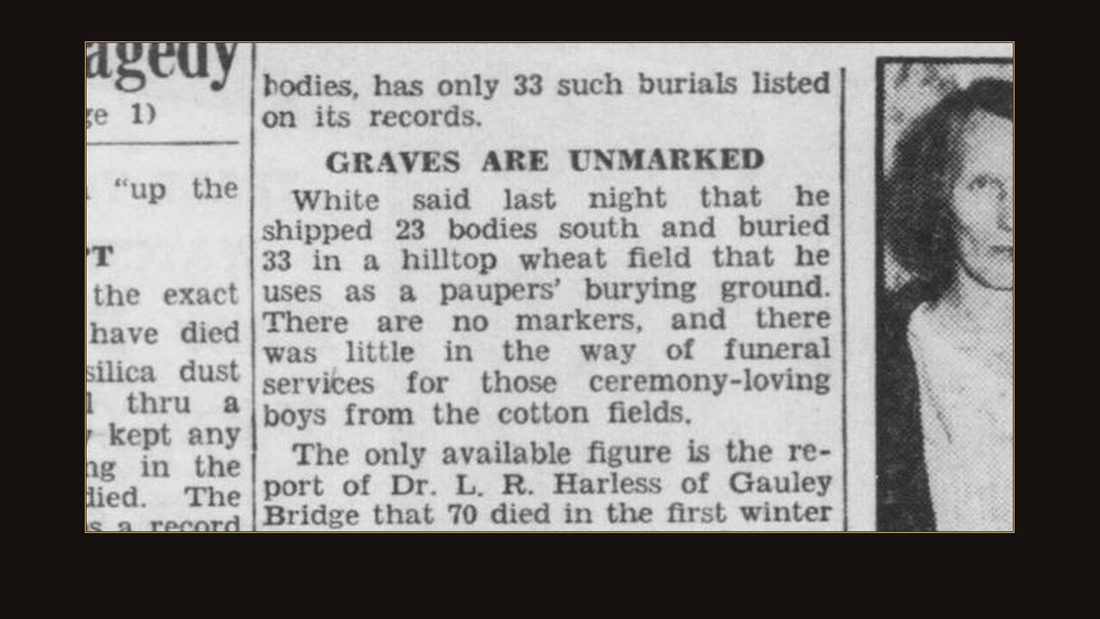
There is a hilltop field outside Summersville, West Virginia, that used to grow wheat. In nineteen thirty-one an undertaker began burying men in it. He was paid fifty dollars a head.
N9
The Washington Daily News, Jan. 15, 1936, p. 3. View the original.

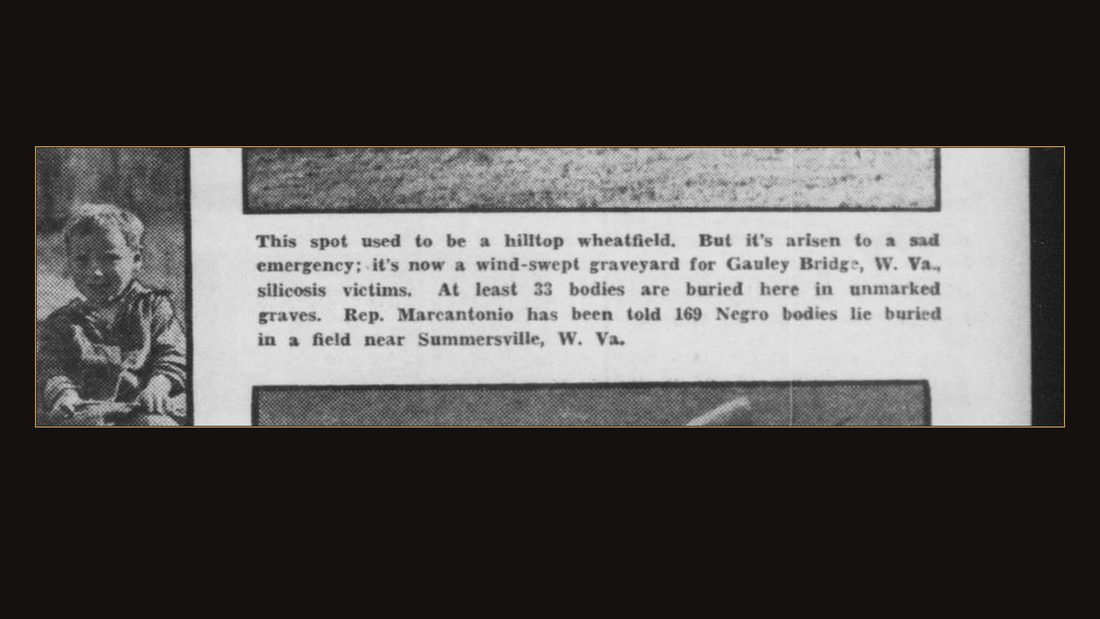
He put thirty-three of them in the ground there. There were no markers.
N2
The Washington Daily News, Jan. 15, 1936, p. 3. View the original.
A congressman was told that a hundred and sixty-nine bodies lay in a field near Summersville. The funeral home's own books listed thirty-three.
The promise
N3
The Washington Daily News, Jan. 15, 1936, p. 3. View the original.
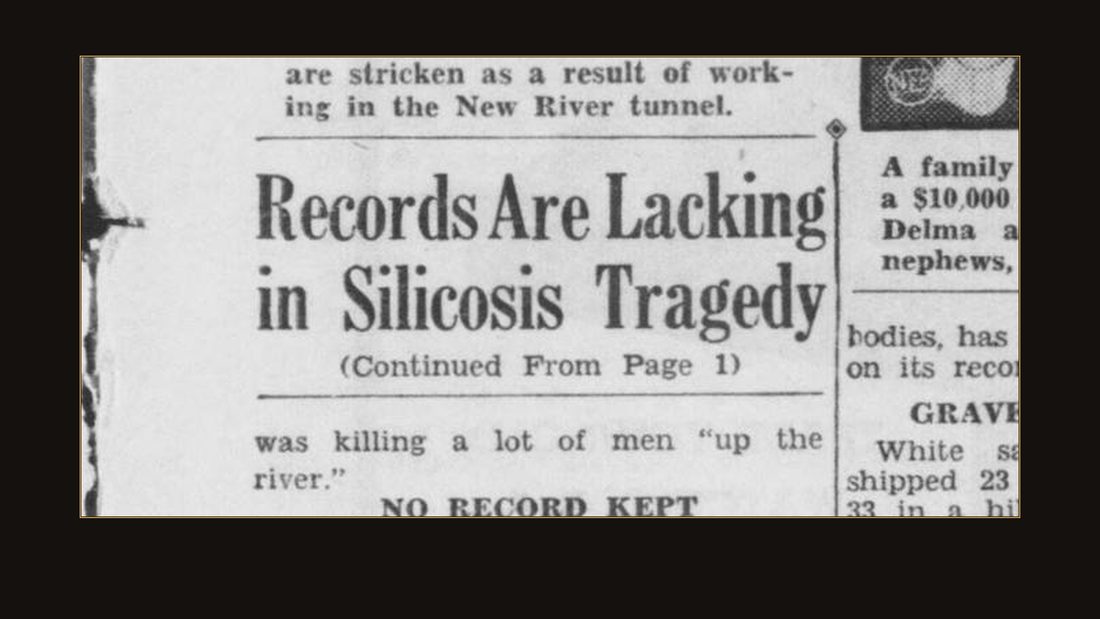
Neither number can be checked. That is not a gap in the reporting. It is the entire story of the Hawks Nest tunnel, and the reason is that nobody was ever required to count.
The horseshoe
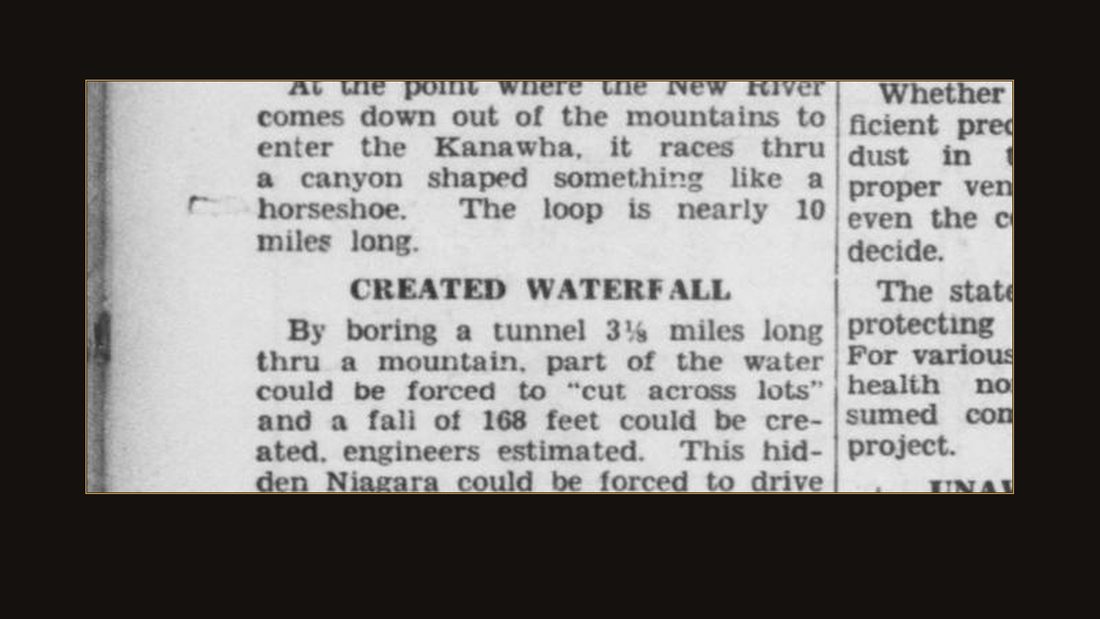
Where the New River comes down out of the mountains to meet the Kanawha, it swings through a canyon shaped like a horseshoe. The loop is nearly ten miles long.
N19
The Washington Daily News, Jan. 16, 1936, p. 38. View the original.

Engineers looked at that loop and saw waste. Bore a tunnel through the mountain the river goes around, and the water takes the short way, falling a hundred and sixty-eight feet as it goes.
Enough to drive dynamos and produce a hundred and twenty thousand horsepower of electricity.
N17
The Washington Daily News, Jan. 16, 1936, p. 38. View the original.
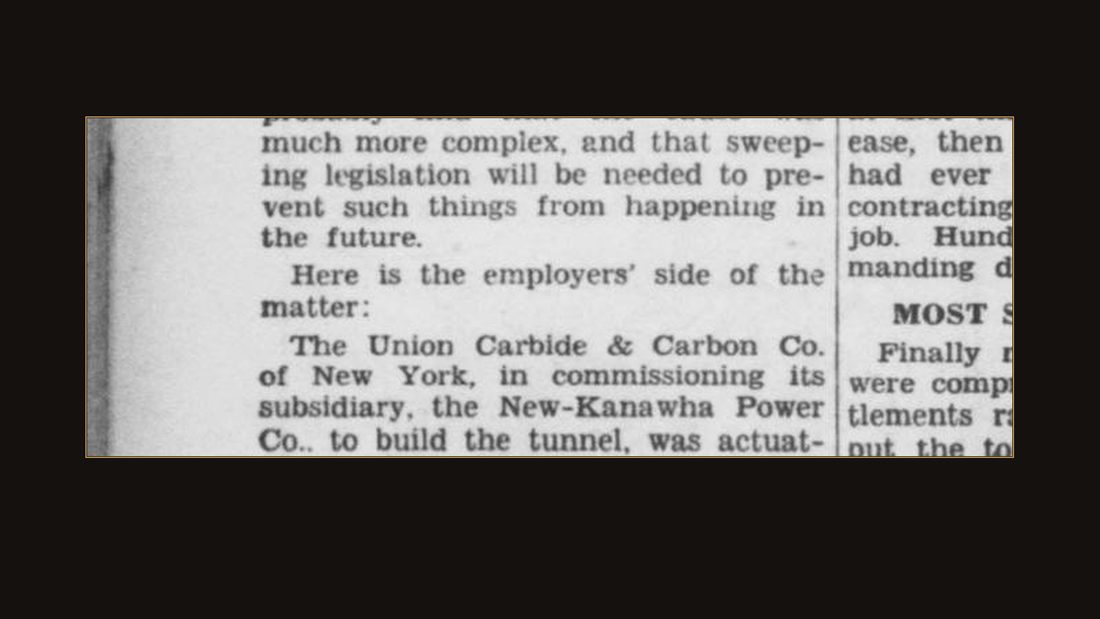
The Union Carbide and Carbon Company of New York wanted that power for its own plants in the Kanawha Valley. It commissioned a subsidiary, the New Kanawha Power Company, to build the tunnel.
N20
The Washington Daily News, Jan. 16, 1936, p. 38. View the original.
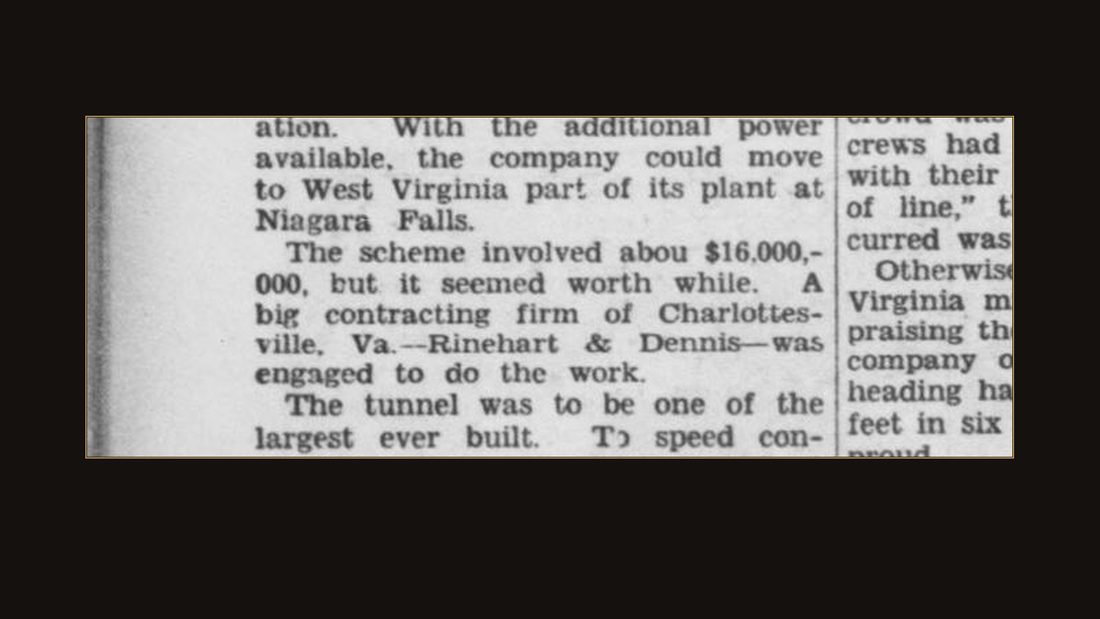
The contract went to Rinehart and Dennis, a firm out of Charlottesville, Virginia. The scheme involved about sixteen million dollars.
Work began on the thirteenth
N21
The Washington Daily News, Jan. 16, 1936, p. 38. View the original.
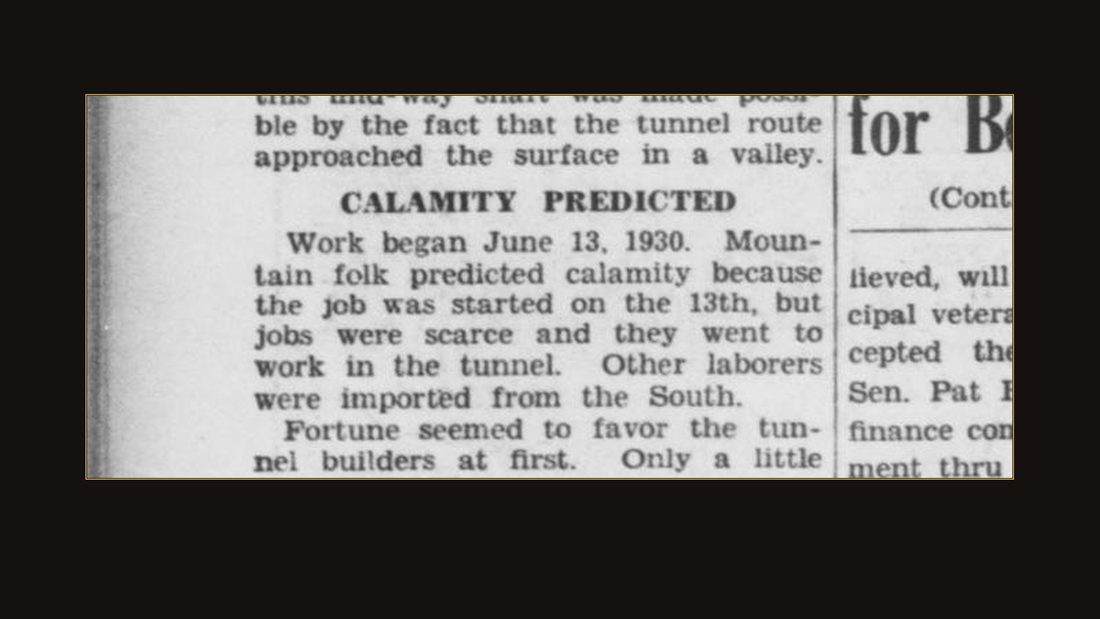
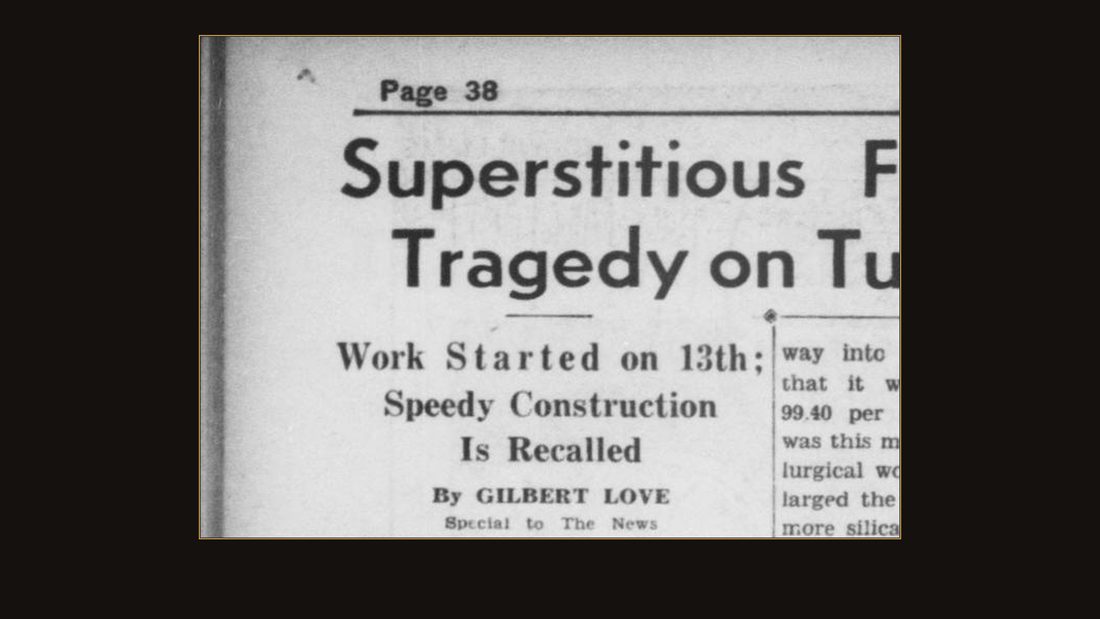
Work began on the thirteenth of June, nineteen thirty. Mountain folk said it was bad luck to start a job on the thirteenth. It was nineteen thirty. Jobs were scarce.
N6
The Washington Daily News, Jan. 15, 1936, p. 3. View the original.
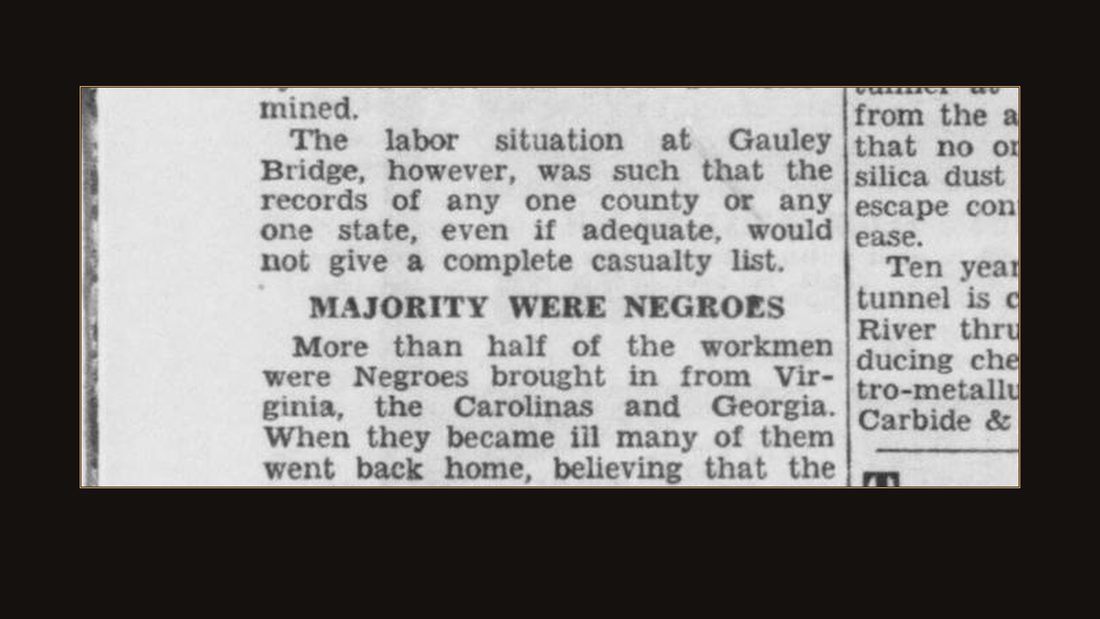
More laborers were brought up from the South. More than half the workmen were Black men recruited out of Virginia, the Carolinas and Georgia.
They came for steady work at steady wages, in a job supposed to carry fewer hazards than mining.
What the mountain was made of
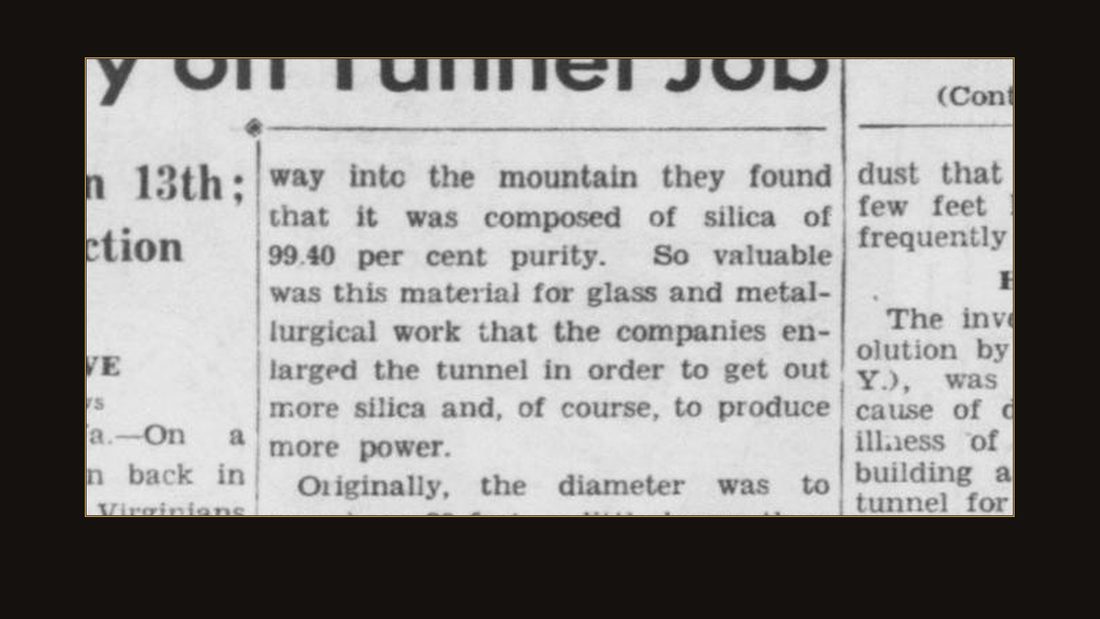
Then the crews got into the mountain and found what it was made of.
N22
The Washington Daily News, Jan. 16, 1936, p. 38. View the original.
Silica. Tested at ninety-nine point four per cent purity. Almost pure glass sand, locked up in stone.
Silica of that grade is worth money. It is raw material for glass and for metallurgical work.
N23
The Washington Daily News, Jan. 16, 1936, p. 38. View the original.
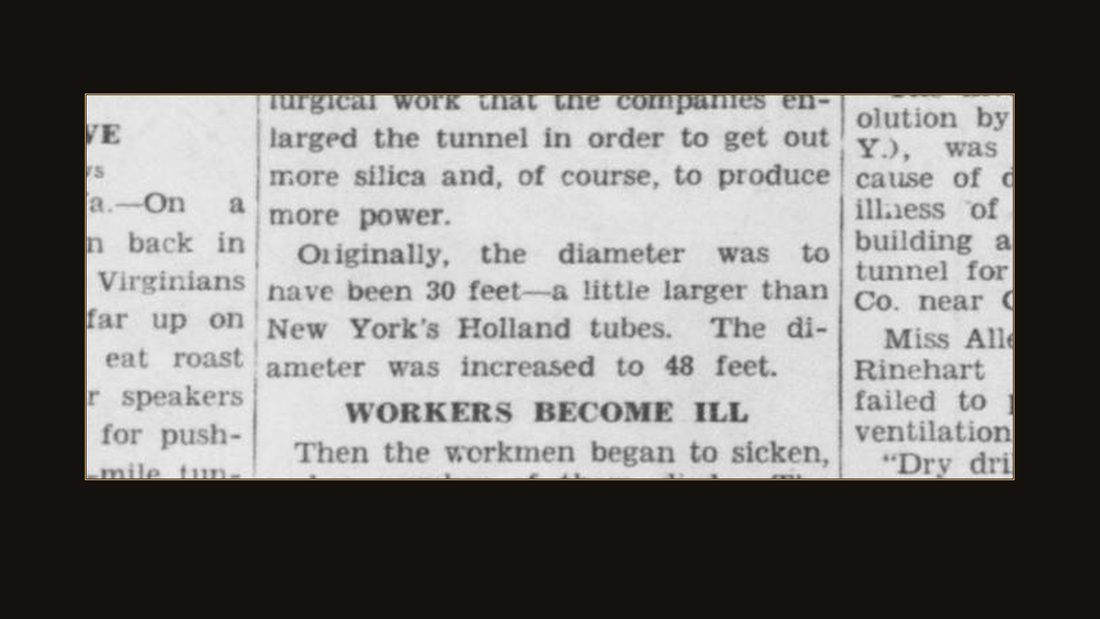
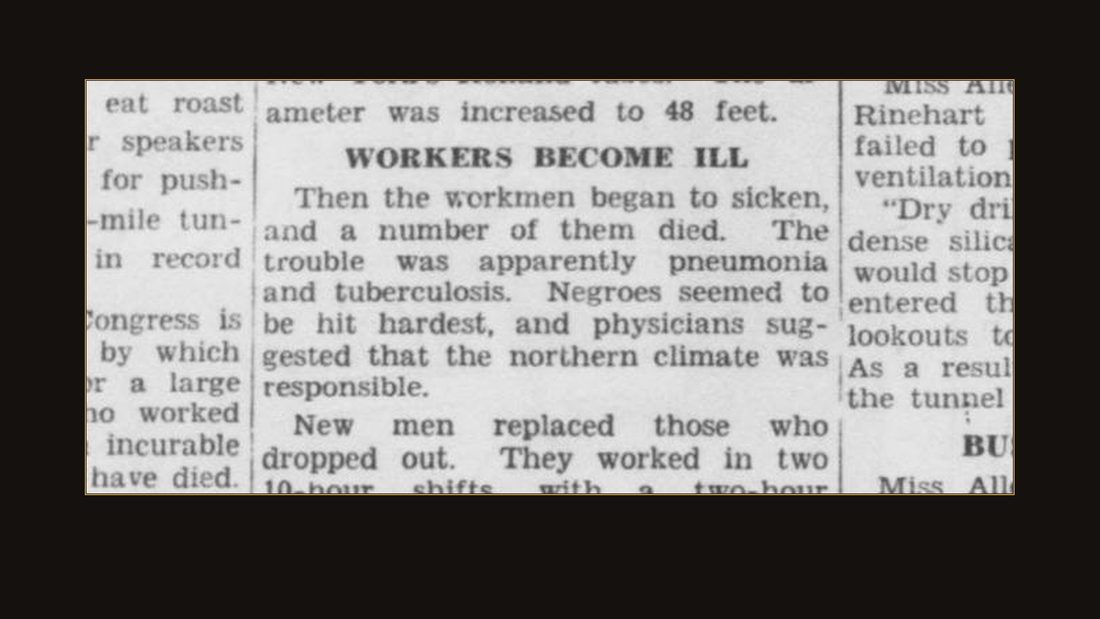
The tunnel had been designed at thirty feet across, a little larger than the Holland tubes under the Hudson. The companies increased the diameter to forty-eight feet.
N16
The Washington Daily News, Jan. 16, 1936, p. 38. View the original.
The Washington Daily News printed the reason without comment. So valuable was this material, it wrote, that the companies enlarged the tunnel in order to get out more silica.
They widened the hole to sell the rock. The men were not digging through the product. They were digging it out.
The dust
Silica does nothing to you in a lump. Ground fine enough to hang in the air and breathed, it scars the lungs until they stiffen. The disease is silicosis, and by nineteen thirty it had been described for well over a century.
N33
The Washington Daily News, Jan. 16, 1936, p. 38. View the original.
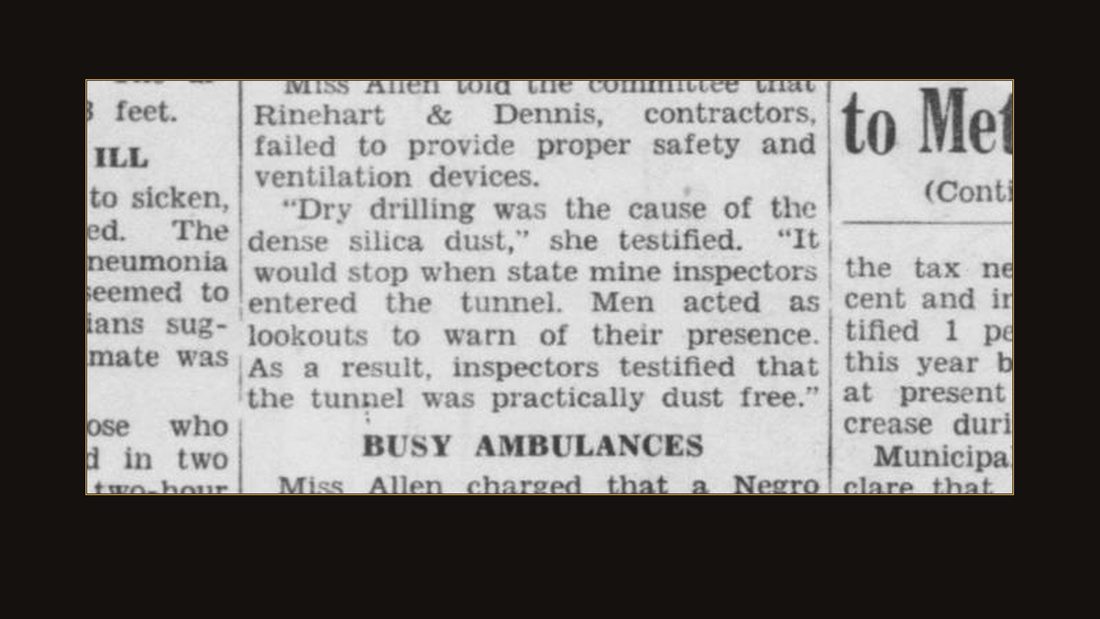
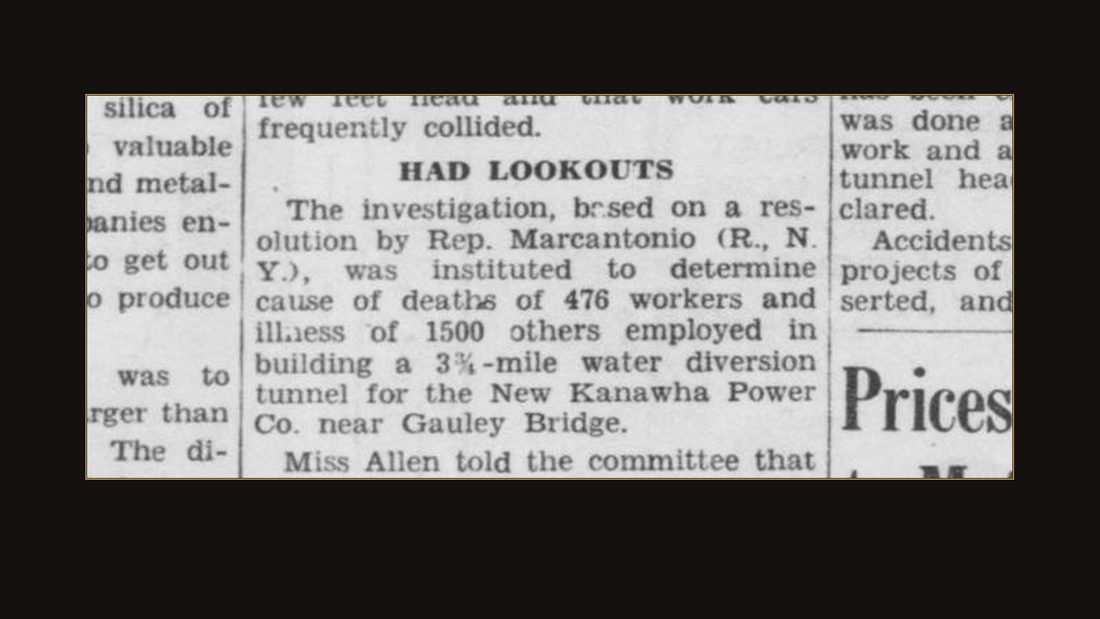
The known control is water. Drill wet, and the dust never leaves the rock. Philippa Allen, a social worker from New York, testified to Congress that the drilling at Hawks Nest was dry.
N32
The Washington Daily News, Jan. 16, 1936, p. 38. View the original.
It would stop, she said, when state mine inspectors entered the tunnel. Men were posted as lookouts to warn of their coming.
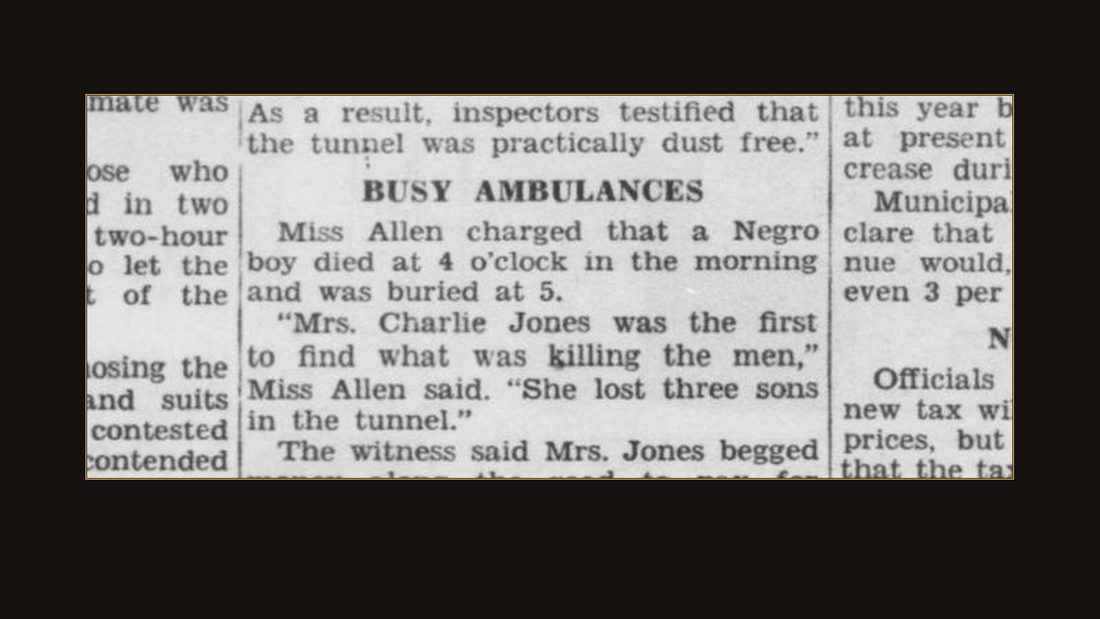
As a result, the inspectors testified that the tunnel was practically dust free.
N25
The Washington Daily News, Jan. 16, 1936, p. 38. View the original.
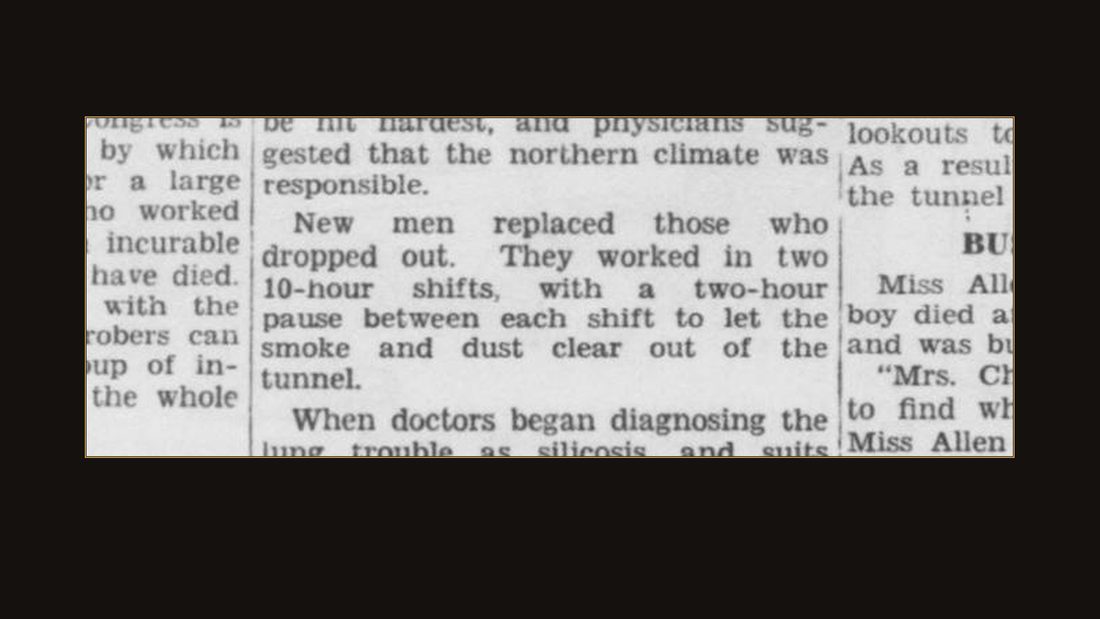
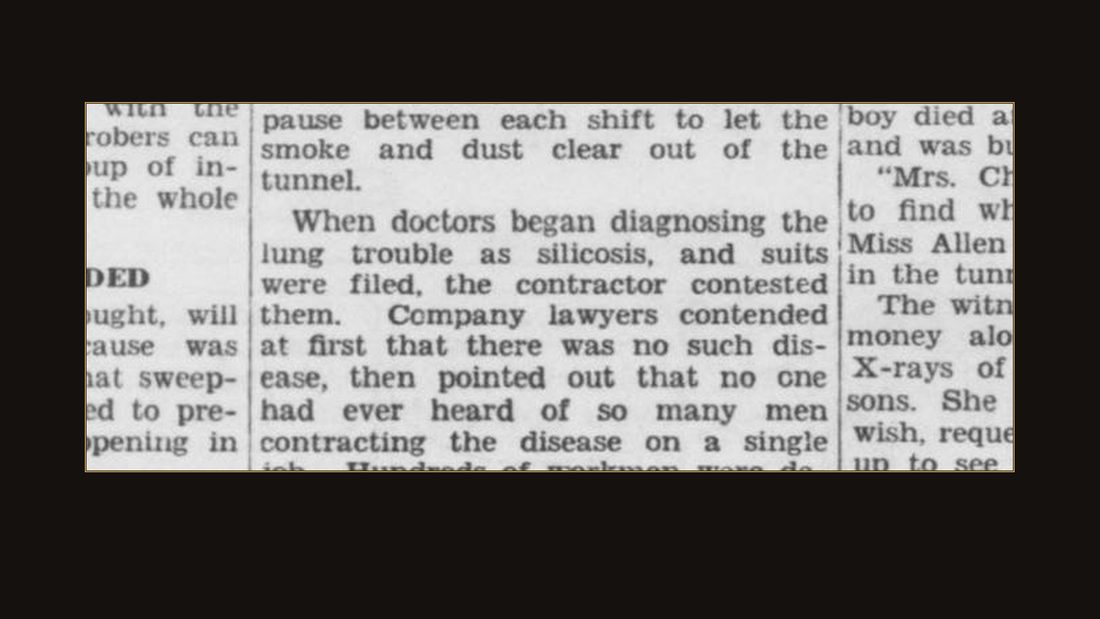
The shifts ran ten hours, two a day, with a two-hour pause between them to let the smoke and dust clear out.
Pneumonia
N24
The Washington Daily News, Jan. 16, 1936, p. 38. View the original.
Then the workmen began to sicken, and a number of them died. The trouble was apparently pneumonia and tuberculosis.
The Black workers seemed to be hit hardest. Physicians suggested that the northern climate was responsible.
New men replaced the ones who dropped out. The work went on.
The roast ox
N29
The Washington Daily News, Jan. 16, 1936, p. 38. View the original.
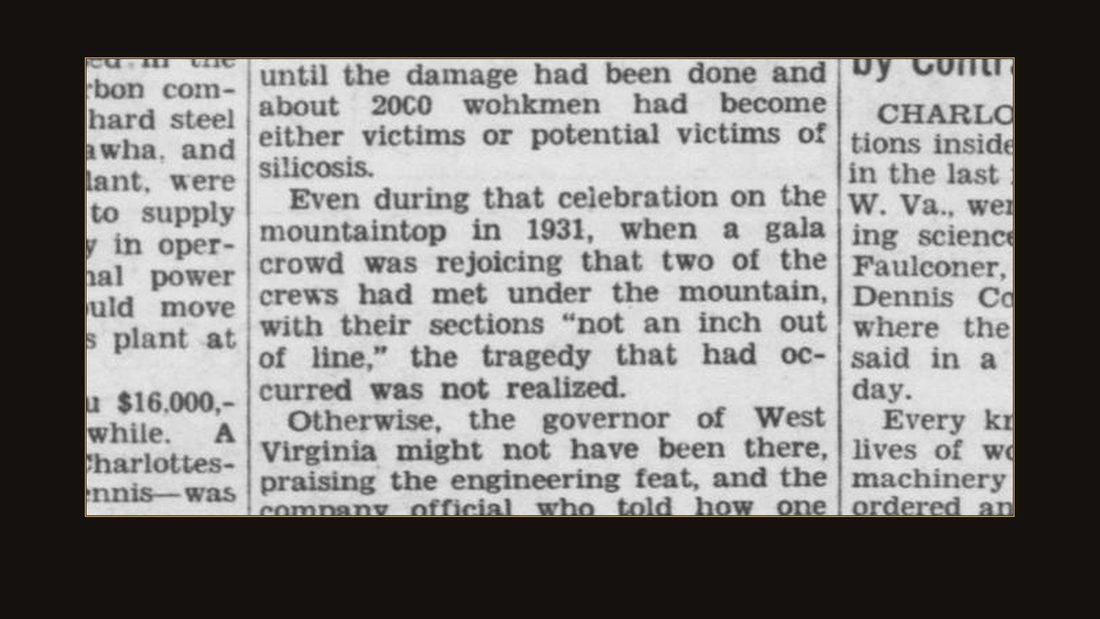
In the summer of nineteen thirty-one, a thousand West Virginians climbed Hawks Nest Mountain for a celebration. There was a roast ox. There was dancing.
N30
The Washington Daily News, Jan. 16, 1936, p. 38. View the original.
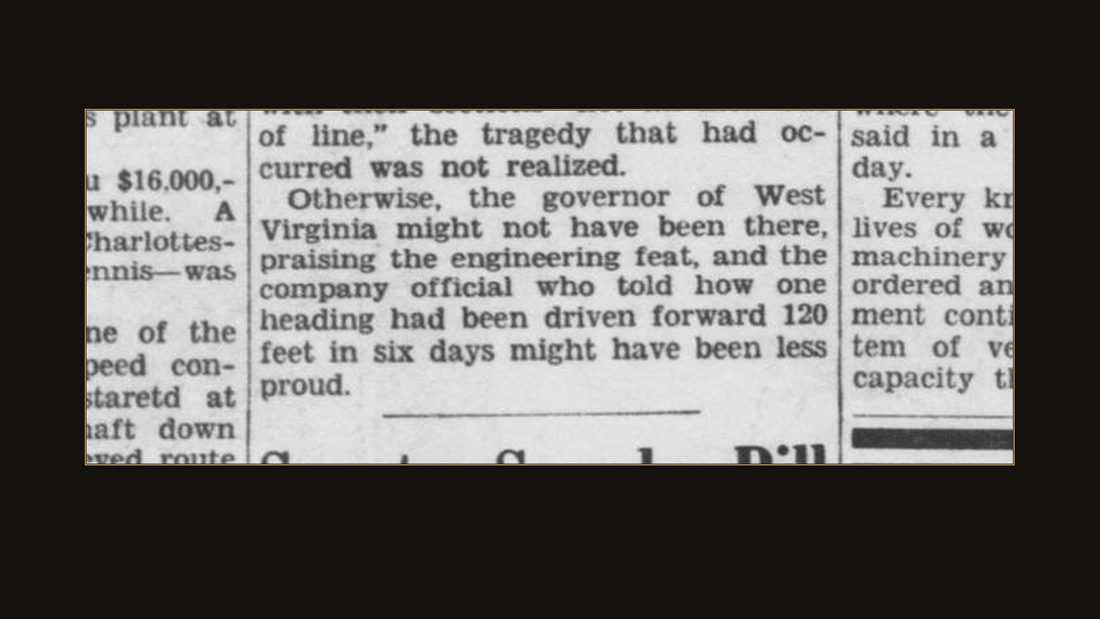
Two crews had met inside the mountain and their headings were not an inch out of line. The governor came to praise the engineering. A company official said one heading had been driven a hundred and twenty feet in six days.
N28
The Washington Daily News, Jan. 16, 1936, p. 38. View the original.
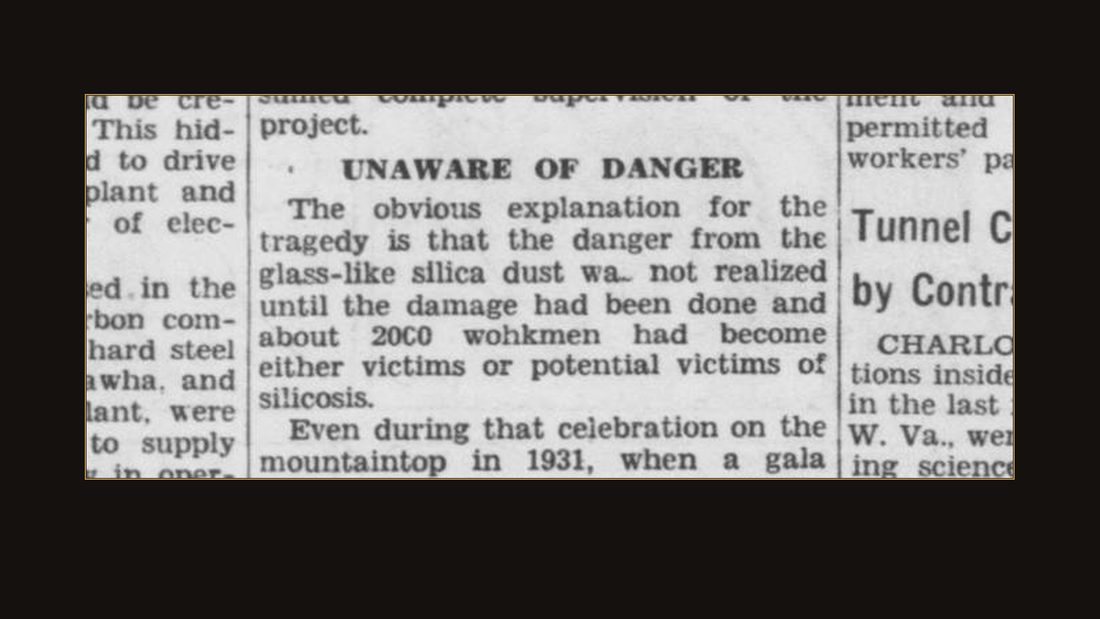
By then, on the newspaper's own estimate, about two thousand workmen had already become victims or potential victims of silicosis. Nobody on that mountaintop knew it.
That is the most generous reading of Hawks Nest, and it is the one the reporter offered. It does not survive what came next.
Emma Jones
N34
The Washington Daily News, Jan. 16, 1936, p. 38. View the original.
A woman named Emma Jones lived at Gauley Bridge. She was the first to work out what was killing the men.
N13
The Washington Daily News, Jan. 15, 1936, p. 3. View the original.
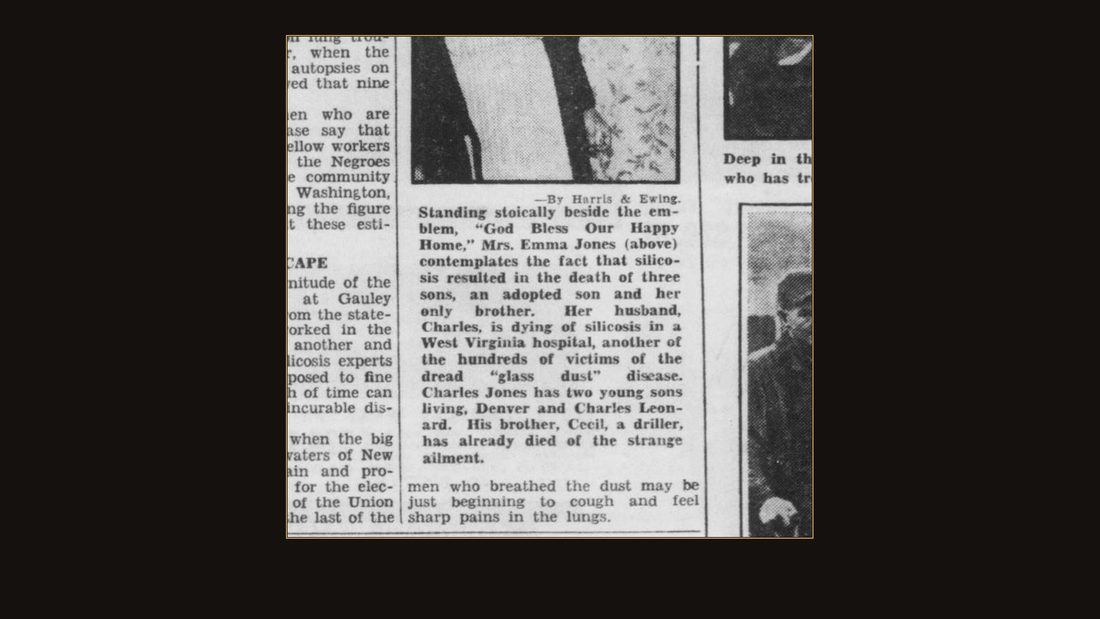
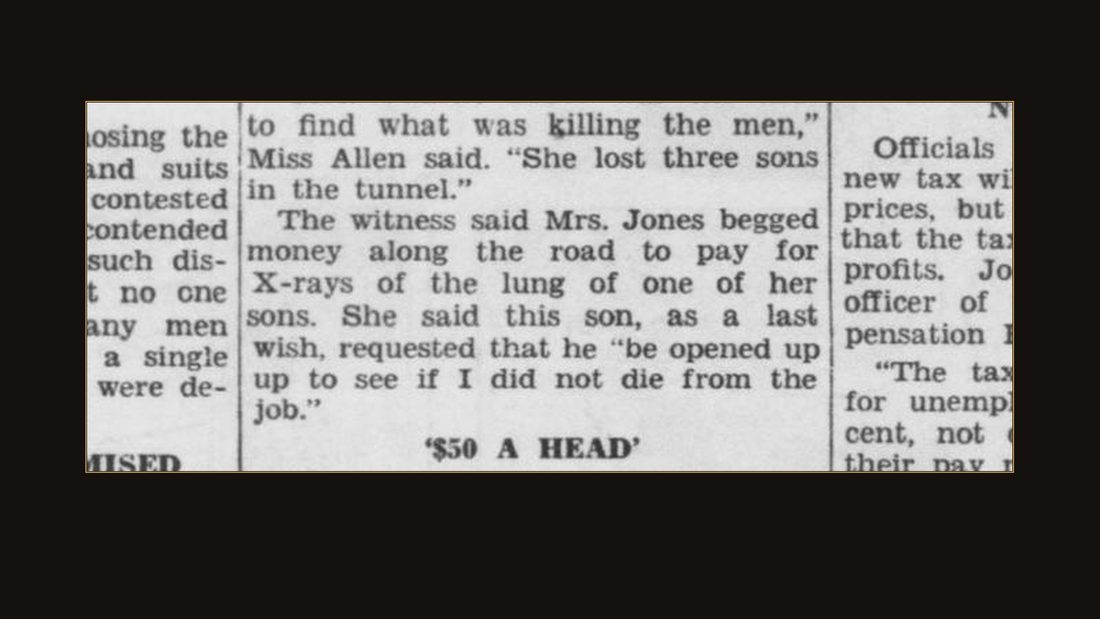
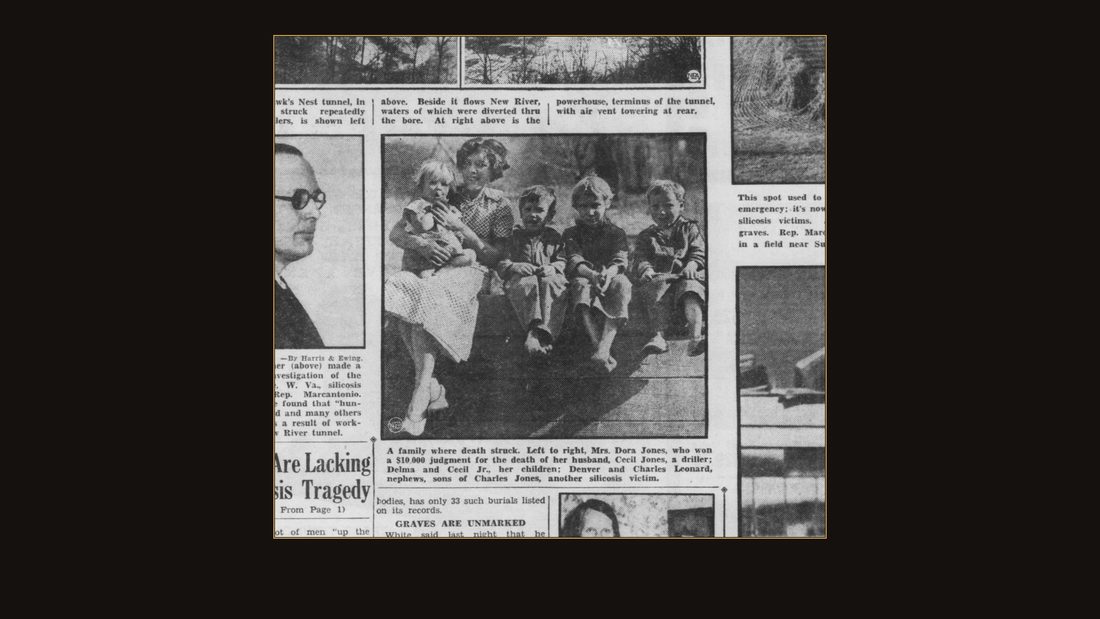
Three of her sons had worked in the tunnel and died of it. So had an adopted son, and her only brother. Her husband Charles was dying of it in a West Virginia hospital.
N35
The Washington Daily News, Jan. 16, 1936, p. 38. View the original.
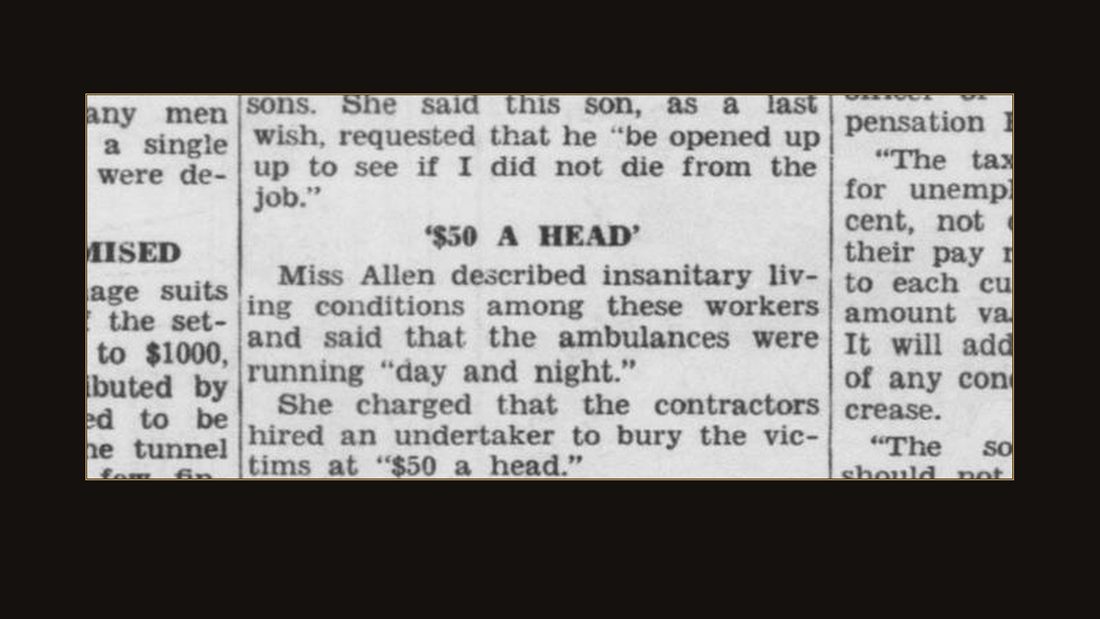
She begged money along the road to pay for an X-ray of one son's lungs. That son left a last request. He asked that he be opened up, to see if he did not die from the job.
N14
The Washington Daily News, Jan. 15, 1936, p. 3. View the original.
Her daughter-in-law Dora Jones won a ten thousand dollar judgment for the death of her husband Cecil, a driller.
Vanetta
N50
The Washington Daily News, Jan. 18, 1936, p. 2. View the original.

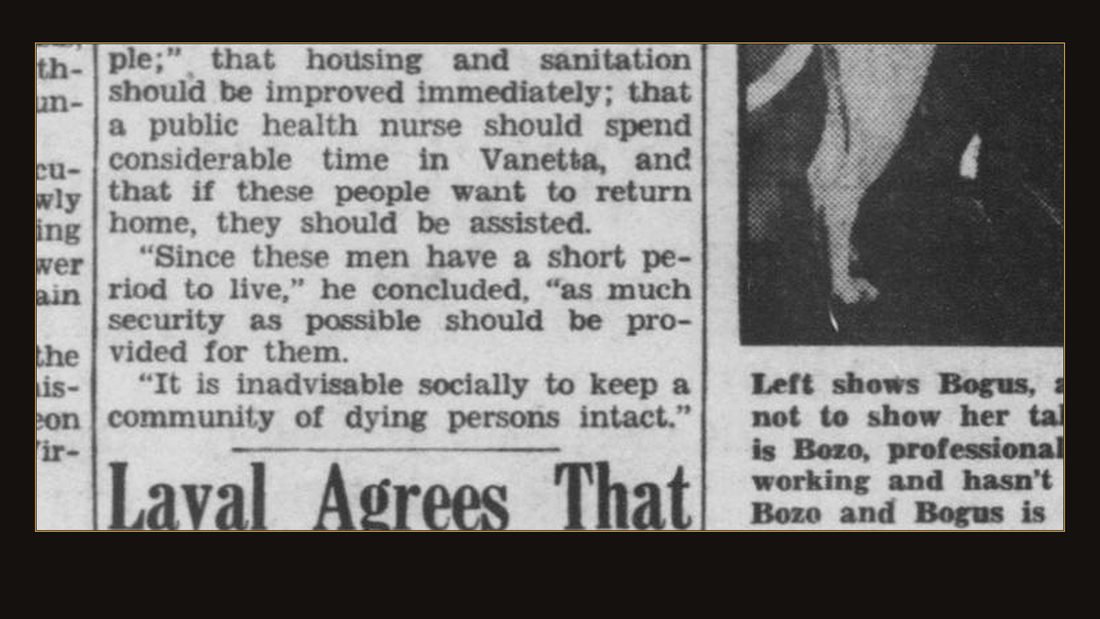
At a settlement called Vanetta, federal relief investigators found families in tumbledown shacks where nearly every adult man had silicosis. The report stayed in confidential government files until the hearings began.
Relief had always been spasmodic and irregular, it said. Every family complained of the lack of food. Milk had been unheard of for at least two years.
Fifty dollars a head
N8
The Washington Daily News, Jan. 15, 1936, p. 3. View the original.
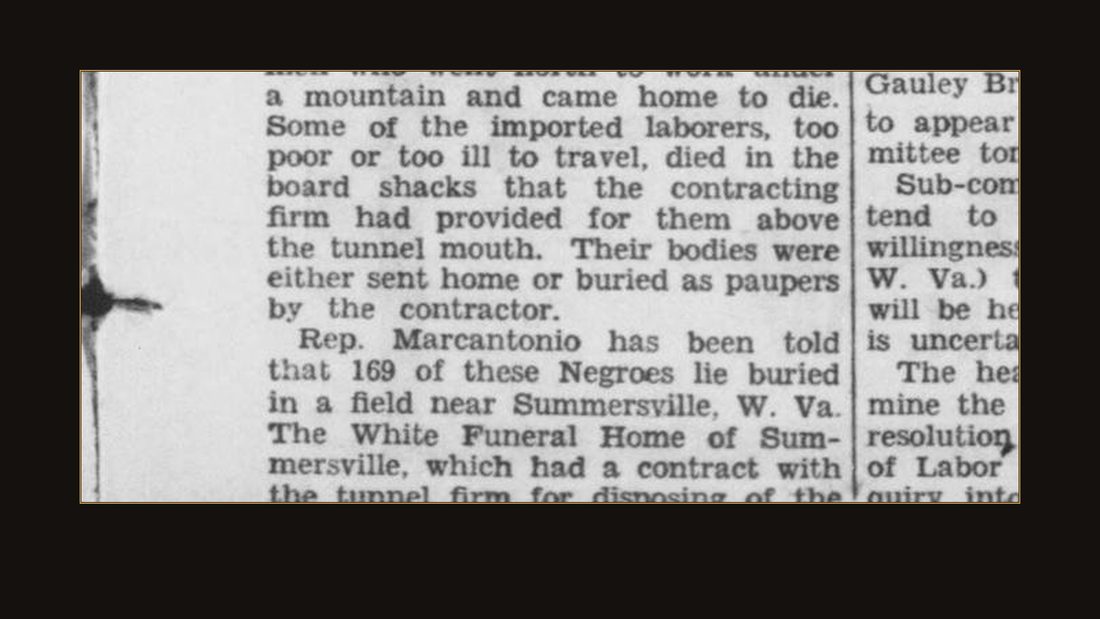
Some of the imported laborers were too poor or too ill to travel home. They died in the board shacks the contractor had put up above the tunnel mouth, and were sent home or buried as paupers by the contractor.
N36
The Washington Daily News, Jan. 16, 1936, p. 38. View the original.
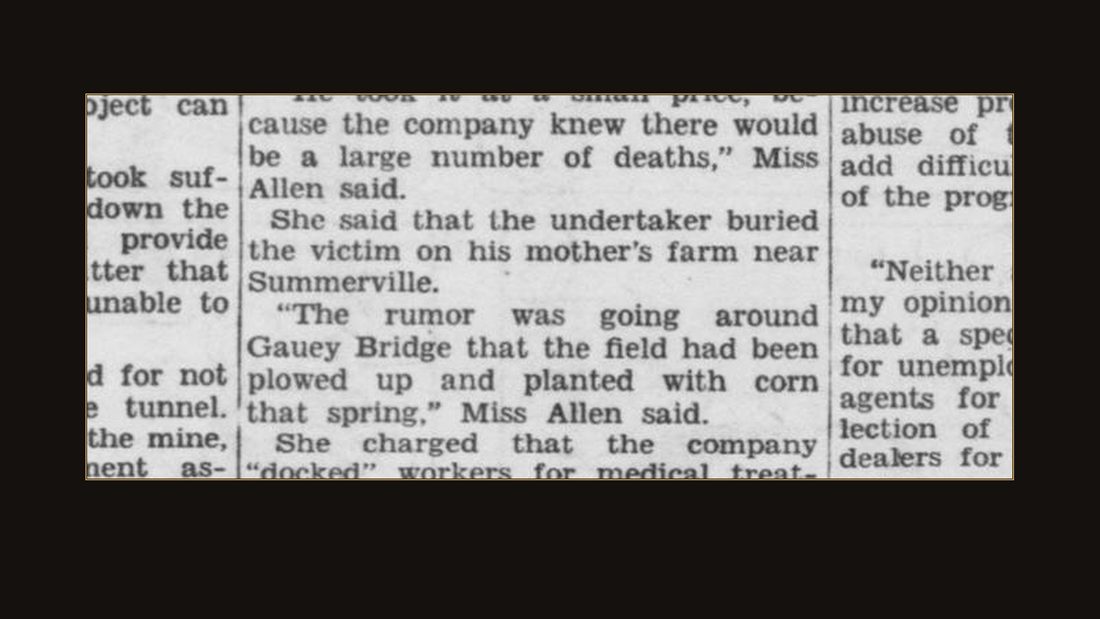
Allen told the committee the contractors hired an undertaker to bury the victims at fifty dollars a head. He took it at a small price, she said, because the company knew there would be a large number of deaths.
The undertaker was named White. He ran a funeral home in Summersville under contract to the tunnel firm.
N9
The Washington Daily News, Jan. 15, 1936, p. 3. View the original.
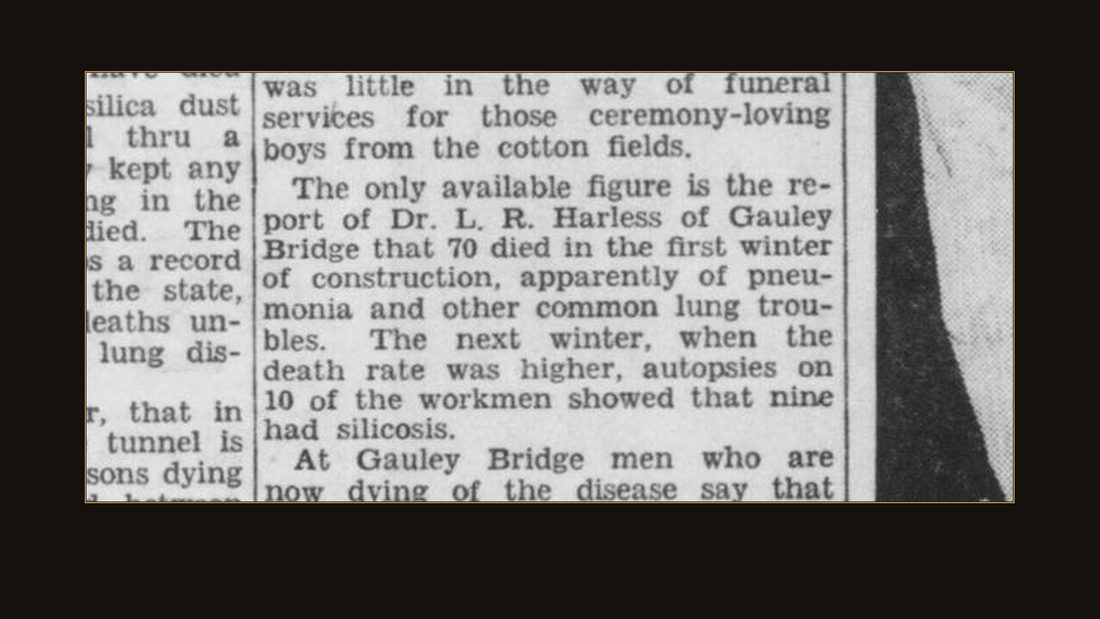
He said he shipped twenty-three bodies south, and buried thirty-three in a hilltop wheat field he used as a paupers' burying ground. There were no markers, and little in the way of funeral services.
N37
The Washington Daily News, Jan. 16, 1936, p. 38. View the original.
Allen testified to one more thing said around Gauley Bridge. That the field had been plowed up, and planted in corn, that spring.
The parade of the doomed
N26
The Washington Daily News, Jan. 16, 1936, p. 38. View the original.
Hundreds of workmen sued. The cases went to circuit court in Fayette County.
Company lawyers contended at first that there was no such disease. Then that nobody had ever heard of so many men contracting it on a single job.
N48
The Washington Daily News, Jan. 14, 1936, p. 3. View the original.

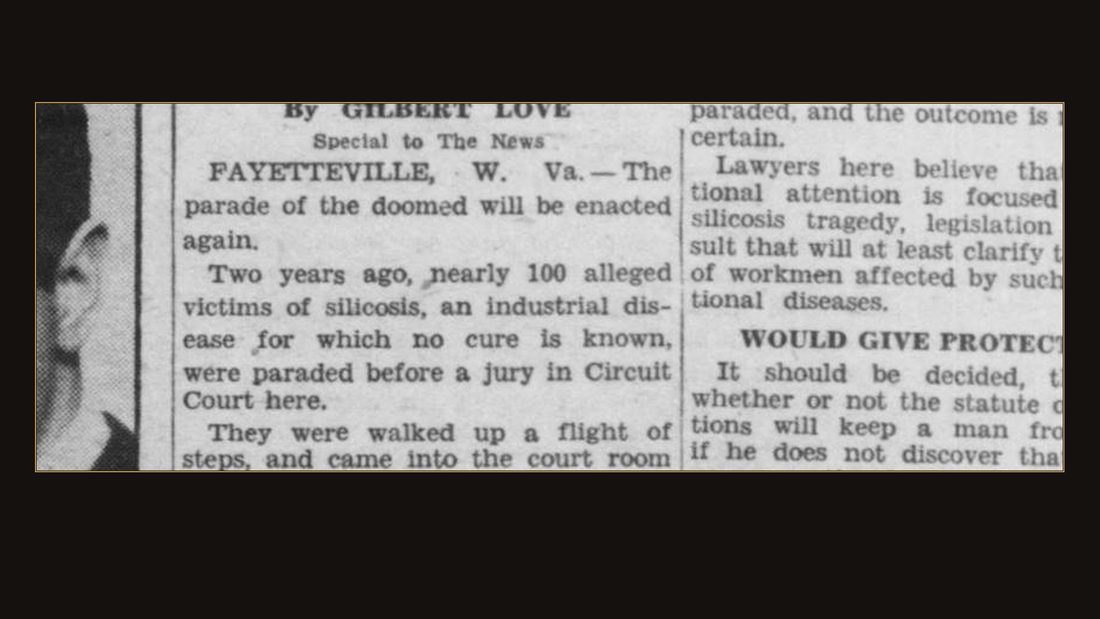
To show a jury what silicosis does, the plaintiffs walked their own witnesses up a flight of courthouse steps. The men came into the courtroom gasping. Some were stripped to the waist, to show bodies little more than skeletons covered with tightly drawn skin.
The local paper called it the parade of the doomed.
N27
The Washington Daily News, Jan. 16, 1936, p. 38. View the original.
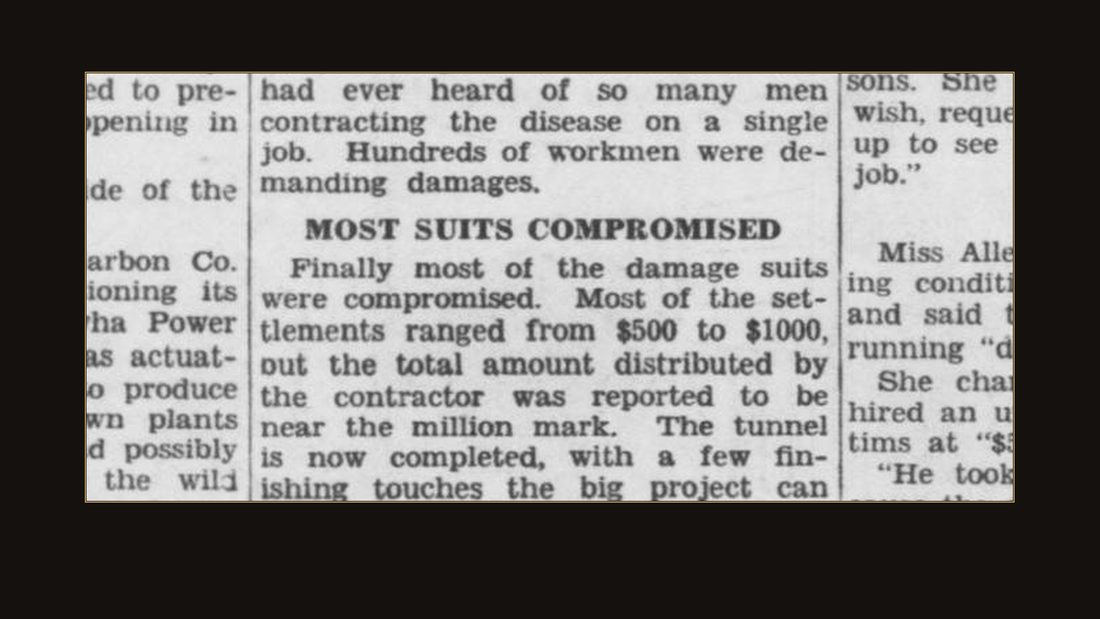
Most of the suits were compromised. Most settlements ran between five hundred and a thousand dollars, and the total the contractor paid out was reported near the million mark. The tunnel had cost sixteen million to build.
Washington
N47
The Evening Star, Washington, Jan. 16, 1936, p. B-1. View the original.

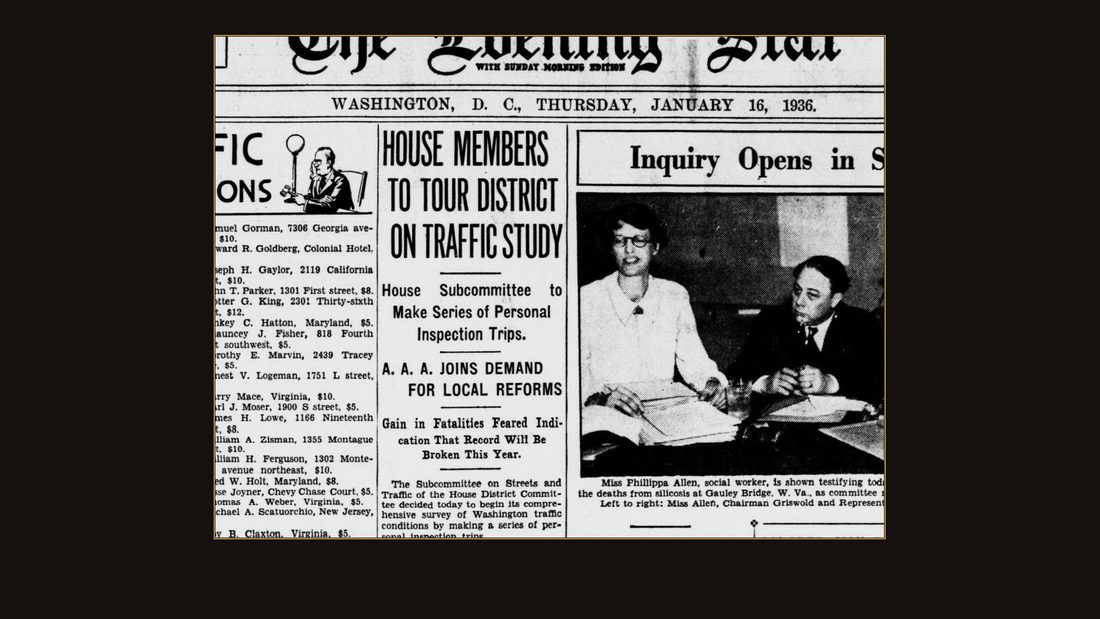
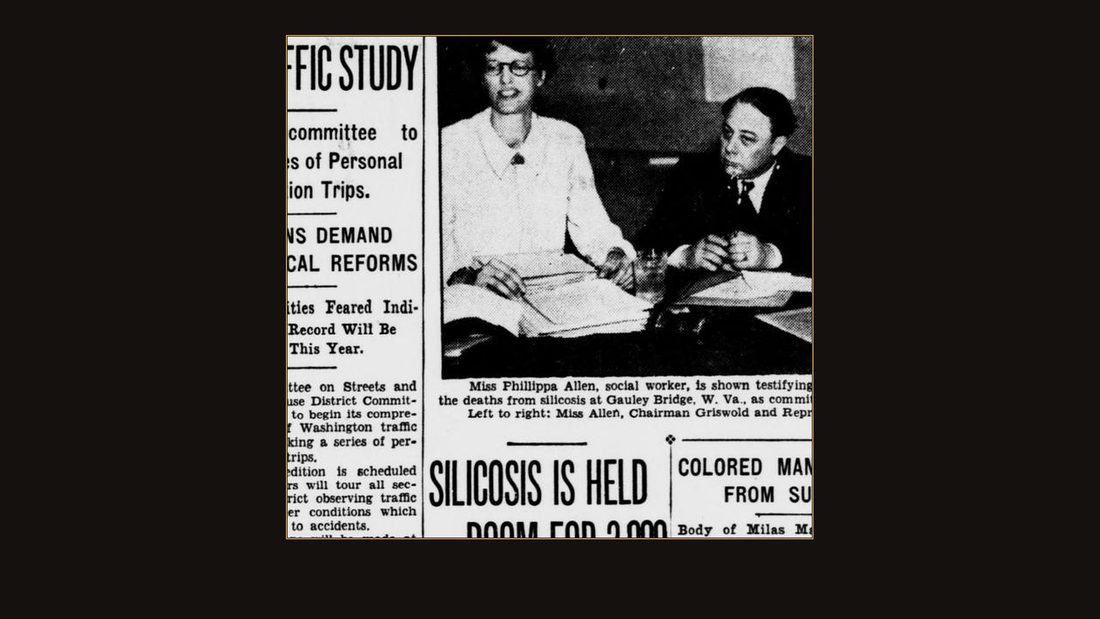
In January of nineteen thirty-six a subcommittee of the House Labor Committee opened hearings in Washington. Glenn Griswold of Indiana chaired it. Vito Marcantonio of New York had written the resolution that created it.
N39
The Evening Star, Washington, Jan. 16, 1936, p. B-1. View the original.
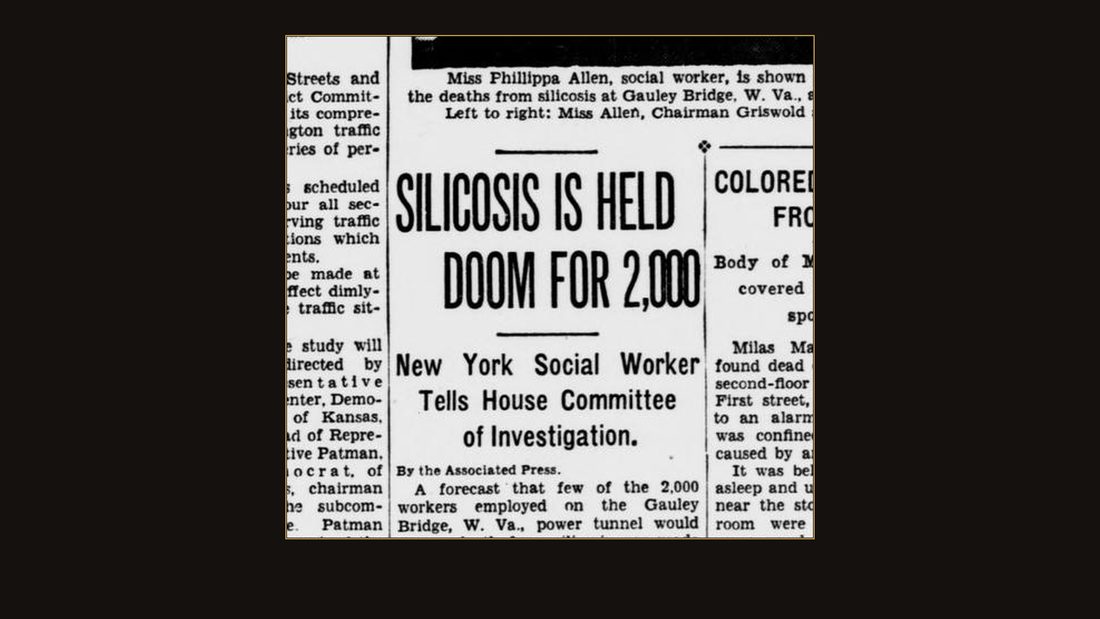
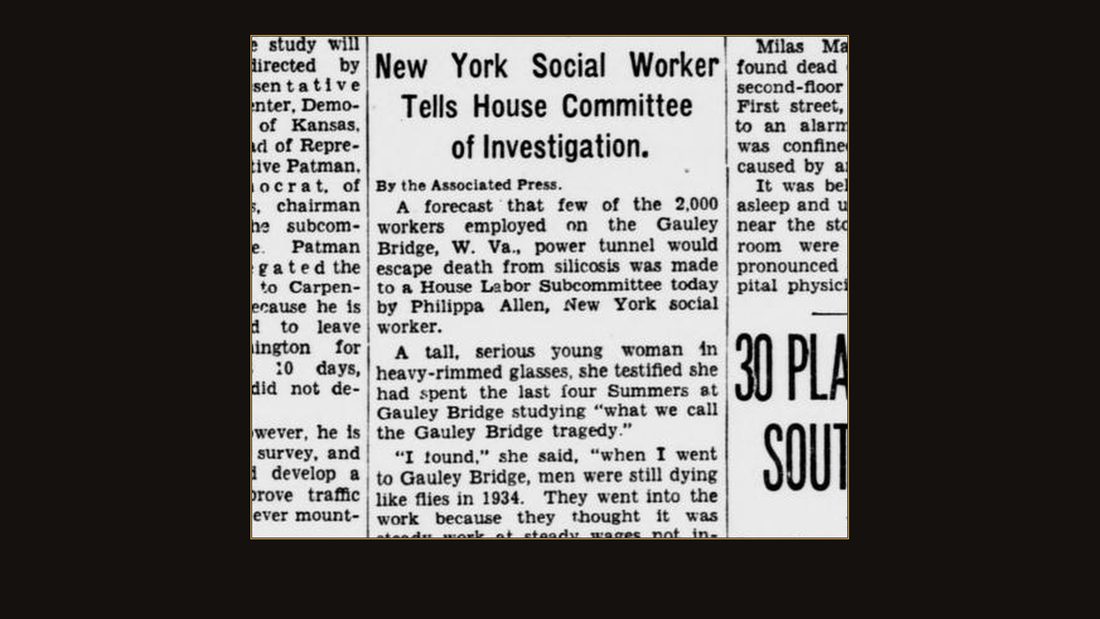
Philippa Allen was the first witness. She had spent four summers at Gauley Bridge.
N40
The Evening Star, Washington, Jan. 16, 1936, p. B-1. View the original.
When I went to Gauley Bridge, she said, men were still dying like flies in nineteen thirty-four.
N41
The Evening Star, Washington, Jan. 16, 1936, p. B-1. View the original.
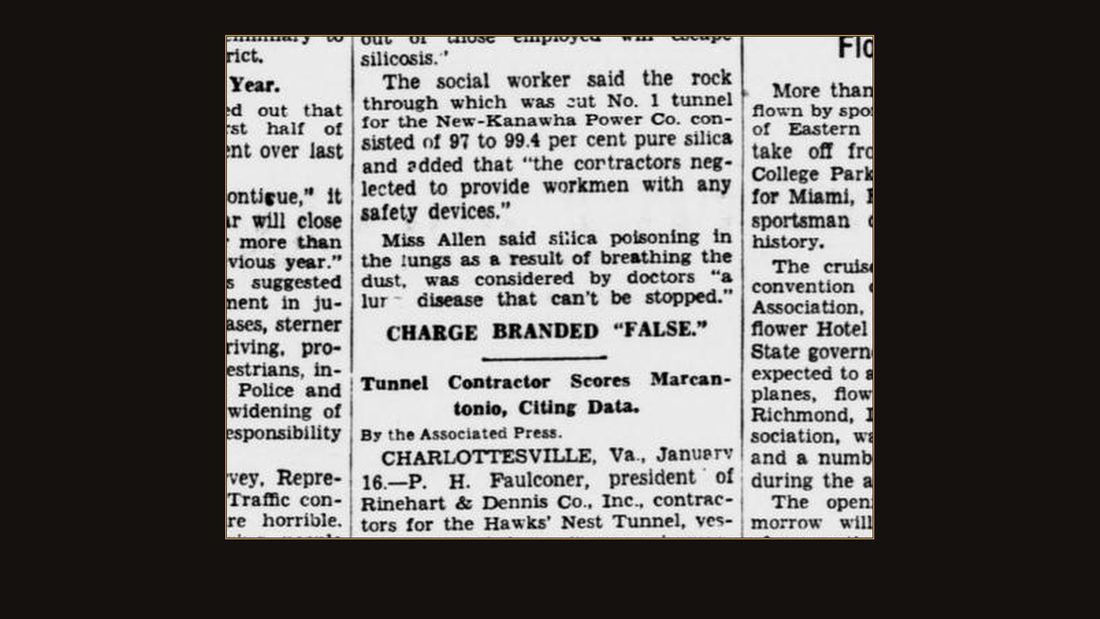
She testified the rock ran ninety-seven to ninety-nine point four per cent pure silica, and that the contractors neglected to provide workmen with any safety devices. There seems little doubt, she said, that few of those employed will escape silicosis.
No money, no subpoena
N49
The Washington Daily News, Jan. 17, 1936, p. 8. View the original.

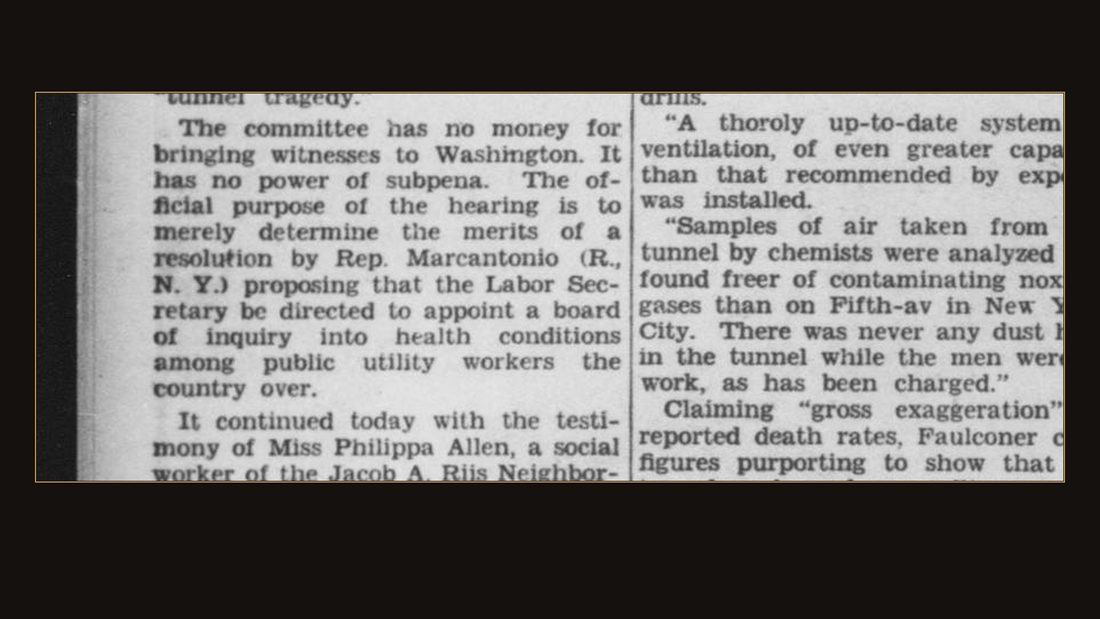
The committee had a problem. It had no money to bring witnesses to Washington, and no power to subpoena anyone. The dying men who testified came on private charity, paid for by a committee in New York.
Forty-eight in five thousand
N42
The Evening Star, Washington, Jan. 16, 1936, p. B-1. View the original.
The president of Rinehart and Dennis answered from Charlottesville, in a statement to the Associated Press. His name was P. H. Faulconer.
N31
The Washington Daily News, Jan. 16, 1936, p. 38. View the original.
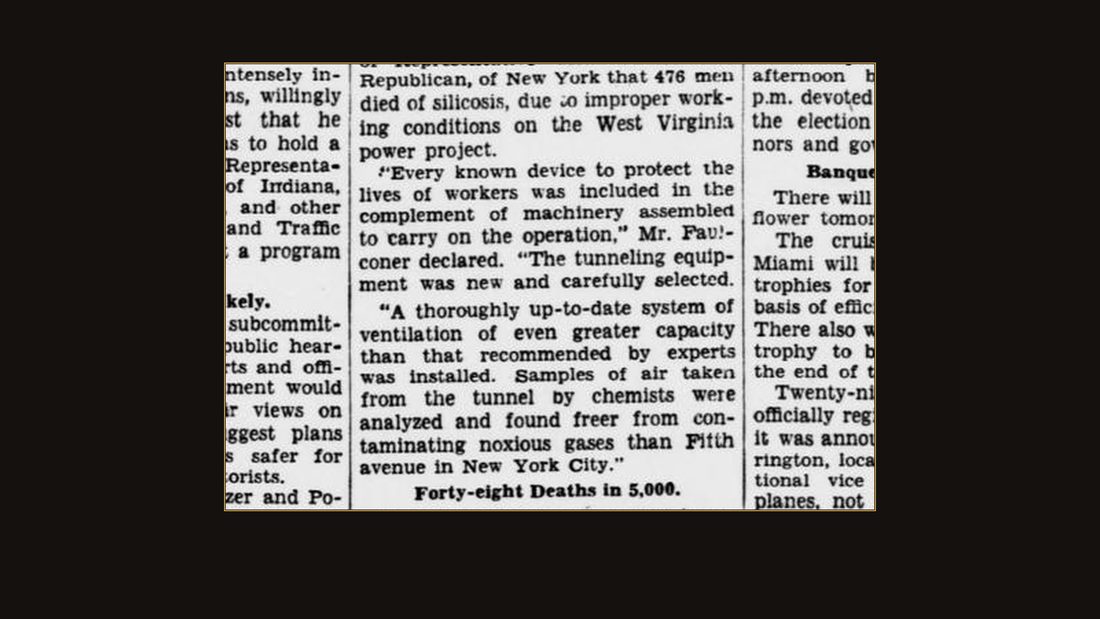
He branded as gross misrepresentation and falsehood the claim that four hundred and seventy-six men had died.
N43
The Evening Star, Washington, Jan. 16, 1936, p. B-1. View the original.
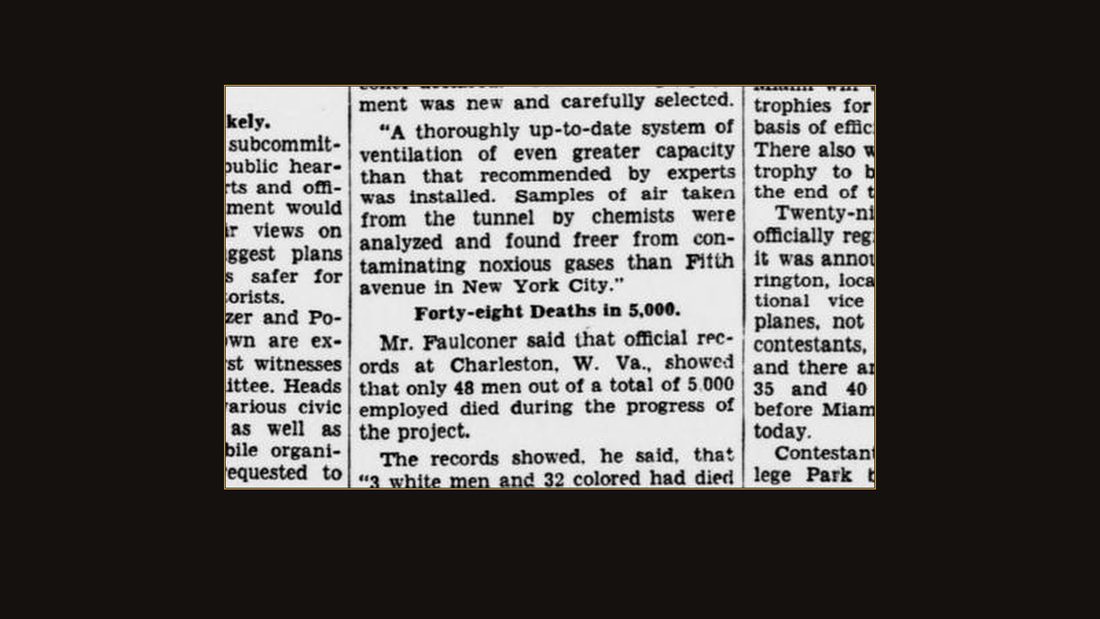
Every known device to protect the lives of workers, he said, was included in the machinery assembled to carry on the operation. Wet drilling, he said, was ordered and insisted upon.
N44
The Evening Star, Washington, Jan. 16, 1936, p. B-1. View the original.
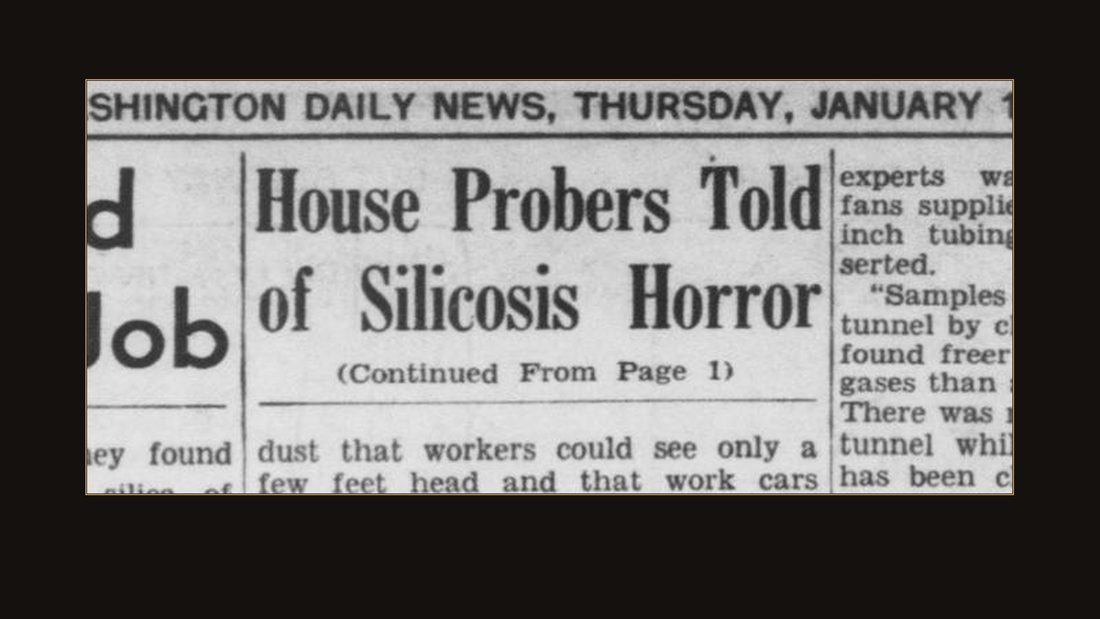
Samples of air taken from the tunnel by chemists, he said, were analyzed and found freer from contaminating noxious gases than Fifth Avenue in New York City.
N45
The Evening Star, Washington, Jan. 16, 1936, p. B-1. View the original.
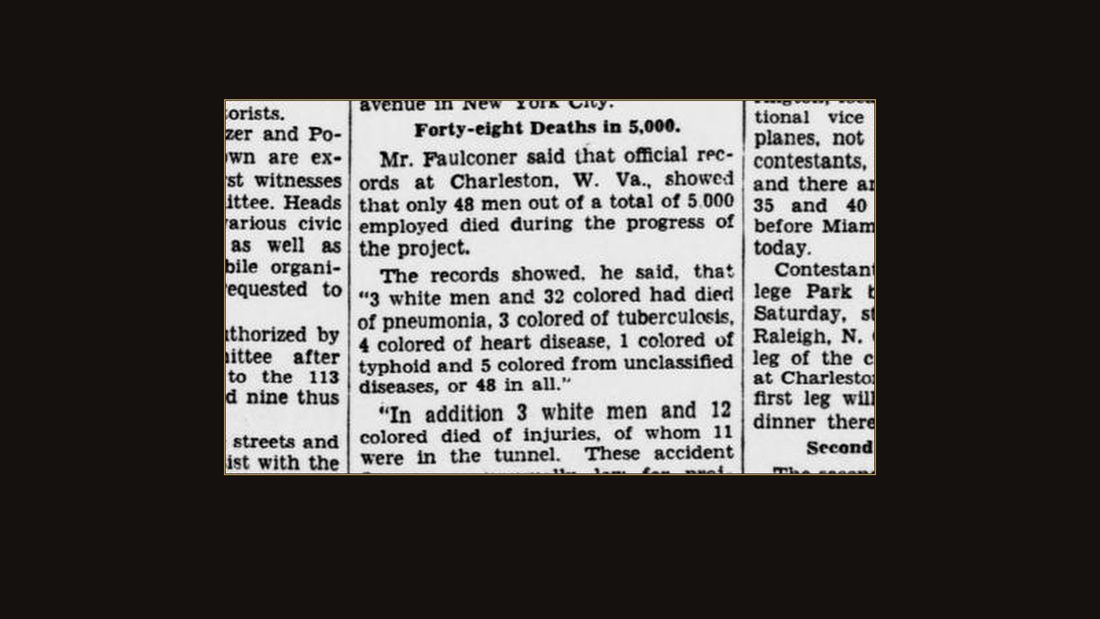
Then he gave his numbers. Official records at Charleston, he said, showed that only forty-eight men out of a total of five thousand employed died during the progress of the project.
N46
The Evening Star, Washington, Jan. 16, 1936, p. B-1. View the original.
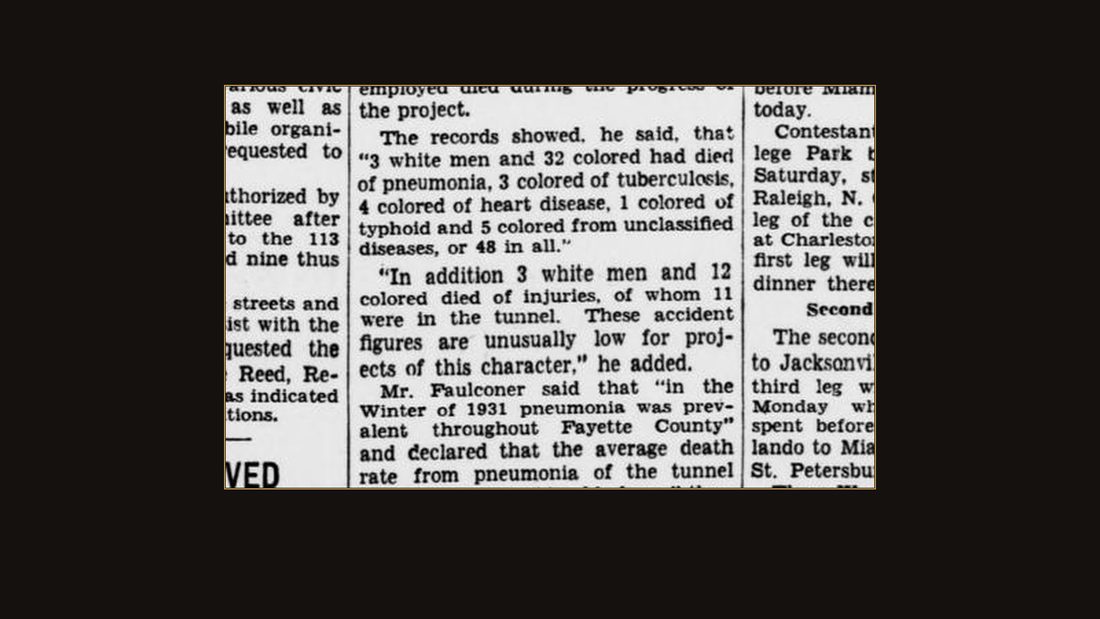
And he itemized them. Three white men and thirty-two colored had died of pneumonia. Three colored of tuberculosis. Four colored of heart disease. One colored of typhoid, and five colored of unclassified diseases.
That was his list of the men who died of disease. He added fifteen more killed by injuries, eleven of them inside the tunnel. Twelve of those fifteen were Black.
What the list admits
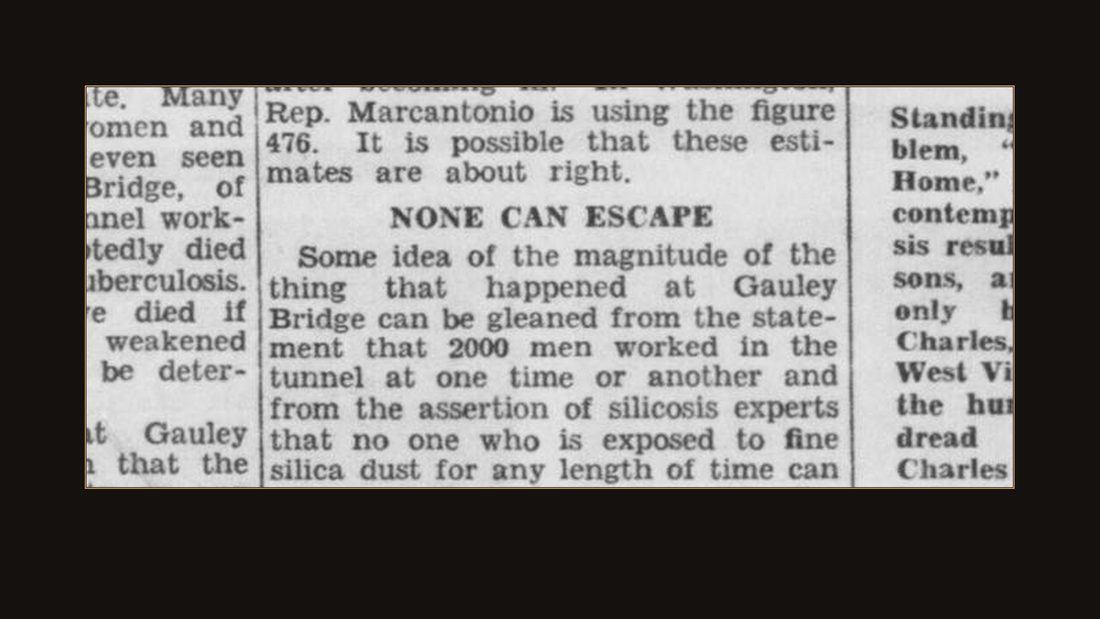
Read the disease list again. Of the forty-eight deaths the contractor was willing to concede, forty-five were Black men. And thirty-five of the forty-eight were certified as pneumonia.
Acute silicosis kills quickly, and in nineteen thirty-one it was routinely written down as pneumonia. Faulconer offered that list as his exoneration. It is a fair description of how the dead were hidden.
N12
The Washington Daily News, Jan. 15, 1936, p. 3. View the original.
There is one more thing in his arithmetic. Nobody could agree on the number he was dividing by either. The reporters and the first witness put the workforce at two thousand. Later testimony to the same committee put it close to four thousand. Faulconer needed five thousand, and used five thousand.
The doctor's letter
N51
The Washington Daily News, Jan. 21, 1936, p. 6. View the original.

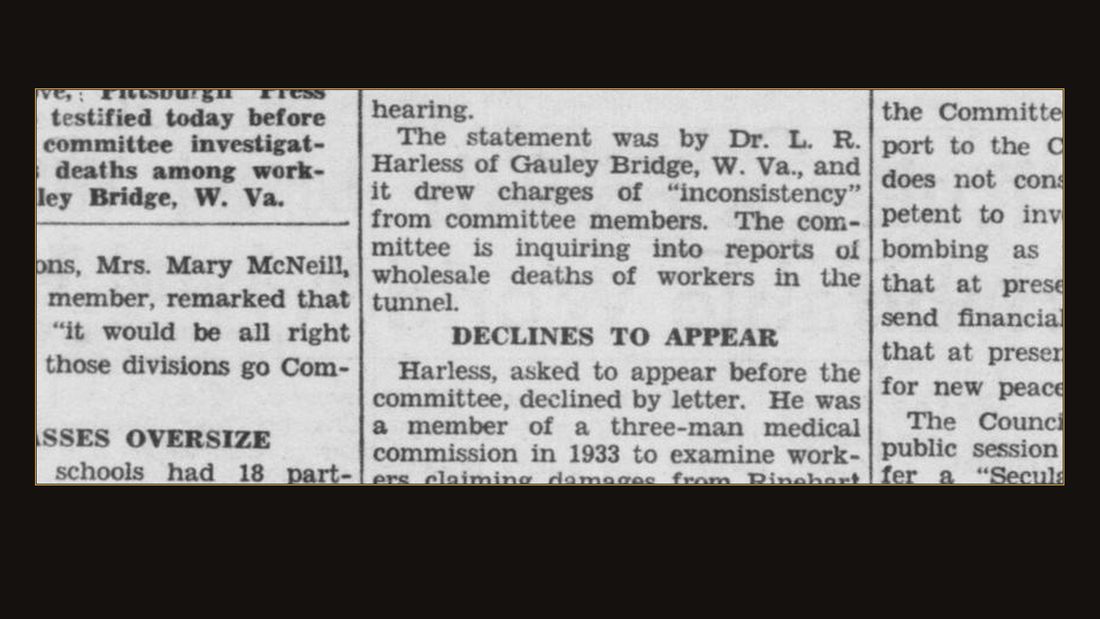
The village doctor at Gauley Bridge was asked to appear. He declined, and sent a letter.
N56
The Washington Daily News, Jan. 21, 1936, p. 6. View the original.
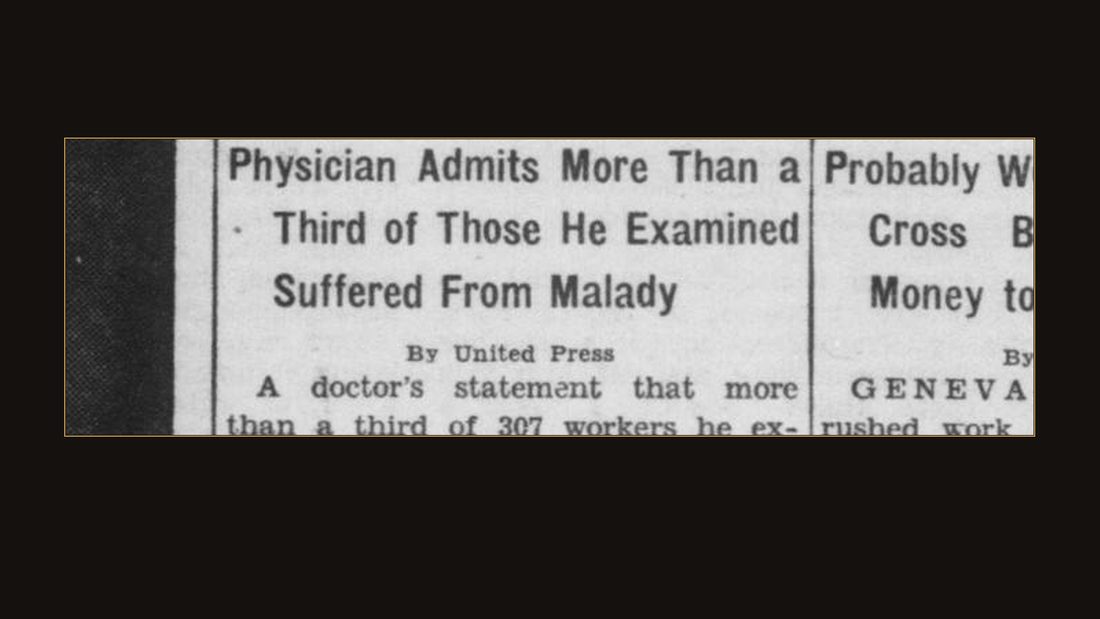
Doctor L. R. Harless had sat on a three-man medical commission examining workers who were claiming damages. His letter said newspaper reports had grossly exaggerated the situation.
N51
The Washington Daily News, Jan. 21, 1936, p. 6. View the original.
It also said that more than a third of the workers he examined had silicosis. Committee members pointed out that those two statements sit badly together.
They declined
N52
The Washington Daily News, Feb. 4, 1936, p. 4. View the original.

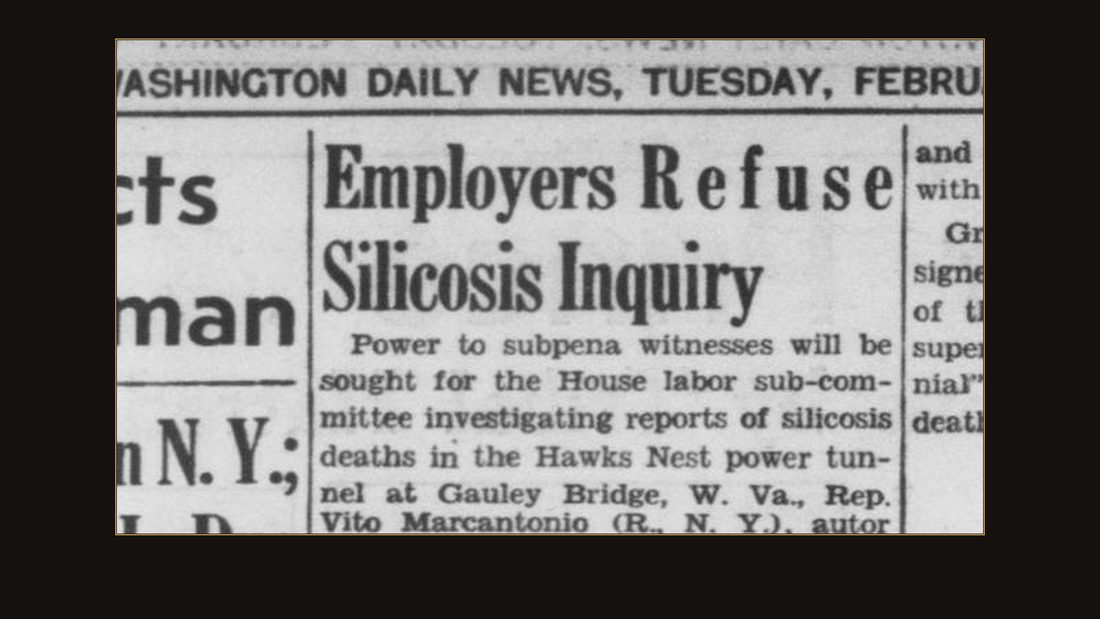
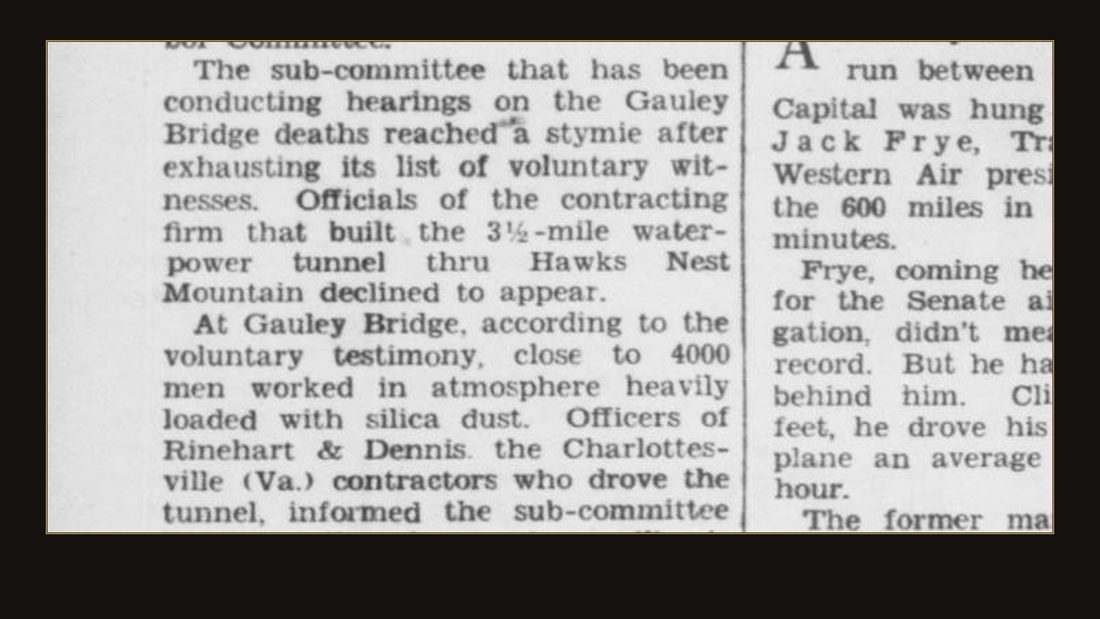
On the fourth of February, the officers of Rinehart and Dennis declined the committee's invitation to testify at all.
They sent a letter signed by Faulconer and their superintendent, making a general denial of any knowledge of silicosis deaths among the tunnel workers.
The subcommittee had run out of voluntary witnesses. The men who built the tunnel would not come, and it could not make them.
The run-around
N53
The Washington Daily News, Feb. 19, 1936, p. 12. View the original.

So it asked for the power to compel them. On the eighteenth of February the full Labor Committee voted to report the resolution favorably.
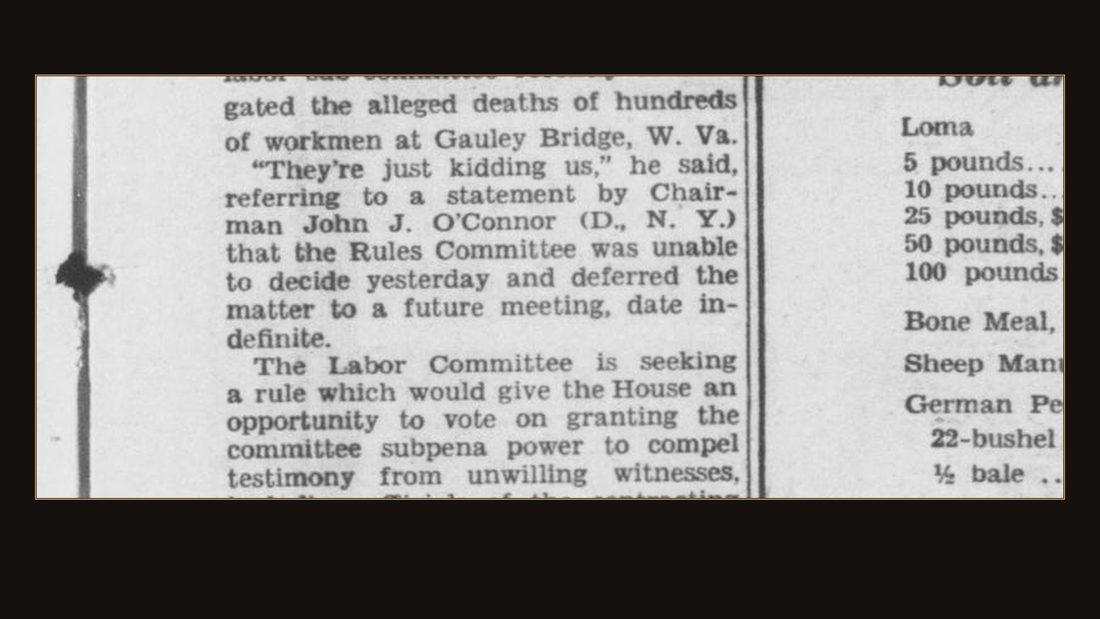
Before the House could vote on it, the Rules Committee had to let it reach the floor. The Rules Committee did not.
N54
The Washington Daily News, Mar. 25, 1936, p. 7. View the original.

After three weeks Marcantonio said they were giving him the run-around. They are just kidding, he said.
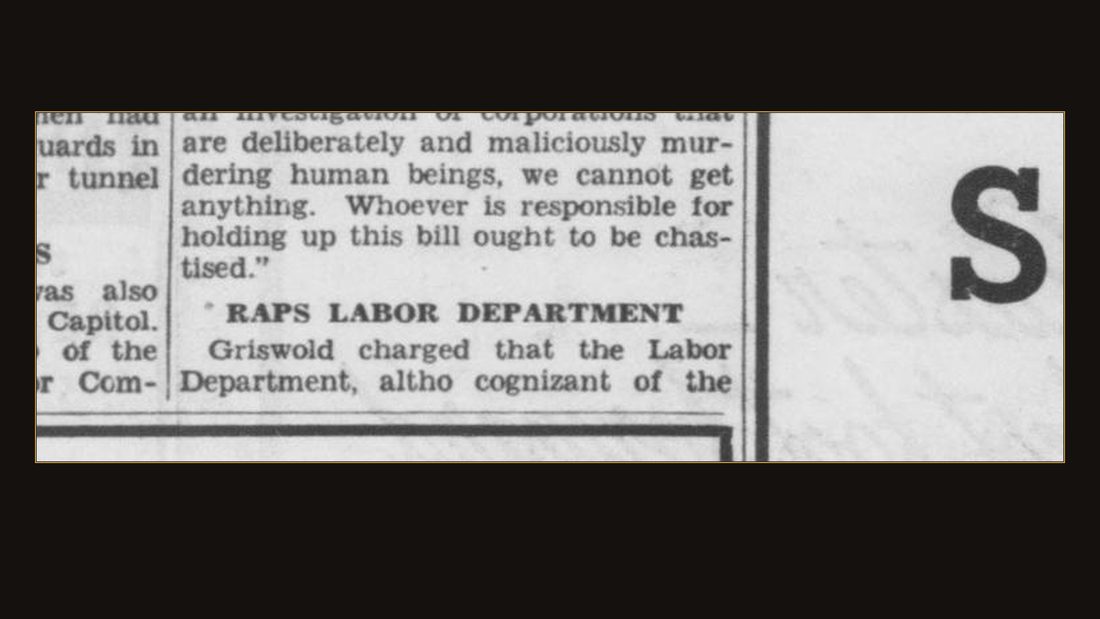
By April it had been bottled up a month. Congressman Matthew Dunn put it plainly.
N55
The Washington Daily News, Apr. 2, 1936, p. 12. View the original.

I ask for a few thousand dollars to make an investigation of corporations that are deliberately and maliciously murdering human beings, he said, and I cannot get anything.
Griswold charged that the Labor Department had known about the disease and done nothing until the House inquiry started.
The subpoena power never came. The men who built the tunnel were never heard under oath.
Afterward
Two years later the Department of Labor put out a film telling industry how to stop silicosis. It opens on the headlines from the hearing.
N15
The Washington Daily News, Jan. 15, 1936, p. 3. View the original.
By then the tunnel had been carrying the New River through the mountain for six years.
What is still buried
So how many men died at Hawks Nest.
N45
The Evening Star, Washington, Jan. 16, 1936, p. B-1. View the original.
The contractor said forty-eight. The undertaker accounted for fifty-six, between the ones he shipped south and the ones he put in his field.
N10
The Washington Daily News, Jan. 15, 1936, p. 3. View the original.
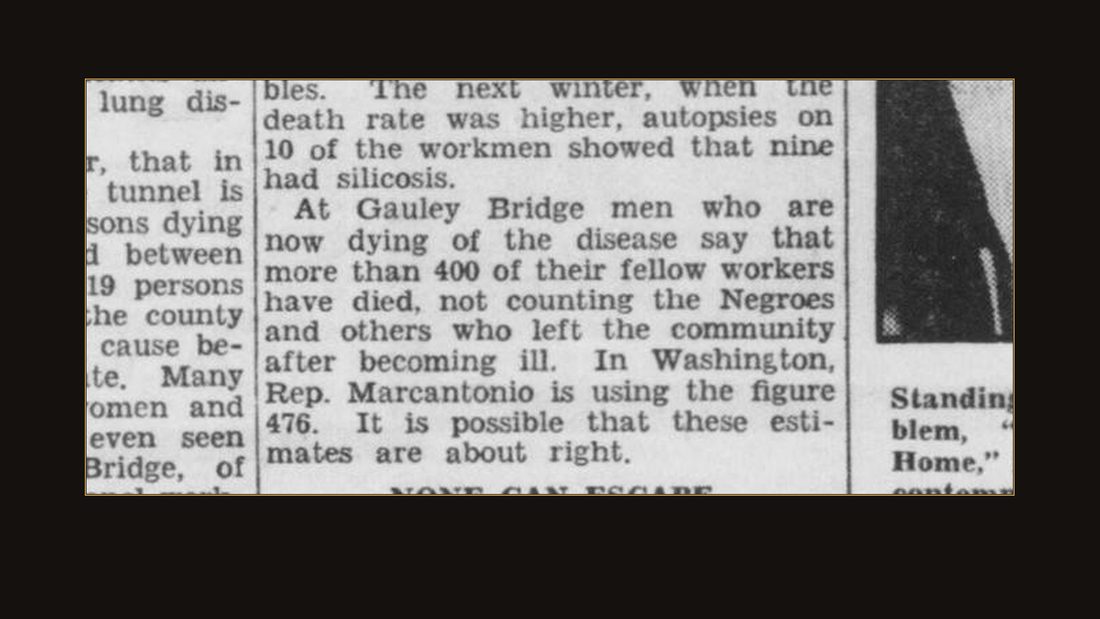
The village doctor reported seventy dead in the first winter alone, apparently of pneumonia. The next winter the death rate was higher, and autopsies on ten of the workmen showed that nine had silicosis.
N11
The Washington Daily News, Jan. 15, 1936, p. 3. View the original.
The men still dying at Gauley Bridge said more than four hundred of their fellow workers were gone. Marcantonio used the figure four hundred and seventy-six.
N3
The Washington Daily News, Jan. 15, 1936, p. 3. View the original.
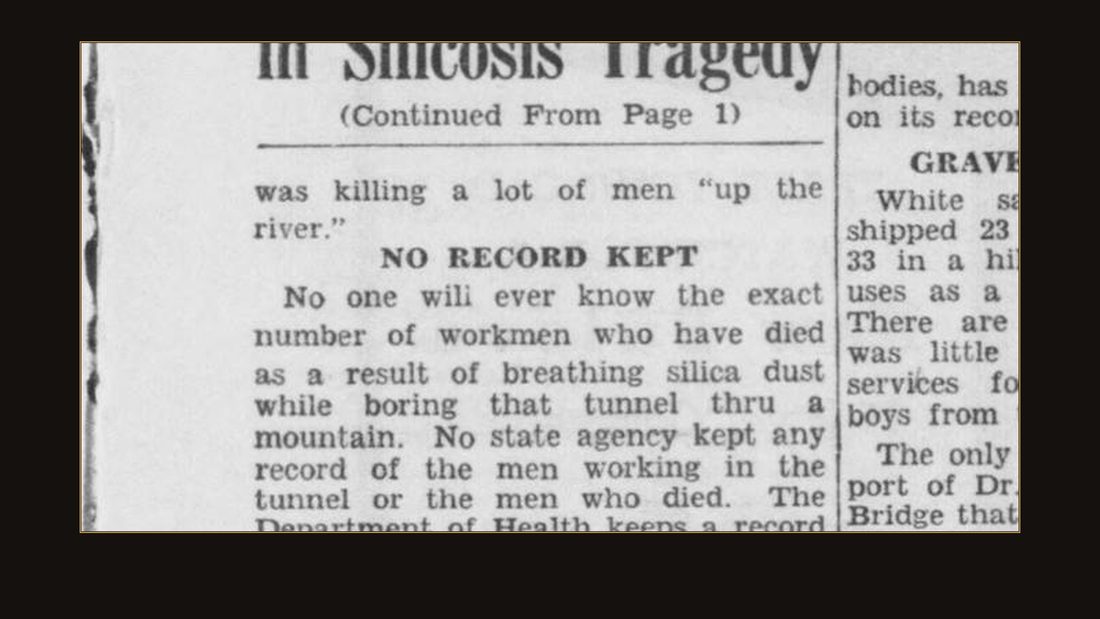
None of those numbers can be reconciled with any other, and the reason is set out in one paragraph on page three of the Washington Daily News for the fifteenth of January, nineteen thirty-six.
N4
The Washington Daily News, Jan. 15, 1936, p. 3. View the original.
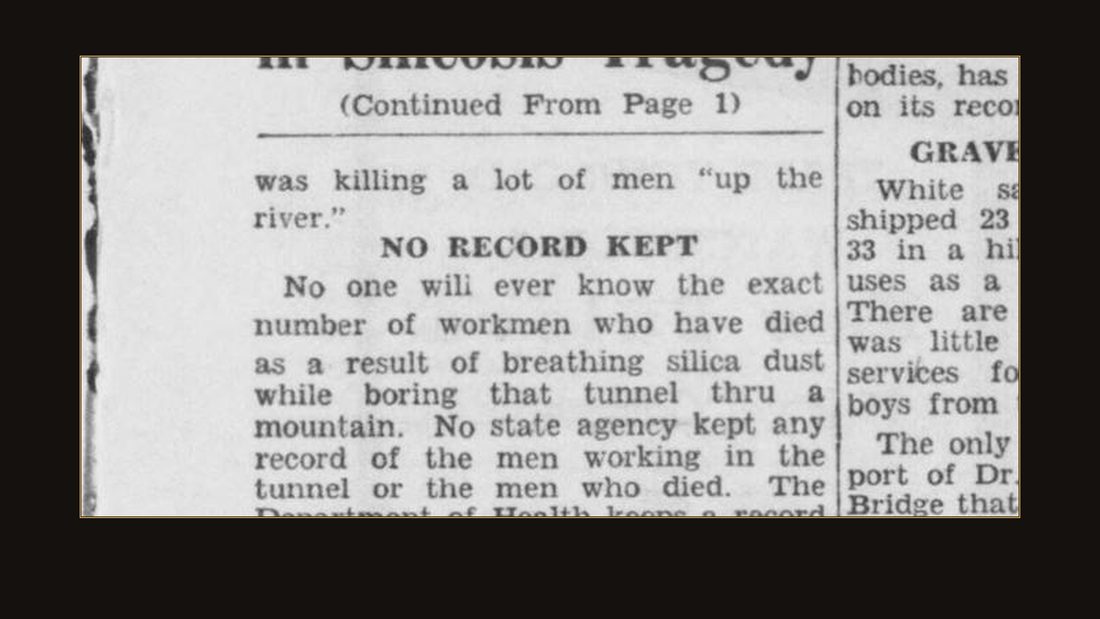
No state agency kept any record of the men working in the tunnel, or the men who died.
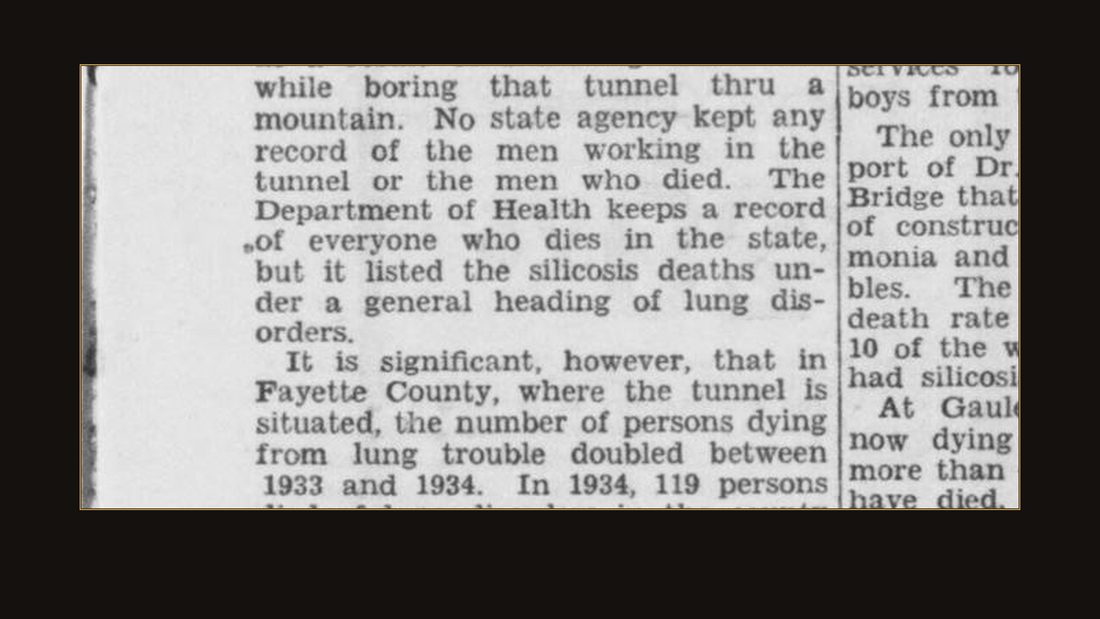
The state Department of Health kept a record of everyone who died in West Virginia. It filed the silicosis deaths under a general heading of lung disorders.
N5
The Washington Daily News, Jan. 15, 1936, p. 3. View the original.
In Fayette County, where the tunnel is, deaths from lung trouble doubled between nineteen thirty-three and nineteen thirty-four. In nineteen thirty-four a hundred and nineteen people died of lung disorders in that one county, the highest such rate in the state.
N6
The Washington Daily News, Jan. 15, 1936, p. 3. View the original.
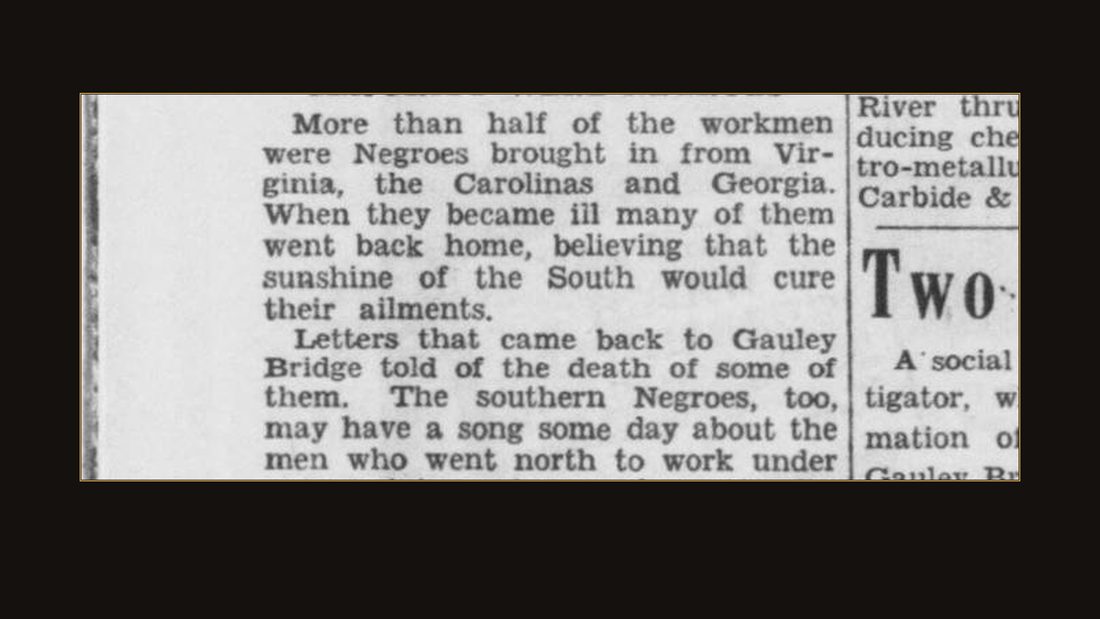
But a county count only holds the men who stayed. More than half the workforce had come up from Virginia, the Carolinas and Georgia.
N7
The Washington Daily News, Jan. 15, 1936, p. 3. View the original.
When they got sick, many went home, believing the sunshine of the South would cure them. They died a state or two away, of pneumonia, in counties that had never heard of the tunnel. Letters came back to Gauley Bridge telling of it.
N57
The Washington Daily News, Jan. 15, 1936, p. 3. View the original.
The reporter who wrote that page understood exactly what it meant. No one, he wrote, will ever know the exact number.
That is the part that is still buried. Not a secret somebody kept. A count nobody was ever obliged to take.
If your people went north to work under a mountain in nineteen thirty, and came home to Virginia or the Carolinas or Georgia and got sick, that is a death that never made anybody's list. I would like to hear about it in the comments.
Sources
- "The Village of the Walking Dead" — The Washington Daily News, Jan. 15, 1936, p. 3 (Gilbert Love / NEA). https://www.loc.gov/resource/sn82016181/1936-01-15/ed-1/?sp=3
- "Superstitious Feared Tragedy on Tunnel Job" / "House Probers Told of Silicosis Horror" — The Washington Daily News, Jan. 16, 1936, p. 38. https://www.loc.gov/resource/sn82016181/1936-01-16/ed-1/?sp=38
- "Silicosis Is Held Doom for 2,000" / "Charge Branded False" — The Evening Star, Washington, Jan. 16, 1936, p. B-1 (AP). https://www.loc.gov/resource/sn83045462/1936-01-16/ed-1/?sp=21
- "The Parade of the Doomed Will Be Enacted Again" — The Washington Daily News, Jan. 14, 1936, p. 3 https://www.loc.gov/resource/sn82016181/1936-01-14/ed-1/?sp=3
- "Need Funds to Bring Tunnel Victims Here" — The Washington Daily News, Jan. 17, 1936, p. 8 https://www.loc.gov/resource/sn82016181/1936-01-17/ed-1/?sp=8
- "Confidential Files Back Silicosis Charge" — The Washington Daily News, Jan. 18, 1936, p. 2 (Fred Perkins). https://www.loc.gov/resource/sn82016181/1936-01-18/ed-1/?sp=2
- "Third of Those He Examined Suffered From Malady" — The Washington Daily News, Jan. 21, 1936, p. 6. https://www.loc.gov/resource/sn82016181/1936-01-21/ed-1/?sp=6
- "Employers Refuse Silicosis Inquiry" — The Washington Daily News, Feb. 4, 1936, p. 4. https://www.loc.gov/resource/sn82016181/1936-02-04/ed-1/?sp=4
- "House Vote Cheers Advocates of Probe" — The Washington Daily News, Feb. 19, 1936, p. 12. https://www.loc.gov/resource/sn82016181/1936-02-19/ed-1/?sp=12
- "House Rules Group Scored for Delaying Silicosis Decision" — The Washington Daily News, Mar. 25, 1936, p. 7. https://www.loc.gov/resource/sn82016181/1936-03-25/ed-1/?sp=7
- "Silicosis Inquiry Gets Attention in Both Houses" — The Washington Daily News, Apr. 2, 1936, p. 12 https://www.loc.gov/resource/sn82016181/1936-04-02/ed-1/?sp=12
- "Stop Silicosis" — U.S. Department of Labor, 1938. Public domain. https://archive.org/details/StopSilicosis