Masked Men Captured a Kentucky City. Only a Lawsuit Ever Named Them. | 1907
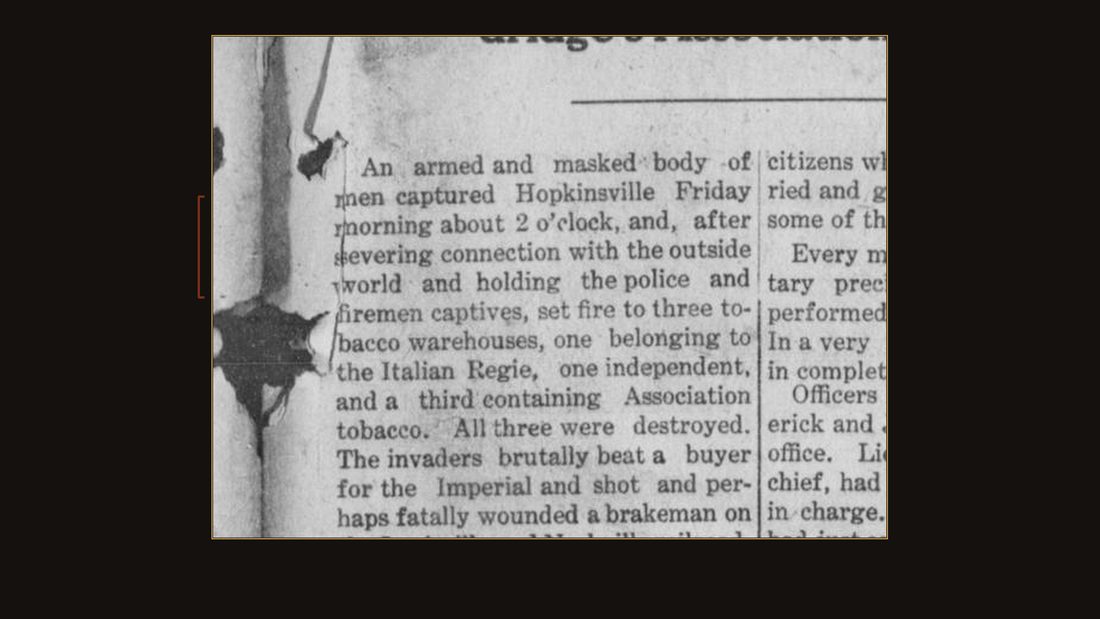
At about two o'clock in the morning on Saturday, December 7th, 1907, an armed and masked body of men captured Hopkinsville, Kentucky — a city of ten thousand people with three railroads, banks, a courthouse, a police force and a fire department.
Transcript
Cold open
In a federal courtroom in Padookah, Kentucky, in the spring of nineteen oh eight, a judge told a jury that he was ashamed of his own memory.
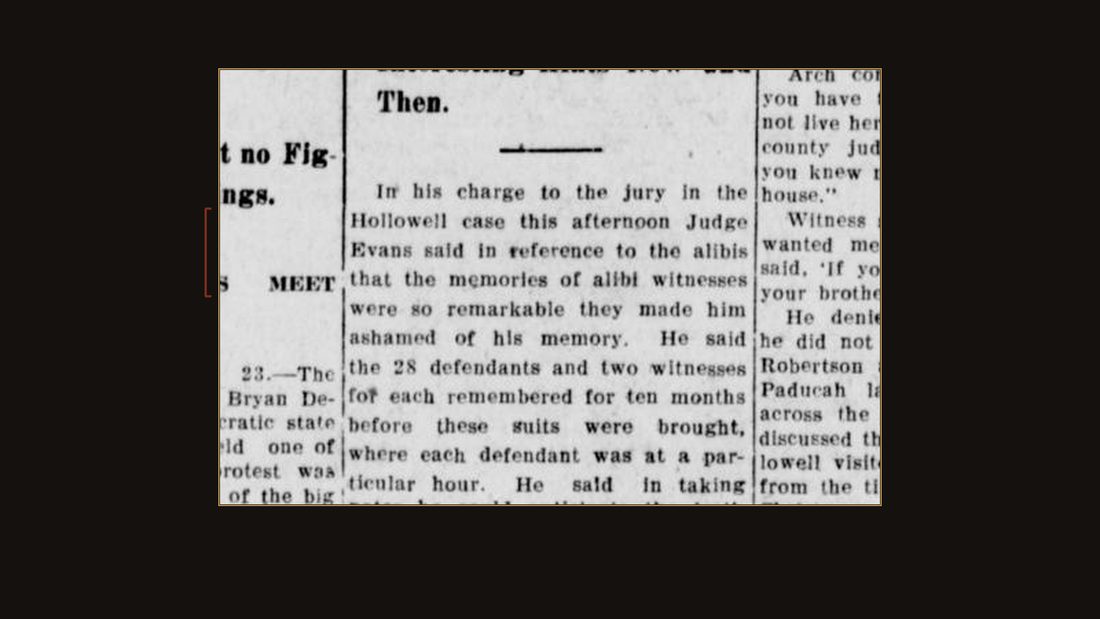
N24
The Paducah Evening Sun, Apr. 23, 1908, p. 1. View the original.

Twenty-eight men had been sued. Each had brought two witnesses. And every one of them could say exactly where that man had been, on one particular night, at one particular hour, ten months before anybody filed anything.
In four counties of western Kentucky, thousands of men had spent two years riding at night in masks. Whole towns had been taken. Warehouses had burned to the ground with the population watching from their windows.
And in those same counties, in those same two years, the record of who did it is almost perfectly blank.
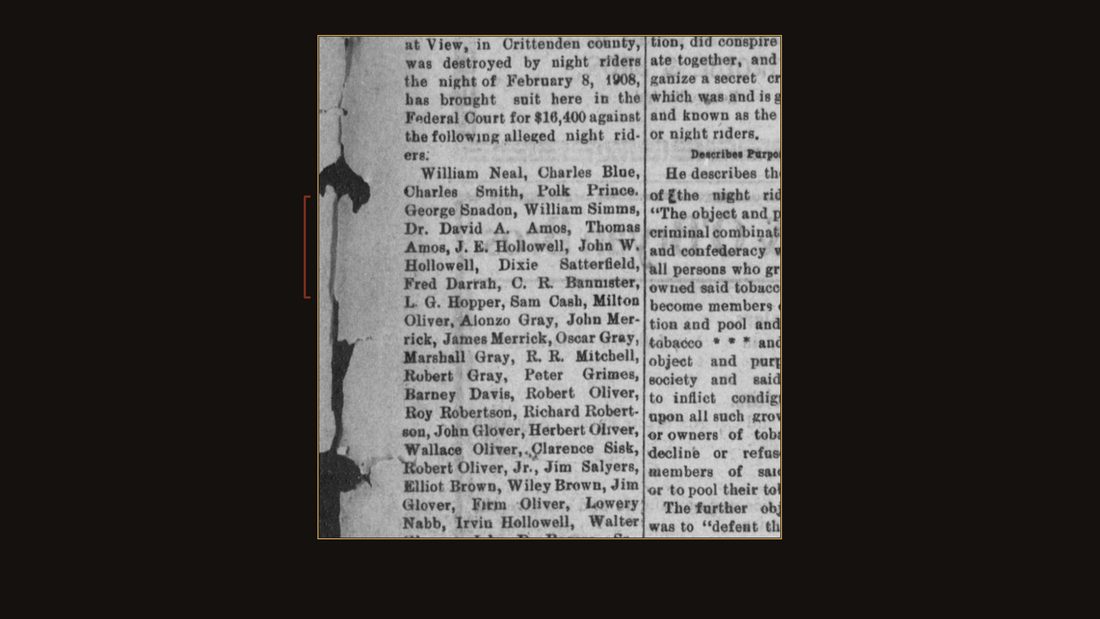
N20
The Bee, Earlington, Ky., Jan. 14, 1909, p. 1. View the original.

Almost. There is one place the names got written down, and it is not an indictment.
The Black Patch
They called it the Black Patch — a stretch of country across western Kentucky and into north-middle Tennessee, named for what comes out of the ground. Dark-fired tobacco, cured over smoldering hardwood until the leaf turns almost black.
Most of it went overseas, and the buyers who mattered were not a market. They were a short list. The American Tobacco Company. The American Snuff Company. Britain's Imperial Tobacco. And the Italian Regie.
By nineteen oh four, a pound of dark tobacco sold for less than it cost to raise. So the growers organized. The Planters' Protective Association — everyone called it the pool — asked its members to hold the crop back until the price came up.
A pool only works if everybody is in it. And not everybody was. Some men needed the cash that season. Some had a buyer they liked. Some just wouldn't.
Beginning in nineteen oh five, things happened to those men at night. Plant beds scraped bare. Barns burned. Men pulled out of their houses and whipped in their own yards.
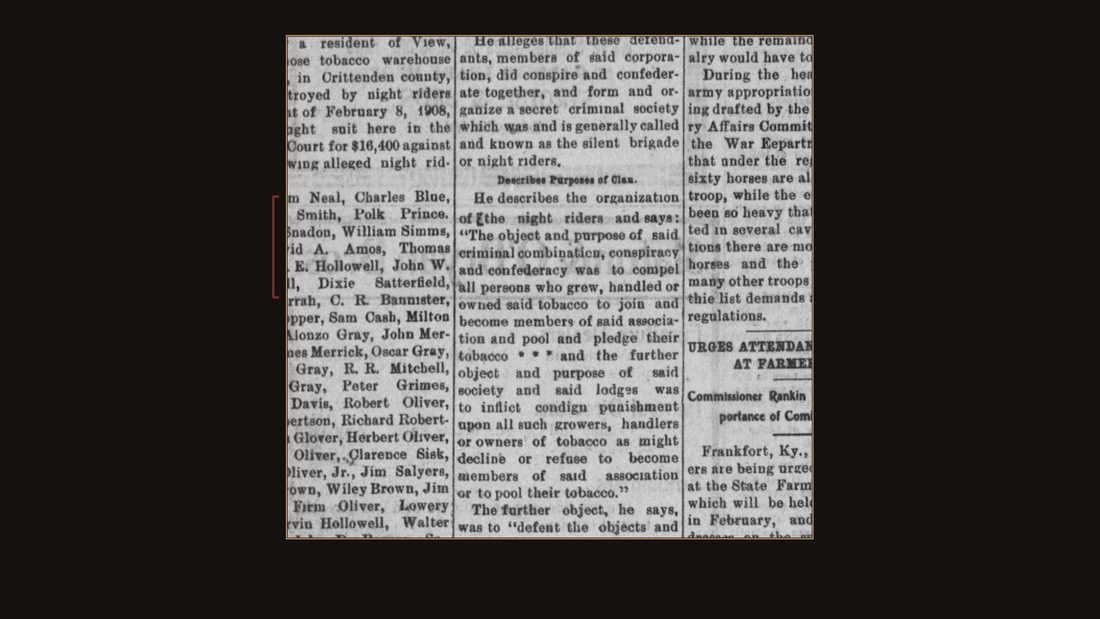
N21
The Bee, Earlington, Ky., Jan. 14, 1909, p. 1. View the original.
They had a name for themselves. Years later a lawyer put it into a federal complaint in plain legal English: a secret criminal society, generally called and known as the silent brigade, or night riders.
Princeton
On the first of December, nineteen oh six, they stopped visiting farms one at a time.
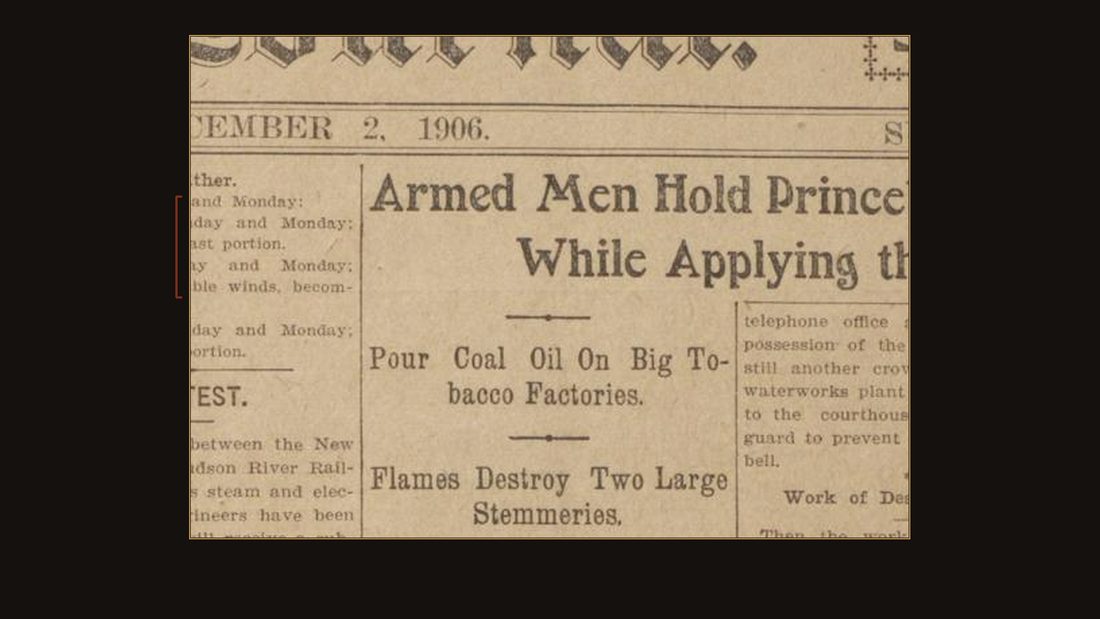
N1
The Courier-Journal, Louisville, Dec. 2, 1906, p. 1. View the original.

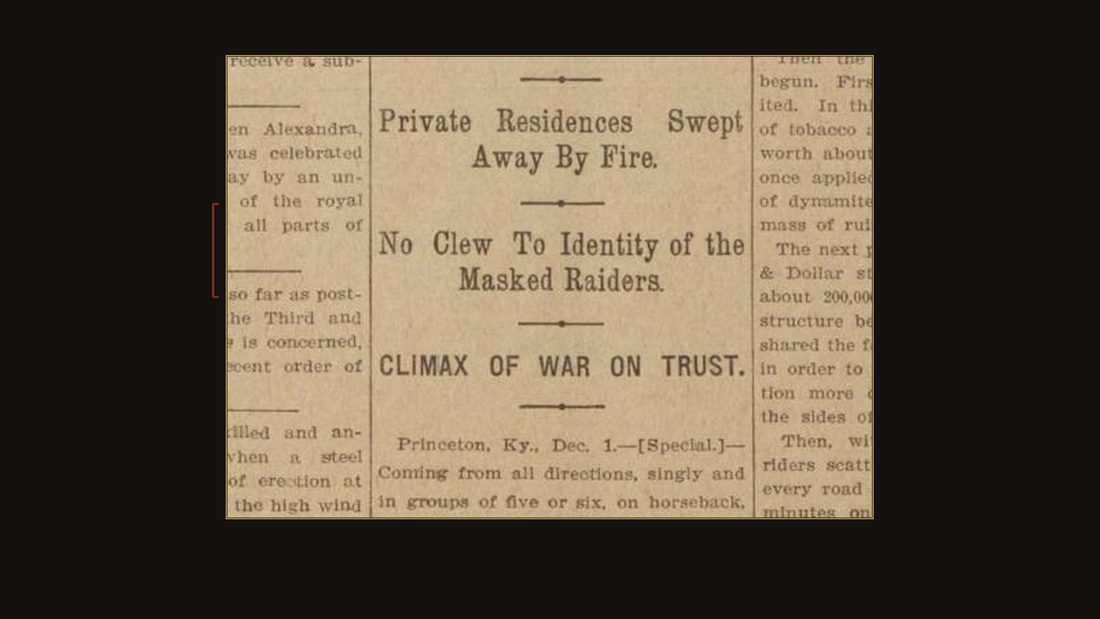
Princeton, Kentucky. County seat of Caldwell County. Shortly after midnight, armed men came in from every direction — single riders, groups of five and six, on horseback, walking, driving.
They took the town and held it an hour, poured coal oil inside two big tobacco stemmeries and lit them from within. Three houses burned with them, because nobody was allowed out to fight the fire.
N2
The Courier-Journal, Louisville, Dec. 2, 1906, p. 1. View the original.
By morning Princeton had a burned-out center, and one other thing.
No clue to the identity of the masked raiders. In a town of three thousand people, where hundreds of men had just marched through the streets for an hour.
The witness
Except that wasn't quite true, and everybody involved knew it wasn't.
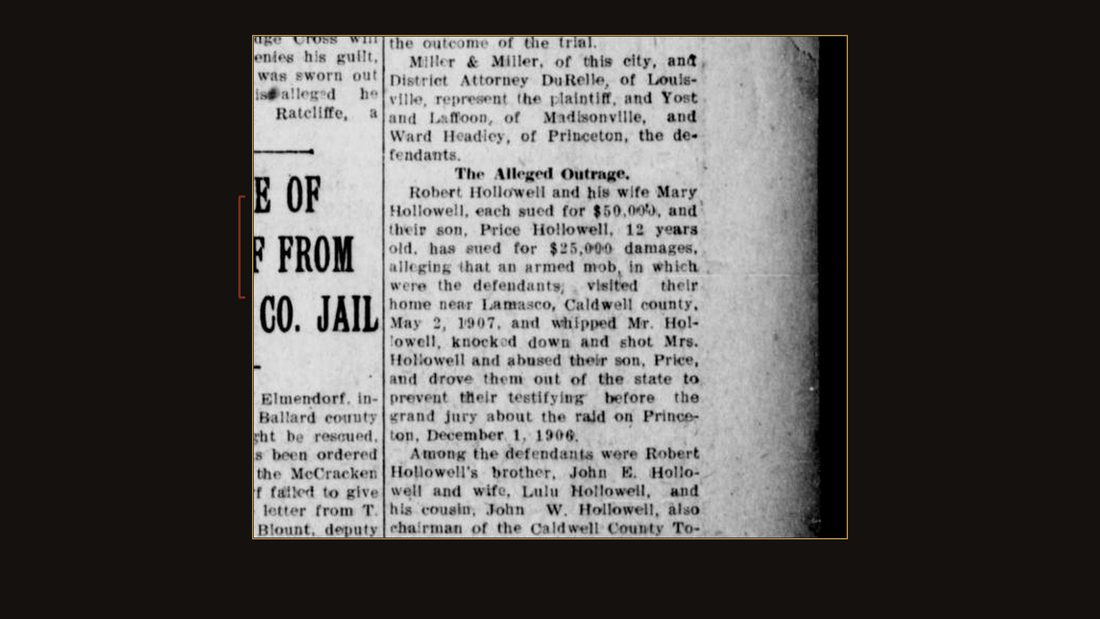
A Caldwell County grand jury began looking into the Princeton raid. Among the people it wanted to hear from was Mary Hollowell, who lived with her husband Robert near Lamasco.
N15
The Paducah Evening Sun, May 13, 1908, p. 1. View the original.

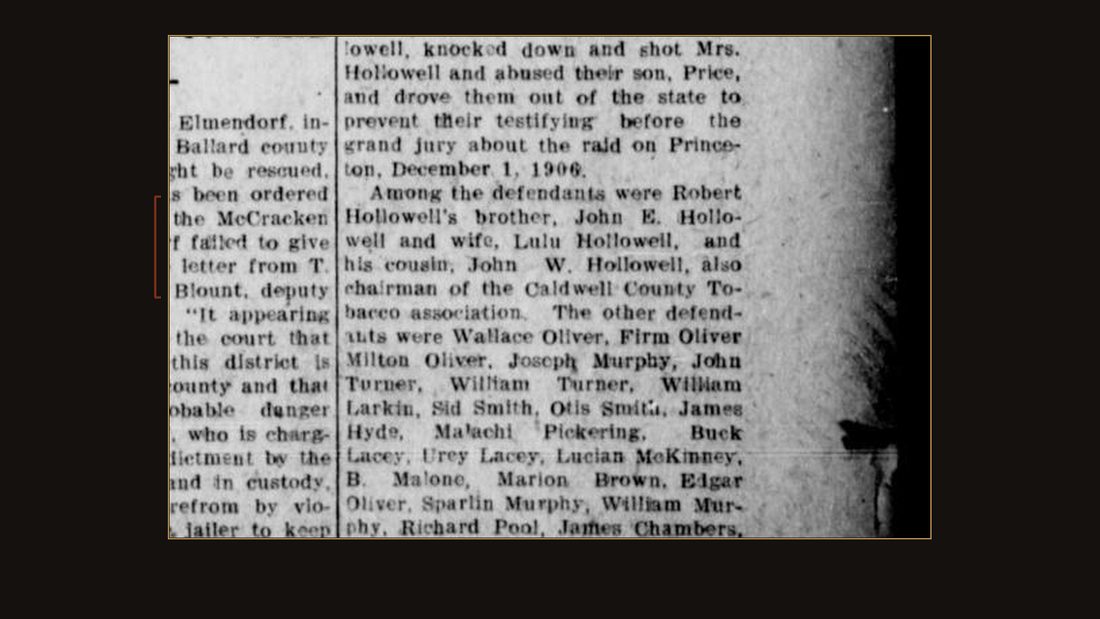
On the second of May, nineteen oh seven, an armed mob came to that house. They whipped Robert Hollowell. They knocked his wife down and shot her. They abused their son Price, who was twelve. And they drove the family out of the state.
The reason — as it was later stated in federal court, and printed on a Kentucky front page — was to prevent their testifying before the grand jury about the raid on Princeton.
Hold onto that. The mob that could not be identified came back six months later to make certain the witnesses could not identify it.
Two o'clock
Seven months after that, they took the largest city in the region.
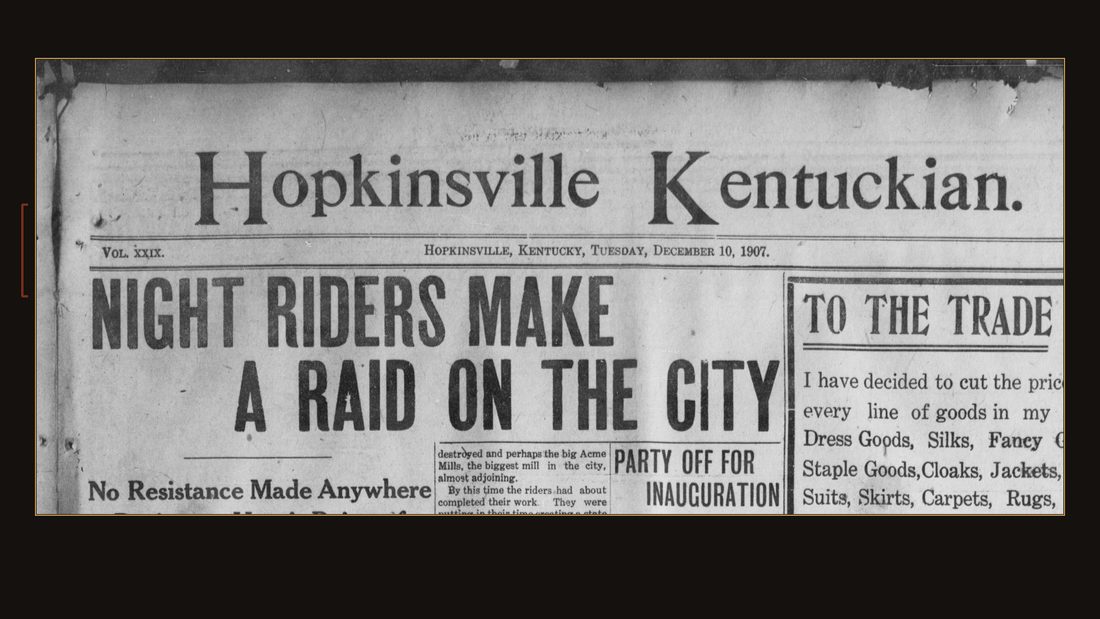
Hopkinsville, Kentucky. Ten thousand people. Three railroads, banks, a courthouse, a police force, a fire department.
N3
Hopkinsville Kentuckian, Dec. 10, 1907, p. 1. View the original.

At about two o'clock in the morning on Saturday, the seventh of December, nineteen oh seven, an armed and masked body of men captured it.
N6
Hopkinsville Kentuckian, Dec. 10, 1907, p. 1. View the original.
That is not a figure of speech, and it isn't my phrasing. It is the phrasing of the town's own newspaper, four days later.
They left their horses at a rail crossing two miles out and came in on foot along the tracks, marching in a solid phalanx, a piece of white cloth pinned to every shoulder.
An hour's reign
Six squads. One stopped at the telephone exchange. One at the fire department. Two went on to the depot. Three men held the West Seventh Street bridge.
The firemen were held in their own station and told the order was to shoot every living thing, man or horse, that tried to leave the building. Nobody tried, for half an hour.
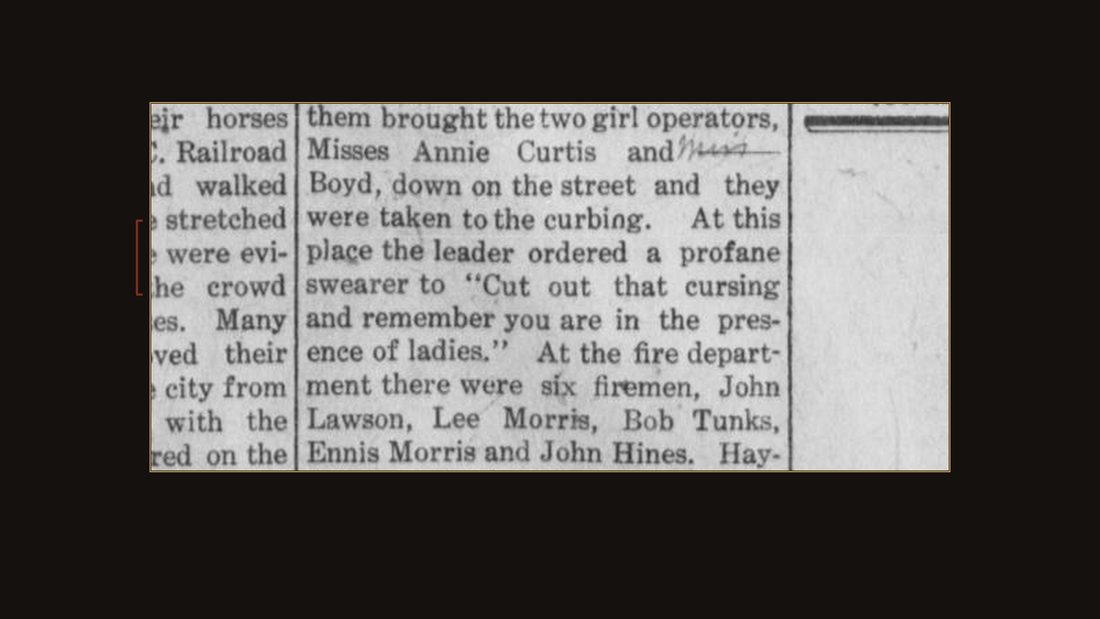
At the Home Telephone office, an operator named Maude Brown turned in the fire alarm. The man who answered told her they were captives. She turned out the lights, went upstairs to a back room, and was not molested.
N8
Hopkinsville Kentuckian, Dec. 10, 1907, p. 1. View the original.
At the other exchange, eight of them brought the two girl operators down onto the street and stood them at the curb. And there, in the middle of it, a leader told a man who was swearing to cut out that cursing and remember he was in the presence of ladies.
That is the detail I keep coming back to. Not the fires. The manners.
What the town saw
N5
Hopkinsville Kentuckian, Dec. 10, 1907, p. 1. View the original.
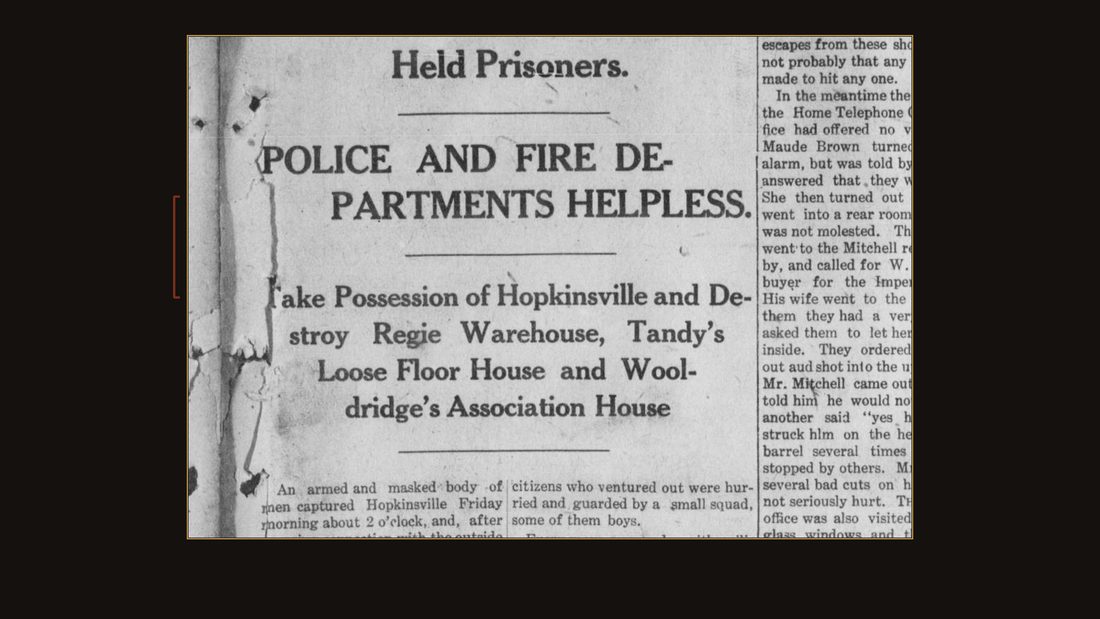
Three tobacco warehouses were burned. One belonging to the Italian Regie. One independent. And one holding association tobacco — their own side's crop, because it happened to be stored in the wrong house.
N9
Hopkinsville Kentuckian, Dec. 10, 1907, p. 1. View the original.
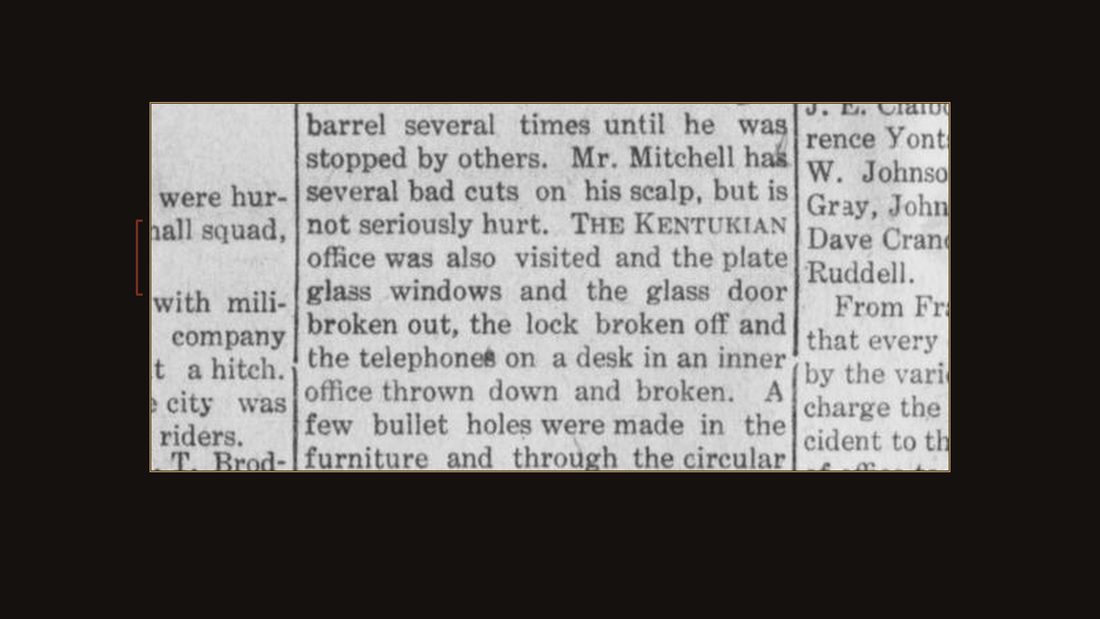
The bank windows were shot out. So were the courthouse windows. And so were the windows of the Hopkinsville Kentuckian, which had been printing editorials against the night riders.
N7
Hopkinsville Kentuckian, Dec. 10, 1907, p. 1. View the original.
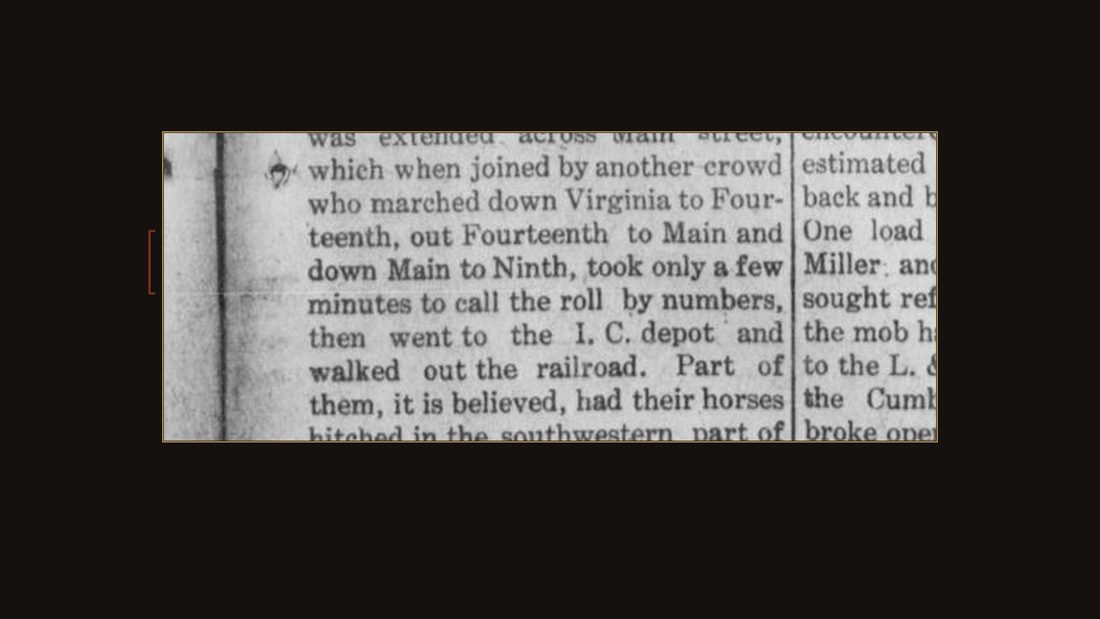
At Ninth and Main the squads formed up, and it took a few minutes to call the roll.
By numbers. Not by name. Whatever else the silent brigade was, it had thought carefully about never saying a member's name out loud in a public street.
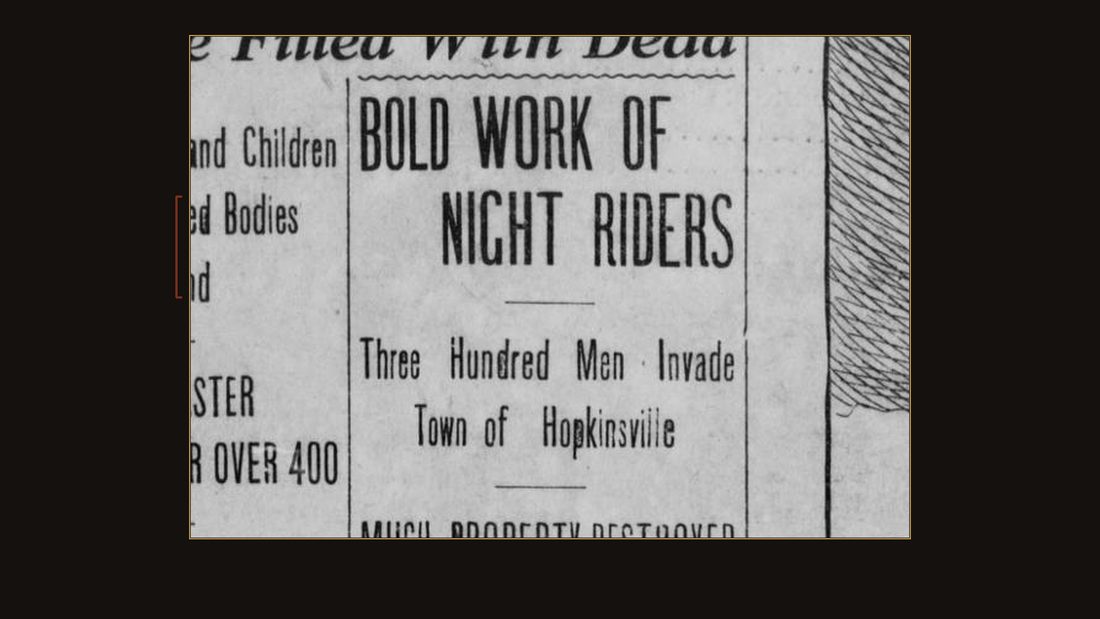
N10
The Birmingham Age-Herald, Dec. 8, 1907, p. 1. View the original.

How many were there. The Associated Press wire said three hundred.
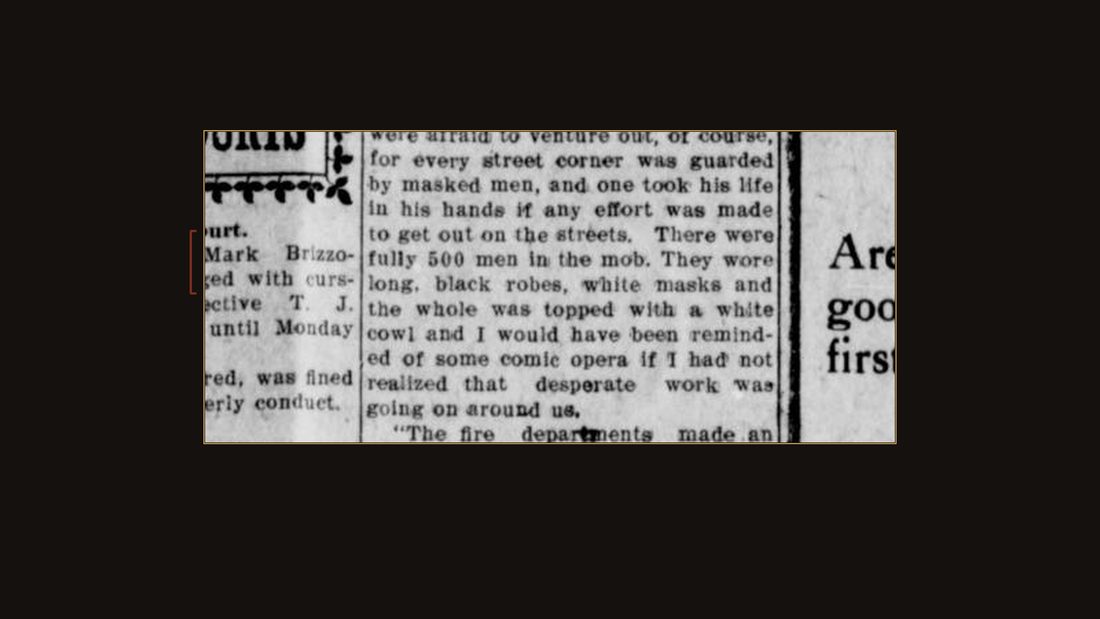
N11
The Paducah Evening Sun, Dec. 7, 1907, p. 5. View the original.

Two men from Padookah who spent the hour at the Hotel Latham said five hundred, in long black robes and white masks under a white cowl.
The town's own paper counted six squads of between six and thirty. Those accounts cannot all be true, and nobody ever reconciled them — because reconciling them would have required somebody to be counted.
The state responds
The governor ordered troops into Hopkinsville that same night. The reason the officials gave is worth hearing exactly: they believed soldiers would let them secure witnesses who could positively identify members of the mob.
The grand jury
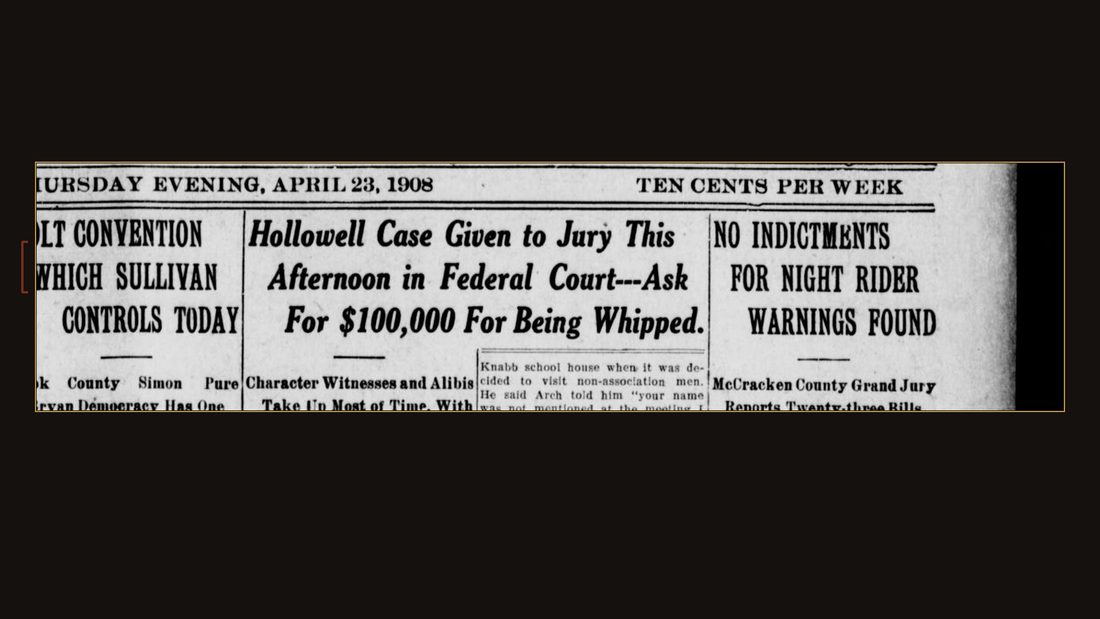
N26
The Paducah Evening Sun, Apr. 23, 1908, p. 1. View the original.
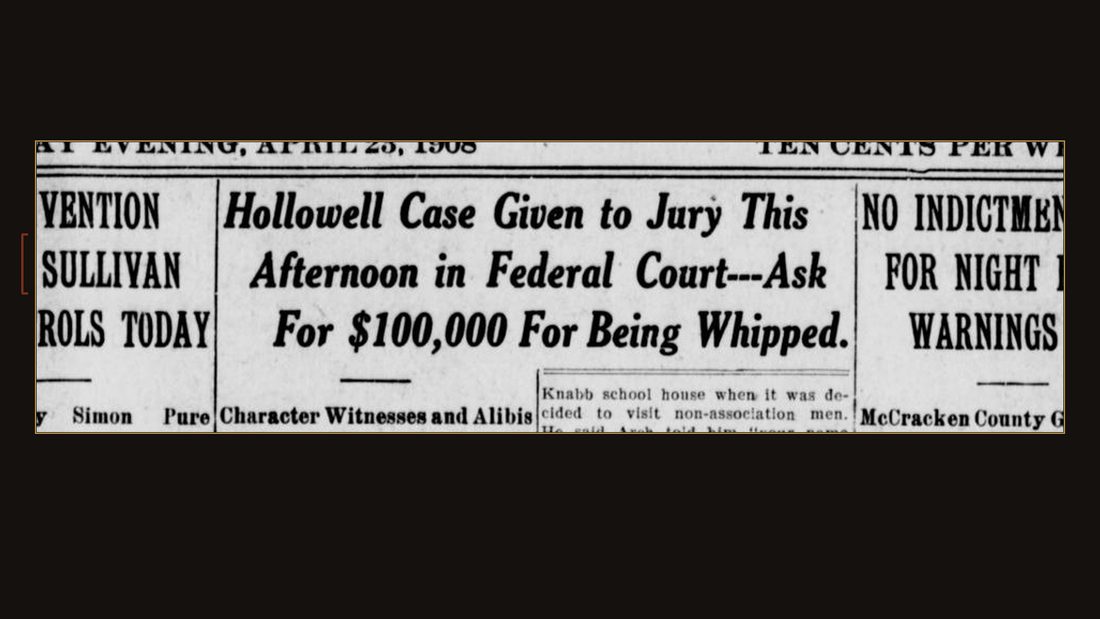
That was December. Now go forward to the twenty-third of April, nineteen oh eight, and look at one front page of the Padookah Evening Sun.
On the left of that page, a federal jury is being handed the Hollowell case. On the right of the same page, a county grand jury is going home.
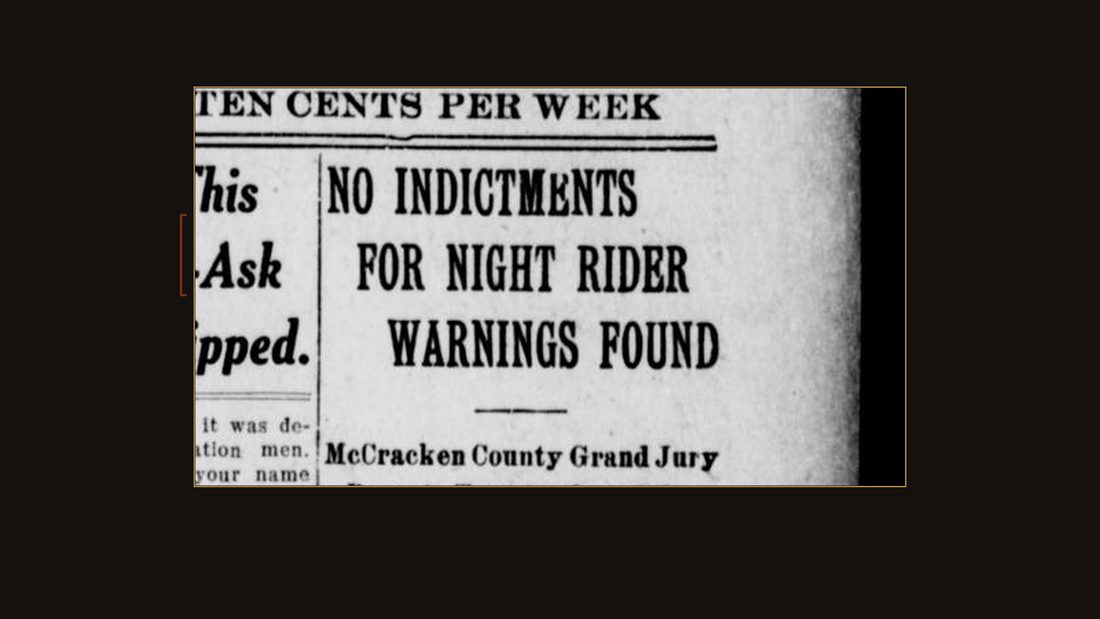
N23
The Paducah Evening Sun, Apr. 23, 1908, p. 1. View the original.
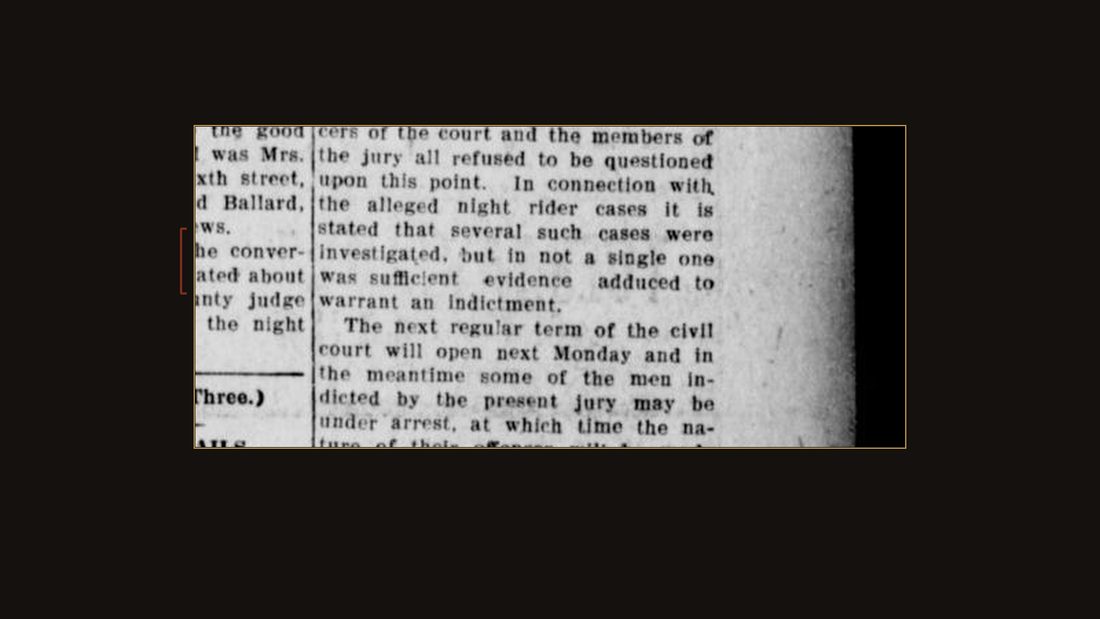
No indictments for night rider warnings found. That grand jury had sat more than three weeks. It returned about fourteen indictments, and none were for night riding.
N25
The Paducah Evening Sun, Apr. 23, 1908, p. 1. View the original.
Several night rider cases were investigated, the paper says. And in not a single one was sufficient evidence adduced to warrant an indictment.
N18
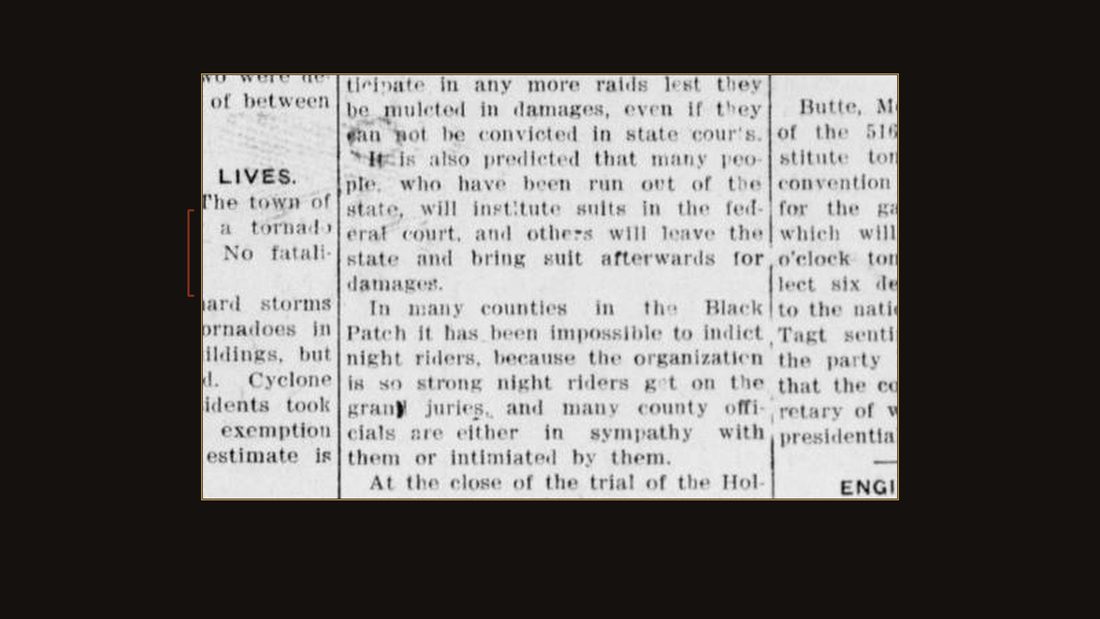
The Cairo Bulletin, Cairo, Ill., May 14, 1908, p. 1. View the original.

In many counties in the Black Patch it has been impossible to indict night riders, because the organization is so strong night riders get on the grand juries, and many county officials are either in sympathy with them or intimidated by them.
Paducah
Which brings us back to Robert and Mary Hollowell, run out of Kentucky a year earlier for being willing to talk.
N12
The Paducah Evening Sun, Apr. 23, 1908, p. 1. View the original.
They could not get anyone indicted. So they sued. Robert for fifty thousand dollars, Mary for fifty thousand, and their son Price for twenty-five thousand more.
They brought their case in the federal court at Padookah, and that is the whole trick. A federal court draws its jurors from the entire western district of Kentucky. It does not have to seat twelve men out of Caldwell County.
N16
The Paducah Evening Sun, May 13, 1908, p. 1. View the original.
They named twenty-eight defendants. Among them was Robert Hollowell's own brother, John E. Hollowell. And his brother's wife. And Robert's cousin John W. Hollowell, who was chairman of the Caldwell County tobacco association.
N17
The Cairo Bulletin, Cairo, Ill., May 14, 1908, p. 1. View the original.
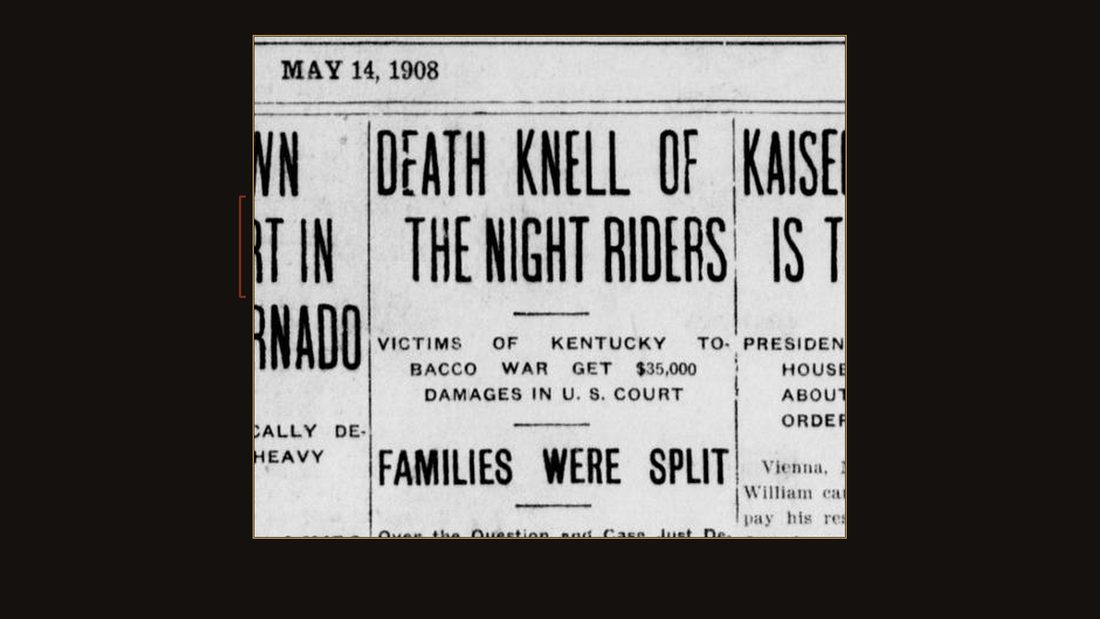
The Cairo Bulletin, across the river in Illinois, put a subhead on it. Families were split.
Forty-five minutes
The first trial produced no verdict. So Judge Evans said something remarkable for a sitting federal judge. He said that for the retrial he would go and get a jury out of a part of the state that did not grow tobacco, made up of men who belonged to no association at all.
He got retired businessmen from Louisville and farmers out of Bullitt County. Men with no crop in the pool and no neighbor to face on Monday.
N14
The Paducah Evening Sun, May 13, 1908, p. 1. View the original.
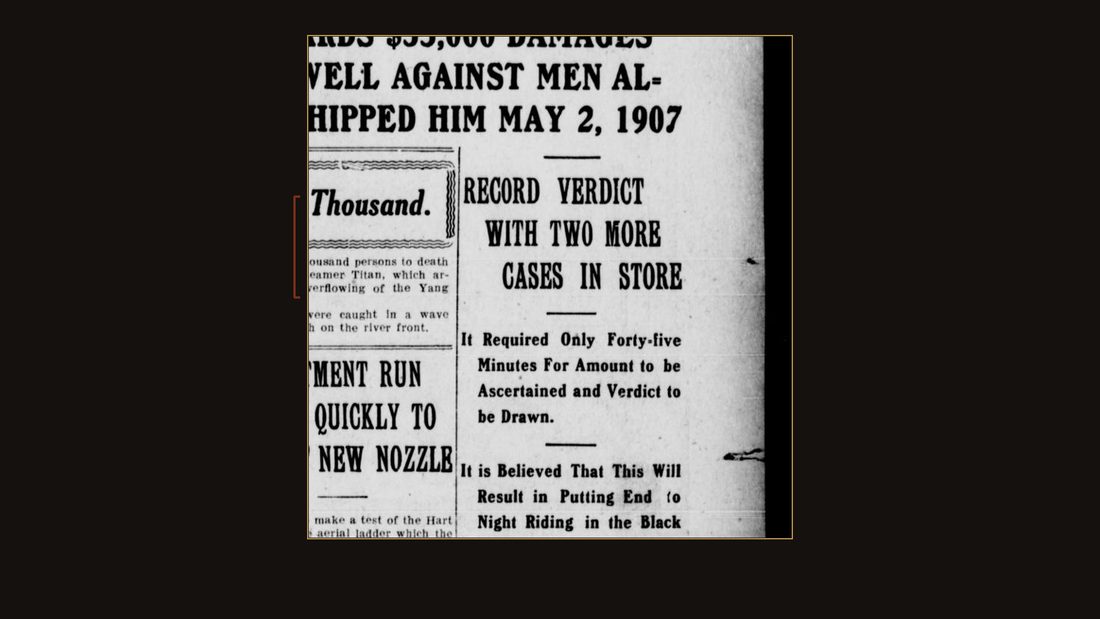
The second trial ran a week. Twenty-eight alibis again. The next morning the jury called for pen, ink and paper. Forty-five minutes later they came back.
N13
The Paducah Evening Sun, May 13, 1908, p. 1. View the original.
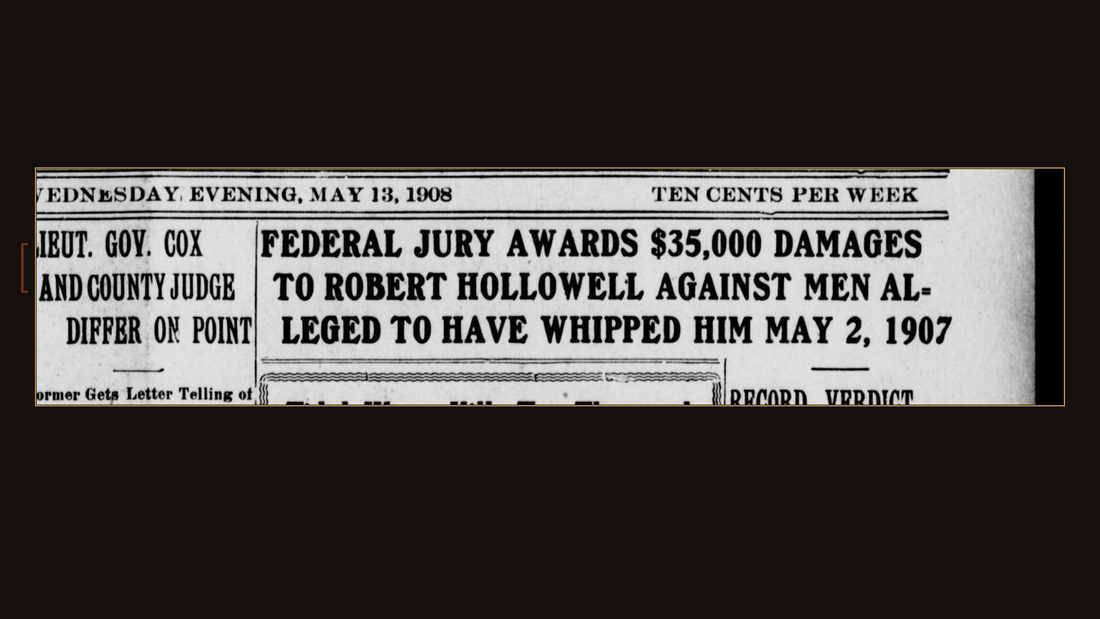
Thirty-five thousand dollars for Robert Hollowell. The largest verdict ever returned in Padookah, in any court.
That is somewhere near a million dollars today, assessed against twenty-eight farmers, most of whom owned land — and every one of whom now had a federal judgment standing against it.
N17
The Cairo Bulletin, Cairo, Ill., May 14, 1908, p. 1. View the original.
The Cairo Bulletin called it the death knell of the night riders. That was, at best, early. What the verdict actually did was show every other victim in the Black Patch where the door was.
The eighth suit
N19
The Bee, Earlington, Ky., Jan. 14, 1909, p. 1. View the original.
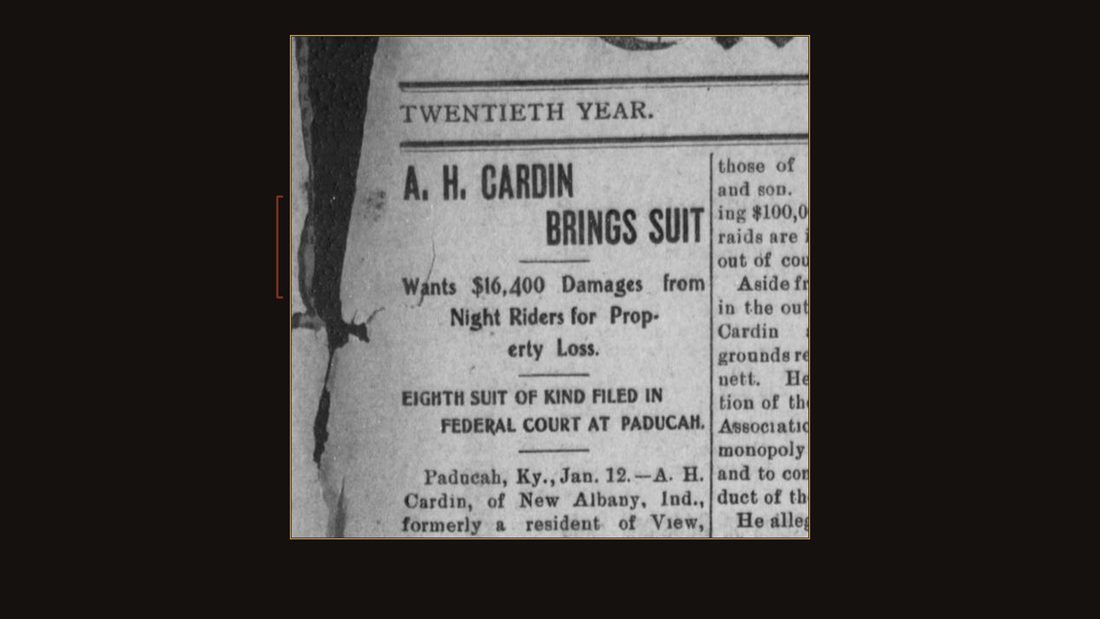
Eight months later a man named A. H. Cardin filed suit in that same federal court. His warehouse at View, in Crittenden County, had been burned the previous February. He asked for sixteen thousand four hundred dollars.
His was the eighth such suit filed there in twelve months. And this is what I wanted to show you from the beginning. In order to sue them, Cardin had to name them.
N20
The Bee, Earlington, Ky., Jan. 14, 1909, p. 1. View the original.
William Neal. Charles Blue. Charles Smith. Polk Prince. George Snadon. William Simms. Doctor David A. Amos. Thomas Amos. J. E. Hollowell. John W. Hollowell. Dixie Satterfield. Fred Darrah. C. R. Bannister. L. G. Hopper. Sam Cash. Milton Oliver.
It runs on like that for most of a newspaper column. Roughly ninety men, printed in a weekly paper in Earlington, Kentucky, where a fair number of their neighbors read it over breakfast.
And the paper noted something about that list. Nearly every defendant in Cardin's suit had been either a defendant, or an alibi witness, in the Hollowell case.
The deputy marshal serving all those summonses was Elwood Neel. The paper reports, without any comment at all, that Neel now knew most of them by sight, and was having less difficulty finding them.
N21
The Bee, Earlington, Ky., Jan. 14, 1909, p. 1. View the original.
And when Cardin's lawyer had to describe, in a pleading, what this organization was for, he set down three purposes.
To compel every man who grew, handled or owned dark tobacco to join the association and pool his crop. To inflict condign punishment on anyone who refused.
And third: to defeat the purpose of the courts of justice in those counties, and corruptly to influence the grand and petit jurors empaneled there, and so procure the release of any member from trial for the crimes he had committed.
That is not a historian's theory about why nobody was indicted. That is the plaintiff's own allegation: the jury tampering was not a side effect of the organization. It was one of its objects.
What is still buried
The suits worked, roughly the way lawsuits do. Several settled out of court. Night riding in the Black Patch thinned out over the next two years and stopped.
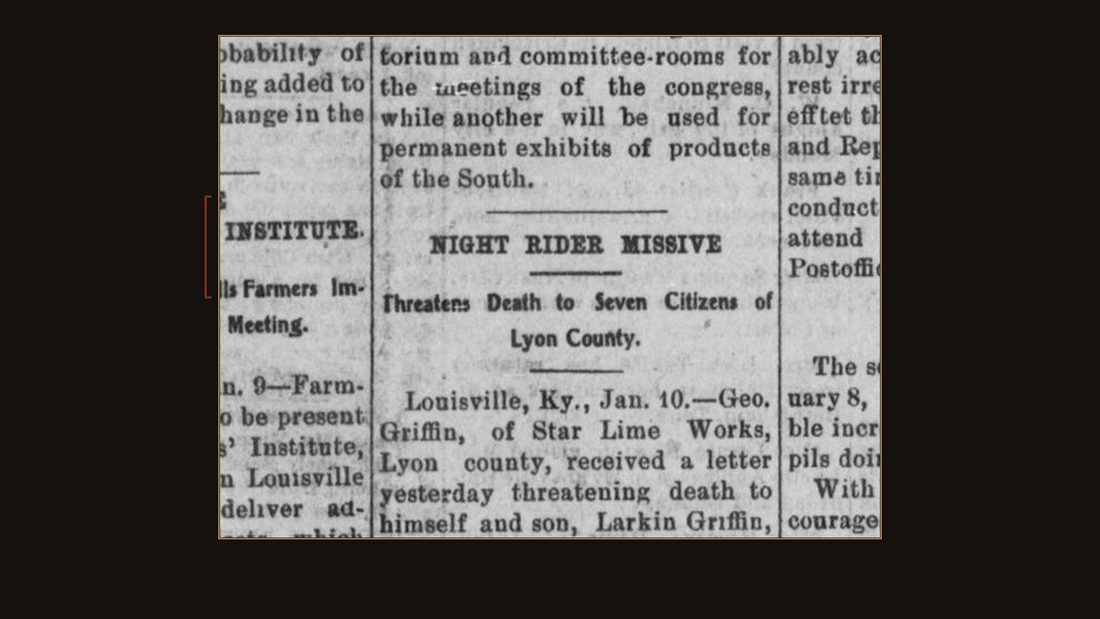
N22
The Bee, Earlington, Ky., Jan. 14, 1909, p. 1. View the original.
But not right away. Turn to the same page of the same paper that reported Cardin's suit, and read one column over.
A man at the Star Lime Works in Lyon County had received a letter threatening death to himself, his son, and five neighbors. It read: be prepared for death, for we will get you most any time.
It was not signed. The paper observed that the seven men named in it all belonged to the Law and Order League.
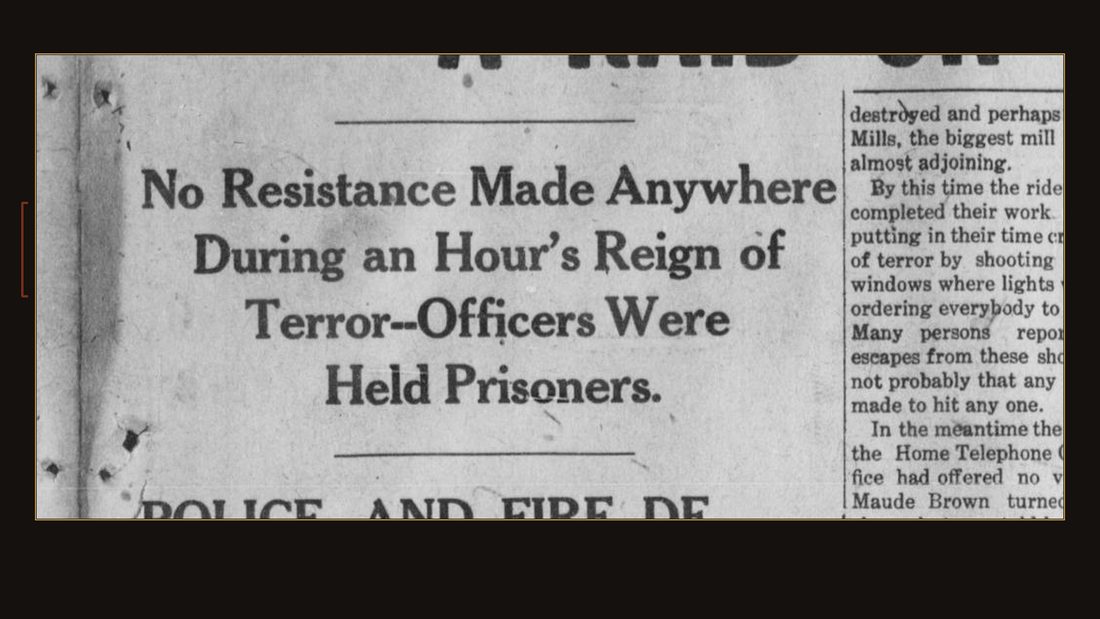
N4
Hopkinsville Kentuckian, Dec. 10, 1907, p. 1. View the original.
The record holds a city of ten thousand taken and burned by men who called their roll by number. It holds a family whipped and shot and driven out of Kentucky for being willing to testify.
N23
The Paducah Evening Sun, Apr. 23, 1908, p. 1. View the original.
It holds a state grand jury adjourning with nothing. And a federal jury of strangers taking forty-five minutes.
N20
The Bee, Earlington, Ky., Jan. 14, 1909, p. 1. View the original.
And it holds about ninety names, printed in a weekly paper under a dollar figure — because the only way to get those names into a public record was to put a price on what had been done to you and hand it to a federal judge.
Nobody in Hopkinsville was ever tried for the night of December seventh.
If your people farmed in Christian, Caldwell, Lyon, Crittenden or Trigg County in those years, they were on one side of this or the other — and plenty of families were on both. What did they tell you about it?
Sources
- The Courier-Journal, Louisville, Dec. 2, 1906, p. 1 — the Princeton raid, reported the morning after. https://www.loc.gov/resource/sn83045188/1906-12-02/ed-1/?sp=1
- Hopkinsville Kentuckian, Dec. 10, 1907, p. 1 — the raided city's own paper, four days after its windows were shot out. https://www.loc.gov/resource/sn86069395/1907-12-10/ed-1/?sp=1
- The Birmingham Age-Herald, Dec. 8, 1907, p. 1 — the Associated Press account, as the country read it. https://www.loc.gov/resource/sn85038485/1907-12-08/ed-1/?sp=1
- The Paducah Evening Sun, Dec. 7, 1907, p. 5 — two eyewitnesses who spent the hour at the Hotel Latham. https://www.loc.gov/resource/sn85052114/1907-12-07/ed-1/?sp=5
- The Paducah Evening Sun, Apr. 23, 1908, p. 1 — the single front page that carries the whole argument: a federal jury getting the Hollowell case, and a county grand jury going home with nothing. https://www.loc.gov/resource/sn85052114/1908-04-23/ed-1/?sp=1
- The Paducah Evening Sun, May 13, 1908, p. 1 — the verdict. https://www.loc.gov/resource/sn85052114/1908-05-13/ed-1/?sp=1
- The Cairo Bulletin, Cairo, Ill., May 14, 1908, p. 1 — the Associated Press analysis of what the verdict meant, and why indictment had been impossible. https://www.loc.gov/resource/sn93055779/1908-05-14/ed-1/?sp=1
- The Bee, Earlington, Ky., Jan. 14, 1909, p. 1 — the eighth federal suit, the roster of names, and a fresh death threat one column over. https://www.loc.gov/resource/sn87060004/1909-01-14/ed-1/?sp=1