175 Men Checked In. Nobody Could Count the Dead. | Fraterville, 1902
On Monday, May 19th, 1902, the mine boss at the Fraterville mine in Coal Creek, Anderson County, Tennessee checked in 175 miners. Behind them went the boys — helpers, drivers, road men — and nobody checked those in at all. At 7:30 that morning the mine blew.
Transcript
Cold open
Three miles underground, in the dark, a man wrote the time at the top of his letter. Two thirty in the afternoon.
The explosion had been at seven thirty that morning. He had been alive for seven hours inside a mine the whole valley had already given up on.
Five men left six letters. Everything in them is exact. Almost nothing written about them above ground that week was — starting with the simplest question anybody asked. How many men were down there.
Coal Creek
Coal Creek, Anderson County, Tennessee. A narrow valley in the eastern part of the state. Coal on both sides of it, a rail line down the middle.
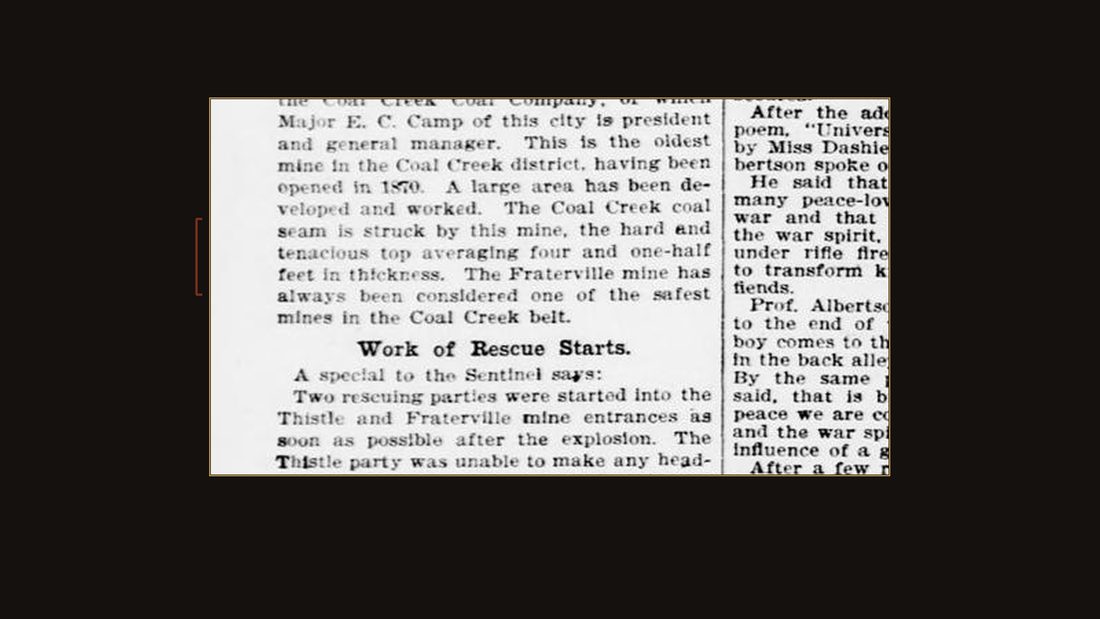
Two miles west of town was a mine called Frayterville. It had been opened in eighteen seventy. It was the oldest working mine in the Coal Creek district, and by reputation, the best one.
N2
The Evening Star, Washington, D.C., May 19, 1902, p. 2. View the original.

The Evening Star put it plainly, the day of. The Frayterville mine had always been considered one of the safest mines in the Coal Creek belt.
It belonged to the Coal Creek Coal Company. The president and general manager was Major E. C. Camp of Knoxville. The superintendent at the mine was George Camp.
N14
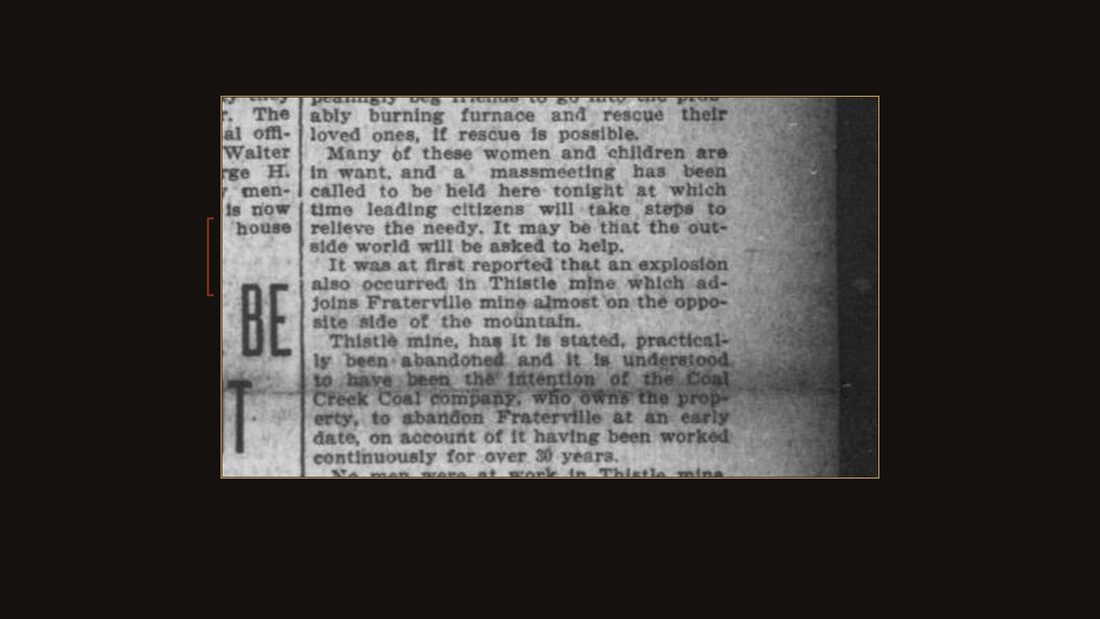
Atlanta Semi-Weekly Journal, May 22, 1902, p. 1. View the original.

The seam had been worked continuously for over thirty years, and the company had already decided to shut it down. That is in the record too, printed three days after the explosion.
From the mouth of the mine to the place where the men actually cut coal was three miles. Everything that happened that day happened at the far end of a three-mile tunnel.
Monday morning
N4
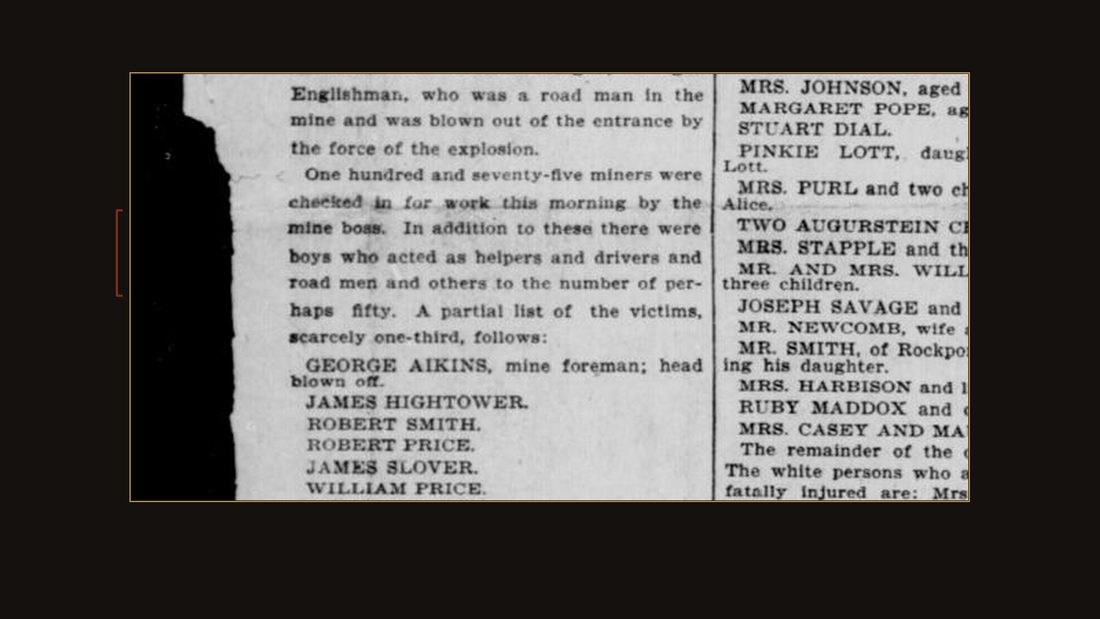
The Indianapolis Journal, May 20, 1902, p. 1. View the original.

Monday morning, the nineteenth of May, nineteen oh two. The mine boss checked in one hundred and seventy-five miners.
Behind them went the boys. Helpers, drivers, road men. Nobody checked those in. The paper put the number at perhaps fifty.
At seven thirty there was a roar, and flame came out of the entrance and out of the air shafts.
One man came out alive right away. William Morgan, an aged Englishman, a road man, blown out of the entrance by the force of the blast. The papers said the same thing about him every day that week. He could not live.
Two rescue parties went in. One through the Thistle mine, which adjoined Frayterville on the far side of the mountain. The gas stifled them almost as soon as they entered the shaft, and they came back out.
The other party went in the main entrance. They got as far as a place the men there called the Parting of the Ways. A heavy fall of slate had closed the passage.
They could not move it. And the heat coming back through it told them what they did not want to know. The mine was on fire.
At half past twelve, they brought one body out. The dispatch describes it in six words. An unrecognizable mass of flesh.
The counting
By that afternoon the news was moving on the wires, and this is where the record starts coming apart.
N1
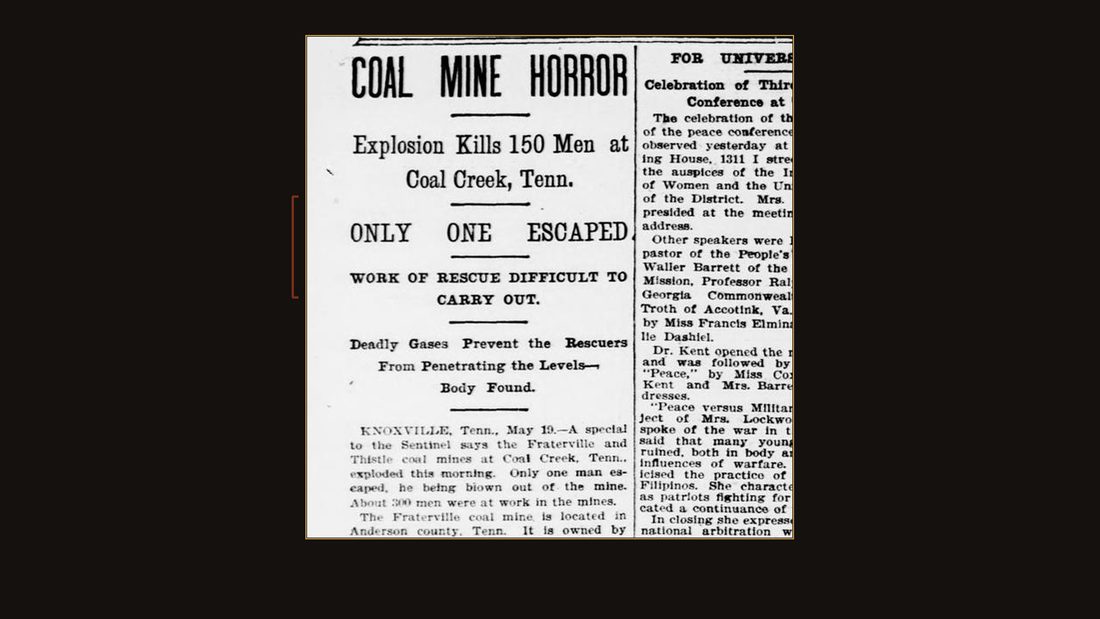
The Evening Star, Washington, D.C., May 19, 1902, p. 2. View the original.
The Evening Star, that same evening. Coal Mine Horror. Explosion kills one hundred and fifty men at Coal Creek, Tennessee. Only one escaped.
Read four lines further down, in the same story, under that same headline. About three hundred men were at work in the mines. The paper contradicted its own headline before the end of its own first paragraph.
Superintendent George Camp was asked for an official statement. He said he was positive that one hundred and sixty men were in the mine. He also said there may have been from two hundred and fifty to three hundred. He could not determine which until an investigation was made.
N3
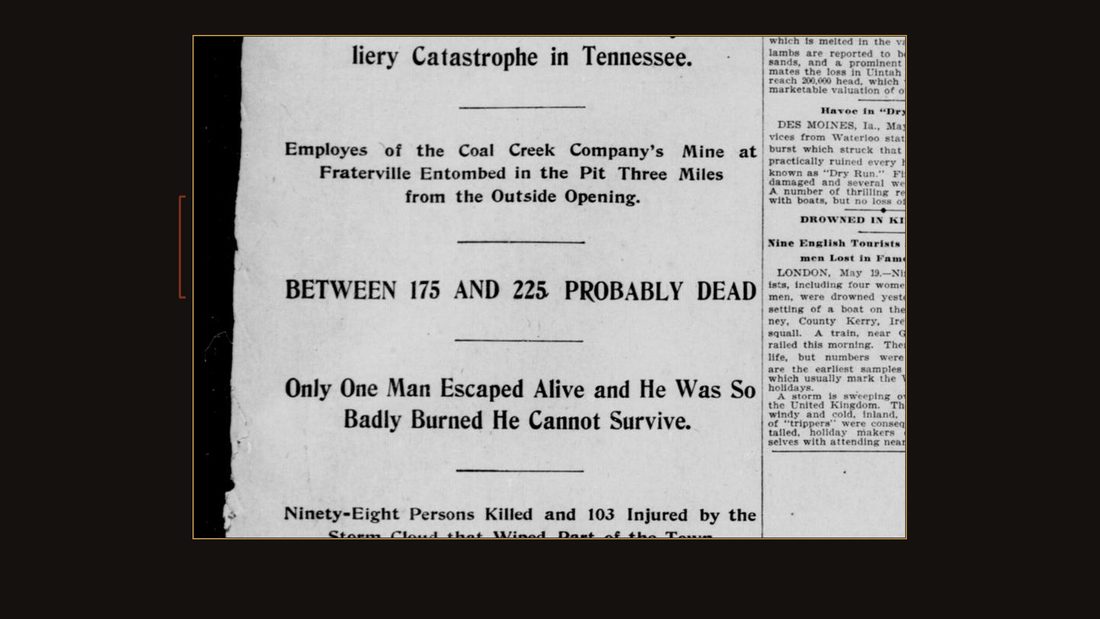
The Indianapolis Journal, May 20, 1902, p. 1. View the original.
The next morning, the Indianapolis Journal ran it across the top of page one. Between one hundred and seventy-five and two hundred and twenty-five probably dead.
That is a range fifty men wide. Not fifty men rounded off. Fifty men whose families did not yet know whether to hope.
N6
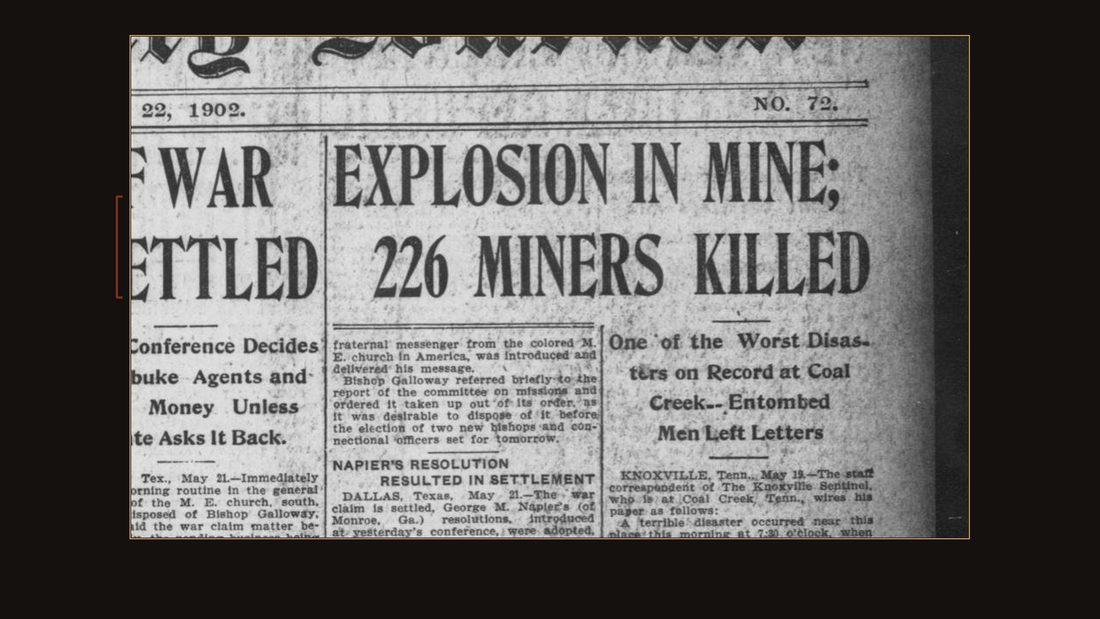
Atlanta Semi-Weekly Journal, May 22, 1902, p. 1. View the original.
By the twenty-second, the Atlanta Semi-Weekly Journal had it at two hundred and twenty-six. Contract miners, day laborers, and boy helpers.
The second man
N17
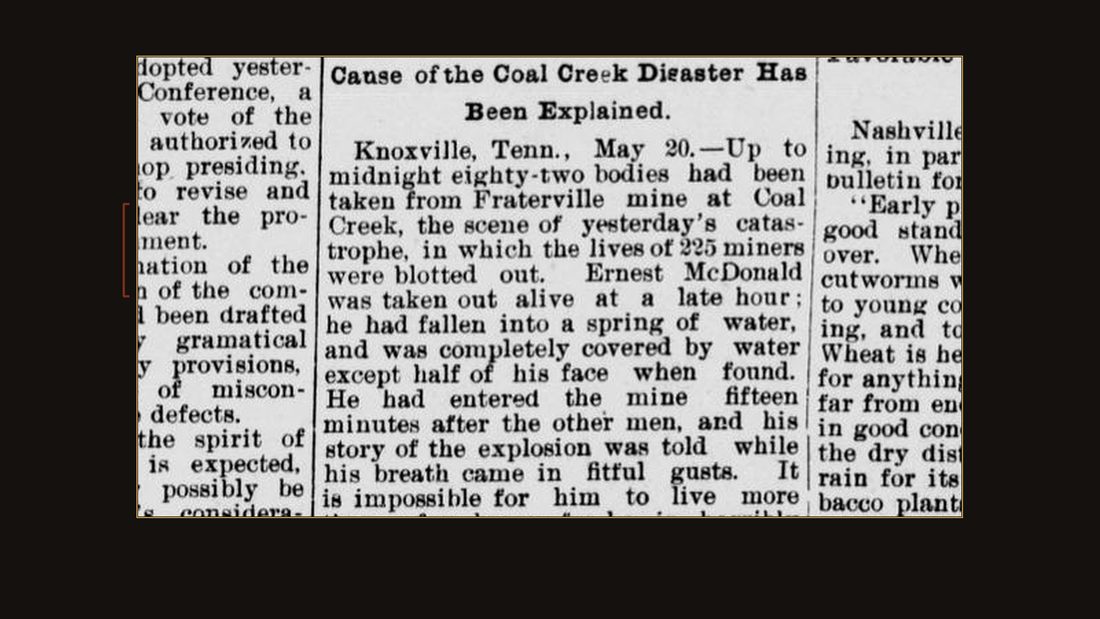
The Columbia Herald, Columbia, Tenn., May 23, 1902, p. 7. View the original.

And then there is the number that came out of Knoxville on the twentieth. Two hundred and twenty-five. Same dispatch, and in the same sentence, something no headline that week ever mentioned.
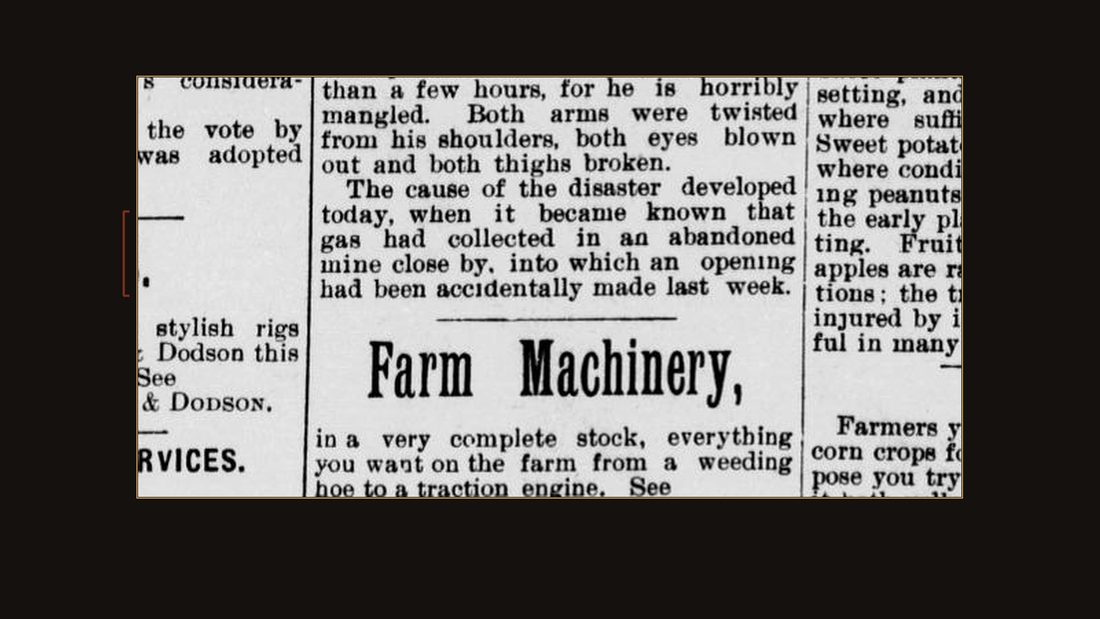
A second man had come out of Frayterville alive. His name was Ernest McDonald. He had gone into the mine fifteen minutes behind the other men.
They found him lying in a spring of water, covered by it except for half his face.
He told them what he had seen while his breath came in fitful gusts. Both arms twisted from his shoulders. Both eyes blown out. Both thighs broken. It was impossible, the dispatch says, for him to live more than a few hours.
Every headline that week said one man escaped. Two men came out of that mine alive. Neither of them lived. Nobody went back and corrected the number, because by then the number had already been printed a thousand times.
One fifty. Three hundred. One sixty. Two twenty-five. One seventy-five to two twenty-five. Two twenty-six. Six numbers in four days, and not one of them came from a list, because there was no list.
The list
N5
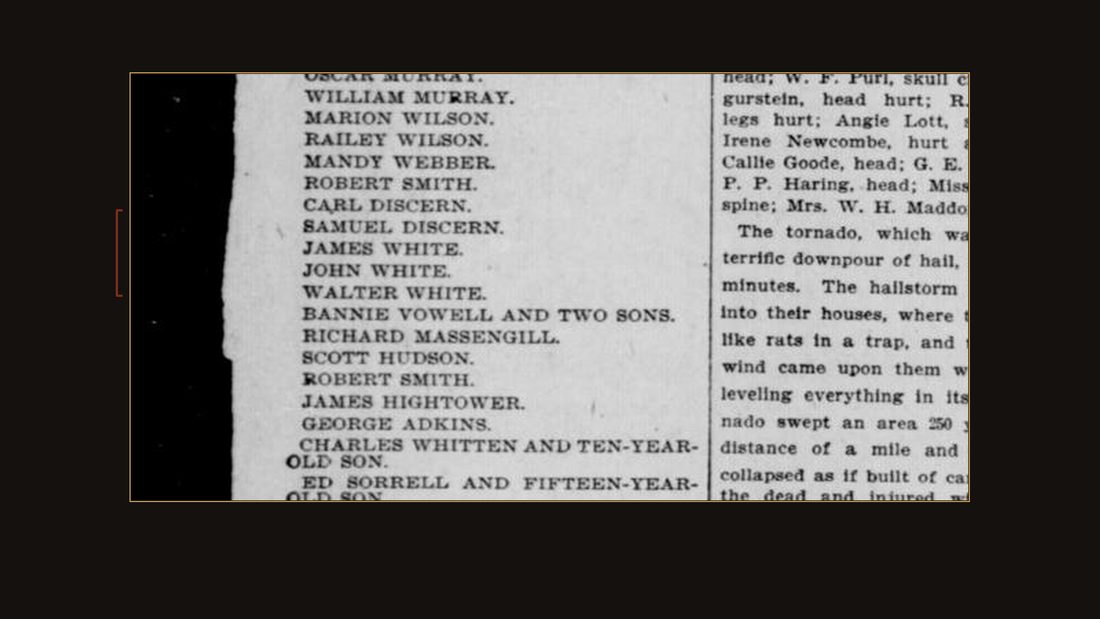
The Indianapolis Journal, May 20, 1902, p. 1. View the original.
What the Indianapolis Journal printed instead was a partial list of the victims. Its own words. Scarcely one third.
Read down it and you stop reading names and start reading households. Three Whites. Two Murrays. Two Bradleys. Two Discerns. A woman listed as Bannie Vowell, and two sons.
And then two entries the paper wrote out in full, because a surname alone would not carry them. Charles Whitten, and ten-year-old son. Ed Sorrell, and fifteen-year-old son.
A ten-year-old was in that mine because a ten-year-old could lead a mule, and a grown man cost more.
N15
Atlanta Semi-Weekly Journal, May 22, 1902, p. 1. View the original.
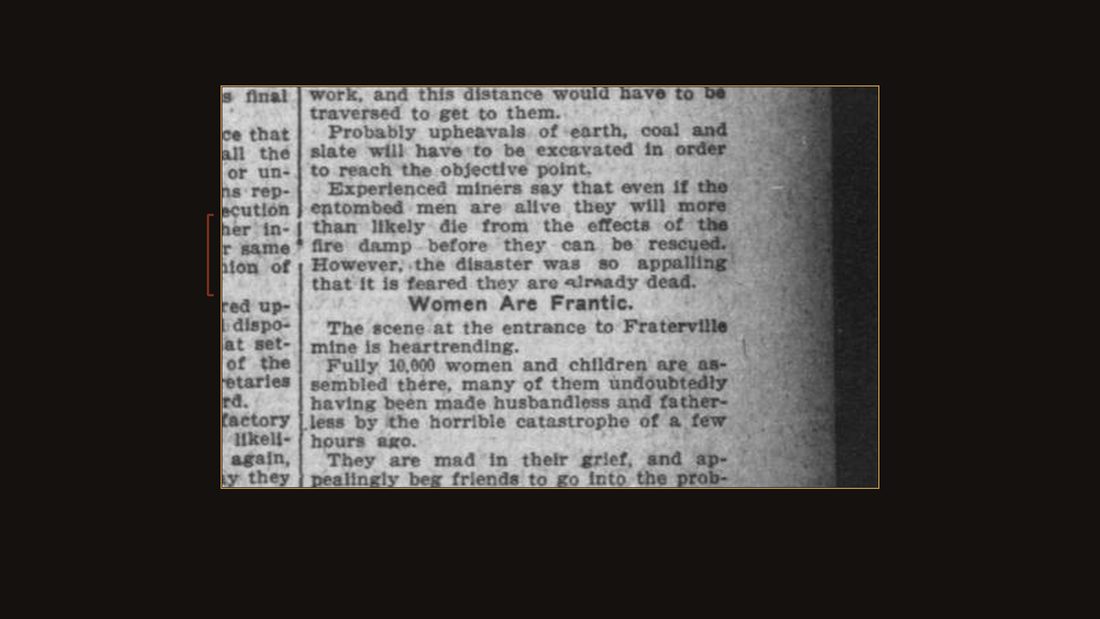
Above ground, they waited. The dispatch says fully ten thousand women and children were assembled at the entrance. That number is almost certainly wrong. It is also the only measurement anybody bothered to write down.
The letters
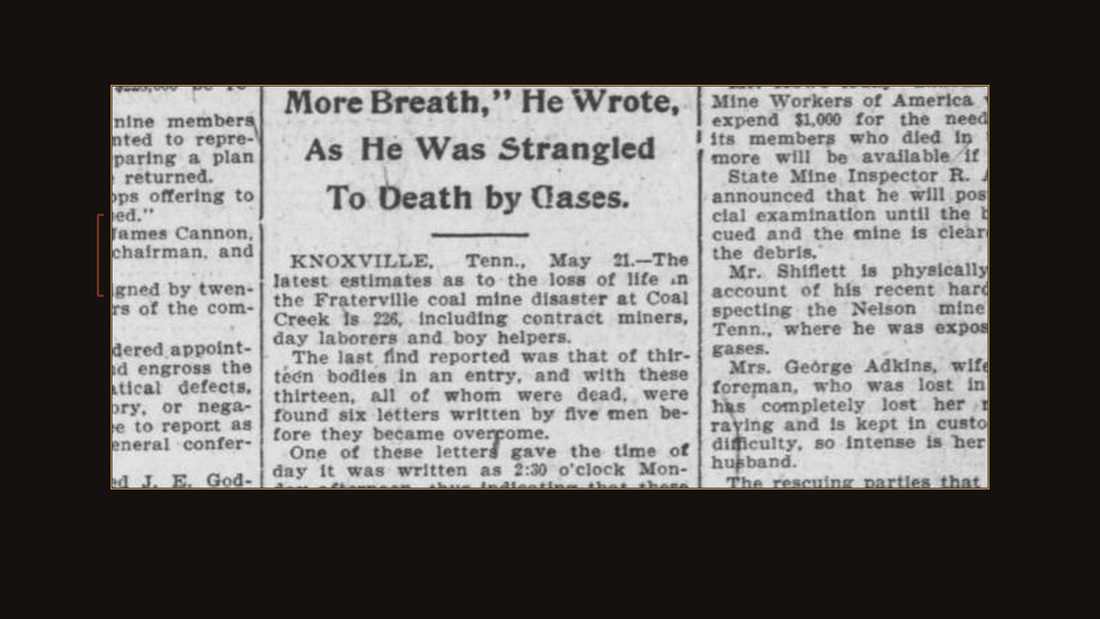
The bodies came out slowly, over days. And on the twenty-first, in an entry off the main heading, the rescuers found thirteen men together.
N16
Atlanta Semi-Weekly Journal, May 22, 1902, p. 1. View the original.
All of them dead. And with them, six letters, written by five of them, before they were overcome.
One of the letters carried the time it was written. Two thirty, Monday afternoon.
Seven hours after the blast. So the men in that entry survived the explosion, and knew it, and sat in the dark doing arithmetic about their own air.
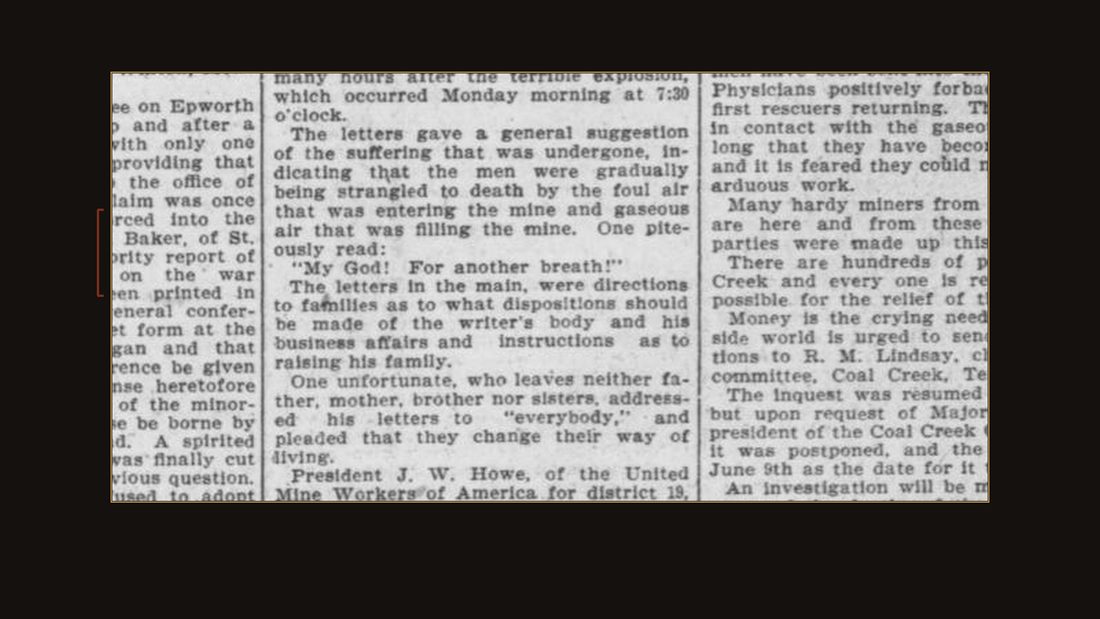
The letters were mostly practical. What should be done with the writer's body. What should be done about his business affairs. Instructions on raising his family.
One man had nobody. No father, no mother, no brother, no sisters. He addressed his letters to everybody, and asked them to change their way of living.
N7
Atlanta Semi-Weekly Journal, May 22, 1902, p. 1. View the original.
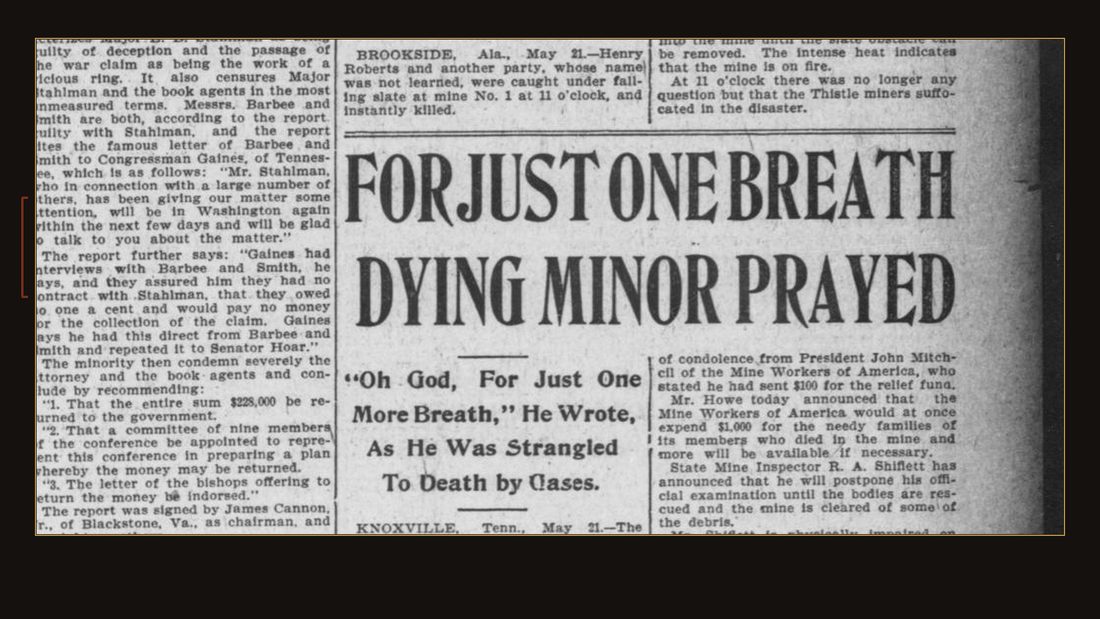
And one line from those letters went out across the country. The Atlanta Semi-Weekly Journal put it in the headline deck. Oh God, for just one more breath, he wrote, as he was strangled to death by gases.
Two versions of four words
N8
Atlanta Semi-Weekly Journal, May 22, 1902, p. 1. View the original.
Then, further down the same column, on the same page, the same paper printed that line again. My God, for another breath.
Two versions of a dying man's last written words, in one newspaper, on one page, on one day. The paper never noticed. Nobody corrected it.
We do not know which one he wrote. The letters were what the reporters were reading from, and what the reporters printed is what came down to us.
After
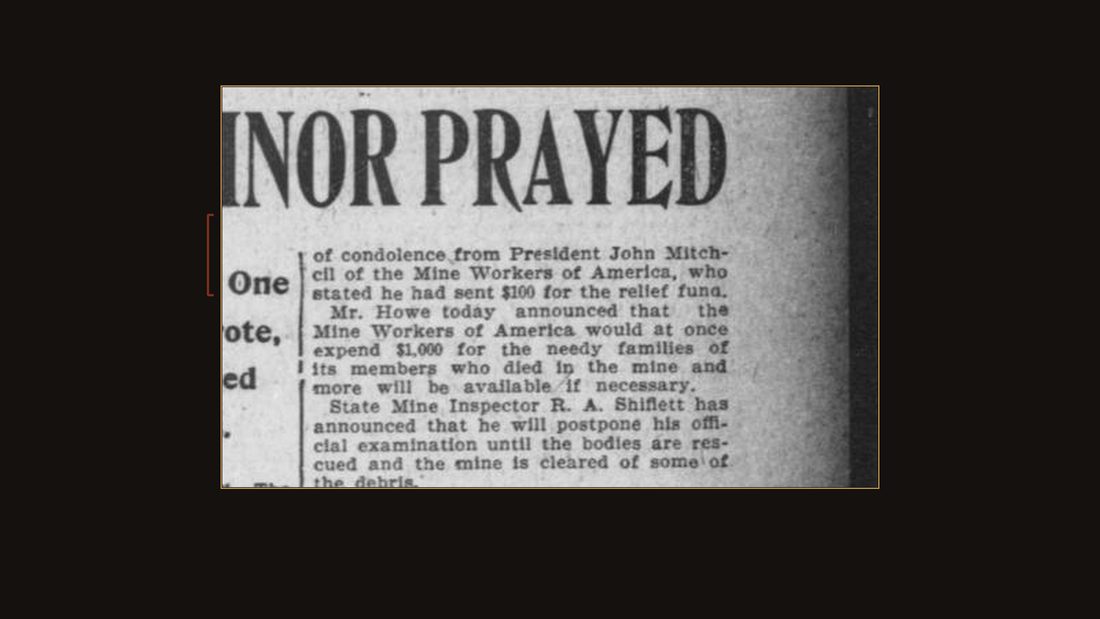
The relief came in fast, the way it does. John Mitchell of the United Mine Workers wired a hundred dollars. The district president, J. W. Howe, put up a thousand more, and went into the mine himself to look.
N18
The Columbia Herald, Columbia, Tenn., May 23, 1902, p. 7. View the original.
The cause developed the day after the explosion. Gas had collected in an abandoned mine close by, and an opening into it had been accidentally made the week before.
N9
Atlanta Semi-Weekly Journal, May 22, 1902, p. 1. View the original.
And the state mine inspector, R. A. Shifflett, announced that he would postpone his official examination until the bodies were out and the mine was cleared.
He had a reason. He was physically impaired, the paper said, from his recent hard work inspecting the Nelson mine at Dayton, Tennessee, where he had been exposed to noxious gases.
The inquest ran into June. On the night of the twenty-third, at eleven o'clock, the coroner's jury at Knoxville came back.
The verdict
N10
The Columbia Herald, Columbia, Tenn., June 27, 1902, p. 1. View the original.

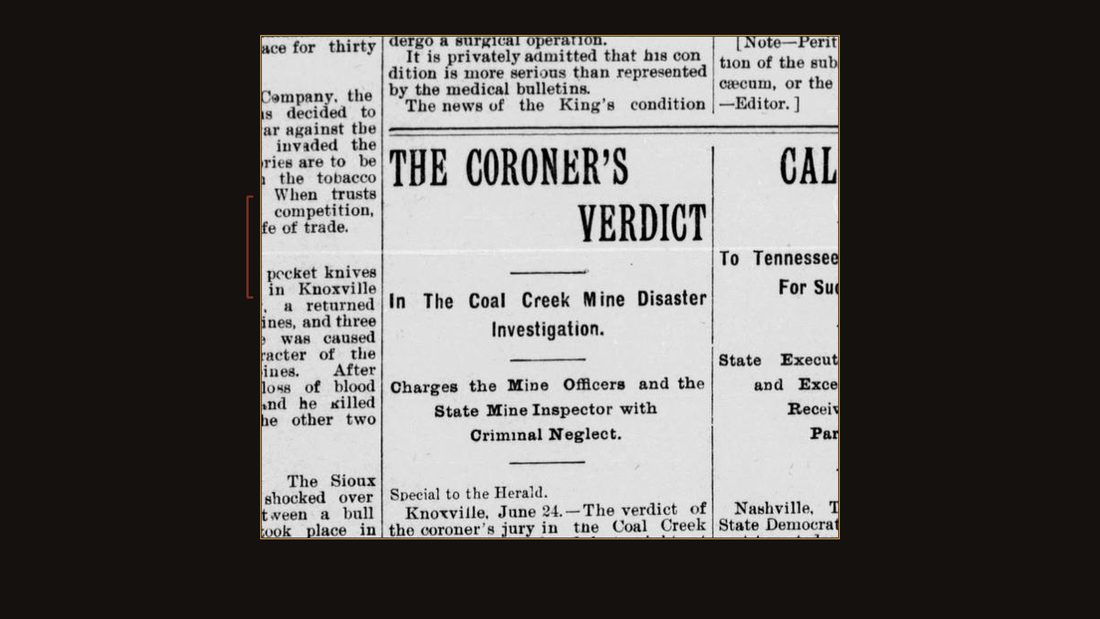
Their verdict charged the mine officers and the state mine inspector with criminal neglect.
N11
The Columbia Herald, Columbia, Tenn., June 27, 1902, p. 1. View the original.
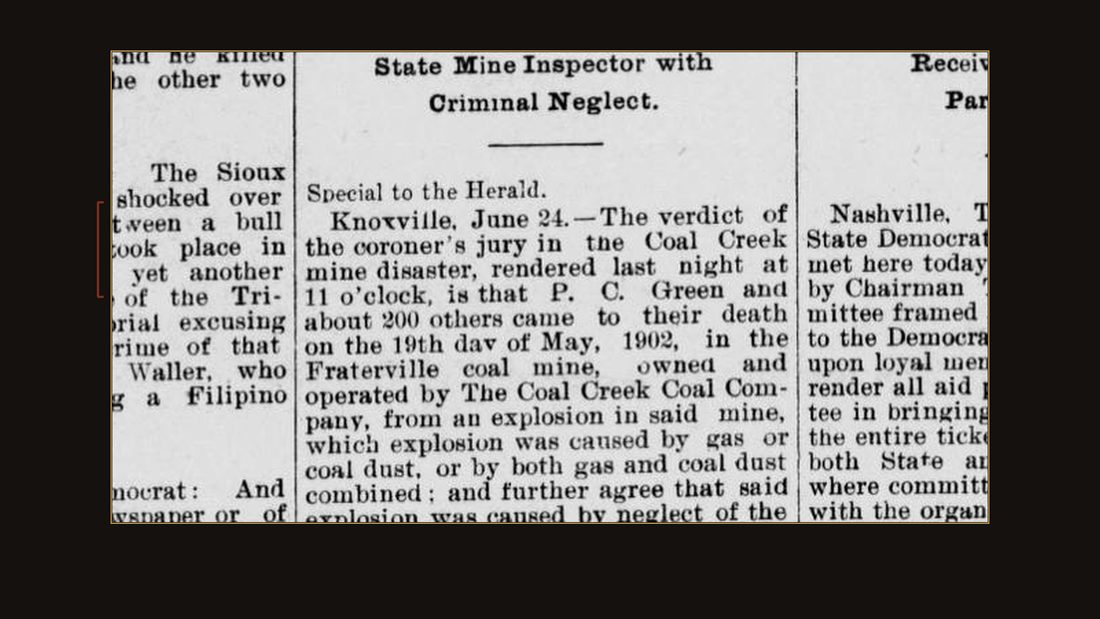
Read the finding itself and the same hole is still in it. P. C. Green, and about two hundred others, came to their death on the nineteenth day of May.
About two hundred others. That is the official document. Five weeks after the explosion. A legal finding that used the words criminal neglect. And the State of Tennessee still could not say how many men it was talking about.
Nine years later
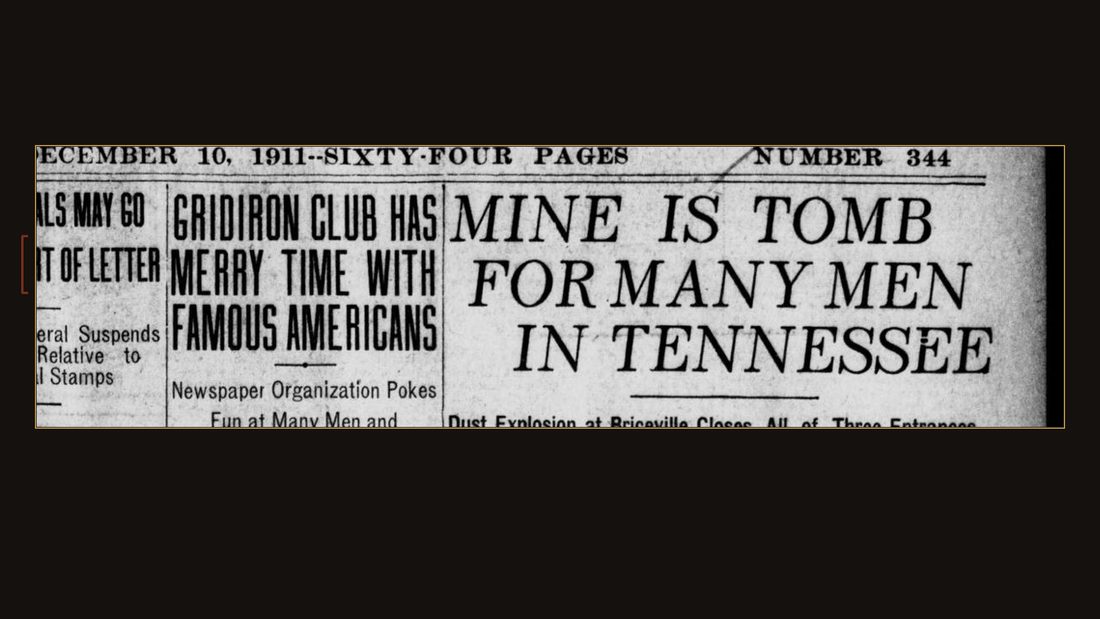
N12
The Montgomery Advertiser, Dec. 10, 1911, p. 1. View the original.

Nine years later, on the ninth of December, nineteen eleven, three miles up the same valley at Briceville, the Cross Mountain mine blew.
Something had changed. A federal rescue crew came in that afternoon with oxygen helmets, and walked into gas that would have killed the men of nineteen oh two where they stood. That was real, and it saved lives later.
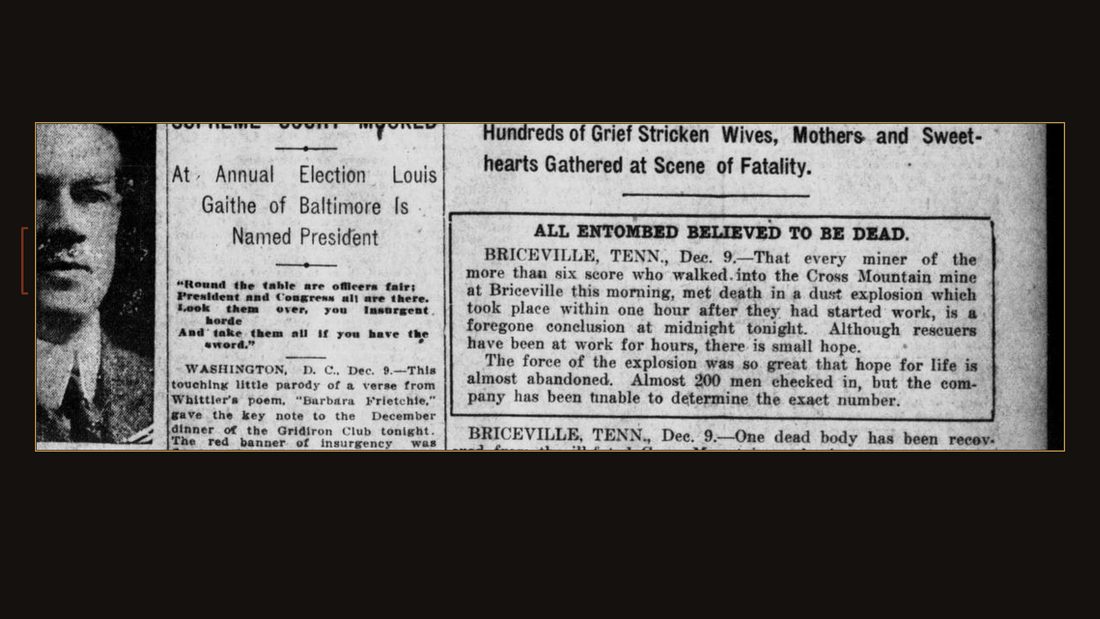
N13
The Montgomery Advertiser, Dec. 10, 1911, p. 1. View the original.
And one thing had not. Almost two hundred men checked in that morning, the dispatch says, but the company has been unable to determine the exact number.
Nine years. Three miles. The same sentence.
What is still buried
So here is what the record leaves us. The official count is a range. The victim list is one third. The second survivor barely made the paper. And the most famous sentence anybody wrote that day exists in two versions in the same newspaper.
The only precise document that came out of Frayterville, on the nineteenth of May, was written three miles underground, by a man who knew he was dying, and who stopped to put the time on it. Two thirty in the afternoon.
Sources
- [N1] *The Evening Star*, Washington, D.C., May 19, 1902, p. 2 — "COAL MINE HORROR / Explosion Kills 150 Men at Coal Creek, Tenn. / ONLY ONE ESCAPED." https://www.loc.gov/resource/sn83045462/1902-05-19/ed-1/?sp=2
- [N2] *The Evening Star*, Washington, D.C., May 19, 1902, p. 2 — body text.
- [N3] *The Indianapolis Journal*, May 20, 1902, p. 1 — "HORRORS IN THE SOUTH / Employes of the Coal Creek Company's Mine at Fraterville Entombed in the Pit Three Miles from the Outside Opening / BETWEEN 175 AND 225 PROBABLY DEAD / Only One Man Escaped Alive and He Was So Badly Burned He Cannot Survive." https://www.loc.gov/resource/sn82015679/1902-05-20/ed-1/?sp=1
- [N4] *The Indianapolis Journal*, May 20, 1902, p. 1 — body text.
- [N5] *The Indianapolis Journal*, May 20, 1902, p. 1 — the victim list.
- [N6] *Atlanta Semi-Weekly Journal*, May 22, 1902, p. 1 — "EXPLOSION IN MINE; 226 MINERS KILLED / One of the Worst Disasters on Record at Coal Creek — Entombed Men Left Letters." https://www.loc.gov/resource/sn86090947/1902-05-22/ed-1/?sp=1
- [N7] *Atlanta Semi-Weekly Journal*, May 22, 1902, p. 1 — "FOR JUST ONE BREATH / DYING MINOR [sic] PRAYED / 'Oh God, For Just One More Breath,' He Wrote, As He Was Strangled To Death by Gases."
- [N8] *Atlanta Semi-Weekly Journal*, May 22, 1902, p. 1 — body text of the same story.
- [N9] *Atlanta Semi-Weekly Journal*, May 22, 1902, p. 1 — relief and inspection column.
- [N10] *The Columbia Herald*, Columbia, Tenn., June 27, 1902, p. 1 — "THE CORONER'S VERDICT / In The Coal Creek Mine Disaster Investigation / Charges the Mine Officers and the State Mine Inspector with Criminal Neglect." https://www.loc.gov/resource/sn96091104/1902-06-27/ed-1/?sp=1
- [N11] *The Columbia Herald*, Columbia, Tenn., June 27, 1902, p. 1 — body text.
- [N12] *The Montgomery Advertiser*, Montgomery, Ala., Dec. 10, 1911, p. 1 — "MINE IS TOMB FOR MANY MEN IN TENNESSEE / Dust Explosion at Briceville Closes All of Three Entrances…" https://www.loc.gov/resource/sn84020645/1911-12-10/ed-1/?sp=1
- [N13] *The Montgomery Advertiser*, Dec. 10, 1911, p. 1 — "ALL ENTOMBED BELIEVED TO BE DEAD."
- [N14] *Atlanta Semi-Weekly Journal*, May 22, 1902, p. 1 — Thistle paragraph.
- [N15] *Atlanta Semi-Weekly Journal*, May 22, 1902, p. 1 — "Women Are Frantic."
- [N16] *Atlanta Semi-Weekly Journal*, May 22, 1902, p. 1 — Knoxville dispatch, May 21.
- [N17] *The Columbia Herald*, Columbia, Tenn., May 23, 1902, p. 7 — Knoxville dispatch of May 20. https://www.loc.gov/resource/sn96091104/1902-05-23/ed-1/?sp=7
- [N18] *The Columbia Herald*, Columbia, Tenn., May 23, 1902, p. 7 — same dispatch.
- [N19] *Atlanta Semi-Weekly Journal*, May 22, 1902, p. 1 — Knoxville Sentinel dispatch of May 19, reprinted.